

For a decade, the goal was omnichannel: make every touchpoint feel connected to the customer. That job is mostly done. The next one is harder, because it’s not your customers reading your data anymore; it’s AI shopping agents.
When product, inventory, pricing, or customer information differs across systems, the experience breaks down. Recommendations are wrong, products appear unavailable when they’re in stock, and customers lose confidence in your brand.
How can this be fixed? Unified commerce brings POS, payments, inventory, and customer data into a single integrated system, creating one trusted source of truth. That means more flexible shopping experiences for customers, fewer operational headaches for your teams, and a foundation for sustainable growth.
Key Takeaways
- Unified commerce connects customer-facing touchpoints and backend systems into a single centralized platform, eliminating data silos across POS, inventory, payments, and customer profiles
- Omnichannel strategies only connect frontend channels, whereas unified commerce also connects backend infrastructure to streamline operations
- Unified commerce enables personalized shopping experiences and helps to protect brand trust, thanks to real-time inventory data and customer activity tracking
- A centralized data hub helps retail, restaurant, and ecommerce businesses provide accurate product recommendations to agentic AI tools
- Adopting a unified tech stack requires an audit of your existing software, selecting an API-first platform, and integrating key systems
In this guide:
- What is Unified Commerce?
- Unified Commerce vs Omnichannel
- The Benefits of Unified Commerce
- How Does Unified Commerce Support Agentic AI?
- Is Unified Commerce Right for Your Business?
- How Do You Choose the Right Unified Commerce Provider?
- How To Implement an Integrated Tech Stack
- Final Thoughts: Why Your Business Needs Unified Commerce
- FAQs
What is Unified Commerce?
Unified commerce is a single-platform architecture that integrates all frontend sales channels and backend operational systems – including POS, payments, inventory, and CRM – into one centralized data hub. This removes the need to switch between tools and provides business owners with a complete overview and single source of truth for the entire business ecosystem.
Unified commerce streamlines behind-the-scenes operations while delivering seamless, personalized shopping experiences across all channels.

Get a clear overview of your frontend and backend business operations with NCR Voyix. Source: NCR Voyix
Unified Commerce vs Omnichannel
While both unified commerce and omnichannel businesses connect and serve customers across multiple channels, there is a key difference between the two strategies.
Omnichannel means your frontend systems – your customer touchpoints – are all connected, providing a seamless cross-channel shopping experience. But your backend systems remain separated, which can be expensive and difficult to manage.
Unified commerce integrates all customer-facing channels and backend systems into one platform, helping you make data-informed decisions, engage with customers efficiently, and scale with ease.
Pros of unified commerce
- Customers can shop smoothly between channels
- Personalized experiences based on unified customer profiles and tracked behavior
- Real-time data and inventory updates to optimize sales and strategy
- Streamlined frontend and backend operations, with less risk of human error
- Great for multi-location businesses, such as quick-service restaurants and retail brands
Cons of unified commerce
- Technical setup and initial integration costs
- Staff will need training
- Greater reliance on one vendor relationship, which is why it’s so important to choose the right unified commerce platform
What's the difference between multichannel and unified commerce?
A multichannel business experiences even more disconnect than an omnichannel strategy. Your brand might be engaging with customers and selling products through multiple channels, but these channels aren’t speaking to one another. You’ll have to manage each channel individually, with no product sync. Unified commerce brings together the siloed data so businesses can manage everything from a centralized hub.
Unified commerce replaces fragmented omnichannel setups by synchronizing frontend touchpoints with backend operations in real time.
| Benefit | Why businesses should care | How unified commerce helps |
|---|---|---|
| Flexible customer journey | Slow and inconsistent experiences can damage brand trust and result in lost sales | |
| Create personalized experiences | Modern customers expect personalized, cross-channel shopping experiences (according to McKinsey & Company, 76% of consumers get frustrated if there’s no personalized interaction) | |
| Get your store agentic AI ready | AI needs consistent data to pull from to showcase your products in conversations | |
| Real-time inventory updates | Pricing inconsistencies and stock issues can turn customers away | Offer unique services, such as endless aisle or buy-online-pick-up-in-store (BOPIS) |
| Efficient and connected operations | Your business can’t adapt to new challenges if data is spread across multiple channels, and you waste time navigating disconnected systems | |
| Improve staff management | Multiple accounts and systems require time-consuming training | |
| Enhanced business data | Without unified data, business decisions are a stab in the dark, and your brand lacks agility when dealing with complex issues | |
| Consistent branding | Inconsistent messaging can cast doubt over your business and damage your brand’s reputation |
How Does Unified Commerce Support Agentic AI?
Consumer behavior is shifting toward agentic shopping – your customers are conversing with AI to carry out product research and shop online. But agentic AI can’t provide accurate recommendations or execute a sale if your retail catalog is fragmented across channels. That’s where unified commerce steps in.
Unified commerce gives AI agents the real-time data, customer context, and machine-readable code they need to operate. This centralized source of truth lets AI agents know if an item is in stock, compare products, suggest local fulfilment options, and apply personalized discounts based on customer loyalty.
Is Unified Commerce Right for Your Business?
Businesses operating on a single channel won’t need to invest in a unified commerce strategy, but consumers are adopting a multichannel approach to shopping.
The 2026 Global Unified Commerce Benchmark found that over 66% of shoppers use two or more channels before buying a product. As a result, complex and expanding businesses can find value in unified commerce, since it helps you meet customer expectations across multiple channels while streamlining and improving backend workflows.
In particular, I recommend unified commerce for these business types:
- Retail – track purchase history, sync inventory, deliver tailored customer experiences, and combine your online and physical presence into one connected ecosystem
- Restaurants – recognize your regulars across locations and deliver personal experiences (such as reserving their favorite table), connect bookings, speed up workflows, and offer preferred payment methods (such as digital payments)
- Convenience stores & fuel – meet customer demand with flexible and speedy service to reduce wait times, create loyalty programs to improve experiences, and connect sites for greater consistency
How Do You Choose the Right Unified Commerce Provider?
Unified commerce providers, such as NCR Voyix, integrate key business processes, including ecommerce, POS, payments, loyalty, and data. Everything is managed from a single location, saving business owners time, improving overall efficiency, and enhancing the customer experience.
Because you’re only reliant on a single vendor relationship, you won’t have to manage a fragmented tech stack, pay for multiple subscriptions, or learn multiple tools.
Before you settle on your unified commerce provider, you should ensure they offer:
- API-first infrastructure (NCR Voyix has 50+ published APIs to help you scale your business)
- Compatibility with existing tools
- Unified data
- Native payment support
- Scalability
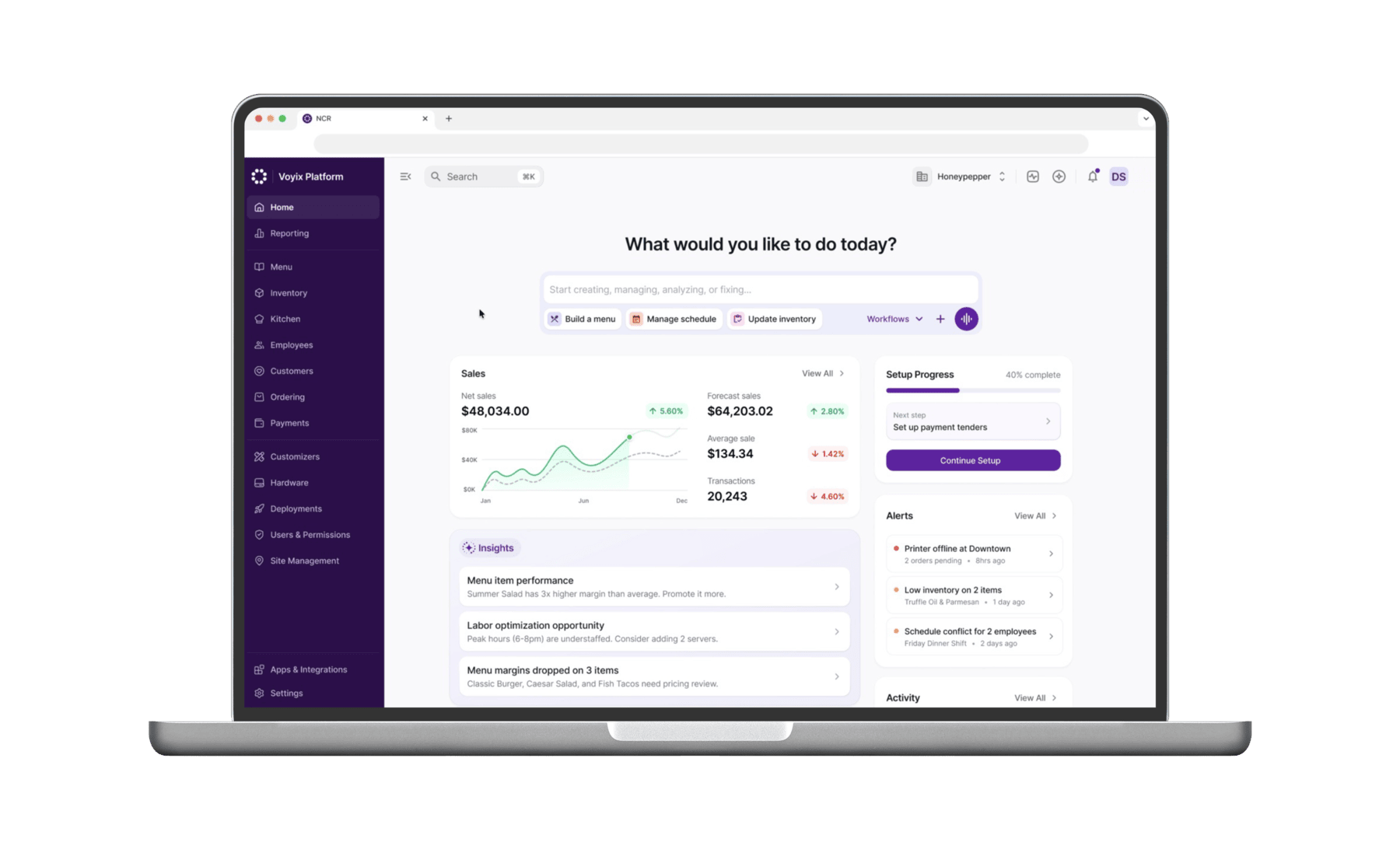
NCR Voyix integrates POS, payments, customer loyalty, and data into a centralized hub. Source: NCR Voyix
How To Implement an Integrated Tech Stack
Implementing a unified commerce tech stack requires a six-step process, centered on auditing legacy systems, selecting an API-first platform, and consolidating data sources.
Unified commerce brings departments together, ensuring everyone in the business is in sync and using the same information to drive growth.
Follow these steps to implement an integrated tech stack:
- Audit your existing tech stack – review your current channels and systems, identify gaps in processes, and see what needs updating
- Choose a unified commerce platform – select a platform, like NCR Voyix, to unify your online and offline activity
- Merge your systems – integrate your tech stack with your chosen platform, including your POS system, CRM, and inventory management tools
- Connect all channels – with everything set up, adapt your sales channels to support seamless customer journeys and train your team in the new processes
- Reap the benefits of unified commerce – use the cross-channel data and customer profiles to create flexible customer experiences, access real-time product updates, get your store agentic AI ready, and more
- Review and adapt as needed – update your workflows and tech stack as needed, whether you’re responding to a change in the market or adapting to shifting customer behavior
Why should your business avoid a fragmented tech stack?
A fragmented tech stack can be costly for a business in terms of time, money, and efficiency. Not understanding your customer at different touchpoints leads to generic, irrelevant marketing; siloed data and inventory lead to overstocking and lost sales; and disconnected payment methods can cause queues and abandoned carts.
All of this makes it harder for business owners to track sales and performance across channels, which is why unified commerce is a must-have for growing businesses.

Final Thoughts: Why Your Business Needs Unified Commerce
To keep up with customer demands, changing markets, and cross-channel expectations, businesses need to adopt unified commerce to streamline operations and deliver truly personalized shopping experiences.
Unified commerce connects your customer-facing and backend systems, including POS and inventory, ensuring that every sales channel communicates seamlessly. That’s why it’s worth investing in a platform like NCR Voyix, which provides real-time data, tracks customer activity, and shapes long-term strategy decisions.