
AI is changing how industries operate and logistics is no exception. At a particularly divisive time for the sector, where workforce shortages, rising costs, and an unsteady regulatory landscape are forcing companies to adapt, I wanted to investigate how logistics leaders are navigating the change they’re facing.
I spoke to five experts to understand their perspectives on how AI is shaping the logistics industry, including their opinions on AI autonomy versus human expertise, and AI’s potential impact on efficiency and sustainability goals.
Logistics AI: The Picture So Far
A September 2025 study from Tech.co found that 70% of logistics professionals report some level of interaction with AI in their daily work, which shows that AI is no longer a future concept for the industry — it’s a present-day reality.
Already, experts are reporting on wins. Mike Branch, vice president of data and analytics at Geotab, says the company as a whole has seen efficiency gains of 30%–50% from using AI tools.
However, Branch says that AI’s infiltration of daily work has been its surest path to success so far, suggesting that big gains are made at the desk, with teams exploring AI’s capabilities for themselves. “That grassroots adoption is where the productivity gains are happening,” according to Branch, instead of through “top-down mandates.”
In short, it’s not enough for companies to simply pay for an OpenAI subscription and demand that employees use it. Teams and individuals need to take the time to figure out and personalize AI for their specific workload, if it’s to have any impact.
“AI is reshaping how shippers, carriers, and brokers work together. Shippers increasingly expect real-time risk and service signals from their carriers; carriers need AI that keeps drivers safer and assets utilized; brokers want better predictions on capacity and service levels.”
Gautam Kunapuli, director of AI & machine learning at Motive
Beyond individual workers and teams, companies are thinking holistically when it comes to logistics AI. Experts want to see how supply chains can become more visible and how individual elements, such as shippers and carriers, can work more cohesively.
Kevin Price, logistics consultant at Dematic, says, “AI has huge potential to enable organizations to view their operations end-to-end. For example, if there are delays higher up in the supply chain, then operators can take steps to either look for alternative sources of goods or change delivery routes to address this challenge.”
This is primarily being achieved through the real-time data AI can provide. Vinny Licata, head of logistics at Fictiv, explains how AI helps companies “connect signals across quoting, supplier capacity, production status, and logistics.”
With real-time, end-to-end data, teams are no longer “reacting to issues after they happen.” Instead, they can make “more informed decisions” and adjust “as conditions change.”
A Collaborative Approach to Human Expertise and AI Autonomy
Among the headlines that dominate the AI conversation are those of job losses. Companies such as Salesforce have admitted that AI is enabling them to reduce their headcount and Klarna at one point replaced 700 customer service workers with AI, only to then reverse the decision not long after.
However, the logistics professionals I interviewed proposed a collaborative approach to AI autonomy and human expertise. Human judgement is a necessary step towards AI development, and while the AI may lead performances, humans will always have a place backstage. Branch even said that his company found AI “only works when paired with human judgment.”
“The future isn’t AI replacing people; it’s AI acting instantly where humans can’t, and humans making the AI smarter, safer, and more trustworthy over time.”
Gautam Kunapuli, director of AI & machine learning at Motive
This is realized, on the one hand, in decision-making. Logistics companies want humans to be held accountable for decisions made, acting as a filter between AI output and the final product. AI should inform decisions, but it shouldn’t make them. Humans do that, and “with far better context and confidence” when using AI, according to Fictiv’s Licata.
It’s not enough for humans to just use AI, however. Price explains that individuals “must trust the technology, be properly trained, and help redesign workflows. With the right design and integration, AI and cobots [collaborative-robots] will amplify human expertise while making operations more productive, adaptable, and resilient.”
Humans are therefore not only accountable, but necessary to make AI as effective as it can be.
How AI Will Impact Efficiency and Sustainability Targets
The name of the game with AI adoption is increased efficiency. Businesses want operations to move faster and more accurately, to keep up with shifts in demand, budget cuts, and policy changes, as well as recurring tariff drama.
The main benefit of AI will be the automation of manual and repetitive processes. This frees up workers to “focus on higher-value work,” according to Kunapuli, who points out that “AI also gives managers real-time visibility into what actually needs attention, saving time and keeping operations running smoothly.”
In this case, humans are free to focus on the jobs that they can do better than AI, such as managing client relationships and providing expertise based on experience.
Increased Efficiency in Warehouses
Inside the warehouse, efficiency can be seen through automating manual or repetitive tasks, faster response to disruptions, and an overall more connected supply chain through visibility. AI can help to increase throughput, reduce errors, and create better coordination across systems.

Better visibility, in turn, can also significantly improve sustainability gains for logistics companies. If managers can understand their vehicles, equipment, and worksites better, this can lead to “less wasted fuel, fewer unnecessary miles, reduced idling, and more efficient routing — all of which directly lower emissions,” Kunapuli says.
Route optimization software is a great example of this, with the ability to reduce unnecessary miles driven, which “lowers fuel consumption and directly cuts carbon emissions,” says Licata.
Similarly, AI can assist companies in planning resources more intelligently. Licata suggests that AI will help manufacturers “better align product schedules with real demand, reducing overproduction, excess inventory, and waste.”
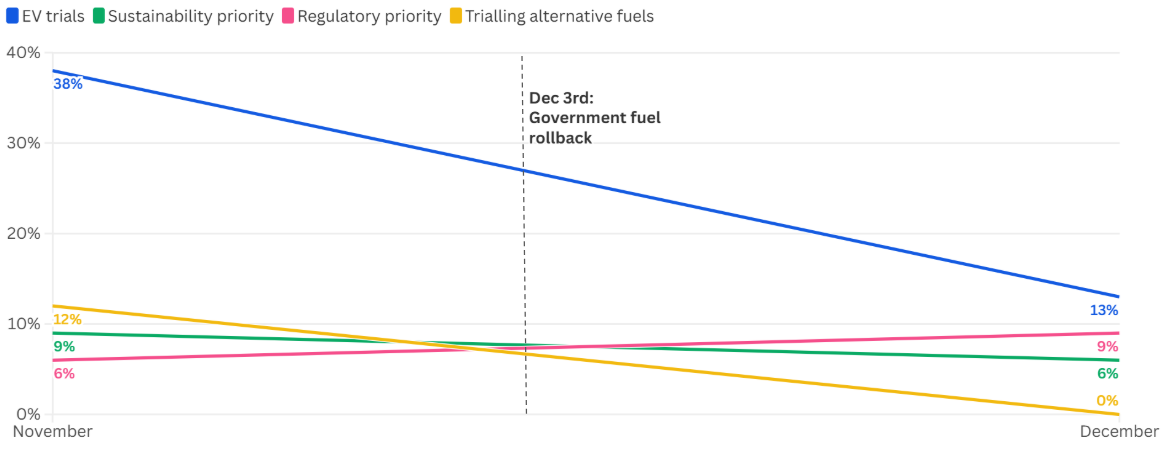
The number of logistics companies trialing EVs dropped significantly from November to December in our latest research data. Source: Tech.co
It seems that the biggest role AI will play in improving sustainability initiatives is by making it easier for companies to make greener decisions. Data from Tech.co’s latest survey revealed a dramatic drop in the number of companies trialing electric vehicles (EVs), from 38% in November to 11% in December.
This shift is directly linked to a change in policy, essentially making diesel trucks more cost-effective for logistics businesses, despite their bigger environmental impact.
On the whole, this suggests that companies are more concerned with adapting to regulations than meeting sustainability targets, and that greener decisions will only be more widely implemented when it’s worthwhile.
“Consumers increasingly demand sustainable supply chains, from fit-to-size ecommerce packaging to reductions in waste and returns. AI-driven optimisation can support these goals by improving packaging decisions, reducing damage and helping retailers better understand where waste is being generated across their networks.”
Kevin Price, logistics consultant at Dematic
If AI continues to make visibility and inventory management more immediate and straightforward, businesses could be encouraged to follow more sustainable practices, because it will be part of a natural change in operations rather than a decision that has to be made between two other priorities, such as adapting to regulations.
Overall, this contributes to what Licata describes as moving “sustainability from a reactive goal to something that’s embedded in everyday operational decisions.”
While AI Is Not Optional, It Has To Be Strategic
According to Branch, AI “will touch every aspect” of the logistics industry. Many of today’s experts are already reporting efficiency improvements and predict that further progress will be made in terms of supply chain visibility and sustainability.
However, while Amy Dean, vice president of operations at SC Codeworks says “AI is a powerful tool, and we have not seen anything else quite like it,” she warns that companies “shouldn’t expect AI to solve everything.” Businesses should “start slow” and investigate specific areas where AI can make an impact.
Indeed, they should also not abandon the human element of their businesses. Dean adds, “I think we will find the most success when we balance the two [humans and AI] and use them to work together.”