

Thanks to AI, today’s marketers can create content, drive hyper-personalization, and streamline their everyday processes in a fraction of the time.
With tools such as monday CRM, professionals are discovering new use cases for AI in marketing. McKinsey expects this trend to continue, with 92% of businesses planning to invest in the technology.
That’s why it’s crucial that your business starts to explore the possibilities.
Key Takeaways
AI has many marketing use cases, including helping marketers to scale and unlock deep personalization.
Predictive analytics tools allow businesses to forecast customer behavior and optimize campaign performance.
Successful AI implementation depends upon high-quality data, continuous monitoring and improvement, and human involvement.
- In the future, AI will enable marketers to create unique customer experiences, as well as providing genuine strategic support.
In this guide:
- What Is AI in Marketing?
- What Are the Use Cases of AI in Marketing?
- What Are the Benefits of Using AI in Marketing?
- How to Implement AI in Marketing
- What Are the Typical Costs of Implementing AI in Marketing?
- What Are the Data Privacy Implications of Using AI to Contact Customers?
- What Does the Future Hold for AI in Marketing?
- Verdict: How to Use AI in Marketing
- FAQs
What Is AI in Marketing?
AI in marketing is the use of AI tools to gain deeper customer insights and streamline everyday workflows.
By adopting AI capabilities such as natural language processing (NLP) and machine learning (ML), marketers can learn more about their customers, and ultimately deliver products that are hyper-personalized.
What Are the Use Cases of AI in Marketing?
AI in marketing has many use cases, with tools such as monday CRM helping businesses to turn their raw data into actionable insights.
- Automatic audience segmentation
- Content creation
- Bespoke product recommendation
- Advanced sales forecasting
- Search engine visibility boost
1. Automatic audience segmentation
AI increases conversion rates by using ML to segment customers into groups with shared traits to facilitate targeted messaging.
AI-powered customer relationship management (CRM) platforms are capable of this. monday CRM, for example, automatically groups contacts based on engagement signals, purchase intent, or pipeline stage. This means that you can personalize your messaging at scale to progress leads through the sales funnel.
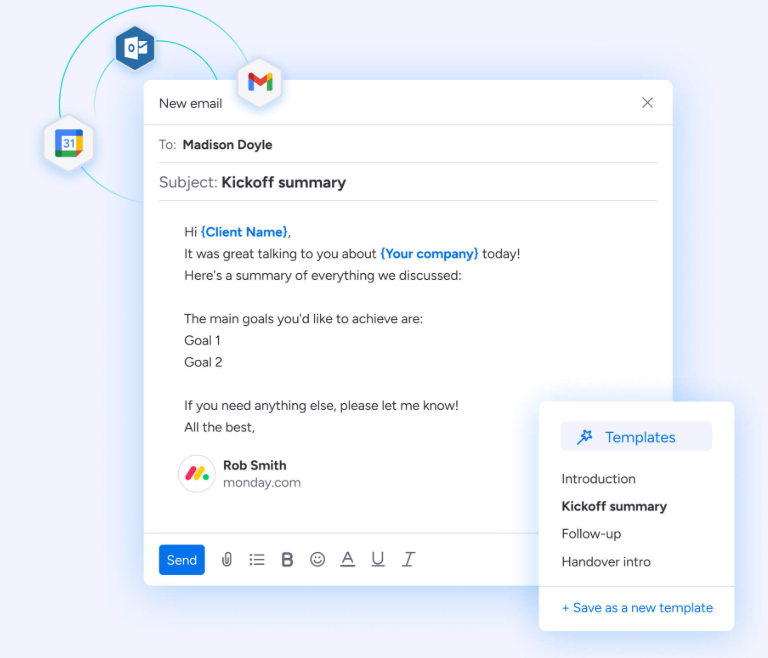
Through its integrations with Gmail and Outlook, monday CRM lets users send personalized emails. Source: monday
2. Content creation
Increasingly, marketers use AI to create content, including social media posts, articles, newsletters, and more. AI tools can play a pivotal role in the content creation process by:
- Drafting subject lines
- Creating email copy
- Captioning images
- Identifying keyword opportunities
By automating these tasks, AI frees up users to focus on high-level objectives, such as giving final sign-off on a new marketing campaign.
For example, monday’s AI Sidekick can craft email messaging from a written prompt.
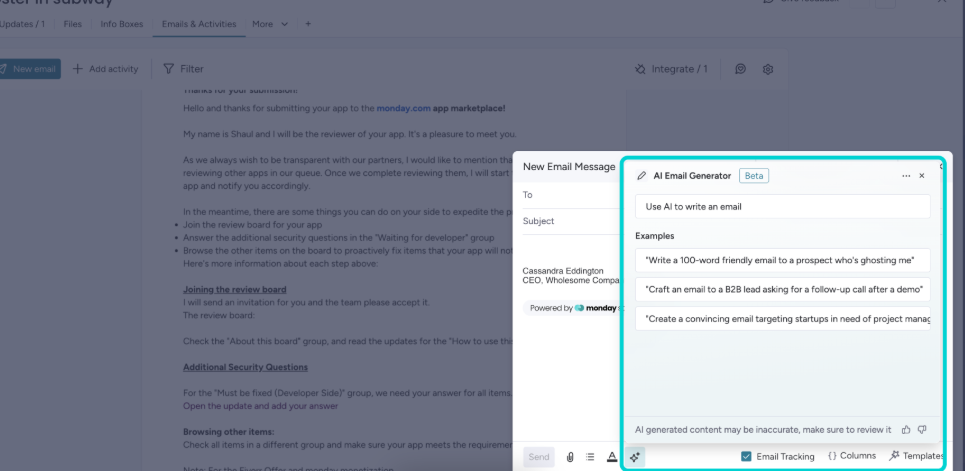
With monday CRM, you can generate email copy from a written prompt. Source: monday
3. Bespoke product recommendation
Online businesses can use AI to develop a deeper understanding into their customers’ habits. AI agents, for instance, analyze website visitor behavior in real-time to identify browsing patterns and suggest relevant products.
AI chat significantly increases conversion rates, with 12.3% of shoppers who engage with AI chat making a purchase, compared with just 3.1% of those who do not.
4. Advanced sales forecasting
AI enables marketers to forecast future trends and informs their decision-making accordingly. Using ML to analyze historical data sets, AI produces predictive analytics. Predictive analytics suggests which products might perform better, informs pricing, and drives sales.
For example, monday CRM has built-in predictive AI tools, including a variety of sales forecasting templates to bring its analytics tools to the fore. Among other things, these templates feature AI-generated formulas to pull through real-time deal insights.
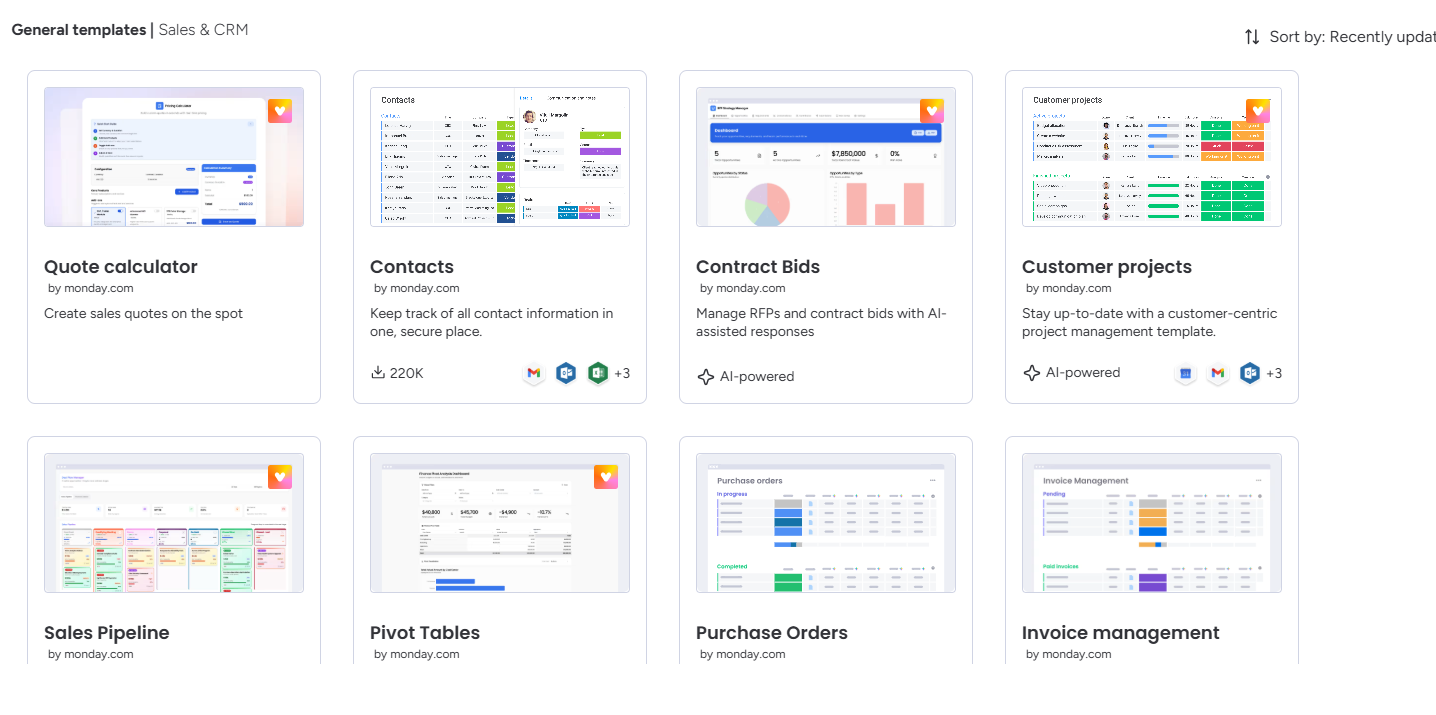
A selection of monday CRM’s sales and CRM templates. Source: Tech.co testing
5. Search engine visibility boost
Using AI, marketers can improve search engine optimization (SEO). The technology can automate keyword research and optimize your content for SEO, ultimately increasing page ranking, and subsequently attracting more visitors to your website.
Search engine algorithms change regularly, making it difficult for humans to predict which trends will next be popular. By streamlining the content creation process, AI enables marketers to quickly adapt to the latest standards.
Expert Tip
In 2026, it’s absolutely essential to implement AI into your marketing strategy. However, it’s even more important to make sure that this doesn’t come at the cost of human involvement.
When it comes to automating simple tasks and making life easier for you and your team, AI is unmatched. But remember: only humans can do the human stuff — relatability, empathy, and poignancy.
These emotions are the pillar of every marketing campaign. Don’t forget to include them in yours.

What Are the Benefits of Using AI in Marketing?
AI in marketing brings numerous benefits, including increased efficiency, personalization, return on investment (ROI), and scalability.
1. Increased efficiency
AI increases efficiency in marketing by automating repetitive, time-consuming tasks such as data analysis, customer segmentation, and performance tracking. The knock-on effect of this is that marketers have more time to focus on higher level tasks, including strategy.
Reportedly, AI can reduce marketing expenditure by 15%–30%, while increasing operational efficiency.
2. Hyper-personalization
AI customizes offers and messaging based on real-time analysis of customer behavior. This depth of personalization forges a stronger bond between your customer and your brand.
76% of customers are frustrated when brands fail to deliver personalized experiences, spotlighting the vital role that AI can play in personalizing your messaging.
3. Improved ROI
By improving performance measurement accuracy, AI analytics enable businesses to optimize their spending and enjoy greater returns.
For example, monday CRM’s AI-enhanced CRM dashboards give users clear insight into their data, helping marketers to better understand key performance indicators (KPIs) such as revenue, customer acquisition cost (CQC), and customer lifetime value (CLV).
With access to this information, you can budget more accurately and improve performance against budget, ultimately improving your bottom line.
4. Better scalability
Marketers can confidently scale campaigns across channels and into new markets by leveraging AI, which can create high volumes of targeted content at speed. As the campaigns grow in complexity, real-time data access means that they remain targeted and effective.
How To Implement AI in Marketing: Tips and Best Practices
To successfully implement AI into your marketing strategy, you should focus on the quality of your training data, monitor and iterate your AI tools, and upskill team members to get the best out of AI.
1. Supply your AI with good data
To build an AI platform that can effectively communicate with your customers, you need to supply it with a high volume of good quality data, particularly that which is related to customer preferences.
For example, monday CRM leverages data to predict churn, suggest next actions for individual leads, and intelligently route leads to specific sales reps.
When handling sensitive customer data, it’s critical to adhere to relevant privacy protocols. Practice good data governance and transparently explain to your customers how and why their data is used, to build trust.
2. Monitor and optimize your tools
Once your AI tool has been deployed, key stakeholders should monitor its performance over time, iterating as necessary.
To measure the success of your AI marketing campaigns, develop a rigid framework, and continuously monitor and evaluate your AI marketing against it, in order to improve.
This should include agreed-upon KPIs relevant to your campaign type. An email marketing campaign might focus on click-through rate (CTR), unsubscribe rate, and open rate (OR).
3. Don’t exclude human involvement
Human involvement in AI marketing is crucial. While AI is an effective facilitator, only skilled marketers can deliver empathetic storytelling, create genuine connection, and mitigate potential ethical issues.
Evidence is mounting that a hybrid approach, comprising human and AI involvement, is pivotal to marketing success, with marketers who deploy AI-driven content testing noting a 25% increase in engagement.
If you are using AI to generate most of your copy, you need an experienced copywriter or content marketer to sign-off on it before you publish. This helps to avoid potential brand voice mishaps.
4. Upskill your marketing team
Develop training programs, mentorship schemes, and other resources to upskill your existing employees on how to use AI in marketing. This will not only allay internal fears around job automation, but enable your team to fully realize the possibilities of this technology.
5. Optimize your page for AI visibility
Optimize your website to make sure that it is seen by as many people as possible. In recent years, search engine visibility has been one of the dominant metrics for website success, but that is no longer the full story. In 2026, appearing in AI chatbot search, as well as the AI Overview “snippet,” is equally as important. To do so:
- Create authoritative, experience-led content
- Directly answer user queries
- Regularly update content to ensure freshness
What Are the Typical Costs of Implementing AI in Marketing?
The cost of implementing AI into marketing can range from $100 to over $500,000 per year, depending on whether you opt for an existing software as a service (SaaS) solution or a custom-built AI tool, as well as the size of your company.
For example, monday CRM pricing plans start at $12 per seat, per month, billed annually ($144 per year). At this tier, you’ll unlock AI Blocks and 6,000 trial credits, meaning that you can automate existing workflows to boost your productivity.
At the same time, large, complex multinationals will command significantly higher costs.
What Are the Data Privacy Implications of Using AI To Contact Customers?
Using AI to contact customers raises several potential security risks. For example, many AI models are trained on user inputs, meaning that sensitive data shared with a chatbot could be used in future AI responses.
Furthermore, because AI requires large data sets for its training, this runs counter to existing principles to only collect required data.
To mitigate these risks, it’s important to notify your customers about how their data might be used. This is a good opportunity for your brand to build trust.
What Does the Future Hold for AI in Marketing?
The future of AI in marketing will involve strategy ideation, unique customer engagement, and personalized storytelling.
1. Strategy ideation
AI is set to play a part in high-level marketing strategy. While it is currently the preserve of skilled human marketers, soon AI will be able to ideate and deliver compelling creative suggestions to steer decision-making at the highest organizational levels.
70% of marketers expect AI to play a larger role in future work. Before long, this will include strategy ideation and delivery.
2. Unique customer experiences
AI can provide unique experiences for customers who are “always on.”
Because of the modern proliferation of mobile and social media, marketers are required to deliver content at speed. With automation, AI has already eased some of this workload. But customers are increasingly demanding unique experiences.
One example is Netflix. The streaming giant analyzes viewer behavior, searches, and preferences to suggest more content that a user might like. There is a clear market opportunity for bespoke customer experiences at scale and AI is the answer.
3. Personalized storytelling
By leveraging in-depth preference data, AI will allow brands to tailor storytelling to individual customers. Targeted advertising is already a big part of marketing in 2026, but AI is expanding these capabilities.
4. Agentic AI as an active collaborator
Agentic AI has the potential to go beyond simple automation and deliver active collaboration. Rather than executing requests, AI agents will autonomously launch campaigns, monitor performance, and iterate accordingly.
For example, monday CRM is soon launching a new feature, AI Sales Agent, which can perform personalized phone and SMS outreach at scale, as well as coordinating and scheduling follow-ups.
5. Elevated humanity
Somewhat ironically, the increasing prominence of AI in marketing will lead to a growing appetite for “human” storytelling. This will be built around authentic stories and voices, with humans firmly at the center of future marketing campaigns.
Verdict: How To Use AI in Marketing
AI has already changed marketing forever, but we’ve barely scratched the surface of its potential. In the coming years, businesses will use AI to bring authentic, personalized stories to an increasingly demanding audience, while also providing unique, value-add customer experiences.
If you don’t act now, you will get left behind. To integrate AI into your marketing strategy, you should start by supplying your chosen CRM with a stream of high-quality data. Then, it’s essential that you continuously monitor and iterate to improve your tools.
Human involvement is necessary to carry this out, as well as to mitigate potential ethical issues and provide much-needed authenticity. Finally, you should ensure that your existing employees are suitably trained to take advantage of this exciting technology.
If you effectively channel AI in your marketing, you can look forward to increased operational efficiency, scalability, and the ability to tailor your content with a high degree of personalization. Ultimately, you’ll improve on your bottom line — and futureproof your business ahead of the AI revolution.