

Agentic AI workflows are autonomous processes where AI agents adapt based on their environments, provide output in real-time, and respond to feedback.
Agents help businesses make smarter decisions across marketing, finance, HR, and IT. Because agents are able to act autonomously, managers can spend more time on higher-value work.
From simplifying employee onboarding to helping supply chain teams monitor stock levels, agentic AI workflows have a wide range of business use cases.
Key Takeaways
Agentic AI workflows execute multi-step business processes autonomously using AI agents that reason, plan, adapt, and self-reflect in real time.
While traditional workflows rely on fixed conditional logic, agentic AI workflows independently determine the best way forward and self-correct when problems arise.
Key workflow components include LLMs, memory, planning and orchestration, tools and integrations, and feedback mechanisms.
Business use cases include competitive monitoring intelligence in marketing, real-time risk monitoring in finance, and candidate evaluation in HR.
In this guide:
- What Is an Agentic AI Workflow?
- How Do Agentic AI Workflows Work?
- What Are the Difference Between Agentic AI Workflows and Traditional Workflows?
- What Are the Components of an Agentic AI Workflow?
- Agentic AI Workflows: Top Use Cases
- How Do I Enable Agentic AI Workflows?
- How Much Do Agentic AI Workflow Platforms Cost?
- Verdict: How Agentic AI Workflows Can Transform Your Business
- FAQs
What Is an Agentic AI Workflow?
An agentic AI workflow is an end-to-end process executed autonomously by AI agents that reason, adapt, and make real-time decisions without human intervention.
At the core of agentic workflows is an agent’s ability to reason, plan, extract data from various tools, and review and analyze its own performance to ensure consistent, high-quality, and relevant output.
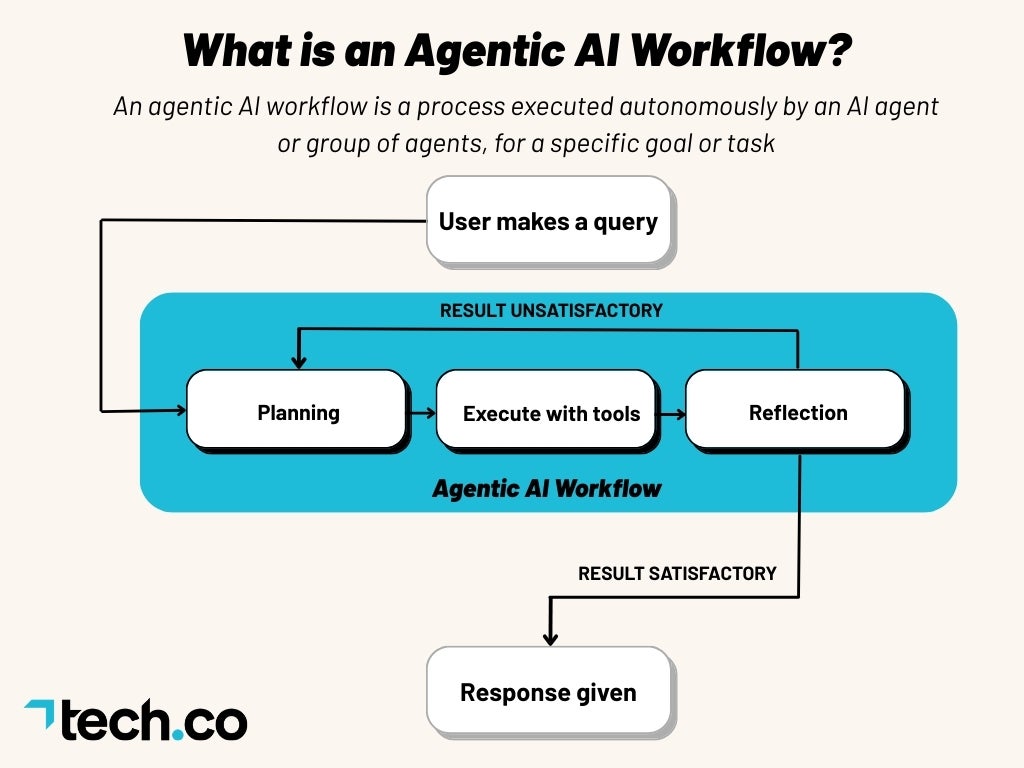
monday’s AI Work Platform demonstrates the steps that an agent takes when executing a workflow. Source: Tech.co
How Do Agentic AI Workflows Work?
Agentic AI workflows operate by automatically decomposing complex goals into sequential planning, execution, and self-reflection steps.
In the final stage, the agent evaluates its answer against the original query. If the output doesn’t meet the original requirements, it revisits earlier stages or restarts the process entirely.
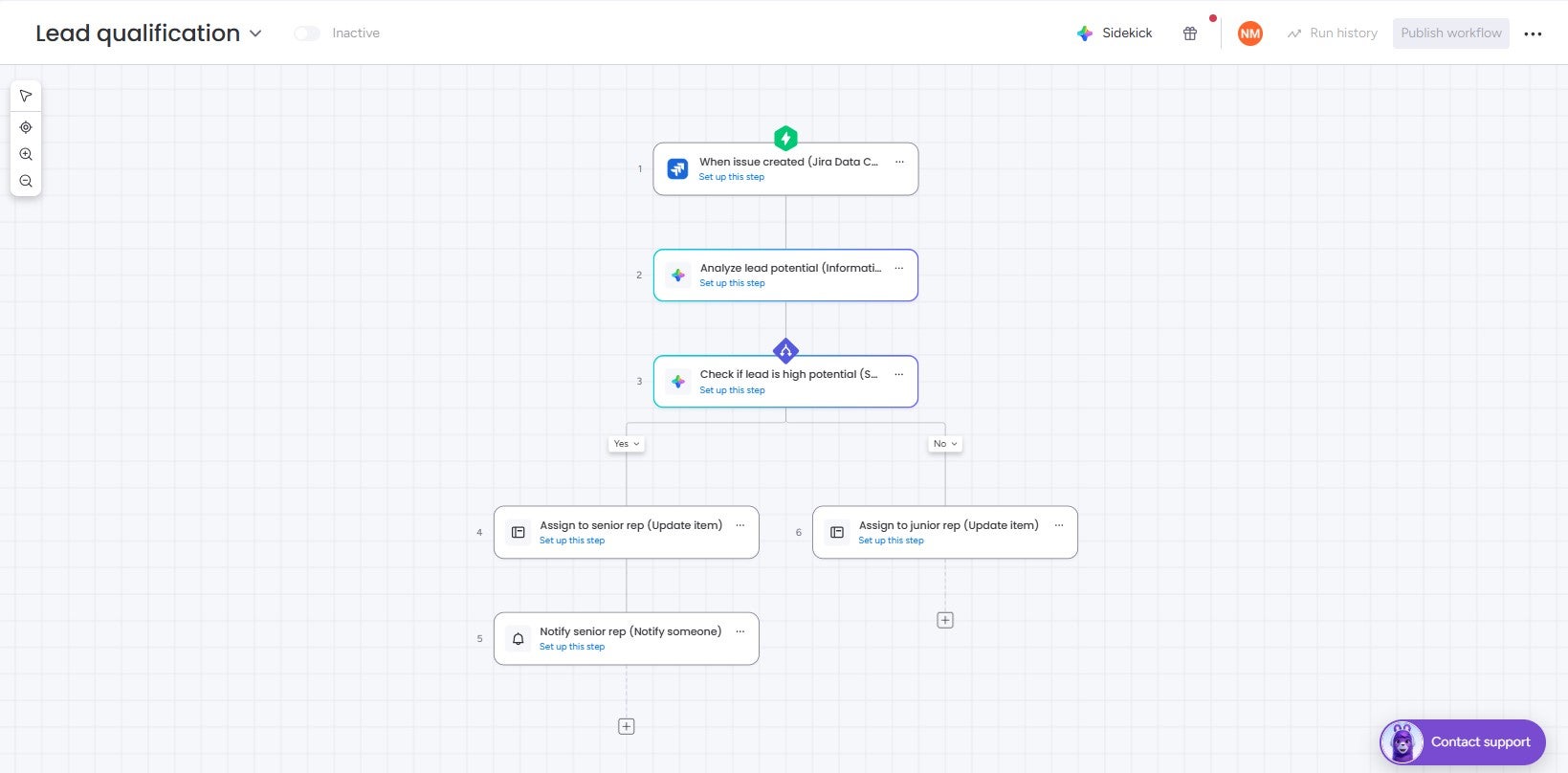
monday AI Work Management has a library of pre-built agentic AI workflows, including this “lead qualification” example. Source: Tech.co
What Are the Difference Between Agentic AI Workflows and Traditional Workflows?
Traditional workflows are step-by-step processes with conditional logic and predefined triggers, such as “if x, then y.”
Agentic AI workflows deploy agents to execute complex processes based on context and intelligent decision making.
| Traditional Workflows | Agentic AI Workflows | |
| Best for | Simple, repetitive tasks with predictable outcomes | Complex, multi-step processes that can be unpredictable |
| Structure | Fixed if/then format | Chooses its own path to success |
| Flexibility | Predictable and deterministic | Flexible and adaptable |
| Oversight | Requires manual intervention if bottlenecks appear | Human-in-the-loop review with autonomous execution |
| Instructions | Follows simple, straightforward instructions | Uses reasoning, memory, and tools to interpret goals |
| When stuck | Stalls until a person intervenes | Interprets the situation and tries alternative approaches |
| Execution | Sequential, rule-based | Autonomous and independent |
What Are the Components of an Agentic AI Workflow?
Agentic AI workflows comprise large language models (LLMs), memory, planning and orchestration, and more.
LLMs
LLMs are the reasoning engine behind agentic AI workflows. They’re designed to process, summarize, and generate natural language, allowing agents to interpret instructions and produce accurate, contextual outputs.
Some LLMs and AI assistants can build and manage complex project workflows and tasks, such as monday AI sidekick.
Memory
Agents use memory to retain context across tasks, both within a single workflow (short-term) and across repeated interactions over time (long-term).
This allows them to build on previous outputs, stay consistent, and improve with use.
Planning and orchestration
Before acting, agents break a goal down into a sequence of steps and decide which order to execute them in.
In multi-agent workflows, an orchestrator agent coordinates the work of specialist agents, delegating tasks and assembling the final output.
Tools and integrations
Agents connect to external datasets, search engines, and business software. monday.com’s AI Work Platform integrates with Gmail, ChatGPT, and Salesforce via 2-way sync, making it easier for teams to centralize and streamline work.
Feedback mechanisms
Agents use feedback mechanisms to evaluate and improve their responses.
By maintaining a human in the loop, businesses ensure that people review, respond to, and intervene in agent activity, such as approving AI-drafted communications before they’re sent.
Agentic AI Workflows: Top Use Cases
Marketing, finance, HR, and IT and operations teams can all find specific value in agentic workflows.
Marketing
AI agents, such as monday’s Competitive Intel Research agent, analyze current trends and customer behavior to surface insights in real time.
Finance
AI agents perform real-time financial data analysis to help identify market patterns.
Finance teams can use the monday Risk Analyzer to monitor transactions, flag anomalies, and surface risks in real time, giving them the tools to respond to crises quickly.
HR
AI agents can streamline key HR processes. For example, monday’s Lead Scorer agent analyzes skill assessments and interview data to identify strong candidates.
How Do I Enable Agentic AI Workflows?
Enabling AI workflows depends upon your AI work management tool of choice. By way of example, to enable monday’s Competitive Intel Research agent:
- Locate “Agents” on the left-hand navigation column.
- Select “+ New agent.”
- Scroll down to “Marketing.”
- Select “Competitive Intel Research,” or Dan.
- Click “Get agent.”
- Customize your agent, if you like.
- Click “Onboard.”
- Configure your agent’s “Brain,” “Triggers,” “Channels,” and “Activity.”
- You are now ready to use Competitive Intel Research agent.
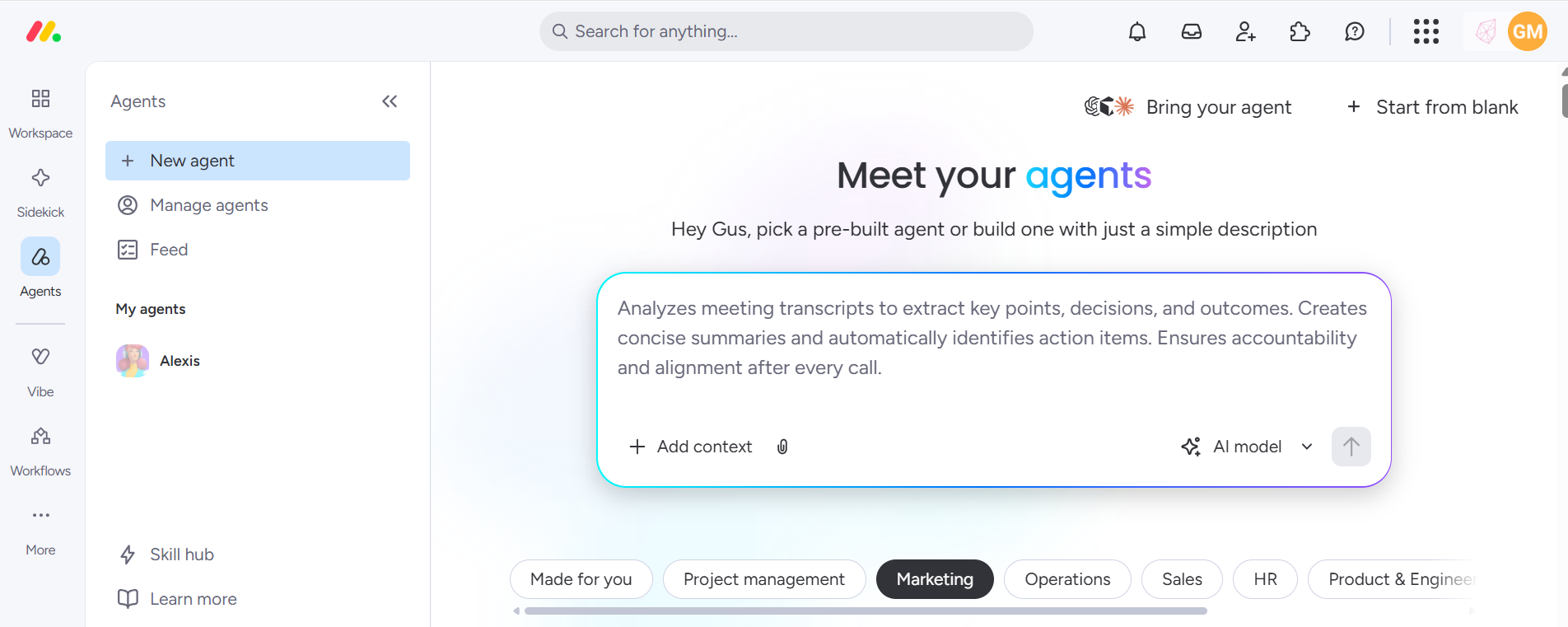
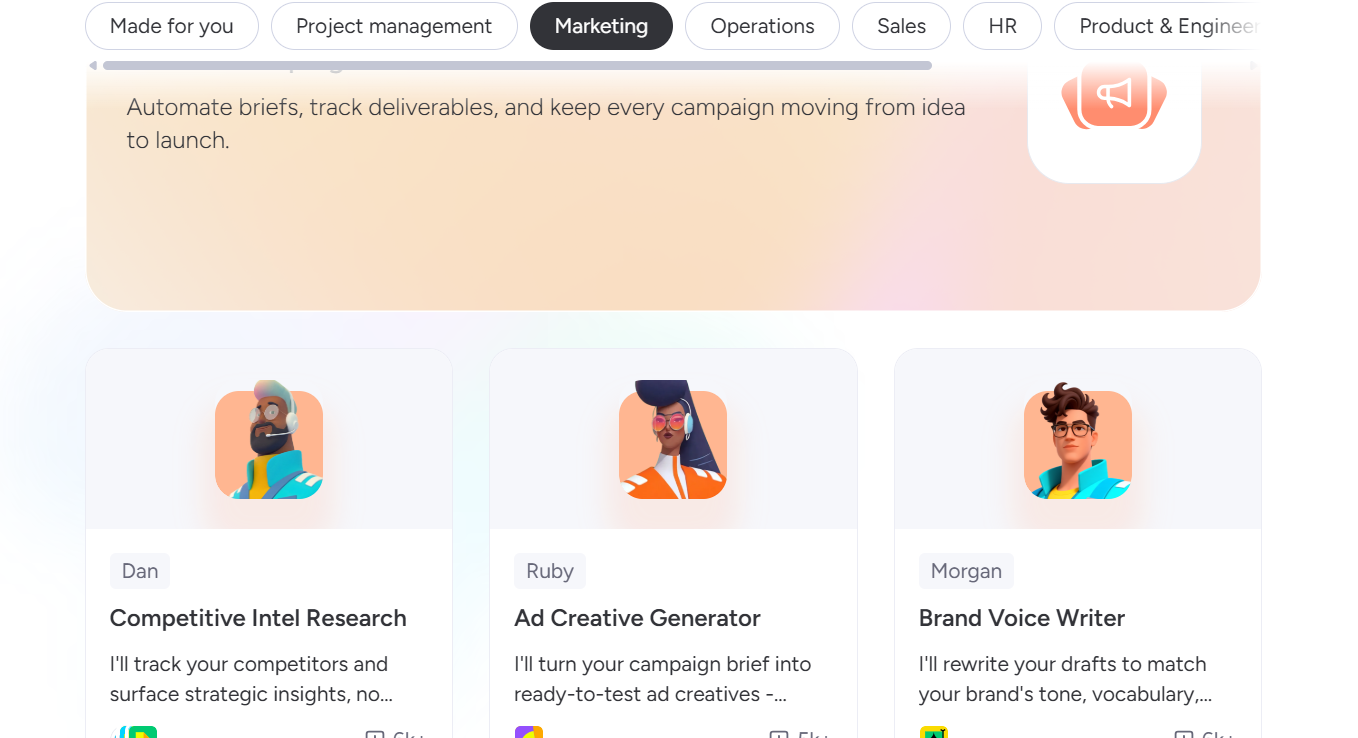
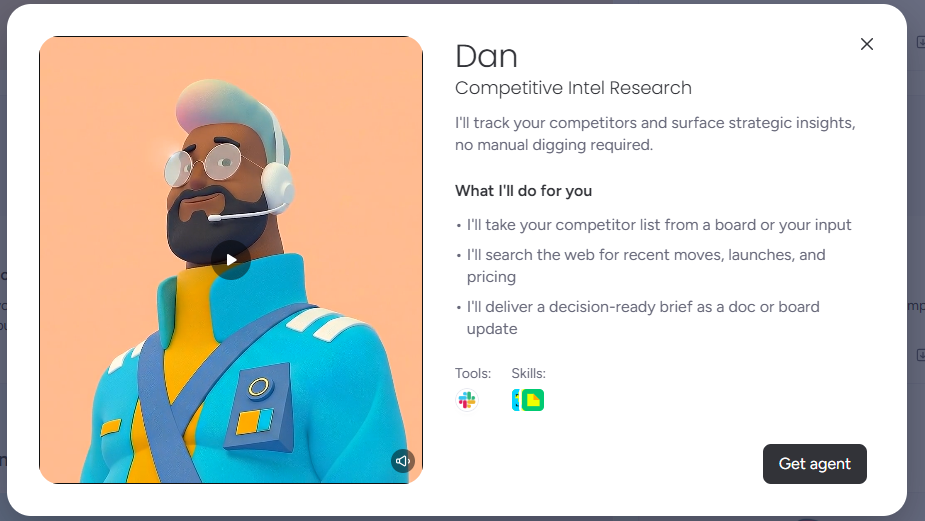
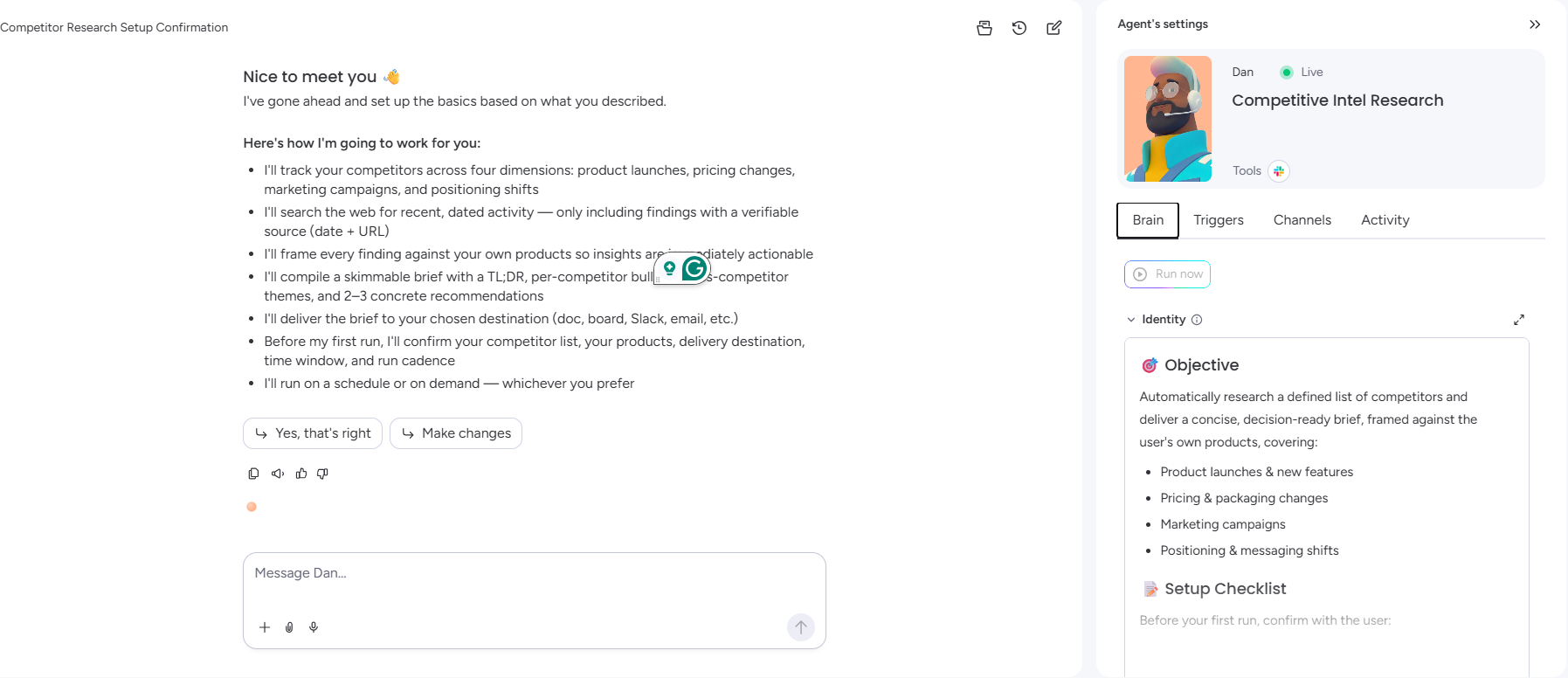
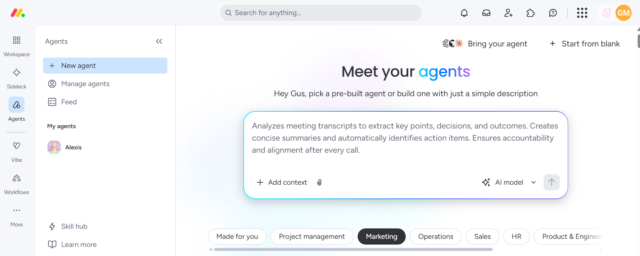
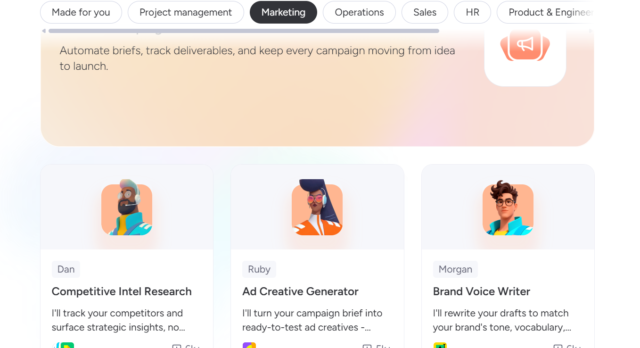
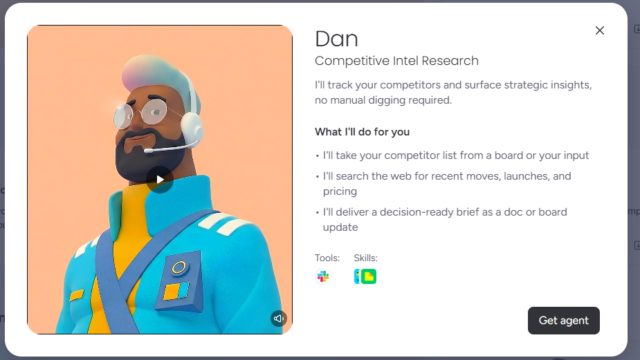
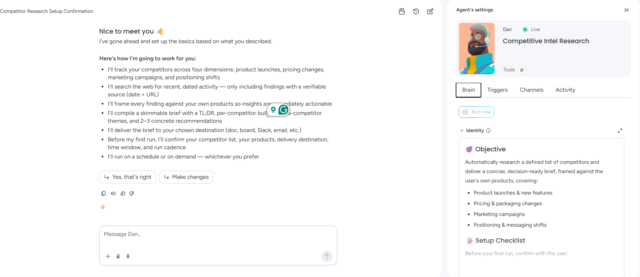
monday’s Competitive Intel Research agent, Dan, tracks competitor activity and surfaces relevant insights without any manual effort required. Source: Tech.co
Verdict: How Agentic AI Workflows Can Transform Your Business
Agentic AI workflows give teams the speed and flexibility to act on what matters most.
Unlike traditional workflows, agents adapt to their environment and self-correct, so you can make faster decisions, waste less time on repetitive tasks, and free up time to focus on strategic work.
monday.com’s AI Work Platform makes it easy to get started. You can prompt monday sidekick to build a workflow for you, choose from a library of templates, or build one from scratch.
monday.com’s AI agents come equipped with built-in security features: data encryption, admin settings, granular permissions, and compliance with SOC 2 Type II and ISO certifications.