
AI agents perform tasks and projects autonomously by leveraging tools, data, and integrations to achieve specific business goals.
AI agents usually operate within agentic workflows by leveraging connections to various tools, data sets, integrations, and sometimes other agents. Agents can work independently from humans and can take on feedback to improve their performance over time.
Businesses can use AI agents to automate simple, repetitive tasks that involve a level of decision-making. Agents can also be used for large-scale projects, taking on more complex and multi-step processes to increase productivity and efficiency.
Key Takeaways
- AI agents are autonomous systems able to perform complex, multi-layered tasks by interacting with external environments and learning from feedback to improve performance over time.
- Businesses use AI agents to automate workflows like lead assignment, device quality control, and financial reconciliations, to reduce manual effort.
- Implementation costs of basic agents usually range between $5,000 and $15,000, whereas advanced enterprise solutions can reach up to $300,000, including monthly upkeep fees.
- Distinguish agents from chatbots by their ability to act autonomously without human prompting, and their ability to execute long-term, goal-oriented projects.
- Businesses should prioritize security as a design requirement, by defining clear data boundaries and maintaining human oversight.
What Are AI Agents?
An AI agent is an autonomous system able to perform tasks and projects, usually as part of an agentic AI workflow, where it has access to various tools, integrations, and knowledge. An agent can make decisions independent of humans, solve problems, and interact with its external environment.
Agents are able to adjust their process and learn from past mistakes based on feedback, in order to find the most effective way to reach its predefined goals. The more an agent interacts with its environment, the more effective it can become.
How do AI agents work?
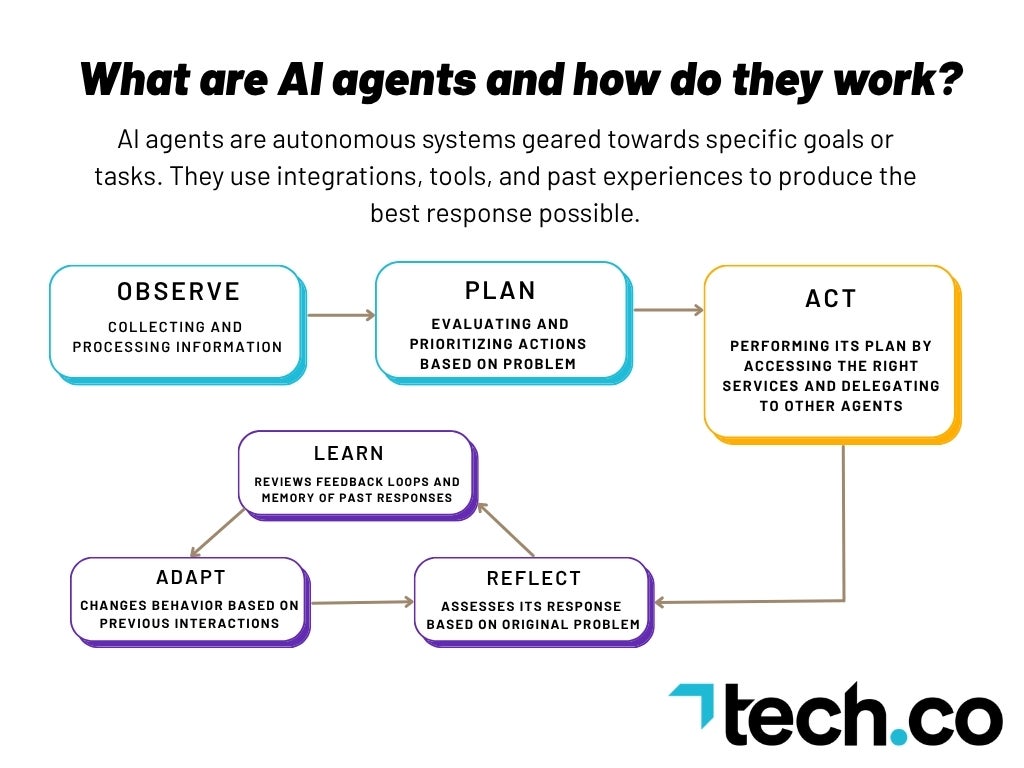
AI agents work by running through a process that includes observation, planning, and acting, before entering a loop of learning, adapting, and reflecting, until they’re satisfied their output is the correct one.
- Observation: The agent processes the request and collects the information it needs from various sources, including databases, live feeds, and sometimes collaborating with other agents.
- Planning: The agent devises a plan of action based on the information it has been fed. It uses machine learning to navigate data, natural language processing to interpret and understand natural language, and large language models (LLMs) for contextual understanding and problem-solving capabilities. LLMs also allow agents to generate responses similar to human communication.
- Act: The agent puts its plan into action and executes the tasks it has devised in the right sequence.
- Reflect – learn – adapt: The agent reviews its results by incorporating user feedback on whether its actions were effective, and updates its internal models and knowledge base to reinforce successful strategies and adjust less successful ones. Over time, this process allows the agent to make better decisions and become increasingly more accurate and efficient.
How much do AI agents cost?
Basic AI agents are available as part of project management software packages for monthly subscriptions, ranging from $7 per user, per month, to $25 per user, per month. These agents are a good option for repetitive, easily automated team-level tasks. However, they will be limited to project management and aren’t as easily scalable for more complex tasks.
Implementing basic AI agents from external providers costs between $5,000 and $15,000, while enterprise-level autonomous solutions can reach $300,000. You’ll also have to pay monthly fees for agents, which are usually in the realm of around $1,000 to $2,000 for general upkeep.
AI chatbots
Example: Google Gemini or ChatGPT
- Respond to short-term, one-time queries from users
- Don’t plan ahead of responses
- Require human input to provide a response
- Limited learning capabilities, answer-to-answer
- Better suited for simpler tasks and interactions
AI agents
Example: Spotify or Netflix recommendation engines
- Are programmed to meet a specific goal or task over time
- Adapt to user expectations over time to provide a personalized experience
- Can act autonomously without human input
- Flexible in planning and executing complex tasks
- Better suited to multi-layered and long-term projects
Should I Use an AI Assistant or an AI Agent?
AI assistants are best for enhancing daily productivity within your business, such as asking an assistant to polish an email or schedule a meeting. If an employee has a short-term query that needs addressing, an AI assistant is the most efficient option.
AI agents are better for autonomous processes that don’t need human intervention. For example, sales teams can use AI agents to assign and delegate leads to different employees, based on lead scores.
If a process requires decision-making and access to various company integrations, creating an agentic AI workflow with AI agents is a better choice.

How Businesses Are Using AI Agents
Businesses are using AI agents to automate complex workflows, ranging from quality control in civic organizations to demand forecasting in retail.
Civic organizations
Human-I-T, a social organization set on creating equitable access to technology, uses AI agents to handle quality control within a high-volume device processing workflow.
According to Jean Favela, head of IT at Human-I-T, the agent reduced device review times from two hours to 30 minutes, all the while running more than 14 hours a day.
Favela adds, “But the real impact isn’t the time — it’s the quality. We eliminated the class of errors that were breaking our downstream reporting. Now I can assess every device in our organization with confidence. That was impossible before — not difficult, impossible.”
Supply chains
Cherie Brinkerhoff, senior vice president of operations in retail, technology & healthcare at Ryder, reports deploying AI agents to automate and execute different tasks, improving productivity.
In one instance, Brinkerhoff used an agent to identify missed growth opportunities with existing customers.
She says, “With the assistance of an AI agent, the team was able to populate estimated customer supply chain spend and compare it against our current revenue to surface missed opportunities within existing accounts, materially improving insight quality compared with manual analysis.”
Finance
Cloud software provider BlackLine reports that agents have helped teams reduce manual effort by 80% by “autonomously analyzing data to identify missed expenses and drafting the necessary entries,” according to chief technology officer Jeremy Ung.
Ung also describes an agent that “manages customer outreach and transcribes calls to log promise-to-pay data autonomously” and “identifies high-risk reconciliation items before an employee reviews”. This has allowed customers to “reduce the time to create and process reconciliations by over 90%”.
Retail
Thomas Kraus, global head of AI at Onix, a data and AI company, has reported that retailers are using AI agents to monitor real-time inventory updates, coordinate with suppliers, and forecast demand.
Likewise, AI agents improve customer service by providing hyper-personalization and real-time sentiment analysis, according to Kraus.
How Can I Keep My AI Agents Secure?
I think the most important thing businesses can do when deploying AI agents right now is to treat security as a design requirement. It can’t be an afterthought.
In practice, that means defining clear boundaries around what data an agent can access and act on, building in human oversight checkpoints for high-stakes decisions, and auditing agent behavior continuously, rather than assuming it stays within bounds.
Agentic AI has brand new attack surfaces and brand new failure modes, so the organizations that are successful with agentic deployments will be the ones who apply the same rigor to AI governance that they bring to any other enterprise software deployment.

Benefits of AI Agents
- Increased efficiency and productivity: Agents can streamline repetitive, time-consuming tasks that take humans away from the creative aspects of their jobs, leaving them to be more productive elsewhere. Likewise, groups of agents are able to divide tasks like specialized workers, increasing efficiency, and can operate for longer hours.
- Improved decision-making: Agents can refine and improve their output based on user experience, ensuring the most efficient route is always taken to achieving their goals. Agents can also collaborate with each other and debate ideas, insights which can improve their overall output.
- Better quality responses: Agent responses are accurate, comprehensive, and more personalized to the needs of a user, compared with a traditional AI assistant. This leads to a better experience and more useful outputs that can enhance businesses.
Drawbacks of AI Agents
- Data privacy concerns: Businesses should tread carefully when giving AI agents access to potentially sensitive customer and employee data, and human oversight is a necessity. There is potential for data to be misused or accessed by malicious parties if it’s not secured behind the necessary security protocols.
- Time consuming and expensive to implement: Building AI agents or deploying them on a high scale can be expensive and time consuming, particularly for enterprise-level workflows.
- Unpredictability: Agents can make mistakes and, without proper monitoring, these can be harmful to your business, especially if the agent has access to sensitive data or starts to show certain biases.
Verdict: Should My Business Use AI Agents?
AI agents are a valuable long-term business investment for those needing to automate complex, multi-step workflows and enhance decision-making.
Unlike AI assistants, agents can also learn from user feedback and reflect on past answers, meaning they become more effective at their role over time, making them a valuable long-term investment.
I’d recommend trialing agents through project management software platforms before deploying on a larger scale. It’s also crucial that businesses consider their budget and implement the correct security protocols before getting started.
While AI agents work well for automating processes, such as lead assignment and IT ticket escalation, they can overcomplicate simple processes that can be completed by a traditional workflow or an AI assistant.