

The short answer: for most commercial fleets, AI is worth upgrading for—if safety, insurance claims reduction, and driver coaching are priorities. For tiny fleets that only need accident evidence, a standard dash cam is sufficient.
Modern AI dash cams offer a range of safety features that will keep your fleet safer and more efficient than traditional non-AI models.
Standard dash cams will shoot footage of the road ahead, and are key for insurance purposes in the case of a collision. But add in artificial intelligence, and those cameras can instantly react to poor driver habits, providing real-time coaching alerts that help to prevent accidents before they happen.
Here’s how those AI features work, and what makes them so much better at keeping your drivers and vehicles safe and sound.

Key Takeaways
- Proactive vs. Reactive Safety: While standard dash cams record evidence for a post-collision review, AI safety cameras help prevent accidents by identifying risk and alerting drivers in real time.
- Comprehensive Risk Monitoring: Top-tier video solutions evaluate safety through a triple lens: Advanced Driver Assistance Systems (ADAS) for road threats, Driver Monitoring Systems (DMS) for cab distractions, and vehicle telematics rules for rough driving.
- Streamlined “Event-Based” Reviews: Instead of forcing managers to scroll through hours of unbroken footage, advanced AI dash cams use local, secure processing to automatically review, flag and prioritize unsafe events to streamline reporting and coaching
- Data-Driven Future Proofing: The deep analytics provided by integrated management software reveal long-term driving patterns, enabling fleet managers to foster a continuous culture of safety and accountability.
Learn more about how GeoTab’s fleet safety tools can help your business.
Defining AI Cams vs. Standard Dash Cams
AI fleet safety cameras designed for commercial vehicles can identify a range of poor driving habits and road hazards, triggering alerts to address the problem in the moment. This provides real-time risk prevention, stopping incidents before they happen.
In contrast, standard cameras will simply record the road ahead or the cab interior. This is helpful data to have on hand, but requires a lengthy footage review process and doesn’t help reduce risk. It’s reactive, not proactive.
| Traits of a standard dash cam: | Traits of an AI safety cam: |
|---|---|
| Passive | Active, with real-time warnings and alerts |
| Records video | Records and interprets video for intervention |
| Requires lengthy review process | Automatically detects and flags unsafe events |
| Stores footage as a long, unbroken video file | Stores a searchable video file that flags risky or critical driving habits |
Standard cameras are serviceable for those with basic needs, since they don’t need to rely on data connectivity to do their job and will remain reliable in many locations or extreme conditions.
There’s no question that AI safety cams have more functionality to offer than their standard equivalents, from flagging incidents to issuing real-time coaching safety alerts for both drivers and managers.
Four Top Benefits of an AI Safety Camera
The biggest practical benefits your fleet will gain from installing AI cameras? They’re safer, more secure, faster, and support behavioral change.
Proactive safety
Prevention is the best form of safety. AI-powered safety cameras will look ahead towards future problems, catching issues immediately in order to keep risks low at all times.
To fully benefit, a fleet manager must understand and implement the right camera rules. The camera rules will determine what conditions will trigger the generation of a driving event and alert. These events can include instances of poor driving habits, like harsh braking or a near collision, as well as driver distractions like phone use.
The Geotab GO Focus Plus offers driving rules and instant alerts for three different categories of safety processes:
- Advanced Driver Assistance Systems (ADAS) rules – These include rules for unsafe events including rolling stops, tailgating, swerving, lane drifting and near -collisions warning. When an ADAS rule detects one of these critical events, the system triggers an immediate in-cab voice prompt. This alerts the driver to correct the risky behavior on the spot, while also surfacing the event data and video footage to fleet managers for targeted coaching and review
- Driver Monitoring System (DMS) rules – Designed to monitor driver attention levels and detect risky in-cab behaviors. These include drinking, smoking, phone use, seat belt use, and distractions.
- Telematics rules – These rules rely on data from the vehicle engine, which includes harsh acceleration, braking, and cornering.
In all cases, the camera comes with default thresholds for what triggers an event, but these can be adjusted for your needs.
Once triggered, these Smart Rules will make the AI camera spring into action. Drivers will receive verbal prompts for in-cab coaching – and an opportunity to correct their behaviors as soon as possible. The most severe alerts are surfaced first, helping managers focus on the most critical and repeat behaviors first.
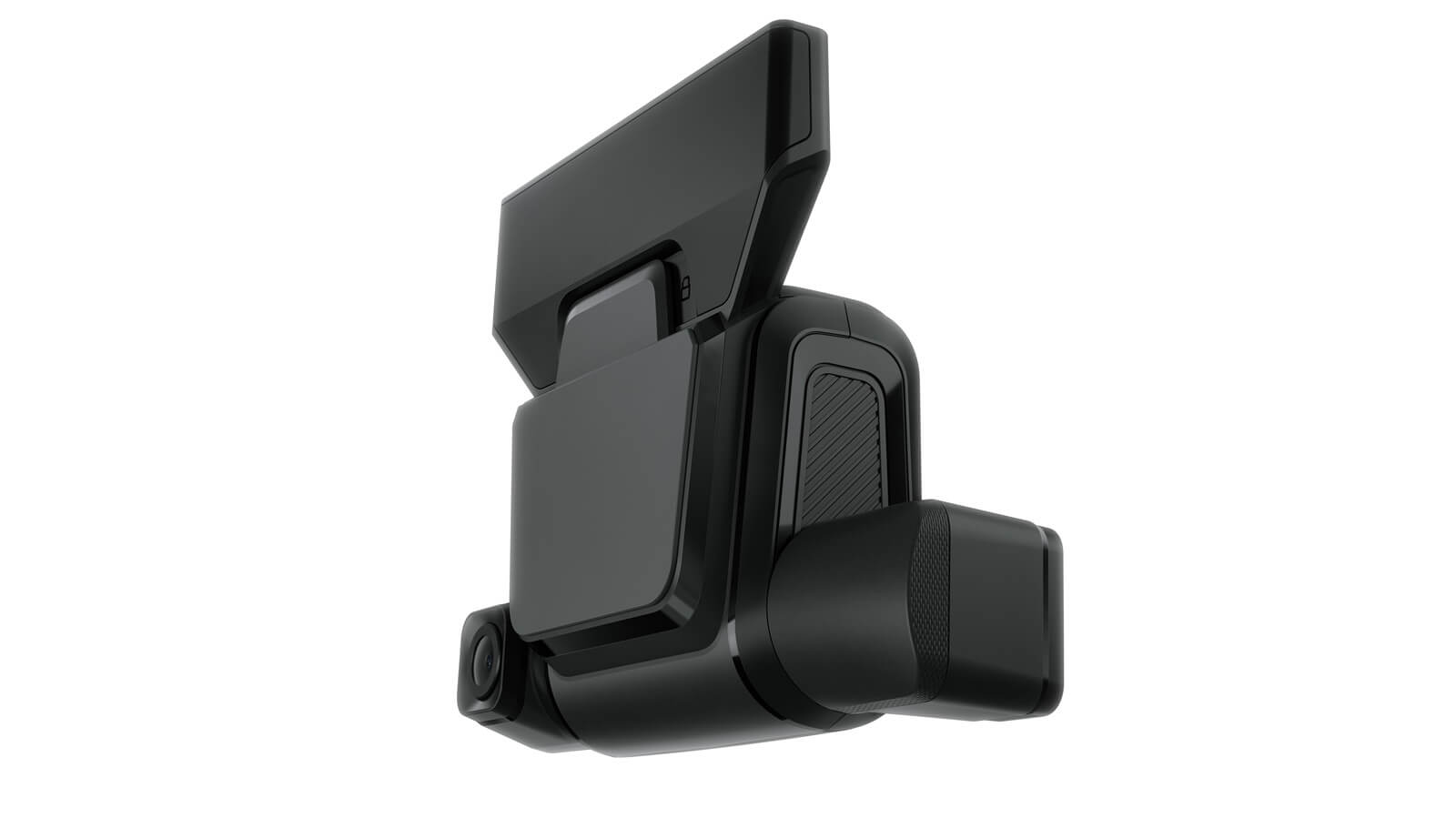
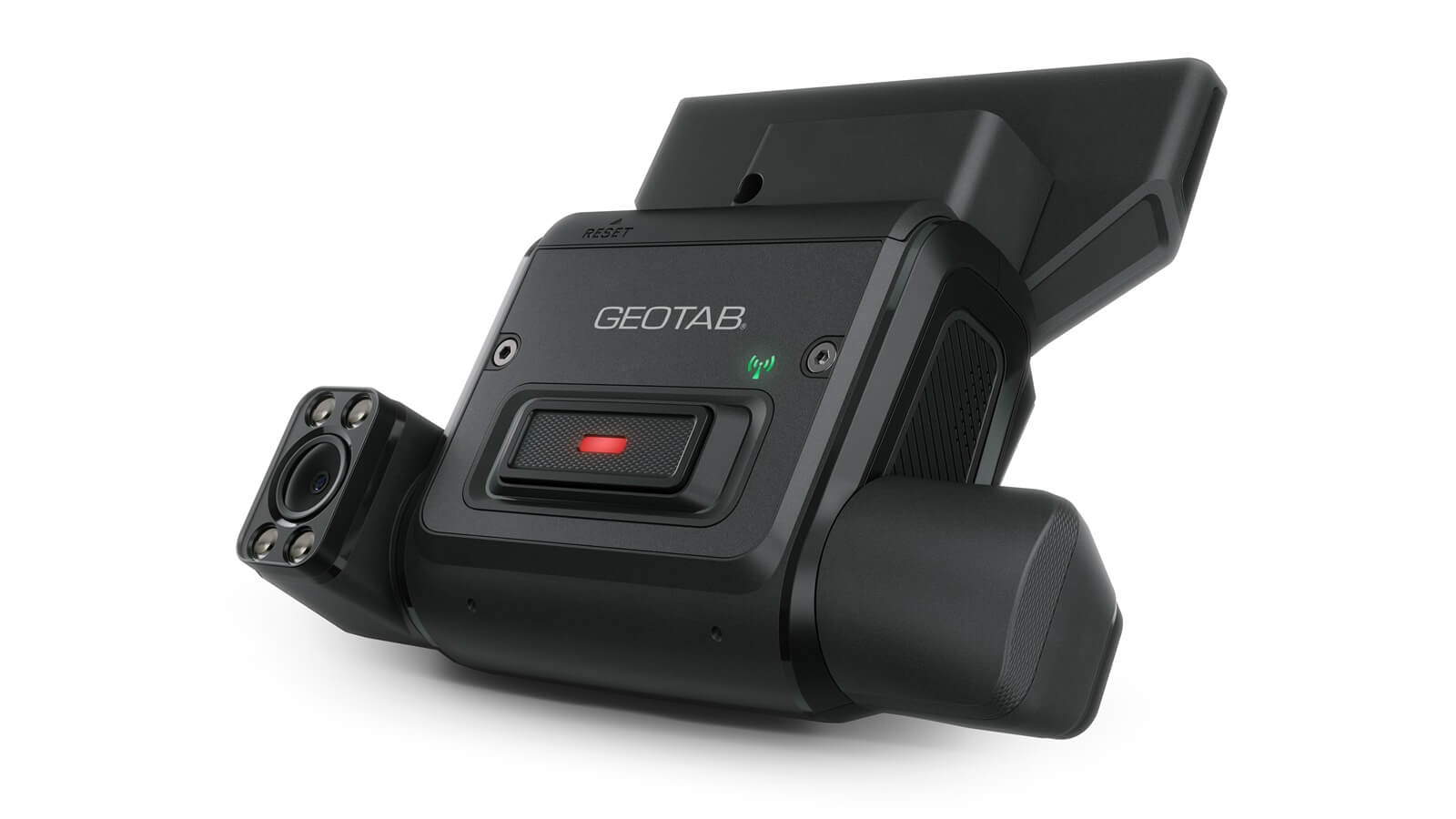
The Geotab GO Focus Plus is a streamlined example of an AI dash cam, as these front and back views reveal. Source: Geotab
Secure & AI automated analysis
Automated analysis is one major way that AI cameras speed up fleet efficiency. The device itself can detect events such as distracted driving, tailgating, harsh braking, or lane departures in real time, helping prevent incidents before they happen and reducing the need to manually review hours of footage.
In contrast, standard dash cams generally won’t automatically analyze the footage, leaving fleet managers to spend hours manually reviewing footage for relevant incidents … after they’ve already happened.
Many enterprise-grade AI camera solutions include safety features such as encrypted storage. Top solutions, like the Geotab GO Focus Plus AI Dash Cam, limit the scope of what is recorded and come with firmware protection and controls to prevent direct downloads. Furthermore, Geotab safeguards this data with an end-to-end security lifecycle and maintains a proven track record of data privacy, trust, and compliance.
Video-based safety and operational efficiency
The biggest way AI cameras promote operational efficiency is through event-based recording. It activates when driving rules are triggered, then uploads that recording to the cloud for company review.
Geotab GO Focus Plus AI dash cam automatically prioritizes and surfaces the riskiest driver behaviors and most critical incidents first using its “Smart Sequence” feature, eliminating hours each week spent digging through endless footage. Event-based recording makes footage reviews faster, since there’s less content to parse. In a unified video telematics solution, footage can be synced with telematics data like vehicle speed and GPS coordinates.This provides a full picture of incidents alongside indisputable evidence to support and accelerate insurance claims resolution.
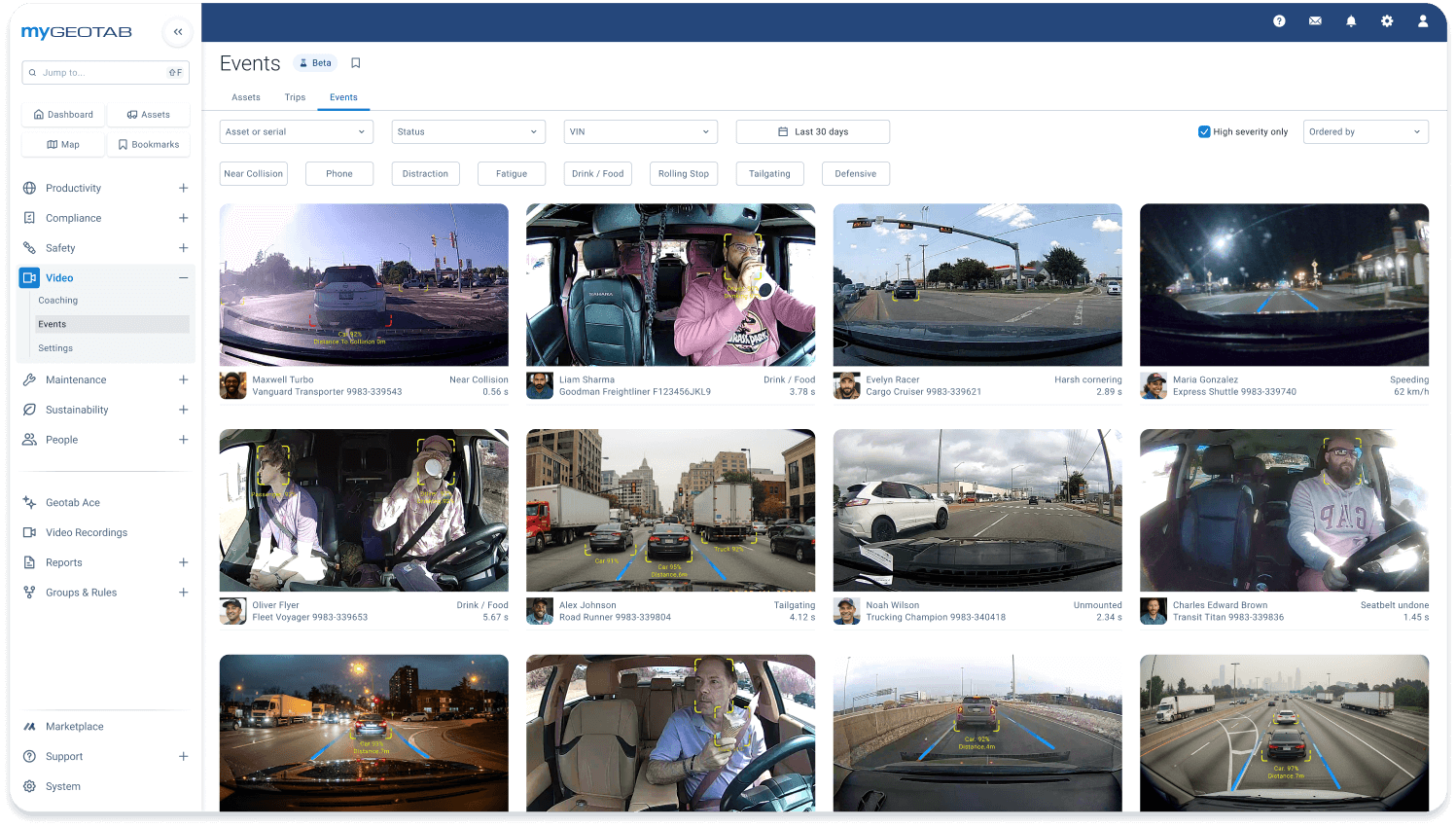
The Geotab GO Focus Plus AI safety camera records and uploads events, which managers can review with the associated software, MyGeotab. Source: Geotab
Analytics for continuous future improvements
AI safety cameras will likely come with a management software. Geotab’s fleet management system, MyGeotab, includes driver profiles and dashboards with role-based access settings to ensure each employee sees the data for their clearance level.
This AI dash camera data provides valuable benchmarking, letting managers see how individual vehicles and drivers perform over time. Patterns that would be missed with manual dash cam reviews are captured and highlighted in automated annual or quarterly reports.
The end result? AI cameras provide the data that guides future decisions, helping a fleet continuously improve in the future as well as the immediate present.
“We believe the safest fleet is a well-supported fleet. […] This system empowers fleet managers to move beyond reactive incident review and instead foster a culture of safety that protects their most valuable asset, which is their people.” -Charlie Elliott, Senior Vice President, Marketing & Marketplace at Geotab
How to Choose the Best Safety Camera
When adapting new hardware for your fleet, you’ll want to stick to a set of general principles: Figure out what features you need, determine a realistic budget, and vet the potential commercial vehicle camera systems.
Risk assessment
Gather all relevant data on your fleet’s history with safety. What problem areas are the biggest and which can be addressed with dash cam functions?
Don’t forget these factors:
- Fleet size
- Vehicle types
- Route conditions
- Historical data analysis
Prioritize dash cam needs
Using the risk assessment, figure out the core dash cam features that you’ll need, ranking them from most to least important. This is when the differences between standard and AI safety dash cams with driver behavior analytics will become most relevant.
Select a camera configuration
Commercial dash cams come in three primary types: Front-facing with a single lens on the road, dual-facing with two lenses to cover the road and the cab interior, and multi-channel 360-degree cameras with four or more lenses to cover the vehicle’s front, rear, and sides, along with cab interior.
| Camera Configuration | Footage | Best For | Primary Safety Benefit |
|---|---|---|---|
| Front-Facing | Road ahead | Small service vans, field technicians | Detects poor driving, helps with insurance. |
| Dual-Facing | Road and the cabin interior | Long-haul logistics, delivery fleets | Detects risky driver behavior and road safety. |
| Multi-Channel | Road ahead, cabin interior, rear, and sides | Heavy trucks, buses, construction | Eliminates blind spots in high-risk environments. |
Compare brands
Figure out which of the top trucker dash cam vendors on the market will best meet your needs at the price that works for your dash cam price range.
Top factors here will likely include:
- Video quality
- Encryption and security
- AI functionality
- Alerts and notifications
- Integrations
Request a free demo in order to see the dash cams in action before you commit to a purchase.
Once you’ve selected your dash cams, you’ll just need to install them and start getting your drivers up to speed on how to best use the cameras now and long into the future.