

A safety program is core to a successful fleet operation. It reduces collisions, keeps vehicles in top condition and, most importantly, keeps an entire employee workforce healthy, happy, and productive.
It’s not easy. Tech.co’s latest industry survey reveals the most crucial element behind a good fleet safety program, according to 25% of fleet professionals: ongoing, continuous training and development.
Additional crucial elements include mentoring, data-backed decisions, and positive feedback. Learn more about how Motive’s AI-powered fleet management platform aids in the monitoring and coaching that’s core to fleet safety programs, according to the professionals we polled.
Key Takeaways
- Safety thrives when training is continuous, say 25% of fleet experts surveyed by Tech.co.
- 18% of logistics professionals say clear policies and procedures are the most effective element of driver safety culture.
- AI replaces generic training with tailored development by analyzing hours of driving footage.
- Video evidence ensures coaching is objective and fair, protecting the relationship between driver and manager.
- Most AI dash cam coaching focuses on reacting to events which have already happened, but AI can offer proactive coaching and development.

What Is a Fleet Safety Program?
A fleet safety program is a set of policies and practices with a goal of keeping drivers and vehicles within a fleet safe and healthy. The exact procedures will vary, but may include:
- Driver training
- Vehicle maintenance policies
- Driver performance monitoring
- Mentorship and coaching
How To Build a Fleet Safety Program
When building a custom safety program that addresses your fleet’s needs, these essential elements must all be present, in order of importance:
- Ongoing training and development
- Clear policies and procedures
- Leadership and role modeling
- Positive feedback
- Data and performance metrics
- Coaching and mentoring
1. Ongoing training and development
The number one core element behind a sturdy culture of driver safety is continuous training and development. A full quarter (25%) of logistics professionals in Tech.co’s fleet industry survey cited the importance of ongoing training activity, which was the highest level of agreement our research recorded.
Fleet safety is a constantly evolving process. It can’t be achieved with a few piecemeal meetings. Instead, managers must establish frequent meetings to address specific development areas.
How can AI support ongoing training and development?
- AI uses data for precision coaching
- AI identifies skill gaps and develops tailored training plans
- AI offers tools for continuous training
Fleet management software providers like Motive offer data collection and AI tools that can streamline and inform the training process.
For example, AI dash cam users report saving an average of 4.5 hours per week.

2. Clear policies and procedures
18% of fleet professionals rank standardized rules as a vital element for a safety-first culture, making it the second most important element in their estimation.
These rules might address topics such as:
- Driver qualification
- Mandatory seat belt use
- Regulation of handheld device use
- Cargo security
- Personal use of company vehicles
- Company use of personal vehicles
Managers can establish regulations by clearly defining “safe driving” thresholds. In many cases, Motive’s platform can nudge them with alerts if these thresholds are violated, since it monitors entire fleets in real time.
Drivers must have easy access to safety handbooks at all times, so they’ll know what infractions look like and what consequences come with them.
How can AI support ongoing training and development?
- AI provides video and data evidence to promote objectivity
- AI enforces policies consistently across the fleet, combating favoritism
- AI builds trust in the system
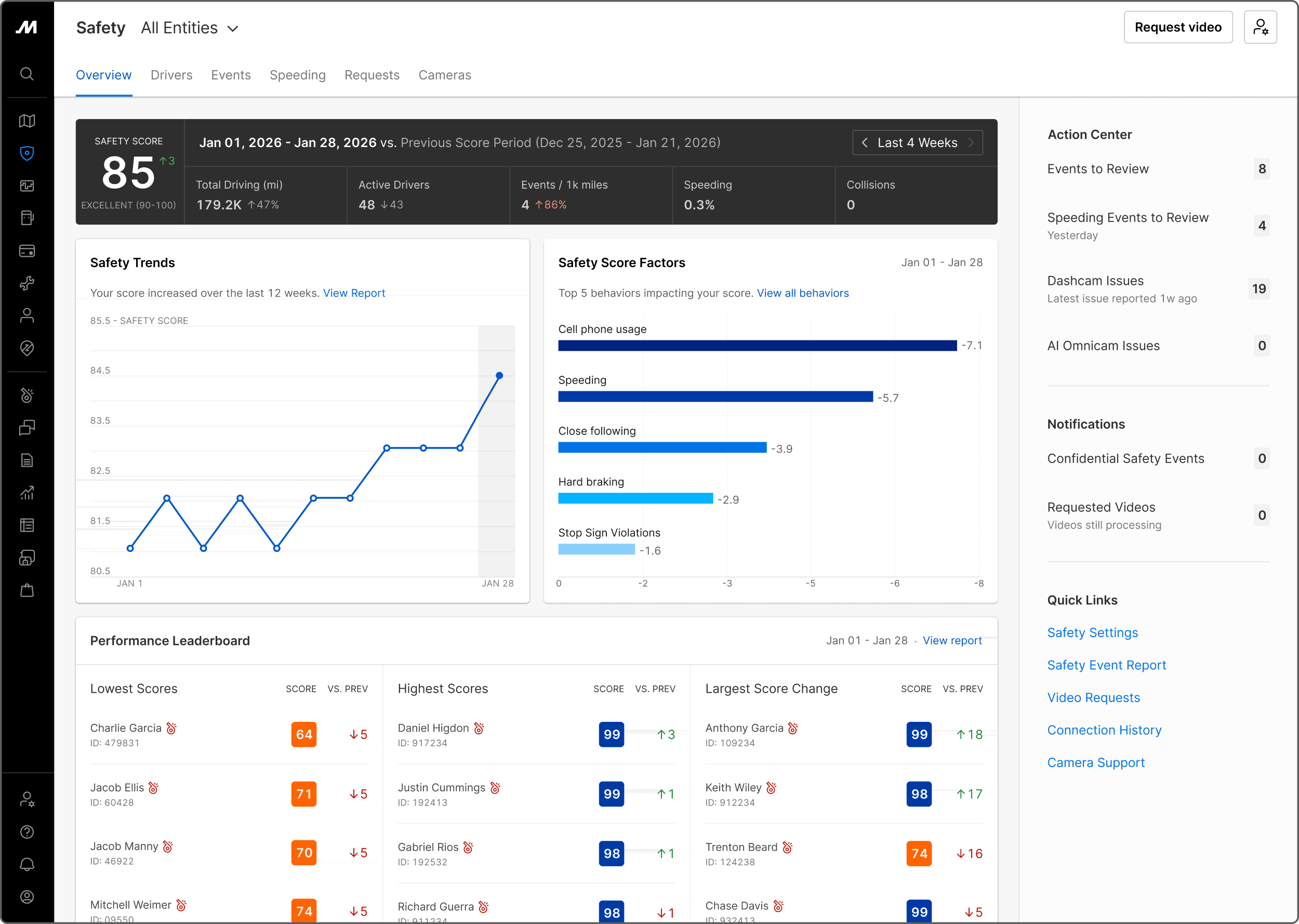
Motive provides a clear, comprehensive overview of your safety measures. Source: Motive
3. Leadership and role modeling
Training and standards only matter if they’re enacted. Fleets need leaders who can model a culture of accountability, as indicated by the 12% of professionals who chose leadership engagement and role modeling as a core element of safety programs.
Senior staff members must personally lead “toolbox talks” and offer safety awards, to signal that the entire company has bought into safety as a cultural value. Day managers will also need to convey the importance of safety as more than just a requirement.
How can AI support ongoing training and development?
- AI provides high-level visibility for general managers and executives
- AI converts data into digestible “safety scores” for each driver
- AI supports proactive, in-the-moment mentorship
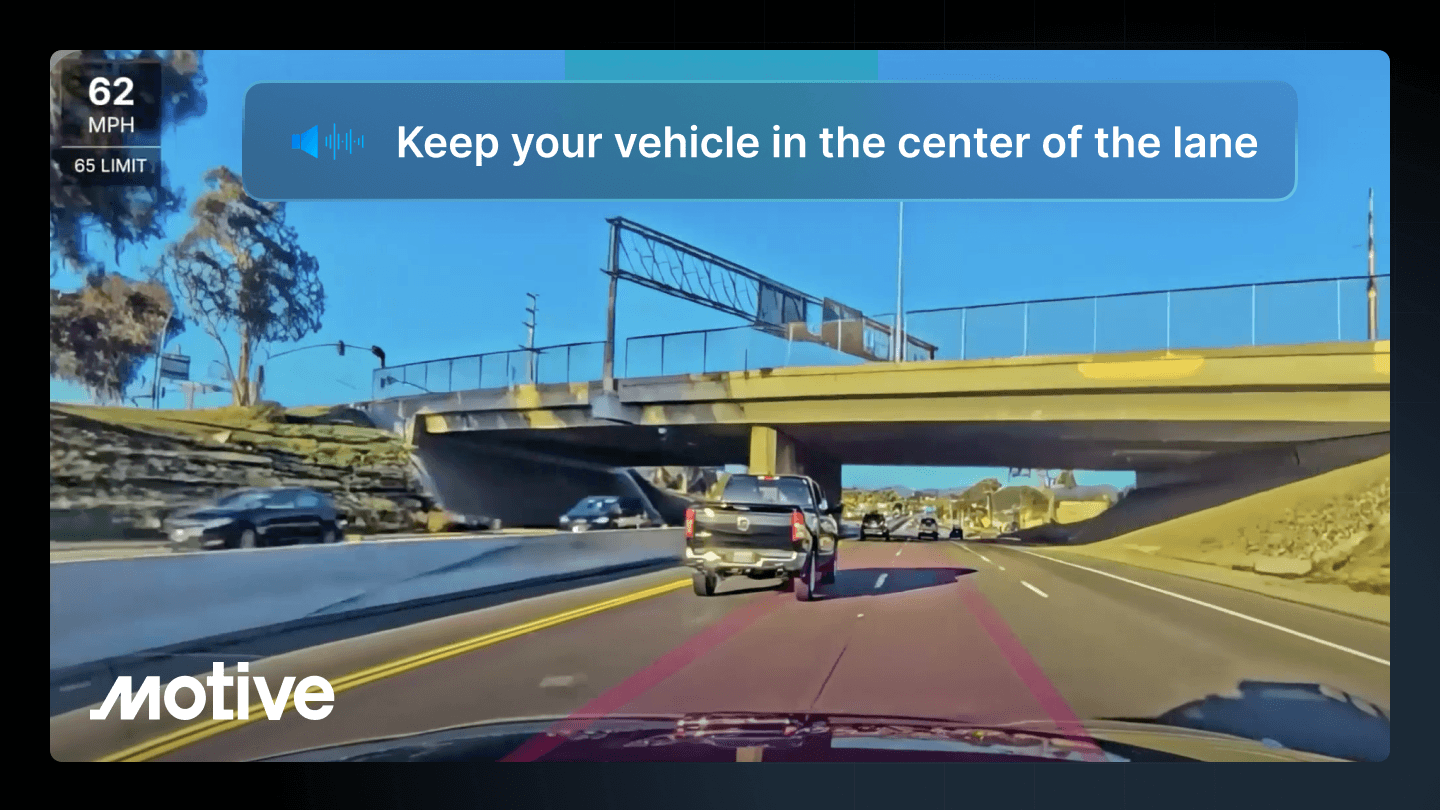
Motive’s AI tools can automate safety alerts for managers, aiding with proactive coaching. Source: Motive
4. Positive feedback
Our survey flagged the importance of celebrating wins, with 10% of fleet managers picking “providing positive feedback and recognition” as a top concern for safety efforts.
Motive’s range of driver safety services to support this include Safety Scores and leaderboards to promote healthy competition between drivers. Perhaps the most relevant function is the AI Coach, a tool that generates custom feedback summaries using AI avatars.
Outside of software solutions, managers can create their own “driver of the month” programs, with tangible rewards like bonuses or gift cards tied to set performance metric milestones.
How can AI support ongoing training and development?
- AI offers fleet management tools that log results
- AI automates recognition
- AI catches positive driving events that might otherwise go unnoticed
5. Data and performance metrics
9% of fleet professionals say using data and performance metrics is the most effective element behind a strong driver safety culture.
Vehicle telematics will always be the fastest, most reliable way to spot events like harsh braking, speeding, or near-collisions.
That data supports better insights: managers must run safety reports to identify fleet-wide patterns, like the rise in fatigue-related events recently revealed in the 2026 Motive AI Road Safety Report. They must then act on these insights by using them to shape the risks or development areas covered in future briefings.
How can AI support ongoing training and development?
- AI analyzes historical data
- AI generates risk assessments
- AI generates safety reports
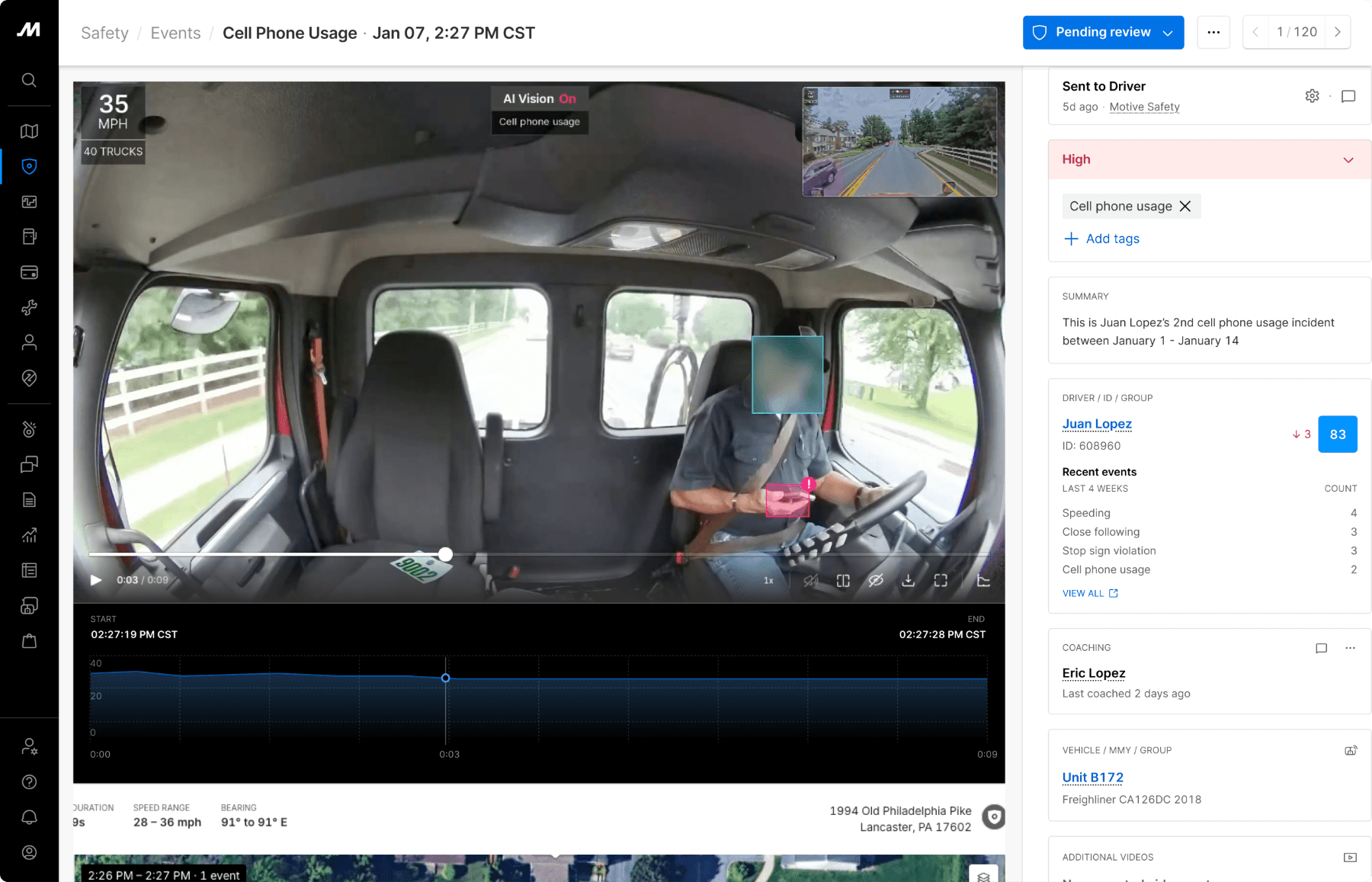
An example of Motive’s system detecting risky behavior. Source: Motive
6. Coaching and mentoring
6% of logistics professionals in our survey highlighted targeted driver coaching, while peer-to-peer learning and mentoring was a core safety concern for another 6%.
Coaching sessions are top-down, while peer mentoring is horizontal, but they’re both examples of one-on-one discussions that help team members understand individual learning styles — a value that 6% also identified as crucial.
How can AI support ongoing training and development?
- AI highlights key individual growth areas
- AI creates meeting transcripts and summaries
About Our Research
This article uses Tech.co data gleaned from a survey of 265 fleet professionals who were polled monthly, and has debuted in this article exclusively for Motive. Additional analysis was conducted with the use of publicly available information.
Common AI-Assisted Safety Tasks
Dash cams are the single fleet safety technology most likely to rely on AI tools, with more than half (55%) of fleet professionals using AI dash cams to assess driver safety.
Here are all the most common AI safety tactics, based on the percentage of fleet professionals that use them:
- Using AI dash cams to assess driver safety: 55%
- Using dash cam video footage to educate drivers: 36%
- AI dash cam notifications triggered when drivers make mistakes: 36%
- Post violation debriefs (based on AI dash cam alerts): 27%
- Using AI dash cams to report on training gaps: 9%
- In-person monthly or quarterly briefings: 9%
- One-to-one mentorship or advice: 9%
Reactive uses of AI (responses to violations) are more common than proactive uses (education and briefings). Safety programs that focus on proactive safety measures, like rewards programs and mentorships, will excel beyond the existing competition.
Benefits of an Effective Fleet Safety Program
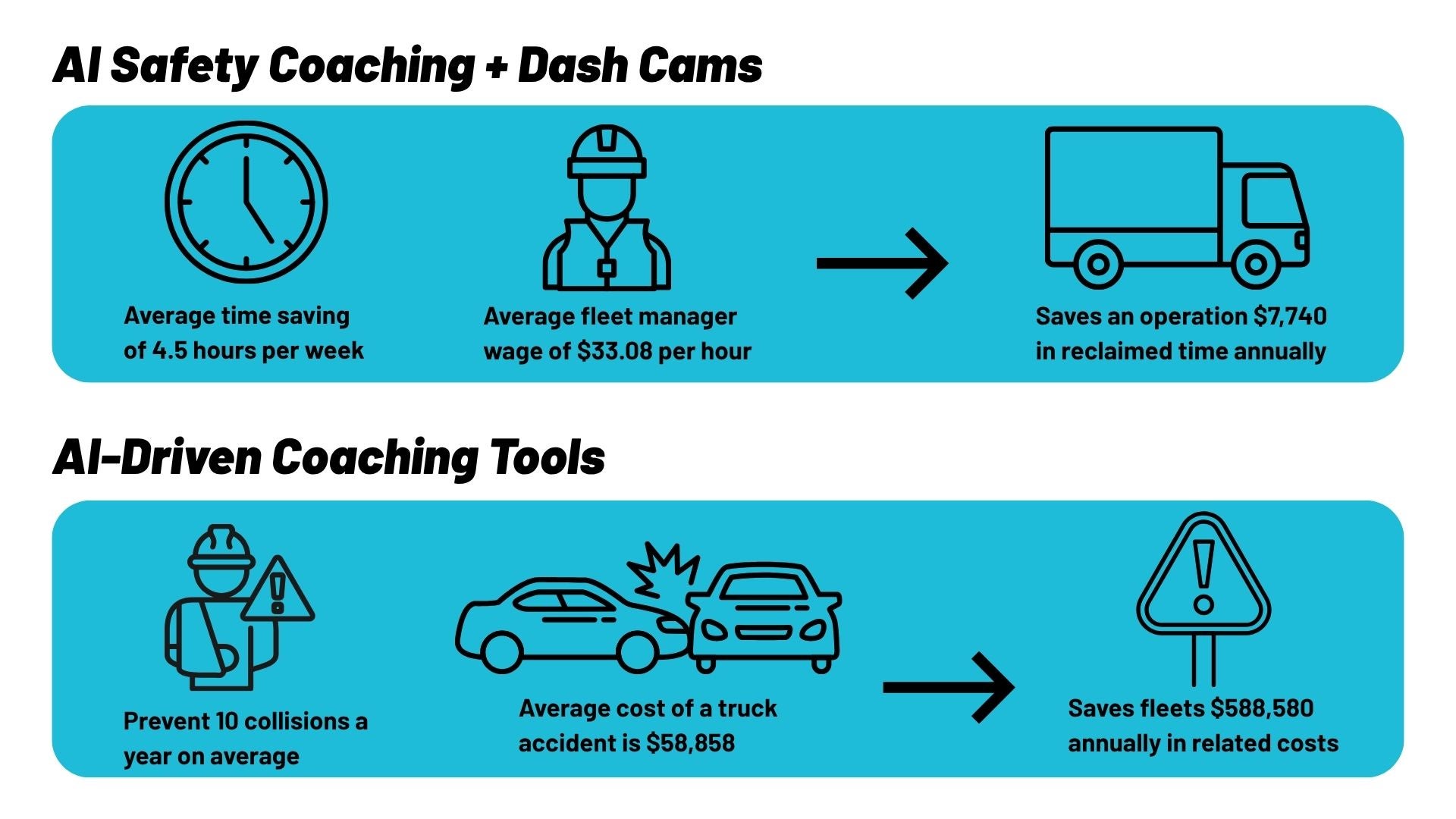
Safety programs protect employees and vehicles alike in direct, measurable ways, saving $7,740 a year with AI dash cams and another $588,580 per year in collisions prevented.
AI safety coaching with dash cams: $7,740 saved annually
Fleet professionals report an average time saving of 4.5 hours per week when using AI dash cams, according to the most recent Tech.co survey.
Those savings will add up over the course of a year. Assuming an average fleet manager wage of $33.08 per hour, AI dash cams would save an operation approximately $7,740 in reclaimed time annually.
AI-driven coaching tools: $588,580 saved annually
These programs prevent 10 collisions per year on average, fleet operators report.
If we assume the average cost of a truck accident — $58,858 — AI coaching will save your fleet $588,580 per year in related costs. The savings will vary depending on the size of the vehicles in question, but even if it only prevents a single collision, a safety program is well worth the effort.
Next Steps: Creating Your Program
As long as you keep all the essential elements of fleet safety programs in mind when crafting your own, the basic steps will be simple.
- Create clear benchmarks and regulations
- Establish regular coaching and mentorship briefings
- Reward milestones
Motive’s AI road safety findings offers more advice on integrating management software and AI with safety programs.