
We may receive a commission from our partners if you click on a link to review or purchase a product or service. Click to Learn More
Managing a commercial fleet? Drivers, vehicles, assets, maintenance, and future planning are all key cost factors you must understand and control to boost efficiency.
Some costs can’t be reduced, like vehicle leases and insurance. Instead, 47% of fleet pros picked optimizing routes for fuel efficiency as their biggest focus in a recent Tech.co survey, while 70% said preventative measures were their top maintenance concern.
The best way to optimize: understand where your fleet management cost comes from and how you can trim it.
Fleet management software can help centralize cost factors and keep them visible at all times. The software itself is another cost — our research shows it’s between $15 to $50 per vehicle, per month — but it adds up to big savings in the long run.
- Fleet management software typically costs between $15 to $50 per vehicle, per month, depending on the number of features.
- Your fleet costs depend upon fuel consumption, vehicle maintenance, driver wages, leases, and the size of your fleet.
- Fuel is the largest operating cost for most fleets, making fuel efficiency a critical area.
- Top constraints facing fleets today include workforce shortages (Tech.co data finds 25% say this is hitting them the hardest), as well as unforeseen weather disruptions (21%), and rising diesel prices (20%).
Fleet Management Costs Breakdown
Total cost of ownership, or TCO, refers to the actual cost of an asset and includes all associated costs like maintenance and depreciation, as well as the initial acquisition cost.
Calculating your fleet’s TCO can be extremely valuable, as it varies dramatically from business to business and even vehicle to vehicle. If you can find ways to better optimize your fleet management cost, you can substantially improve your bottom line.
One way to track your fleet’s financial health is to divide your TCO by the number of miles driven to determine your fleet’s cost-per-mile number. This is the exact amount your company pays to drive one mile. If your TCO is $150,000 and you drive 100,000 miles, your cost-per-mile was $1.50.
Fixed vs operating costs
When it comes to the total cost of owning a particular asset, fleet expenses come in two forms: fixed and operating.
- Fixed costs: Charges that are consistent, regardless of how the asset operates, which includes everything from taxes and insurance to licenses and lease payments. These kinds of costs are often hard to reduce, although that doesn’t always stop fleet managers: our latest survey found 21% said they are or have worked to negotiate better insurance premiums as a way to save money.
- Operating costs: These are more variable and can change depending on the usage of the asset. Major operating costs for fleets include tolls, detailing, repairs, parking, and telematics systems.
When trying to reduce your overall fleet budget, we’d suggest focusing on lowering your operating costs.
Here at Tech.co, we run regular industry surveys covering fleet logistics. For early 2026, the sudden rise of major unforeseen disruptions is the biggest headline: In February, 30% of fleet managers cited them as the biggest source of operational pressure, up from 21% a month earlier.
In that instance, winter snow storms were likely to blame, but disruptions can take many different forms, from unexpected tariffs to gas price hikes. Workforce shortages remain a top concern for many fleet professionals, our data shows.

What Influences Fleet Management Costs?
When calculating your own fleet’s costs, consider these common categories:
Vehicle ownership
Has every vehicle in your fleet been fully paid off or do you pay a per-month lease instead? Whatever the case, you should know the total value of each vehicle. Your calculation should include depreciation, as the value of your vehicle will steadily drop due to wear and tear.
Driver wages
How many drivers does your fleet need, and how much are they paid? You should factor in the average overtime wages you expect to pay over a given period. Labor shortages will be a major factor here as well, and the size of this issue is hard to overstate. Tech.co data finds 25% of freight firms cited workforce shortages as their biggest problem in December 2025.
Fuel costs
Fuel is the biggest operating cost for most US fleets, so you should carefully track how much you spend on fuel per vehicle. For electric vehicles, include charging costs.
Tech.co data from December 2025 found 47% of logistics professionals say optimizing routes for fuel efficiency is their biggest sustainability focus. For more insights like this, check out our key logistics stats for 2026.
Fuel taxes are another element to consider: thanks to IFTA (International Fuel Tax Agreement) regulations, your fleet’s tax liability can be easily calculated each quarter, as long as you track the miles driven and gallons of fuel used across each US state or Canadian province.
Fleet management software
Your management costs should include the monthly subscription to the software that you use for the process of management itself. This may include the hardware devices that record data for the software as well: we’ll explain in more detail in the next section.
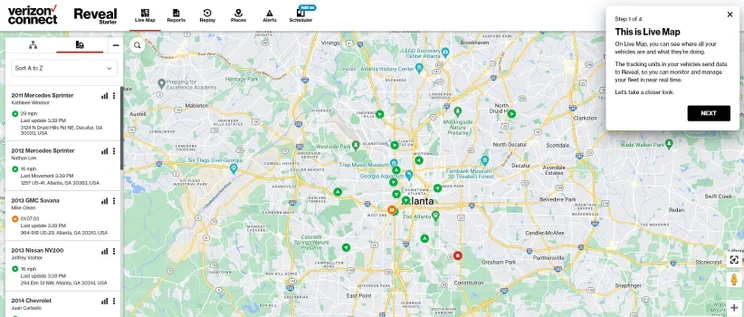
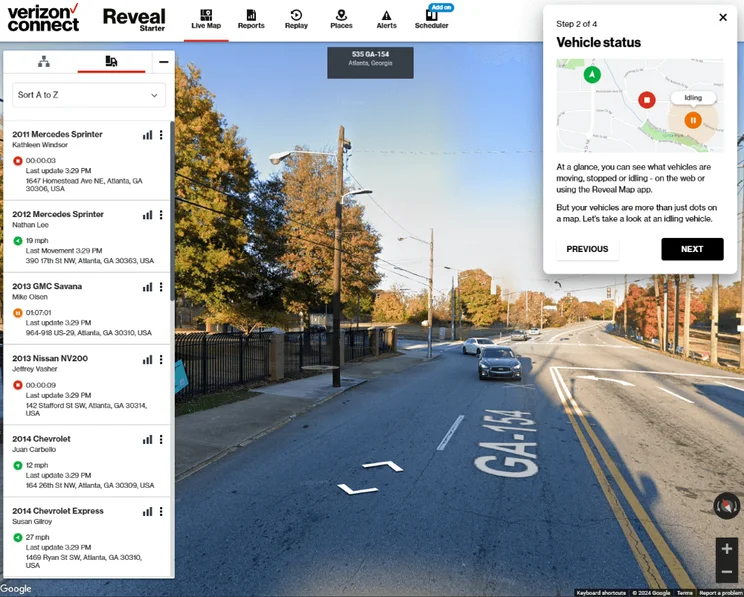
Fleet management software like Verizon Connect Reveal can help you track your fleet and perform a wide range of operations directly on the platform. Source: Tech.co testing
Vehicle maintenance costs
All your vehicles will need regular maintenance to perform at their best. This includes both the cost of materials (such as motor oil, radiator coolant, brake and power steering fluid, windshield wipers, and brake pads) as well as the workforce required to change them.
Vehicle upkeep remains a perennial cost consideration for all logistics firms, although milder weather conditions may have moved it down the list as Spring 2026 dawns: Tech.co’s March 2026 survey found 16% of fleet professionals called vehicle upkeep a top priority, down from 22% a month earlier.
Tickets, fines, and toll charges
Go back over your total funds paid out to federal, state, or local fines across past years or quarters. This might include speeding or traffic tickets, as well as fines for failure to comply with regulations like the ELD mandate.
Toll charges are another cost of operating a fleet. Since they will vary from day to day and month to month, you should determine a typical average cost, so that your budget accounts for toll charges moving forward.
Insurance premiums
Fleets in the US should have several insurance plans covering different categories of risks. Your operation will probably need automobile liability and automobile physical damage insurance. Your prior claim history will impact how much you pay.
TCO and Cost-Per-Mile Breakdown: Example Fleet
Let’s imagine the finances for Jones Delivery, a small, fictional transportation service with three commercial vehicles. These numbers won’t be realistic — they’re just intended to illustrate the types of equation that can help you understand TCO and cost-per-mile for your own fleet.
The manager at Jones Delivery sits down to track all of her yearly major operating costs:
- $200,000 for fuel
- $100,000 for driver wages
- $50,000 for maintenance
- $25,000 for insurance
- $25,000 for additional expenses, including financing and disposal
This comes to a TCO of $400,000 per year. However, there’s one final factor to incorporate: the fleet has driven a total of 200,000 miles this year. $400,000 divided by 200,000 reveals Jones Delivery has a cost-per-mile of $2 for the year.
Armed with this knowledge, the manager can forecast how to save more money next year. For example, increasing miles driven by 20% for the next year will lower the cost-per-mile down to just $1.67 – at least, until you account for the increase in fuel costs and driver wages.
Fleet Management Software Costs
Fleet management software pricing typically ranges from $15 to $50 per vehicle, per month, depending on the features and size of your fleet.
For a small fleet of 10 vehicles with basic features, you can expect to pay around $15 per vehicle, per month, or $180 per vehicle, per year. A larger fleet of 50 vehicles with more advanced features, such as real-time tracking and reporting, could cost upwards of $50 per vehicle, per month, or $600 per vehicle, per year.
This table shows typical cost ranges per each vehicle in a fleet of commercial trucks:
|
GPS tracker
|
Basic
|
Advanced
|
|
|---|---|---|---|
|
Billed Monthly |
Billed Annually |
Installation Cost |
|
|
$10 – $15 |
$100 – $150 |
Free |
|
|
$3 – $25 |
$35 – $250 |
Free or $50 – $100 |
|
|
$30 – $55 |
N/A |
Free or $100 – $150 |
Fleet management systems can be used to dispatch drivers, provide route planning and traffic information, monitor fuel, and more. If your business uses a fleet of vehicles, it’s well worth investing in this kind of service — especially given US federal regulations like the ELD Mandate require some form of fleet tracking.
What influences fleet management software costs?
The total price given for a fleet management system likely covers four different costs:
- Owned or leased hardware devices installed in each vehicle
- Monthly or annual software licensing fee
- One-time hardware installation fee
- Online or in-person training
Many fleet management services will bundle all these costs, giving fleets a simple one-time onboarding cost, followed by a monthly subscription fee, typically billed annually.
Here are the biggest cost factors to know.
- Size of your fleet: Almost all FMS companies charge per vehicle (or user) per month, so a larger fleet will pay more than a smaller fleet.
- Features required: Different systems track different types of data, from ELD compliance to fuel tracking to alerts on when best to rotate your tires, and on average, more extensive features will cost more.
- Vendor: No FMS company is the same, and vendors’ prices can fluctuate.
- Type of shipping service: Less-than-truckload (LTL) shipping operations should check to ensure that an FMS tracks multiple destinations along a single route.
- Additional hardware: Some further costs may be necessary, yet not included in FMS pricing. For example, drivers might need company tablets or smartphones to access data needed to pass roadside inspections.
Licensed or owned?
Fleet management companies might directly sell fleets the hardware devices used to record data from within each vehicle. Alternatively, they might simply license these devices out to a fleet operation, taking the devices back should the operation choose to end its contract in the future.
Wired or plug-and-play?
Wired devices must be individually installed in each vehicle, connecting directly to the engine to monitor data that might otherwise go unrecorded.
If you have a light- or medium-duty vehicle, a plug-and-play option is likely a good choice. If you have a heavy-duty vehicle or are opting for a discreetly installed tracker for anti-theft protection, you should pick a wired device.
How Are 2026 Diesel Price Hikes Impacting Fleet Management Costs?
In 2026, a new source of supply-chain financial pressure has emerged: the Middle East war has sent diesel prices soaring. They’ve been steadily climbing for two months, according to the Department of Energy’s average weekly retail diesel price, the industry standard for price-setting.
It’s due to Iran’s lengthy maritime closure of the Strait of Hormuz, which normally moves about 20% of the world’s oil and liquefied natural gas. Diesel prices are up around 67% in response, eating into logistics companies’ margins.
Stopgap measures won’t be enough, experts predict, while the ripple effects may easily continue well into 2026, even if the disruptions are resolved relatively quickly. Some solutions, like proposed tolls that might add $1 per barrel to the price of crude oil, will set new precedents for high prices.
How Fleet Management Software Can Save You Money
Initial costs for a fleet management system may seem high, but the main reason fleet managers love these tools is for the cost savings they get in return.
The clearest benefit lies in fuel savings. Fleet management software tracks how long vehicles are left idling and how fast those idling vehicles burn through fuel. Add in routing optimization, and a fleet tracking system can save the average operation between 13% and 20% on fuel, reports show.
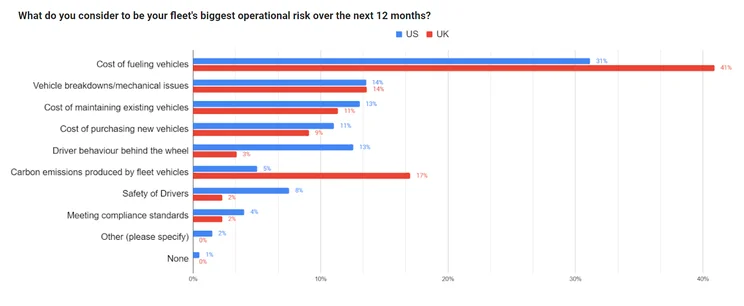
The cost of fueling vehicles is the number one operational risk to fleet management organizations. Source: Tech.co
Another benefit: fewer repair costs. Sudden stops are tracked by many systems, allowing fleet managers to note which drivers are braking harshly and how often. Cutting down on these incidents keeps a fleet’s brake pads in good condition longer.
Since management systems track each driver’s overtime hours, fleet managers will be able to help drivers avoid overtime when it happens — and not learn about it when balancing the checkbook weeks later.
These systems also speed up service: they save transportation operations approximately 54 minutes per day, according to one Motorola study, for a savings of $5,484 per employee.
Finally, these systems give fleets a centralized database that allows for easier analysis and optimization insights. According to research from Aberdeen Group, fleet operations with an FMS are more than twice as likely to have a centralized repository for data collected on the road, to integrate that data into their back office, and to have data scientists dedicated to analyzing it.
Other reasons to use a fleet management system
There are plenty of benefits to using a fleet management system. Here are some of the ways your business can save time and money with one.
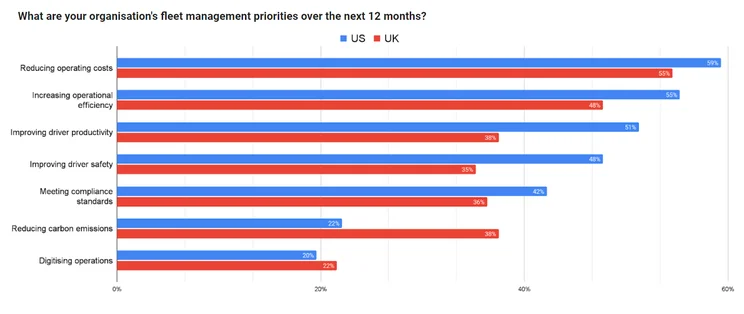
Reducing operating costs is the number one priority for fleet management organizations in March 2026. Source: Tech.co
- Comply with regulations: The ELD Mandate made it essential for businesses to track their drivers’ working hours using some sort of electronic logging device. Management systems can help with many more new trucking regulations, too.
- Stay safe: Fast response times can make a difference and any GPS fleet tracking system can alert a fleet manager within minutes from anywhere on the globe. According to the Federal Motor Carrier Safety Administration itself, ELDs are estimated to save 26 lives per year in the US alone.
- Cut emissions: By tracking and reducing fuel costs, your operation will burn less CO2 to get where it’s going. Saving $250 in annual fuel costs, per vehicle, could cut carbon emissions by 2,500 pounds, per vehicle, each year.
- Reduce travel time: One NuStats study found that drivers with traffic-sensitive navigation systems can cut 18% of the time on the road on any given trip. For the average driver, that’s a full four days out of the year.
- Save money: Tech.co surveys show that reducing operating costs, increasing efficiency, and improving drive productivity are top concerns for fleet managers.
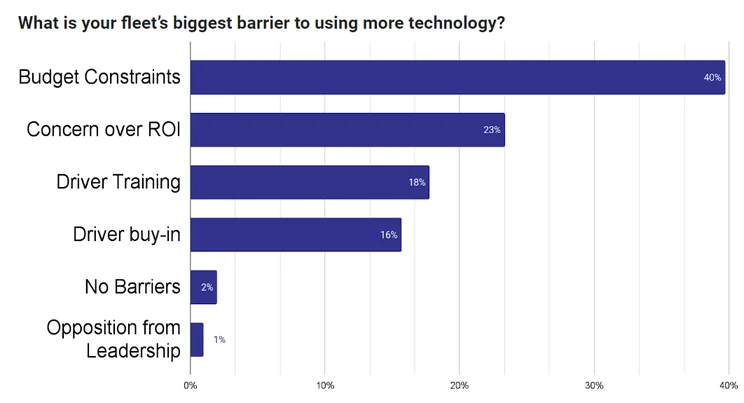
Budget constraints are the number one barrier to the use of new technology in fleet management. Source: Tech.co
A good fleet management system helps with every aspect of operating a fleet, including route planning, live diagnostics, fuel tracking, maintenance tracking, anti-theft precautions, financing, and driver health and safety.
Fleet Management Software Provider Pricing
Let’s take a quick look at how typical fleet management costs stack up across some of the biggest providers in the industry:
|
Price from
The typical lowest starting price. The lowest price available for your business will depend on your needs
|
Free trial or demo
|
|||||||||
|---|---|---|---|---|---|---|---|---|---|---|
|
SPONSORED
 |
BEST OVERALL
 |
BEST FEATURES
 |
 |
 |
 |
 |
 |
 |
 |
 |
|
Motive (formerly KeepTruckin) |
Verizon Connect Reveal |
Samsara |
Teletrac Navman TN360 |
US Fleet Tracking |
Fleetio |
GPS Insight |
GPS Trackit |
Omnitracs |
Quartix |
IntelliShift |
|
Custom |
Custom (typically from $23.50/vehicle/month) |
Custom (typically from $27/vehicle/month) |
Custom (typically from $25/vehicle/month) |
$24.95/vehicle/month |
$4/vehicle/month |
$14.95/vehicle/month |
$24.99/vehicle/month |
Custom |
$14.90/vehicle/month |
$19.99/vehicle/month |
|
Free demo |
Free demo |
30-day free trial — hardware and software |
Free online demo |
Free live demo |
14-day free trial |
Free demo |
Free demo |
Free online demo |
4-week trial |
Free demo |
Fleet Management Best Practice
As with any management software, fleet management software opens fleet managers up to a few vulnerabilities if not used responsibly.
Don’t intrude on privacy
Fleet management software platforms will record vehicle drivers’ speeding habits, locations, and how quickly they take a 90-degree turn. This is perfectly legal during working hours, but employees should be made aware of what’s being tracked and why.
If a fleet operator’s vehicles are ever used privately by employees, the operator should take care to disable the fleet management software for these trips.
Manage driver expectations
Drivers in a fleet may be upset at switching to fleet management software and away from a passive GPS tracker or a paper logging system (neither of which automatically log driving habits or overtime).
The best approach to introducing a fleet management system is through transparency and open communication. Some fleet management software provider offer driver training courses.
Fleet management software like Verizon Connect Reveal will allow you to track your drivers via their dash cams, but don’t overstep your boundaries when checking in. Source: Tech.co testing
About Our Research
We take our impartial research and analysis seriously, so you can have complete confidence that we’re giving you the clearest, most useful recommendations.
After conducting an initial exploration to identify the most relevant, popular, and established tools in the market, we put them through their paces with a research framework designed in-house to see their real strengths and weaknesses. In this case, we analyzed 20 fleet management products across 51 different areas of investigation.
Based on years of market and user needs research, we’ve established a fleet management testing methodology that scores each product in six core assessment areas and six additional subcategories, covering everything, from the driver management features to value for money, customer support, and much more.
Our main testing categories for fleet management systems are:
- Price: The cost associated with using the fleet management software, including upfront costs, subscription fees, hardware costs (if applicable), and any additional charges for advanced features or add-ons.
- Tracking: The core functionality of the fleet management software, which involves monitoring and tracking the location and movements of vehicles in real-time, including features such as GPS tracking, route optimization, and geofencing.
- Driver management: The features and tools provided by the fleet management software to manage and monitor driver activities. This can include driver behavior monitoring, driver performance reports, and driver identification.
- Vehicle management: The functionalities that allow for the efficient management and maintenance of vehicles, such as vehicle health monitoring and maintenance scheduling.
- Product features: The additional functionalities and capabilities offered by the fleet management software, beyond basic tracking and management, such as real-time alerts and notifications, or driver routing and dispatching.
- Support: The resources, assistance, and guidance provided by the fleet management software company to users, including phone support, email or chat support, and online forums.
When it comes to calculating a product’s final score, not all testing and research categories are weighted evenly, as we know some aspects matter more to our readers than others, which are merely “nice to have”. After hundreds of hours, our process is complete, and the results should ensure you can find the best solution for your needs.
At Tech.co, we have a number of full-time in-house researchers, who re-run testing and research processes regularly to ensure our results remain reflective of the present day.
If you manage a commercial fleet and want to save the most money, reduce operating costs: track and cut back on fuel use and harsh driving events, while keeping drivers safe and vehicles maintained.
Lowering these variable costs is the best path towards a lower fleet management cost, whether you’re running a business with five pizza delivery vehicles or one with thousands of semi-trucks.
If you’re interested in a new fleet management software to help track costs, check out our custom quote form.
FAQs
Fleet management software can make a return on its investment as fast as the first month, depending on your fleet’s needs. If you currently have no tools for optimizing routes or tracking fuel use, you’ll likely save thousands within the first year.
TCO analysis often misses certain unexpected costs, such as data plan overages, de-installation fees, or revenue lost during unplanned downtime.
If you click on, sign up to a service through, or make a purchase through the links on our site, or use our quotes tool to receive custom pricing for your business needs, we may earn a referral fee from the supplier(s) of the technology you’re interested in. This helps Tech.co to provide free information and reviews, and carries no additional cost to you. Most importantly, it doesn’t affect our editorial impartiality. Ratings and rankings on Tech.co cannot be bought. Our reviews are based on objective research analysis. Rare exceptions to this will be marked clearly as a ‘sponsored’ table column, or explained by a full advertising disclosure on the page, in place of this one. Click to return to top of page


