We may receive a commission from our partners if you click on a link to review or purchase a product or service. Click to Learn More
Zoom pricing starts at $13.33 per user, per month for Zoom Workplace, the bundle of services that includes access to the video conferencing platform Meetings, as well as Team Chat, cloud storage, and Zoom’s AI companion.
Zoom also offers a free forever plan, allowing users to host 40-minute video calls with fewer than 100 people. On top of that, there’s also a robust VoIP solution, Zoom Phone, which you can buy on its own for as little as $10 per user, per month, or bundle it with Zoom Workplace for as little as $18.33 per user, per month.
In this guide, you’ll learn about all the pricing that goes into Zoom, including how the pricing plans match up, how much it costs to bundle multiple services together, and whether or not the paid add-ons are worth it for your business.
In this guide:
- Zoom Pricing At a Glance
- Is Zoom Free?
- How Much Does Zoom Workplace Cost?
- Zoom Pricing for Education, Healthcare, and More
- How Much Does Zoom Rooms Cost?
- How Much Does Zoom Phone Cost?
- How Much Does Zoom Webinars Cost?
- Does Zoom Have Any Hidden Fees?
- What’s New With Zoom?
- What to Consider Before Buying Zoom
- About Our Research
- Verdict: Is Zoom Worth the Cost?
Key Takeaways
Zoom offers five main Workplace plans, including a free option, with paid tiers starting at $13.33/user/month.
While the free plan hosts up to 100 participants, it does limit group meetings to 40 minutes, making it largely unsuitable for businesses.
The Pro plan ($13.33 per user, per month) removes the 40-minute limit, extending meeting time to 30 hours, and introduces the AI Companion feature for meeting summaries and message drafting.
For growing teams needing more scale, the Business plan ($18.33/user/month) increases the participant cap to 300 and unlocks admin controls like Single Sign-On (SSO).
Zoom also offers specialized add-ons and bundles like Zoom Phone (starting at $10/month per user), Zoom Webinars (starting at $79/month), and Zoom Rooms (starting at $49/month per room).
Zoom Pricing At a Glance
Zoom Workplace offers four core pricing plans:
- Basic (free)
- Pro ($13.33 per user, per month)
- Business ($18.33 per user, per month)
- Enterprise (custom pricing)
With Workplace, you’ll get access to its flagship Meetings tool, as well as team chat, mail, calendar, and more.
With Zoom, there are also several available add-ons that you can pay for to bolster your core package. I’ll go into detail on these further down the page. In the table below, you can get a quick overview of the four plans listed above.
| Price | Licenses | Participants | Storage | Time limit | Whiteboard | VoIP | AI companion | ||
|---|---|---|---|---|---|---|---|---|---|
| Free | $13.33/user/month | $18.33/user/month | Custom pricing | ||||||
| 1 | 1-99 | 1-250 | Minimum 250 | ||||||
| 100 | 100 | 300 | 500 | ||||||
| Local only | Local + 10GB cloud | Local + 10GB cloud | Local + unlimited cloud | ||||||
| 40 minutes | 30 hours | 30 hours | 30 hours | ||||||
| 3 | 3 | Unlimited | Unlimited | ||||||
| | | | | ||||||
| | | | |
Is Zoom Free?
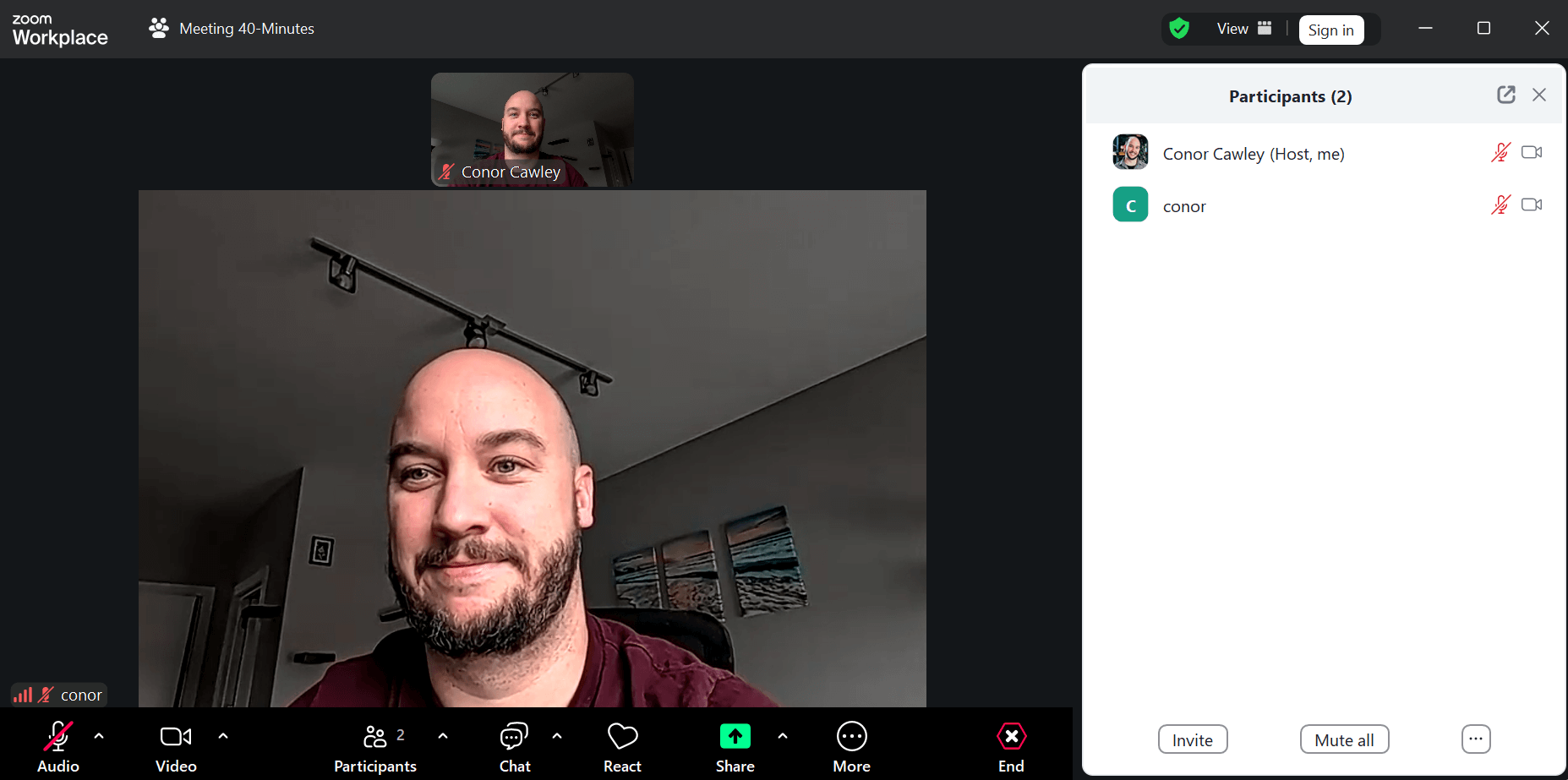
Yes, Zoom does offer a free forever option called the Basic plan, which allows up to 100 participants and 40 minutes of meeting time per call.
As you can imagine, though, the feature offerings are quite limited compared to the paid versions, which means it isn’t ideal for businesses that are looking for a robust tool to conduct a lot of meetings for their larger teams. When we tested Zoom, the time limit alone proved to be a deal-breaking issue, with our team needing to use it for more than 40 minutes on most occasions.
Here’s a breakdown of what is available with the free plan vs the paid plans with Zoom Workplace.
Features included in Zoom’s free plan:
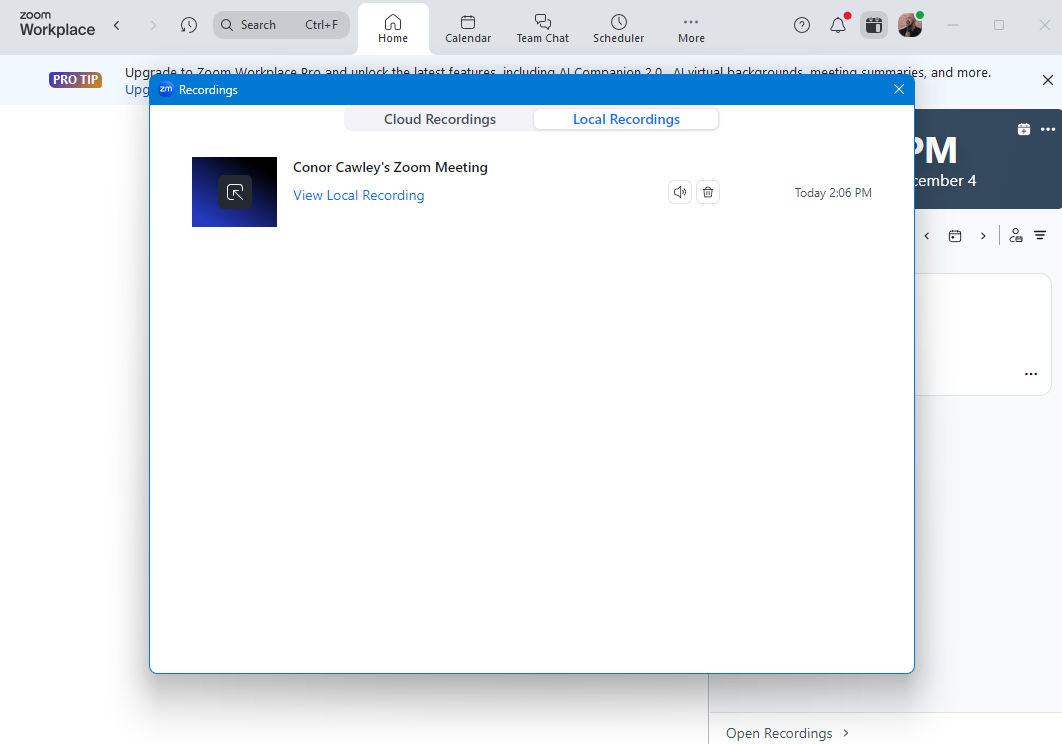
- Local recordings
- Automated meeting captions
- Team Chat
- Whiteboards
- Zoom Mail
- Calendar
- Virtual backgrounds
- Breakout rooms
- Multi-share
- Host controls
Features not included in Zoom’s free plan:
- Cloud stored recordings
- AI Companion
- Translated captions
- Zoom Scheduler
- Telephone dial-in
- Polling
- Streaming
- Reporting
- Alternate host
- Visitor management
The Zoom home dashboard provided us with clear guidance on what to do and how to start meetings. Source: Tech.co testing
How Much Does Zoom Workplace Cost?
The video conferencing platform from Zoom is called Zoom Meeting, but you can’t just buy that on its own anymore. The service is now bundled with other Zoom services, including Team Chat, and is known as Zoom Workplace.
Zoom Workplace comes in three different pricing plans. There’s the Pro plan ($13.33 per user, per month), the Business plan ($18.33 per user, per month), and the Enterprise plan (custom pricing).
On top of that, Zoom offers pricing plans that can bundle the Zoom Workplace platform with the VoIP service from Zoom, called Zoom Phone. The Pro Plus plan costs $18.33 per user, per month and the Business Plus plan costs $22.49 per user, per month.
For larger businesses that need more than 250 users, there’s also the Zoom Workplace Enterprise plan, but it offers no public pricing, so you’ll have to contact the sales team to learn more.
Friendly reminder, Zoom pricing, like other video conferencing tools, uses a per-user model when it comes to cost. This means that, depending on how many users you want, you’ll have to pay more. If you have a team of two, for example, you’ll pay $26.66 per month for the Pro plan, or $36.66 per month for the Business plan.
To find out what each pricing option has to offer, keep scrolling for an in-depth look at each plan.
The Zoom Meetings interface is simple, especially for free users, so our team was able to easily engage with meetings. Source: Tech.co testing
Zoom Workplace Basic – Free
This is the free plan we talked about above. You’re likely familiar with the Basic plan, as it’s the free plan offered to everyone and was the most popular option for those during the pandemic.
Our research found it to be the best free conference call service on the market, too, even beating massive names like RingCentral and Google Meet to the punch. This is largely due to the fact that Zoom is incredibly easy to use, while still offering robust business-facing offers.
Zoom Workplace Basic offers users the ability to host unlimited meetings for up to 100 participants. All meetings are capped at 40 minutes, however, which we found to be a dealbreaker for our business, given that is simply not enough time to get much done.
Zoom Workplace Basic also offers a limited support option in the form of a help center, so we weren’t able to get in touch with an actual person when we had an issue. There’s also a Team Chat function for collaboration and file sharing, as well as three editable whiteboards and a little bit of local storage so you can keep your work for next time.
Despite being free, this plan still gave us access to most Zoom features, including virtual backgrounds and breakout rooms, the latter of which are key tools for running great team workshops.
The Zoom Whiteboard tool made it easy for our team to collaborate in real time. Source: Tech.co testing
Zoom Workplace Pro – $13.33 per user, per month
While the Zoom Workplace Basic plan is decidedly robust for a free plan, it does have some notable limitations, like time caps and limited support options. With Zoom Workplace Pro, you’ll be able to get a little more flexibility for your team for only $13.33 per license, per month.
Zoom Workplace Pro comes with all the features listed above while allowing for 100 meeting participants and up to 99 licenses. You’ll also essentially get rid of the meeting cap, moving it to a full 30 hours, which we found was far more than enough to handle our work meetings. For those longer meetings, we were able to take advantage of the 10GB of cloud storage per license for storing meeting recordings.
Additionally, we had access to live chat support options with this plan, so we were able to get help from an actual Zoom representative to solve our problem quickly and effectively.
Zoom Workplace Pro adds some features that could be beneficial to your business as well, including analytical reporting and social media streaming to Facebook Live and YouTube. You’ll even unlock interoperability with Skype for Business, in the event that your team is transitioning from another platform.
Perhaps most importantly, though, this plan unlocks the AI Companion from Zoom, the generative AI tool available at no extra cost. This feature was able to summarize information, generate messages, take meeting notes, and perform a wide range of other tasks to help our team communicate more efficiently.
Zoom Workplace Pro pricing is right in line with the industry, with other options like RingCentral Ex starting at $20 per user, per month for its Core plan. For this outlay, you’ll unlock up to 100 video participants per call, unlimited audio conferencing, and whiteboards and annotations.
Google Meet ($3.50 per user, per month) and Microsoft Teams ($4 per user, per month), on the other hand, are notably more affordable, but you’ll want to be sure that you’re up for all the additional bloat that comes with those platforms.
Zoom Workplace Business – $18.33 per user, per month
If you’re hoping to find a video conferencing plan that caters to medium and large-sized businesses, Zoom Workplace Business has got you covered. This plan offers more features, more participants, and more licenses, all at the low cost of $18.33 per license, per month, billed annually.
Zoom Workplace Business comes with all the features we’ve already mentioned while allowing for up to 300 participants and up to 250 licenses. Naturally, you’re still without the meeting time cap, and you’ll get live chat support, as well as an added phone support option and a service ticket tool for even more comprehensive customer service.
As we expected, this plan came with more business-focused features when you shell out the extra money for the Zoom Workplace Business plan, allowing our team access to single sign-on, an admin portal, and company branding features.
It also expands on features that Pro offers: For example, Pro offers three editable whiteboards, but Business removes the cap entirely, allowing our team to access unlimited whiteboards. The extra capability makes this a great plan for our remote team, in which team-building workshops must function just as well on a screen as in-person.
Zoom Workplace Enterprise – Custom quote
Globally renowned companies need enterprise-level video conferencing solutions, and that’s where Zoom Workplace Enterprise comes in. There’s no public pricing available for this plan, but it does require you to sign up for at least 250 licenses.
As you can imagine, Zoom Workplace Enterprise comes with all the features listed above, while allowing for 1000 meeting participants and unlimited cloud storage. Plus, you get access to the same live chat and phone support from the Business and Business Plus plans, so you’ll have help on hand whenever you need it.
Zoom Workplace Enterprise is the second Zoom plan with Zoom Phone included, but it’s a bit more advanced than what you get on the Business Plus plan. Features include metered outbound calls, call queues & IVR, and a Common Area Phone.
Outside of the increased meeting participant limit, Zoom Workplace Enterprise also offers some other enticing features for enterprise-level organizations. For one, you’ll get a dedicated Customer Success Manager to help you improve your communication across your business. Additionally, you’ll get advanced reporting tools in the form of executive business reviews to truly understand how Zoom improves your business.
Zoom Pricing for Education, Healthcare, and More
In addition to its standard Workplace package, Zoom also offers specialized plans for different industries. In this section, I’ll dig into them a bit more.
Zoom for education
Educational institutions have specific Zoom plans that offer significant discounts, as well as bespoke features depending on the tier that you opt for. Below, you’ll find a pricing breakdown:
- School and Campus – $10 per user, per month
- School and Campus Plus – $15 per user, per month
- Enterprise – custom pricing
Zoom for healthcare
Similarly, Zoom has a few healthcare-oriented plans that are built to meet HIPAA compliance standards. Find out more below:
- Pro – $13.33 per user, per month
- Business, Business Plus & Enterprise – custom pricing
Zoom for developers
Zoom offers one specific platform for developers, the Zoom Build Platform, which is designed to help tech teams tailor Zoom to fit precisely into their project’s specific needs. It works on a prepaid card basis with “credits.” You’ll find pricing information below:
- $100 per 100 credits, per month
- $450 per 500 credits, per month
How Do I Switch to Zoom?
If you’re unhappy with your current video conferencing platform, the process for getting started with Zoom is pretty straightforward. Switching is the easy part, but it’s important to consider some questions before making the transition from another video conferencing platform to Zoom.
For starters, understanding how much Zoom costs is vital. Compared to competitors, it’s a relatively conservative price, with Zoom landing right in the middle of the $10-15 range for the majority of other video conferencing tools at $13.33 per month.
If you’re looking for a full-on business suite, though, Zoom isn’t going to cut it. You’ll likely do better with Google Meet or Microsoft Teams in that case, which come with vast functionality and much lower prices, starting at $6 per month.
As far as how good Zoom is to the best video conferencing tools, our research found that GoTo Meeting is the best solution, with excellent audio and video quality and plenty of features. Still, Zoom is generally more helpful for beginners, given the easy-to-use interface and helpful customer support.
How Much Does Zoom Rooms Cost?
Zoom Rooms costs $41.58 per room, per month. As the specifically business-facing version of the Zoom video chat function, you’ll get 720p HD video and audio quality, 1,000 meeting participants, and 10,000 webinar viewers, and it allows you to join, book, and schedule meetings with a single click.
You’ll be able to integrate meetings with Google Calendar and Microsoft Outlook, and meetings can be recorded and transcribed in real-time. You can even use the whiteboard and annotation features, as long as you have a touch-enabled display.
Zoom Rooms is also included in the Zoom Workspace Enterprise plan (custom pricing).
There’s also an available add-on, Conference Room Connector, which costs $49 per month. It will enable any standards-based SIP/H.323 video conferencing endpoint, meaning that you can connect via Zoom Rooms on any eligible hardware.
Does Zoom Rooms offer a free trial?
If you aren’t sure about whether or not these Zoom pricing plans are the right fit for your business, Zoom Rooms does come with a 30-day free trial, which gives you access to all the features listed above, at no charge to your business.
How Much Does Zoom Phone Cost?
Zoom Phone has three pricing plans: US & CA Metered ($10 per user, per month), US & CA Unlimited ($15 per user, per month), and Pro Global Select Unlimited ($20 per user, per month) if you opt to buy the VoIP system as a standalone product.
Zoom Phone offers you the ability to consistently monitor call quality and manage user accounts with a centralized management system, as well as integrate with popular software, including Salesforce, Microsoft Office 365, and Google’s G-Suite.
Zoom Phone has a simple interface that’s easy to get started on, especially if you’re already familiar with its video conferencing software. Source: Tech.co user testing
In our VoIP research, Zoom Phone scored quite highly overall in our testing of the best VoIP service providers. In fact, given the low price of plans and the robust nature of the service, our research found that Zoom Phone is the best value option across the VoIP industry.
The best part of the Zoom Phone pricing plan breakup is that each plan still offers all the features you’ll find with the others. This means, no matter what you pay, you’ll get industry-leading HD call quality, voicemail with transcription, and access to native mobile apps for Android and iOS, among other things. The only tangible difference between each plan is where and how often you’ll be able to call.
If you’re interested in getting started with Zoom Phone today, check out our handy comparison tool to get a Zoom VoIP quote right now, as well as custom quotes from top competitors. Alternatively, check out our full guide to VoIP costs and pricing.
| Plan | Price | Users | Unlimited calls in US | Video conferencing | SMS/chat | 24/7 support | Inclusive inbound calling | Inclusive outbound calling | Domestic online fax | |
|---|---|---|---|---|---|---|---|---|---|---|
| 1-99 | 1-99 | 1-99 | 1-250 | |||||||
| | | | | |||||||
| Requires Zoom Meetings | Requires Zoom Meetings | Requires Zoom Meetings | Requires Zoom Meetings | |||||||
| | | | | |||||||
| Phone + chat | Phone + chat | Phone + chat | Phone + chat | |||||||
| Unlimited domestic minutes | Unlimited domestic minutes | Unlimited domestic minutes to 40+ countries | Unlimited domestic minutes to 40+ countries | |||||||
| | | | | |||||||
| | 50 pages | 50 pages | Unlimited |
You can also buy Zoom Phone as a bolt-on with Zoom Workplace. To find out more, read the section below.
Zoom Workplace Pro Plus – $18.33 per user, per month
If you want access to Zoom Workplace and Zoom Phone, you can bundle the two products together in the Zoom Workplace Pro Plus plan, which costs $18.33 per user, per month. This plan allows for up to 99 users and gives you access to both services in a single platform.
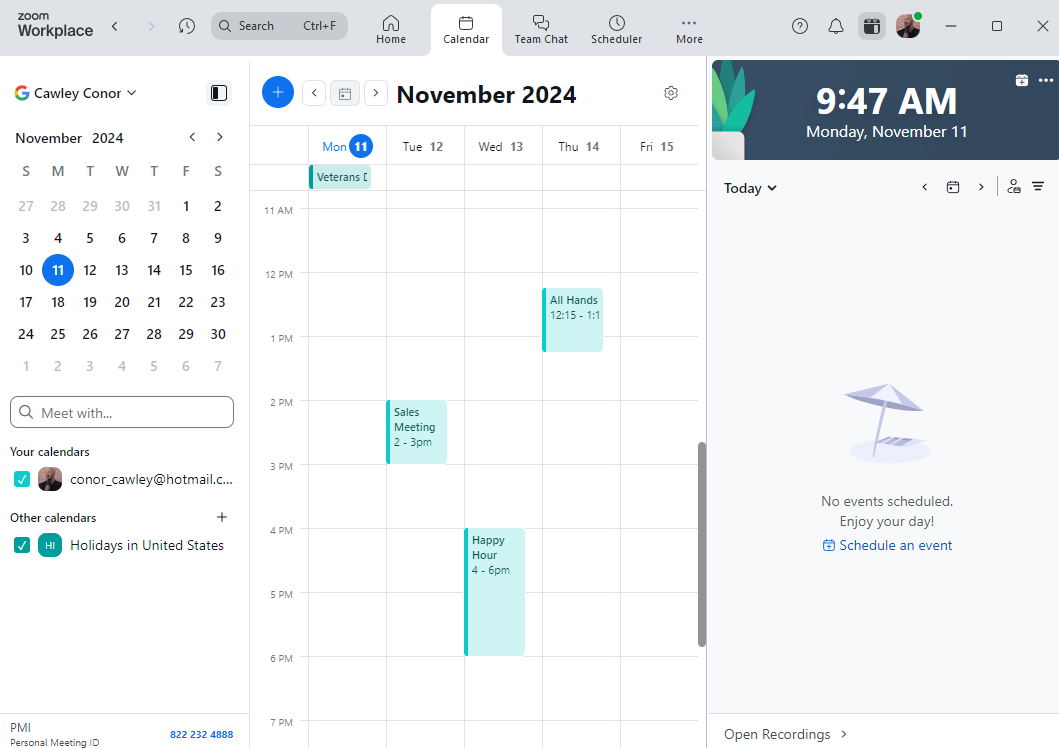
The Zoom Calendar integrated with our Google calendar, which made setting up meetings easier for our team. Source: Tech.co testing
Zoom Workplace Business Plus – $22.49 per user, per month
The Business plan also allows you to bundle the service with Zoom Phone in the Zoom Workplace Business Plus plan, which costs $22.49 per user, per month. You’ll be able to use this plan for between 10 and 250 users and have access to both the video conferencing and VoIP service in one platform.
The Team Chat functionality is built right into the Zoom Meeting platform, so we were able to communicate with our team via video or text. Source: Tech.co testing
How Much Does Zoom Webinars Cost?
Zoom Webinars pricing starts at $66.67 per month when you opt for 300 attendees and the starter plan, known as Webinars. This price increases incrementally depending on how many attendees you opt for and which plan.
There are two other webinar plans — Webinars Plus (starting at $82.50 per month for 100 attendees) and Events (starting at $124.17 per month for 100 attendees).
Please note that Zoom Webinars requires a Zoom Workplace Pro subscription.
If you find yourself using your Zoom account for all-hands meetings, employee onboarding, product announcements, or other large virtual events more often than actual video calls, Zoom Webinars might be for you.
This product is specifically catered to webinars so that you can enjoy specific features designed to make these larger events easier and more engaging. For instance, you’ll be able to host more than 10,000 participants (although you will have to contact sales for pricing, in this scenario), promote engagement with chat, reactions, polls, and Q&A, track event engagement with detailed analytics, and more.
Zoom Video Webinars is also a helpful tool for management, as it provides analytic reporting tools and event assistance to make sure you run the best webinar every single time. Zoom even offers online event consultations, so you can improve throughout your webinar journey.
Zoom Webinar license pricing breakdown
Zoom Webinars has three pricing tiers and different costs depending on how many attendees you opt for. In truth, it’s quite a complicated business, so I’ve broken it down below. Please note that prices given are on an annual basis.
Webinars
- 300 attendees: $66.67 per month
- 500 attendees: $83.33 per month
- 1,000 attendees: $283.33 per month
- 3,000 attendees: $825 per month
- 5,000 attendees: $2,075 per month
- 10,000+ attendees: custom pricing
Webinars Plus
- 100 attendees: $82.50 per month
- 500 attendees: $290.83 per month
- 1,000 attendees: $565.83 per month
- 3,000 attendees: $1,665.83 per month
- 3,000+ attendees: custom pricing
Events
- 100 attendees: $124.17 per month
- 500 attendees: $415.83 per month
- 1,000 attendees: $790.83 per month
- 3,000 attendees: $2,207.50 per month
- 3,000+ attendees: custom pricing
On both the Webinars Plus and Events plans, you can also opt to pay on a per-attendee basis. See the pricing page for a full breakdown.
Does Zoom Have Any Hidden Fees?
Zoom doesn’t have any hidden fees, but it does have optional add-ons that incur extra costs. For example, Zoom Phone users can purchase additional deskphones or headsets with any plan, such as the Poly Edge E220 for $131.51.
Zoom Workplace users, meanwhile, have several available bonuses at their disposal. For example, you can $12 per month for a custom AI Companion, a bespoke AI agent that can be tailored to meet your specific business needs.
Alternatively, you can pay a monthly fee for higher limits across a number of areas. For $50 per month, you can increase your meeting capacity to 5,000, while you can $10 per month for extra cloud storage.
Does Zoom offer any discounts?
Yes, Zoom does offer discounts in certain scenarios. For instance, eligible nonprofits can get select products for 50%. Otherwise, the company itself sometimes offers promotional discounts on various products, usually for a limited time.
What’s New With Zoom?
Right across its suite of products, Zoom is very forthcoming with its new releases and feature updates. In this section, I’ll break down some of the biggest recent innovations.
Zoom Workplace
In November, Zoom unveiled some new features for its Meetings users. Among them, users can now capture key takeaways and keep up with the conversation without the need for manual note-taking.
Furthermore, an AI Companion will now provide a live summary of your meeting discussion points and actions in real-time, which is a super helpful way of organizing your notes and next steps into coherent and actionable information.
Zoom Phone users, meanwhile, now have the ability to manage their call queues from the Workplace mobile app. This is really handy in case you ever need to step away from your desk, ensuring that you can keep an eye on call statistics in real-time, check the availability of your team members, or adjust call participation with a tap.
Zoom Webinars & Events
As of October, Webinars users can now get even better insight into their events with clearer, unified single and recurring session analytics. Through the deployment of new standardized event definitions and visual charts, event organizers get a deeper insight into performance.
The platform has also rolled out functionality to give webinar attendees context when required, reducing unnecessary interruptions for speakers. Late arrivals, for instance, can quickly get caught up with hero prompts. This is a really neat way of making sure your webinars stay on track.
Added to this, attendees can access an AI-generated catch-up summary of the event, courtesy of AI Companion. Hosts will receive an editable AI-generated summary that they can choose to include in any future correspondence after the event, should they so wish.
Are There Any Alternatives to Zoom?
While we believe that Zoom is one of the best web conferencing solutions on the market today, especially for beginners, that doesn’t mean it’s the only one. And considering it’s starting price of $13.33 per user, per month is well above the industry average, we wouldn’t blame you for looking into some Zoom alternatives.
For one, options like Google Meet ($6 per user, per month) and Microsoft Teams ($4 per user, per month) are a literal fraction of the price, all while providing more robust collaboration and broader business functionality.
If you aren’t looking for all those bells and whistles, RingCentral is more affordable at only $10 per user, per month, and like Zoom, it’s a dedicated video conferencing app and not a whole suite of business tools.
Still, the higher price tag for Zoom comes with arguably the most intuitive interface in our research and a massive library of third-party integrations that will allow you to add video conferencing functionality to pretty much any software. All that to say, Zoom may be a tad more expensive, but there is a reason.
Check out the table below to see how Zoom compares to other team communication platforms on the market today.
| Starting price The lowest starting price for a paid plan. The lowest price available for your business will depend on your needs. | Free plan | Best for | Maximum participants | Pros | Cons | ||
|---|---|---|---|---|---|---|---|
| | | | | | |||
| Beginners | Security | Google Workspace users | Microsoft 365 users | Team messaging | |||
| 300 | 200 | 1,000 | 300 | 50 | |||
|
|
|
|
| |||
|
|
|
|
|
What to Consider Before Using Zoom
Now that you understand exactly how much Zoom will cost your business, it’s time to focus on some of the other aspects of the video conferencing software that you’ll want to consider before you commit to a subscription.
Below, we’ll outline some specifics, including who can benefit from Zoom, how the platform stacks up on security, and how to get started with the video conferencing tool today.
The Whiteboarding tool is built right into the Zoom platform, which meant we could easily collaborate with our team during testing. Source: Tech.co testing
Do I really need to pay for Zoom?
Not everyone needs to pay for Zoom. In this instance, the businesses that benefit the most from Zoom’s paid offerings are larger companies with lots of meetings.
In most cases, smaller businesses with few meetings can get by with the Zoom Basic plan, which is free, and you won’t notice a big difference. However, if you’re consistently on calls, trying to manage multiple teams, and require a bit more control over your video conferencing, paying a little bit per month could make a big difference for you, enabling more effective video meetings.
The main reason you would pay for Zoom is to eliminate meeting limits, add sharing features for social channels, and improve your reporting capabilities (if you even need them).
How secure is Zoom?
You may have heard that Zoom security isn’t very good. After all, during the height of the pandemic, Zoom was experiencing some serious problems due to the sudden influx of users. Breached meetings, stolen data, and “Zoom-bombing” became all too common, resulting in some serious consequences.
Fortunately, those days are mostly behind them. Zoom has since established end-to-end encryption as a standard for all users, including the free ones, making it one of the more secure web conferencing platforms on the market today. Additionally, the company has generally owned its previous mistakes and been transparent about efforts to secure users’ data. Simply put, don’t let old news ruin a great video conferencing platform for you.
How to get started with Zoom
Perhaps the most important point to understand about Zoom setup, particularly compared to other popular options like Google Meet, is that you will be required to download it before use. Whether it be the mobile app or the desktop platform, you’ll need to download Zoom ahead of time if you want to take part in a meeting.
Once you’ve done that, though, conference calls should be smooth sailing, as Zoom is famous for its intuitive interface and general ease of use. To simply set up a meeting, all you have to do is create an account, launch a meeting, and invite guests, either by sending them a link or relaying a meeting code. For security purposes, you’ll have to allow guests in from the waiting room, and then you’ll be ready to go.
If you feel like one or more of these Zoom products is going to be a good fit for your business, that’s great news! We’d be happy to help you get set up with a video conferencing solution, as we’ve done with thousands of businesses in the past. Simply use our web conferencing price comparison form, and you’ll be on your way to better communication for your team.
About Our Research
Some websites just throw aggregated information in an article and hope that readers don’t need any more data to make the right decision. At Tech.co, though, we know that knowledge is power, which is why we’ve dedicated hours of our time to do in-depth research on business software.
For web conferencing platforms like Zoom, we took a lot of criteria into consideration when it came to rating and ranking providers, including features, pricing, ease of use, third-party integrations, and help and support options.
If you want to learn more about how we evaluate business software, check out our research guide to peak behind the curtain of our process.
Verdict: Is Zoom Worth the Cost?
If you’ve been comfortable with taking advantage of the free Zoom plan for a while now, the thought of paying for it might seem a bit foolish. Even with Zoom pricing being competitive, moving on from a free plan can be daunting.
However, the reality – particularly for businesses looking to get ahead – is that Zoom’s wide range of paid options can truly improve the productivity and efficiency of your company. From advanced features to improved reporting, Zoom’s paid offerings are designed to make business communication easy and reliable across the board.
If you aren’t feeling it, though, there are plenty of Zoom alternatives to choose from.
If you click on, sign up to a service through, or make a purchase through the links on our site, or use our quotes tool to receive custom pricing for your business needs, we may earn a referral fee from the supplier(s) of the technology you’re interested in. This helps Tech.co to provide free information and reviews, and carries no additional cost to you. Most importantly, it doesn’t affect our editorial impartiality. Ratings and rankings on Tech.co cannot be bought. Our reviews are based on objective research analysis. Rare exceptions to this will be marked clearly as a ‘sponsored’ table column, or explained by a full advertising disclosure on the page, in place of this one. Click to return to top of page