


Understand which metrics define your goals, check them regularly, and adjust when necessary to confidently measure marketing performance.
To get started, outline key performance indicators (KPIs) and goals for your campaign, then collect and filter data using customer relationship management (CRM) software, such as monday CRM.
Key Takeaways
- Start by setting clear, measurable goals and linking them to KPIs. This gives your team a reliable way to know whether a campaign is delivering results.
- Monitor four core metric types: awareness, engagement, conversion, and revenue. Choosing the right ones matters; with email marketing alone, B2B brands see a 2.4% conversion rate and B2C brands a 2.8% rate.
- Review metrics at least once a week. This gives teams enough time to stay agile and adjust strategies before revenue is affected.
- Implement an end-to-end marketing solution like monday CRM to centralize campaign data, track data on real-time dashboards, and execute multi-step workflows and surfacing insights with AI agents.
- Before starting a new campaign, audit previous ones. Identifying what worked and what didn’t helps eliminate wasted spend and maximize ROI from the outset.
How Do You Measure Marketing Performance?
Measure marketing performance by identifying key success metrics, using a CRM to monitor them, and adjusting your strategy as the data dictates.
1. Outline clear campaign goals and KPIs
Define clear, measurable goals linked directly to KPIs before launching any marketing campaign.
Review previous marketing campaigns to see what worked and what didn’t, build on successful campaigns, refine ones that didn’t, improving your overall ROI.
2. Choose your metrics
Your chosen metrics should be directly related to your campaign goals and KPIs. Examples include:
- Awareness metrics: The extent to which people are seeing your brand. Includes impressions, reach, and brand mentions.
- Engagement metrics: How audiences interact with your content, including likes, shares, comments, email opens, and click-through rates.
- Conversion metrics: The actions you want users to take once they’ve seen your campaign. Includes cost per acquisition (CPA), which tells you whether your ad spend is efficient.
- Revenue metrics: Connects campaigns to revenue and measures financial impact. Includes ROI, customer lifetime value (CLV), and return on ad spend (ROAS).
3. Choose your channels
The channels you use to reach your audience are the main drivers of your campaign, and your chosen metrics will directly map to them.
Emails
Email marketing generates an average conversion rate of 2.4% for B2B brands and 2.8% for B2C brands. Conversion rates, open rates, and click-through rates indicate how customers are responding to email campaigns.
monday CRM tracks email campaigns with a dedicated dashboard, and drafts emails with an AI email composer.
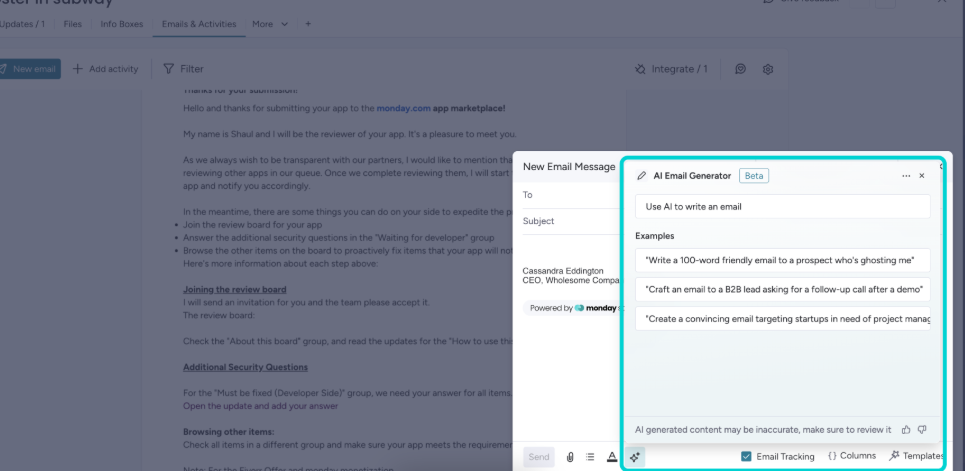
The monday CRM AI email composer helpfully suggests prompts for users who aren’t sure which tone to adopt. Source: monday.com
Social media posts
63% of consumers prefer to find out information about brands and products on mobile devices, making social media a valuable place for your campaigns to live.
Track engagement metrics such as likes, shares, and comments, to see how visible your brand is and how users respond to it.
Blogs
Monitor search engine ranking, traffic, AI visibility, and conversion rates, if applicable.
Phone calls
Track call volume, caller source, call duration, and answer rate when using this channel.
Ads
Measure ROAS and CPA when evaluating the success of out-of-home campaigns and television campaigns.
4. Implement tracking software
CRM platforms such as monday CRM centralize campaign data and automate repetitive tracking tasks, like lead scoring.
Describe your main objectives, metrics, and channels to monday CRM, and monday sidekick builds a custom dashboard in seconds.
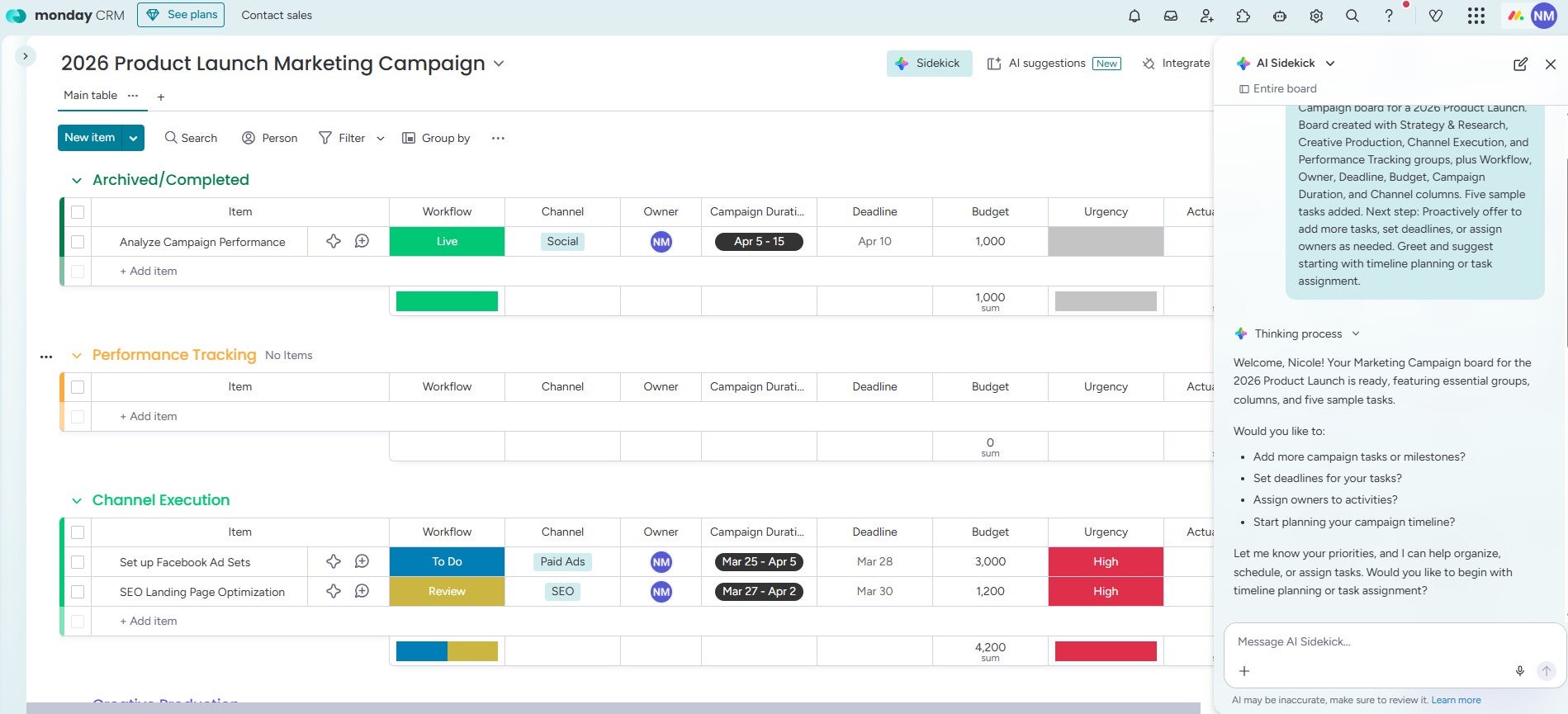
I asked monday sidekick to generate a Marketing Campaign board for a 2026 Product Launch. Source: Tech.co
Other popular performance tracking options include Google Analytics (GA), which helps marketers track website and app traffic.
GA uses short text codes known as Urchin Tracking Modules (UTMs), for example, “utm_source,” to track marketing performance.
Ensure that your chosen tools sync data across all relevant platforms to avoid data silos.
5. Track progress and adjust strategy as needed
Routinely monitor campaign metrics to quickly identify bottlenecks and conserve revenue.
Checking your numbers regularly also helps you spot trends, such as a seasonal uplift in open rate or an engagement dip after a product launch.
Your metrics provide a holistic overview of your overall campaign performance, which can inform future campaigns.
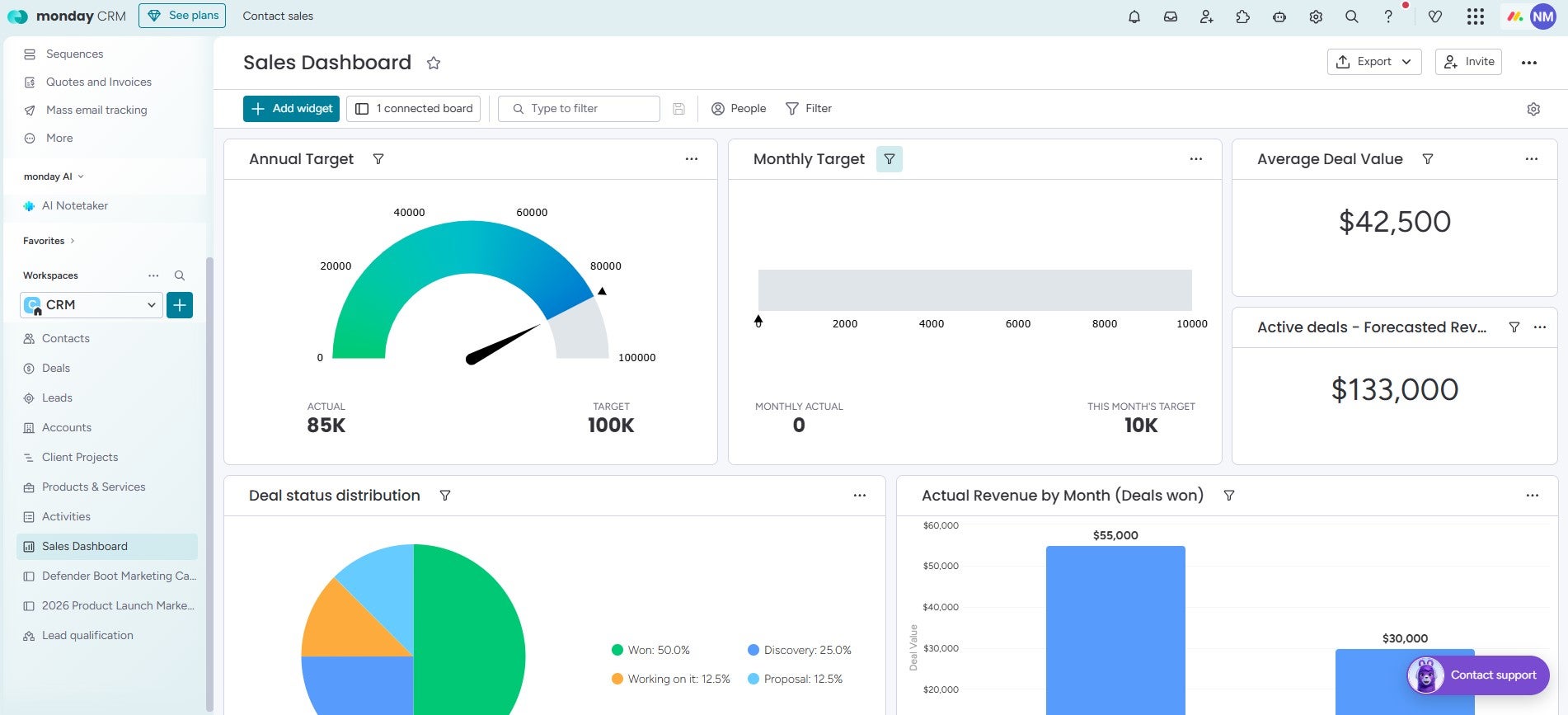
Dashboards provide in-depth analytics to help you understand which elements of your campaign are bringing in the most revenue. Source: Tech.co
Try monday CRM
Why is Campaign Tracking Important for Marketers?
Tracking marketing campaigns ensures optimal budget allocation, data-driven decision-making, and real-time strategic agility.
Improved ROI
Tracking reveals which campaign elements generate the most revenue, helping teams to reduce acquisition costs and increase revenue by shifting resources to the highest performing strategies.
Better decision making
Data-based decisions lead to effective and lucrative campaigns.
Strategic agility
Live data enables your team to be agile and adaptable in real time. If something isn’t working, this data keeps you in the loop, so you can adjust as necessary.
Hyper-personalization
Detailed audience insights mean that you can hyper-personalize content.
Use the monday Lead Agent to source, add, and nurture prospects based on your ideal customer profile.
How to Turn Campaign Data into Smarter Marketing
Track and monitor data and key metrics, such as revenue and engagement, to drive better decision making and performance.
To effectively track your marketing campaigns, establish goals and KPIs, choose metrics and channels to track, deploy software, and adjust your strategy as needed.
monday CRM provides a modern campaign management approach by using monday agents like the Lead Agent to source and enrich prospects, monday sidekick to surface insights and recommend next steps, and automations to streamline repetitive tasks.
A positive percentage means your campaign generated more than it cost. Tracking this over time helps identify which campaigns and channels consistently deliver the strongest returns.
Most teams find that monitoring three to five core metrics across awareness, engagement, conversion, and revenue gives a clear picture. As campaigns grow in complexity, that number can expand, provided each metric connects back to a defined KPI.
Tools like monday sidekick can help by surfacing updates and flagging changes between reviews, so nothing gets missed.