IBM Ordered to Pay Back Remote Working Expenses, but Staff Only Get 25%
IBM has been ordered to pay staff back remote working expenses from the pandemic, but the state is keeping most of the dough.
Written by
Published on October 13, 2023
A case involving several thousand IBM employees has come to a head this week, when the First District Court of Appeal in San Francisco ruled that the company must reimburse its remote staff for their working from home (WFH) expenses.
While hybrid and home working models have boomed since the pandemic, the number of companies offering remote work has dwindled in 2023, with many scaling back their WFH offering.
IBM initially stated it wasn’t going to compensate employees as it was just following the state’s stay-at-home orders. This ruling, however, means the tech company is liable for 15 months of penalties in the form of back payments to remote working staff.
Californian Court Rejects IBM’s Appeal
When California Gov. Gavin Newsom issued a stay-at-home order in March 2020, most companies (like IBM) pivoted to a remote working model.
As workforces became familiar with this new way of working, the change sparked a period of adjustment. This notably included the need to purchase equipment that allowed everyone to do their jobs just as before, so things like headsets for video calls and office chairs instead of just slumping on living room sofas with a laptop.
IBM were amongst many employers who refused to compensate workers for these expenses, arguing that they were just following the state’s orders and shouldn’t have to pay. Since then, the company has also rolled back its remote working policy, with IBM issuing a return to office mandate back in September.
However, the state appeals court said the issue wasn’t over why there was an order to work from home, but whether the employees’ additional expenses were the result of IBM’s orders. The court then ruled that California law protects workers from “bearing the costs of business expenses that are incurred by workers doing their jobs in service of an employer.”
In a 3-0 ruling Justice Mark Simons wrote that despite following Newsom’s order to shut the office, the work was “performed for the benefit of IBM”. This ruling became final on Wednesday, when the state’s high court rejected IBM’s appeal.
IBM Footing the Bill – but State Keeping 75% of It
Despite the workers joining forces to sue the company for violation of labor laws, this may feel more like a moral victory than anything else. The employee compensation won’t be dollar for dollar, but instead they’ll receive 25% of the financial penalties, with the rest going to the state.
Lawyers working for the IBM employees have estimated that around 3,000 of them could receive as much as $100 every two weeks – broken into $25 for an employee and $75 for the state. This is likely to last the length of time spent working from home, which is 15 months.
Other Employer Suits Still Pending
Simons went on to state that the “work-from-home expenses were inherent to IBM’s business” and “allocates the risk of unexpected expenses to the employer.”
While IBM are still yet to comment on the ruling, it’s known that other suits of a similar nature are pending. However, according to Jason Harrow, a lawyer for the IBM employees, it’s clear that in California “big companies can’t force employees to pay for work expenses and then fail to reimburse them”.
Ellis Di Cataldo (MA) has over 9 years experience writing about, and for, some of the world’s biggest tech companies. She's been the lead writer across digital campaigns, always-on content and worldwide product launches, for global brands including Sony, Electrolux, Byrd, The Open University and Barclaycard. Her particular areas of interest are business trends, startup stories and product news.
How To Use Google’s New AI Image Generator in Search
Google has begun rolling out a new AI image generator feature that's integrated directly into Search. Here's how to use it.
Written by
Published on October 13, 2023
Never one to be left in the dust, Google has just begun testing an AI generation tool that can create images using a text prompt. Here’s how to use Google’s new AI image generation tool.
Set to rival Microsoft’s Bing Chat, the AI-powered Search Generative Experience (SGE) is currently only available to a small number of American users. Testers must have opted into the SGE program via Google Labs and be at least 18 years old, although that’s still no guarantee you’ll be amongst the lucky few able to experiment right now.
Still, the world of AI image generation has just opened up even more beyond tools like OpenAI’s DALL-E 3. Fortunately, it’s all pretty straight forward. Here’s everything you need to know about creating AI images direct in Google.
How To Get Started with Google AI Image Generation
If you’re one of the lucky few who’s got access to Google AI image generation, then getting started couldn’t be easier. Provided you’re already signed up for Google’s SGE testing program, as mentioned above, all you need to do is:
1. Open up a Google search and enter an image generation prompt
2. Wait a few seconds
3. Take a look at the four image options shared by the SGE
It’s that simple. If you want to edit the images further, select one of them then amend the description to add more detail.
Google has given the surreal example of a “photorealistic image of a capybara cooking breakfast in the forest” to illustrate how it will work. The example then goes on to show an edited description that changes specific details, like asking for the breakfast to become hash browns instead of bacon, or swapping the background trees to sky. Anyone familiar with entering ChatGPT prompts will be used to the idea, but even if you’re not, you should find the process easy enough.
Are There Any Restrictions on Google AI Image Generation?
Well, it wouldn’t be AI generation without a few restrictions.
The SGE features safeguarding measures that block banned content as outlined in the company’s generative AI policy. This includes anything that creates misinformation, promotes illegal activities, and generates sexually explicit content (if it’s not labelled educational or artistic).
You’ll also find that every AI-generated image will come out with a watermark and ‘metadata labelling’ tag. This is to show everyone that content was made by AI, hopefully deterring the spread of false information.
Along those same preventative lines, Google plans to give all its AI-generated content an ‘About This Image’ description. This will aim to supply context about what a user is looking at, so hopefully nobody can claim the AI-images or text are real.
What Else Should I Know About Google AI Image Generation?
Although not yet confirmed, it’s likely that Google’s AI-image generation will become available outside of Search. As in, you’ll see an option to create an AI picture within Google Images too. This could mean one of the image search results is replaced with a button leading to the generative functionality, which will then pop up in a sub-window.
As mentioned above, the feature is currently only available to American users in English. Nothing about an international release has yet been confirmed.
Keen to try and give it a go? You’ll have to sign up to the Search Labs waitlist first. Head over to Google Labs to get going.
Ellis Di Cataldo (MA) has over 9 years experience writing about, and for, some of the world’s biggest tech companies. She's been the lead writer across digital campaigns, always-on content and worldwide product launches, for global brands including Sony, Electrolux, Byrd, The Open University and Barclaycard. Her particular areas of interest are business trends, startup stories and product news.
Microsoft Finally Cleared to Buy Activision After UK Green Light
The $68.7bn deal is said to be a “game changer” by those who approved it.
Written by
Published on October 13, 2023
UK regulators have this week approved Microsoft’s $68.7 billion deal to acquire Activision Blizzard. Following Microsoft’s recent revamp of the deal, which will transfer cloud gaming rights for Activision Blizzard games over to Ubisoft, the Competition and Markets Authority (CMA) confirmed that it is good to go.
This is sure to be positive news for the tech giant who this week have been tussling with the IRSover a giant tax bill.
CMA Welcomes “More Choice” for Gamers
The CMA was initially concerned that the proposed deal would negatively impact cloud gaming competition, so blocked it back in April.
Microsoft appealed this decision but the whole process was paused when it began to restructure the deal instead. After addressing the CMA’s concerns and making the transfer of rights over to Ubisoft, the UK regulator has now confirmed it’s happy for the merger to go ahead.
“The CMA has decided to give Microsoft Corporation (Microsoft) consent to acquire Activision Blizzard, Inc. (Activision) (the Parties) excluding Activision’s cloud streaming rights outside of the European Economic Area (EEA) (the Merger) subject to the condition that the sale of Activision’s cloud streaming rights completes prior to completion of the Merger,” – the Competition and Market Authority’s statement
CEO of the CMA, Sarah Cardell, called the restructured deal a “gamechanger that will promote competition” in the cloud gaming market.
“With the sale of Activision’s cloud streaming rights to Ubisoft, we’ve made sure Microsoft can’t have a stranglehold over this important and rapidly developing market. As cloud gaming grows, this intervention will ensure people get more competitive prices, better services and more choice.” – Sarah Cardell, CEO of the CMA.
In an email to all Activision Blizzard employees, CEO Bobby Kotick shared the news and stated “We’re excited for our next chapter together with Microsoft and the endless possibilities it creates for you and for our players.”
Not Smooth Sailing for Microsoft
The somewhat controversial deal was originally announced back in January 2022, catching the eye – and scrutiny – of regulators across the world. In fact, EU regulators have only just approved it following 20 months of battles resulting in a restructure from Microsoft.
Closer to home, the Federal Trade Commission is waiting on its own appeal – due this December – of its failure for a preliminary injunction to block the Activision Blizzard acquisition. Without the injunction in place, Microsoft looks set to close on the deal ahead of its December deadline.
Microsoft Vice Chair and President, Brad Smith welcomed the CMA’s decision through a message on X (formerly Twitter) “We’re grateful for the CMA’s thorough review and decision today. We have now crossed the final regulatory hurdle to close this acquisition, which we believe will benefit players and the gaming industry worldwide.”
Gaming Industry’s Biggest-Ever Takeover
Not only does the deal confirm Microsoft’s status as a video game giant, it will no doubt be a blow to rival Sony who actively opposed the acquisition with concerns that popular games could become Xbox exclusives.
Meanwhile, Microsoft is hopeful the takeover will create a surge in demand for Xbox, allowing it to add more titles to the Xbox Game Pass streaming service – a subscription service that allows gamers to access titles from the cloud.
By joining forces with Activision, Microsoft will also now own a studio solely for the creation of mobile games. This is likely highlighting its intent to expand upon the success of titles such as Candy Crush.
The finalization of the acquisition is likely to go through by the end of today, Friday 13 October.
Ellis Di Cataldo (MA) has over 9 years experience writing about, and for, some of the world’s biggest tech companies. She's been the lead writer across digital campaigns, always-on content and worldwide product launches, for global brands including Sony, Electrolux, Byrd, The Open University and Barclaycard. Her particular areas of interest are business trends, startup stories and product news.
Why Your Instagram Settlement Payment Is Going to Be Late
Here's when you can expect to get paid from Instagram's $68.5 million settlement.
Written by
Published on October 13, 2023
If you applied for a slice of Instagram’s $68.5 million settlement, you’ll have to wait a little longer to receive your payout, as the date of the final approval hearing has been postponed.
The final hearing of the class-action biometric privacy settlement has been pushed back from October 11th to November 21st, with no official explanation given. However, if you’re one of the thousands of Illinois residents who applied to Instagram’s Settlement, here’s everything you need to know.
Instagram Class-Action Settlement Has Been Delayed by a Month
While the deadline for the Instagram settlement lawsuit passed at the end of September, claimants still have plenty of time to kill before they find out the case’s results.
According to a post on the Instagram Privacy Settlement website, the case’s final approval hearing has been pushed back by just over a month from October 11th to November 21st.
The approval hearing will determine whether the settlement is fair, whether it should be approved, and its results. This means that its postponement will delay the amount of time it’ll take for claimants to receive payment information and ultimately, their cash payout.
Instagram’s class action lawsuit — otherwise known as Parris v. Meta Platforms Inc — claims that the social media company Meta violated the Biometric Privacy Act (BIPA) in the state of Illinois, after collecting and logging the biometric data of its users.
While Meta has denied any wrongdoing, it agreed to pay a court settlement to Instagram users who were active on the platform between August 10, 2015, and August 16, 2023.
It’s uncertain how much users will receive from this claim, but experts have calculated individual payouts to be around $7. However, the amount you can expect to receive will also be influenced by legal fees, and how long you’ve been using the social media app.
When Will Instagram Users Receive Their Payout?
Originally, claimants were told to expect their payment by January 9th, 2024 — 90 days after the date of the original final hearing.
However, now that this date has been pushed back, it’s more likely Instagram users will be receiving payouts from February 19th onwards. It’s also possible that the final hearing will be postponed again, as the case’s website mentions it’s always possible for court proceedings to move to a different date or time without additional notice.
Ellis Di Cataldo (MA) has over 9 years experience writing about, and for, some of the world’s biggest tech companies. She's been the lead writer across digital campaigns, always-on content and worldwide product launches, for global brands including Sony, Electrolux, Byrd, The Open University and Barclaycard. Her particular areas of interest are business trends, startup stories and product news.
US Space Force Bans AI Tools Like ChatGPT Over Security Fears
The military branch has prohibited the technology over "data aggregation risks" - extending AI bans past the stratosphere.
Written by
Published on October 13, 2023
The US Space Force has temporarily banned its personnel from using certain generative artificial intelligence (AI) tools on government computers, due to concerns over the data security of ChatGPT and similar platforms.
As ChatGPT creator OpenAI comes under fire for its shady data collection practices, the Space Force is just the latest major organization to question its safety – with Apple, Samsung, and Verizon also banning its use among employees.
The Space Force was also quick to recognize AI’s strengths, however, and announced that “strategic pause” will come to an end as soon as they figure out how it can be used in a “responsible and strategic manner”.
AI Prohibition Goes Intergalactic
As the data collection practices of generative AI applications come under increasing scrutiny from the government and private organizations, the US Space Force has decided to stamp out their use altogether until they figure out how to use them safely.
This is according to a recently released memo that was sent to Space Force employees – known within the organization as ‘guardians’ – on September 29.
“A strategic pause on the use of Generative AI and Large Language Models within the U.S. Space Force has been implemented as we determine the best path forward to integrate these capabilities into Guardians’ roles and the USSF mission”, – Air Force spokesperson Tanya Downsworth
According to Lisa Costa, Space Force’s chief technology and innovation officer, the pause will only be temporary, and the military branch has created a generative AI task force with other Pentagon offices to decide how the technology can be used in a “responsible and strategic manner”.
Costa was also quick to point out AI benefits, explaining that despite these current security concerns, artificial intelligence “will undoubtedly revolutionize our workforce and enhance Guardian’s ability to operate at speed.”
The Space Force Isn’t the Only Organization Barring AI
While companies across the US have been quick to leverage AI to their advantage, a number of big names have banned its use outright until they figure out how to work with the technology securely.
Earlier this year, Apple banned OpenAI’s ChatGPT for all its workers, over concerns of the chatbot contributing to a potential data leak. Following this, South Korean tech manufacturer Samsung made a similar crackdown after an employee leaked confidential information on ChatGPT which resulted in a leak of a classified code.
But it’s not just organizations placing restrictions on generative AI. Several countries have decided to ban the AI tool ChatGPT flat out, including Russia, China, Iran, Cuba, and Italy.
From hallucinations and encoded biases to dubious data collection policies, it’s no surprise that powerful companies, military branches, and even governments are thinking twice before trusting the technology completely.
However, if the US Space Force’s account is anything to go by, once these concerns get ironed out generative AI will still take center stage in these organization’s strategies going forward.
Ellis Di Cataldo (MA) has over 9 years experience writing about, and for, some of the world’s biggest tech companies. She's been the lead writer across digital campaigns, always-on content and worldwide product launches, for global brands including Sony, Electrolux, Byrd, The Open University and Barclaycard. Her particular areas of interest are business trends, startup stories and product news.
Microsoft Owes the IRS $29 Billion, But It’s Refusing to Pay
Microsoft and the IRS's tussle marks the biggest corporate tax dispute in US history, with the tech giant fighting back.
Written by
Published on October 13, 2023
Microsoft currently owes the US Treasury $28.9 billion in back taxes, interest, and late payment fees, according to a recent notice from the Internal Revenue Service (IRS).
In what is on track to become the biggest corporate tax disputeon record, the case revolves around Microsoft’s use of ‘transfer pricing’ between 2004 and 2013 – a tax avoidance practice that other big tech companies like Amazon have also been found guilty of.
Microsoft has been fast to dispute these accusations, launching a formal appeal and claiming it would challenge the IRS in court if necessary. Here’s what we know so far.
IRS Demands Microsoft Coughs Up $28.9 in Back Taxes
Microsoft recently revealed the details of an ongoing tax audit by the IRS, which claims the software company owes the statutory body a total of $28.9 billion in unpaid taxes and fees.
According to Microsoft’s 8-K filing, these debts have been accrued over the period of 2004 to 2013 due to how the company chose to allocate its profits among countries and jurisdictions.
The practice, which is known formally as transfer pricing or ‘cost-sharing’, sees large corporations shift profits to international tax havens to avoid paying the US’s steeper corporate tax rates.
Throughout the years outlined in the filing, Microsoft had been moving billions of dollars in profits to jurisdictions with favorable tax rates, like Puerto Rico, Dublin, and Singapore. However, the company has since restructured its corporate structure to conform to increasingly strict US tax laws implimented during the Trump administration.
Microsoft is Appealing The IRS’s Demands
While Microsoft hasn’t hidden away from its history of cost-sharing – claiming that “many large multinationals” take part in the practice – the software firm flat-out disagrees with the IRS’s latest tax demand.
According to a recent Microsoft blog, the company has “always followed IRS rules” and while issues raised by the IRS are “relevant to the past” they do not reflect their current practices. It also said that $10 billion in taxes that the company has already paid have not been accounted for in the IRS’s proposed adjustments.
“We disagree with the proposed adjustments and will vigorously contest the NOPAs through the IRS’s administrative appeals office and, if necessary, judicial proceedings.” – Microsoft’s recent 8-K filing
For these reasons, Microsoft disagrees with the proposed adjustments and is planning to “work through these issues” through a formal appeal with the IRS. The company is even willing to escalate the matter in court if necessary, in a process that will likely take several years to resolve.
Big Tech’s Big Transfer Pricing Problem
Microsoft’s tussle with the IRS marks the biggest corporate tax avoidance dispute in US history. But the software retailer isn’t the only major company accused of shady transfer pricing practices.
In 2018, the global phone network Vodafone revealed that almost 40% of its profits from 2016 to 2017 were allocated to tax havens like Luxembourg, where the company was only required to pay a tax rate of 0.3%. Similarly, in 2019 Amazon was singled out by the IRS for setting the value of its IP artificially low after it was transferred to Luxembourg in 2005.
And the consequences of these frameworks extend beyond US shores. According to ActionAid International, tech companies’ exploitation of global tax loopholes cost developing nations around $2.8 billion in unpaid taxes in 2020 – with Facebook, Google, and Microsoft all found to contribute to the problem.
But while these tax policies are morally questionable, whether they’re illegal is another matter. US tax loopholes mean that massive companies can often avoid paying federal and global corporate tax without much repercussions, a benefit thatMicrosoft could be depending on.
Ellis Di Cataldo (MA) has over 9 years experience writing about, and for, some of the world’s biggest tech companies. She's been the lead writer across digital campaigns, always-on content and worldwide product launches, for global brands including Sony, Electrolux, Byrd, The Open University and Barclaycard. Her particular areas of interest are business trends, startup stories and product news.
Caesars Data Breach Saw Cyber Criminals Steal Over 41,000 People’s Data
Think the house always wins? Casino giant Caesars would beg to differ, after admitting the scale of its recent data breach.
Written by
Published on October 13, 2023
Casino giant Caesars has admitted that more than 41,000 of its patrons had their personal information stolen in a major September data breach that pre-dated that month’s blockbuster MGM cyber attack.
While the total number of victims is still be counted, Caesars has now said that 41,397 folks from the state of Maine had their details pilfered by the cybercrime gang responsible for the ransomware attack. A group called Scattered Spider has been judged responsible for the breach.
Shedding further light on the incident, the chain says that its loyalty scheme specifically was compromised and that the pilfered personal data includes the names, driver’s license and ID card details of customers from The Pine Tree State. However, it insists that financial and payment details were not accessed in the attack, even though it is now offering those affected two-year’s worth of cybersecurity and identity fraud insurance on the house
Caesars Still Counting Total Number of Breach Victims
Caesars made the admission in a recent filing with the Maine Attorney General’s office, where it says that the final number of breach victims is still to be determined.
However, in good news for anyone who visited Caesars from Maine last month, Caesars adds in an attached PDF sample letter sent out to affected residents that it had “taken steps to ensure that the stolen data is deleted by the unauthorized actor, although we cannot guarantee this result.”
This could be translated as Caesars quietly copping to paying out the ransom demand of the cybercrime gang behind the attack. According to CNBC, the casino chain negotiated the figure down to $15 million from an initial price of $30 million.
Caesars Allegedly Paid Demand Days Before MGM Breach
What’s interesting here is the timeframe Caesars allegedly paid out the ransom demand. It was apparently only a matter of days after the chain apparently paid up that the same ransomware gang, Scattered Spider (also known as UNC3944 or Roasted 0ktapus), attacked MGM in another major breach of Vegas heavyweights.
This highlight something that virtually all ransomware statistics confirm: companies should never pay ransom demands to cybercriminals, as it only encourages them to execute further attacks on similar targets.
Explaining exactly what happened in the breach, Caesars notes that it was the “victim of a social engineering attack on an outsourced IT support vendor that resulted in unauthorized access (on August 18, 2023) to Caesars’ network and the exfiltration of data (beginning on or about August 23, 2023).”
Scattered Spider Ransomware Hits “Hundreds” of Companies
The casino chain adds in its letter to affected Mainers that it is providing them with two years of identity theft protection through a third-party provider, IDX. The policy includes “credit and dark web monitoring to detect any misuse of your information” as well as coverage of up to $1 million should anyone fall victim to identity theft.
While Caesars and MGM are two high-profile victims claimed recently by Scattered Spider, the actual number of organizations affected by its latest ransomware campaign could number in the hundreds.
That’s according to Google-owned security firm Mandiant, the group has recently diversified its criminal endeavors to include ransomware attacks on a “wide range of industries including hospitality, retail, media and entertainment, and financial services.” No other major companies have so far been named, but the lesson from the Vegas strip seems to be clear: the house doesn’t win when it pays out ransomware demands.
Ellis Di Cataldo (MA) has over 9 years experience writing about, and for, some of the world’s biggest tech companies. She's been the lead writer across digital campaigns, always-on content and worldwide product launches, for global brands including Sony, Electrolux, Byrd, The Open University and Barclaycard. Her particular areas of interest are business trends, startup stories and product news.
How to Claim Your $30 from Crunchyroll $16 Million Settlement
Customers who have used the anime streaming service in the past three years are entitled to a payment.
Written by
Published on October 13, 2023
If you know what Crunchyroll is, then you’re clearly an avid anime fan, as the streaming service is considered to be the Netflix of all things relating to Japanese animation.
However, last year the Sony-owned platform was put under the microscope, after it was accused of violating user’s privacy rights, by sharing data with third parties.
As a result of these allegations, the company has now agreed to pay Crunchyroll customers around $30 each. Here’s how to get your share.
Why is Crunchyroll Paying its Customers?
In September 2022, legal action was taken against Sony and Crunchyroll, alleging that it had shared personal customer data with third parties including Facebook, Google, Adobe and others. . The case is Beltran, et al. v. Sony Pictures Entertainment, Inc. d/b/a Crunchyroll; Case No.: 1:22-cv-04858.
Sony/Crunchyroll has denied the allegations throughout the process, stating that it has not violated any law, and while the court has not sided with either party, the streaming service has agreed to a settlement payment.
As a result, around $16 million has been earmarked for payments, with each recipient expected to receive around $30 each, provided they meet the criteria.
However, before you can make a claim, you must make sure that you fit both of the below conditions:
You were a registered user of an online website, mobile app, or any video-on-demand service or app owned, controlled, and/or operated by Crunchyroll, and,
You viewed videos on an online website, mobile app, or any video-on-demand service or app owned, controlled, and/or operated by Crunchyroll during the Class Period.
The important bit is the date that the settlement covers. You must have been a Crunchyroll customer between September 8, 2022, and September 20, 2023.
When Is the Deadline to Apply for the Crunchyroll Settlement?
Customers have until December 12th, 2023 to file their claim.
The process involved filling out the form on the settlement website, but your reward for that should be around $30. However, it’s worth noting that this is an estimate, and that final payments can fluctuate slightly.
As for when you’ll get your cash, the final approval date is December 19th, 2023, and successful claimants are expected to receive their money within a 90-day period after this.
Ellis Di Cataldo (MA) has over 9 years experience writing about, and for, some of the world’s biggest tech companies. She's been the lead writer across digital campaigns, always-on content and worldwide product launches, for global brands including Sony, Electrolux, Byrd, The Open University and Barclaycard. Her particular areas of interest are business trends, startup stories and product news.
How To Setup Google Passkeys and Ditch the Password For Good
Passkeys are now a default sign-in option on Google account holders - and they're significantly more secure than passwords.
Written by
Published on October 13, 2023
Google account holders will now be prompted to create and use passkeys when they sign into their accounts, which the tech giant says is a “simpler and more secure way to sign into your accounts online” compared to regular password security.
Google initially launched support for passkeys in May 2023, and after positive feedback, it has been upgraded to the default sign-in method.
Passwords aren’t going to disappear tomorrow, nor is multi-factor authentication. However, moves like this take us further toward a passwordless future, one step at a time.
What Is a Passkey?
A Passkey allows users to harness biometric sensors like face scans and fingerprints – or a preset PIN – to log in, rather than relying on a long, complicated password. It is stored on your computer or phone.
Passkeys are made secure via “public key cryptography”. Proof that a given credential is yours is only provided when you unlock your phone with your biometric data or PIN – the passkey itself is never actually revealed to the server, rather, it just confirms that you have it.
As previously mentioned, if you’re a Google account holder, you’ll now be prompted to use a passkey when you sign into your Gmail or Google account.
All you’ll have to do is follow the instructions and choose what kind of passkey you’d like, something that will be constrained to an extent by your device’s capabilities. If you have an iPhone, for instance, you could make your passkey your fingerprint – although you may not be able to do this on a laptop (but you could use a PIN). Either way, it only takes a couple of minutes.
You can also head over to your Google account settings and toggle on a “skip password when possible” option. If you choose to set up a passkey upon sign-in, however, this will be changed for you automatically.
Don’t worry – it’s possible to opt-out at a later time if you try out the feature and decide you’d like to revert back to using your passwords to log in.
Other Tech Giants Switch to Passkeys
Google might be the first big name to try and push passkeys as the default way to sign into accounts, but they’re not the only big tech company sold on the idea of a passwordless future.
In May 2022, Apple and Microsoft joined Google in committing to expanding support for a new standard for sing-in created by the FIDO (Fast IDentity Online) alliance. Uber and eBay now also provide passkey-based sign-in options.
“While password managers and legacy forms of two-factor authentication offer incremental improvements,” FIDO says, “industry-wide collaboration to create sign-in technology that is more convenient and more secure” is leading us into a new era of account security.
Is this the End for Passwords?
“While [passkeys are] a big step forward, we know that new technologies take time to catch on,” Google admits. “So passwords may be around for a little while.”
However, options like passkeys are certainly going to give them a run for their money sooner rather than later.
“Passkeys will replace passwords,” reads a recent post by Eben Carle on Google’s “The Keyword”. “It’s even broader than that. I’d say our vision for passkeys is to not only get rid of passwords but also eliminate all the Band-Aids the industry has designed to make up for the fact that passwords are so vulnerable.”
In 2024, only sufficiently long, complex, and unique passwords are considered secure – and even then, they can still be extracted during a data breach.
It will take cyber criminals just seconds to crack a password that doesn’t satisfy these crucial conditions, which is why it’s also important to have multi-factor authentication activated wherever you can.
The best password managers that deploy zero-trust infrastructures are, of course, still more secure than simply re-using a password across multiple accounts. However, recent high-profile cyberattacks that have hit LastPasshave called the tech’s security credentials into question.
For Google, password managers are just another “Band-Aid” staving off the inevitable. Passwords becoming a thing of the past isn’t a matter of if – it’s a matter of when.
Ellis Di Cataldo (MA) has over 9 years experience writing about, and for, some of the world’s biggest tech companies. She's been the lead writer across digital campaigns, always-on content and worldwide product launches, for global brands including Sony, Electrolux, Byrd, The Open University and Barclaycard. Her particular areas of interest are business trends, startup stories and product news.
Firefox Launches AI-Powered Fake Review Detector
The simple yet effective feature will help consumers make online buying decisions with new levels of confidence.
Written by
Published on October 13, 2023
Consumers, rejoice: Mozilla Firefox is testing a feature that will detect and identify fake reviews left on products on ecommerce siteslike Amazon, and automatically re-adjust scores after their exclusion.
The feature has been in the works for some time, too – Mozilla acquired the website and browser extension Fakespot, which utilizes AI to spot fraudulent and fake reviews, back in May of this year.
Now, online shoppers using Firefox will be able to purchase goods with more confidence, safe in the knowledge that they’ve been informed by product reviews from real people.
Firefox Focuses on Flushing Out Fakes
In a boon for consumers, product review lists on websites visited using the Firefox browser will soon be given an A-F grading that will signal precisely how legitimate they are.
Product pages graded A or B are considered to have reliable reviews, while a C grade denotes mixed reviews. Anything below C signals that the reviews are likely to be unreliable. The new feature will also sift out what it considers to be unreliable reviews and automatically re-adjust the star ratings of products, as seen in screenshots published by MsPowerUser.
FakeSpot – launched in 2016 and officially acquired by Mozilla several months ago – can already spot fake reviews listed on Yelp, eBay, Amazon, and Trip Advisor.
The majority of users won’t have to wait long for the new feature to be released – reports suggest it will be packaged into Firefox version 120, which is scheduled for release in November 2023.
Others won’t have to wait at all – the feature has already been rolled out to a limited audience in the United States.
How FakeSpot Spots Fakes, and Why It’s Important
Although AI tools like ChatGPT can be harnessed to generate fake product reviews with ease, FakeSpot applies similar machine learning principles to identify patterns between different reviews left by “users”.
This is crucial for online shoppers, as good product reviews will send signals to Google that it’s worth surfacing a given product for related keywords users type in. In theory, the best-reviewed product is the most “useful” result users could be looking for.
Along with actually attempting to dupe users into purchases once they reach a given product page, this fact about Google’s recommendation algorithm is why fake reviews are deployed so often.
Sometimes, it can be pretty easy to spot whether a review is fake – especially if it’s the only one left on an account with no prior activity. But shady sellers’ tactics are getting more and more sophisticated and AI is so widely used now that a little helping hand won’t go amiss.
How to Use FireFox’s Fake Review Detector
Once it’s been widely rolled out, you’ll be able to use the fake review detector by simply heading over to your favorite ecommerce platform where you’d usually make online purchases.
In Firefox 120, you’ll have a small price tag icon on the right-hand side of the address bar located at the top of your screen. If you select “yes” after Firefox asks you if you’d like to try it, the review checker will be activated.
All in all, it looks incredibly easy to use, yet it might just save your skin the next time you’re looking for something online.
Ellis Di Cataldo (MA) has over 9 years experience writing about, and for, some of the world’s biggest tech companies. She's been the lead writer across digital campaigns, always-on content and worldwide product launches, for global brands including Sony, Electrolux, Byrd, The Open University and Barclaycard. Her particular areas of interest are business trends, startup stories and product news.
9 Best Mental Health Apps to Improve Your Well-Being With a Tap
Whether you're looking to tackle burnout or get a good night sleep, these paid-for and free mental health apps can help.
Written by
Published on October 13, 2023
Conditions like anxiety, depression, andworker burnout have been trending upward for years in the US. But while the price of traditional therapy deters many from taking action, mental health apps offer affordable and accessible ways for people to track and manage their emotional well-being.
Whether you want to meditate more, break bad habits, or talk it out with a professional – there’s an app out there that can help. The field is pretty saturated though, so we’ve compiled a list of the best solutions on the app stores based on their price point, customer reviews, and reliance on evidence-based therapies.
If you’re serious about making self-care a priority in 2023 read on to discover our top picks, or jump to a specific app using our links below:
Headspace is an app that helps users manage their thoughts and feelings through guided meditations and mindfulness practices.
Its Headspace Library is home to 500+ podcasts, short videos, and exercise tutorial videos, and its content is broken down into useful categories too – providing targeted support for those looking to improve their general well-being, sleep, focus, energy, and more.
Headspace caters excellently to beginners and advanced users, and its daily courses are a useful way to make mindfulness a part of your routine. Headspace even offers a ‘Headspace for Work’ platform, which offers employees and their families access to coaching within 2 minutes and therapy and psychiatry services within 2 days.
The platform doesn’t offer a free version, however, making it less suitable for users on a tight budget. But there is a free seven-day trial.
Headspace app screenshots. Source: headspace.com
Headspace features
Over 40 themed meditation topics
Dozens of one-off mindfulness exercises
Headspace for Work package for employees
Headspace For Kids package for younger users
The Wake Up for starting your day
Focus Mode to help you stay focused throughout the day
Mindfulness videos
Hundreds of mindfulness articles
Headspace pricing
The app costs $12.99 per month when paid monthly, with a seven day free trial, or $69.99 per year for an annual subscription, with a 14-day free trial.
2. BetterHelp: Best for Digital Therapy
Price: from $240 per month
App Store rating: 4.8/5
Google Play rating: 4.6/5
You probably already recognize the service from your favorite YouTuber’s ad reads, but for those of you who aren’t familiar, BetterHelp is an online therapy platform that connects users to over 30,000 licensed therapists throughout the US.
Users that opt for its monthly subscription are able to send an unlimited number of messages to their counselor, and schedule a 30-minute weekly chat through whichever channel they’re most comfortable with: be it live message, phone, or video call. The app lets you choose your own therapist too, depending on your location, personal preferences, and which type of therapy you’d like to pursue.
Better Help app screenshots. Source: betterhelp.com
Costs for BetterHelp range anywhere between $60 to $90 a week, making its price point a lot steeper than other mental health apps in this list. However, with in-person therapy which can cost anywhere between $100 to $200 a session, the service is still heaps more affordable than traditional options.
BetterHelp features
Instant messaging with a professional therapist
Live phone sessions
Live video sessions
20 live interactive weekly group seminars
Online journaling tools
BetterHelp pricing
BetterHelp’s standard package costs anywhere from $240 to $360 a month, depending on the user’s needs. However, if you’re eligible for financial aid you can receive the service at a discounted price.
3. Calm: Best for Sleep
Price: from $14.99 per month
App Store rating: 4.8/5
Google Play rating: 4.5/5
Calm is a meditation and mindfulness app designed to help users stress less and sleep more. Through its library of over a hundred calming meditations, soundscapes, stories, breathing exercises, and more, Calm offers versatile ways to relax the mind.
Just like Headspace, mindfulness lies at the heart of its practices. But contrary to our frontrunner, Calm is generally more geared toward relaxation and sleep than general meditation.
Calm app screenshots. Source: calm.com
Calm relies on evidence-based solutions, and all of its practices are informed by research from its very own Calm Science team. And aside from its evidence-based practices, the app also offers a raft of unique features, like sleep stories narrated by big names like Matthew McConaughey and LeBron James.
If you’re after a corporate wellness solution for your business, the app also has a business offering, Calm Business, which has been designed to improve the general well-being, workplace engagement, and productivity of employees.
Calm features
Mindfulness lessons
Guided meditations
Sleep stories
Breathing exercises
Movement practices
Ambient soundscapes
Calm for Business package for employees
Calm pricing
Calm’s Premium plan costs $69.99 per year or $14.99 per month. Both options include access to a 7-day free trial.
4. YuLife: Best for Corporate Wellness
Price: from $14.99 per month
App Store rating: 4.8/5
If you’re looking for a corporate wellness app that’s been designed with employees in mind – YuLife is for you. YuLife is primarily a group insurance application, but also offers a range of health and well-being benefits with the ultimate aim of helping workers ‘live their best lives’.
For instance, YuLife’s employee-focused app encourages healthy habits by rewarding workers for taking walks and practicing meditation. Aside from these wellness rewards the app also provides health benefits to workers through its ‘YuDoctor’ and a confidential EAP service called ‘YuMatter’.
The YuLife app also clearly displays employee insurance benefits, including types of coverage and policy IDs for full transparency.
YuLife features
24/7 GP access to employees
EAP service for employees
Wellbeing rewards
Life insurance options
Group income protection
Group critical illness support
YuLife pricing
Businesses need to reach out to YuLife for pricing information.
5. Sanvello: Best for CBT Therapy
Price: from $14.99 per month
App Store rating: 4.9/5
Google Play rating: 4.5/5
Sanvello is a versatile mental health app designed to aid a range of conditions including anxiety, depression, and stress. Guided by the principles of cognitive behavioral therapy (CBT), the app self-care package offers a wide variety of resources including guided meditations, journals, goal trackers, and community boards.
Sanvello app screenshots. Source: sanvello.com
Aside from its self-care toolkit, Sanvello also connects its Premium users to mental health coaches experienced in the fields of healthcare, wellness, or mental health. The app also offers appointments with licensed therapists, but these services are charged on a per-meeting basis.
Sanvello features
Guided meditations
Journaling prompts
Community boards and peer support
Goal trackers
Coaching and therapy
Sanvello pricing
Sanvello’s self-care and peer support package costs $8.99 per month or $53.99 per year. If you opt for coaching services on top, this will cost you $50 per month.
Therapy sessions with licensed professionals are priced at $140 for initial appointments and $85 for follow-up appointments.
6. MoodKit: Best Budget Mood-Booster
Price: $4.99
App Store rating: 4/5
MoodKit is an app that harnesses CBT principles to improve the mood and overall well-being of its users. The app was developed by two clinical psychologists and offers more than 200 activities tailored to the specific goals of its users.
MoodKit app screenshots. Source: apps.apple.com
The app is broken down into four main sections: Activities, Thoughts, Mood, and Journal. Each section has a number of different tasks users can complete to further their goals, on a timeline that suits them.
Applications of MoodKit are diverse: the app can be used to work on a wide range of practices including physical fitness, time management, mindfulness, social skills, and nutrition. The app is user-friendly and intuitive to use, and at $4.99 is a great wallet-friendly alternative to other general mental health apps like Calm and Sanvello.
Unfortunately, MoodKit is only available as an iOS app making it inaccessible to Android users.
MoodKit features
Mood tracker
Thought checker
Journaling
Sharable notes
Guided meditations
Productivity tools
MoodKit pricing
MoodKit costs $4.99 for lifelong support and doesn’t charge extra for in-app purchases. This makes it much more reasonably priced than other mental health apps on our list.
7. MindShift CBT: Best for Tackling Teen Anxiety
Price: Free
Google Play Rating: 3.8/5
MindShift is a free mental health app targeted at tackling specific types of anxiety. Developed by The Anxiety Disorders Association of British Columbia, MindShift is primarily targeted towards adolescents and uses CBT in a similar way to Sanvello and Moodkit.
The app lets you track your mood with Daily Check-Ins, encourages healthy thought behaviors with its Journal feature, and lets you access positive affirmations with its Coping Cards. MindShift offers nine different meditation recordings too, helping users combat fears around specific situations like public speaking and text anxiety.
Screenshots of Mindshift app. Source: Mindshift.com
Mental health awareness is also at the heart of MindShift’s strategy. The app offers a wealth of educational articles about common anxiety triggers and coping mechanisms. MindShift doesn’t include any video or audio content like Headspace, but given it’s free price tag this shouldn’t come as a major surprise.
MindShift CBT features
Guided meditations
Educational articles and resources
Daily affirmations
Thought journal
Daily check-ins
Anxiety questionnaire to pinpoint problem areas
MindShift CBT pricing
MindShift is completely free to use.
8. I Am Sober: Best for Quitting Alcohol
Price from: Free
App Store rating: 4.9/5
Google Play Rating: 4.8/5
I Am Sober is an addiction support app designed to help users build new habits. The app caters to a wide range of addictions – including sex, drugs, and alcohol – and is able to be customized to fit each users personal sobriety journey.
I Am Sober lets users track their sobriety down to the minute, stay inspired with personalized motivation packs, and track progress with customizable metrics like calories or money saved. The app also lets users connect to other members through its “Community” tab – providing them with additional avenues of support.
I Am Sober app screenshots. Source: iamsober.com
I Am Sober even boasts an integration with the digital therapy platform Better Help, although this service does come at a premium.
I Am Sober features
Granular sobriety tracker
Community message boards
Progress tracker
Motivational packs
Integration with Better Help
I Am Sober pricing
I Am Sober offers a generous ad-free plan that doesn’t cost a dime. However, if you want to unlock additional workbook activities, motivational packages, and challenges you’ll have to pay extra for I Am Sober’s Plus Subscription, at $9.99 per month or $119.88 per annum.
9. Happify: Best for Lowering Stress
Price from: Free
App Store rating: 4.5/5
Google Play Rating: 3.5/5
Happify is a user-friendly mental health app that lets users improve their general wellbeing through the applications of CBT and positive psychology.
After asking you to complete a self assessment, Happify works out which areas of life you most require support. The app then administers exercises based on these goals, relating to a range of different categories including health, relationships, work and money, mindfulness and personal growth.
Screenshots of Happify app. Source happify.com
The app offers three to four activities each day, which take around ten minutes each to complete. These activities are fun and engaging, but lack a clear overarching structure, making it hard for users to gauge their process.
All in all, Happify is an user-friendly and visually stimulating app for people new to CBT. However, if you’re looking for a versatile mental health solution with clear practical applications, we’d recommend choosing an app like Sanvello instead.
Happify features
Guided meditations
Focused self-development activities
Thought journals
Educational tracks
Mental health webinars
Happify pricing
Happify offers a quality free version with access to 18 of the 100+ learning “Tracks”, limited guided meditations, and a variety of in-app games and activities.
Happify also offers a Plus plan with unlimited access to learning “Tracks”, guided meditations and findings from your “Happiness Index”, costing $14.99 per month or $139.99 per annum. Happiness Plus can also be purchased for life for a one time fee of $449.95.
Ellis Di Cataldo (MA) has over 9 years experience writing about, and for, some of the world’s biggest tech companies. She's been the lead writer across digital campaigns, always-on content and worldwide product launches, for global brands including Sony, Electrolux, Byrd, The Open University and Barclaycard. Her particular areas of interest are business trends, startup stories and product news.
Most CEOs Plotting a Full 5-Day Return to Office – Here’s Proof
New data from KPMG shows the vast majority of CEOs want to return to an all-office world and even link it to pay rises.
Written by
Published on October 13, 2023
If it seems like the number of companies ending fully remote work in 2023 is constantly rising, it’s not an illusion — it’s because CEOs everywhere clearly favor going back to pre-pandemic ways of working five days in the office.
According to the latest CEO Outlook study from KPMG, a clear majority of CEOs want a return to the traditional five-day office week, with an overwhelming number admitting they see a future where in-office attendance is linked to financial reward.
The data just doesn’t lie; most CEOs surveyed predict a full return to the five day office week within the next few years, and an even more overwhelming majority say they were likely to start linking pay rises and promotion opportunities to in-office attendance in future.
CEOs Want to Go Back to the Future
KPMG’s CEO Outlook report is an annual survey currently in its ninth year. The 2023 edition is based on the responses of more than 1,300 CEOs in 2023, with all respondents working for companies with an annual revenue over $500 million and a third boasting annual revenue of over $10 billion.
It shows that, while there are still plenty of companies offering remote working jobs in 2023, that might not always be the. CEOs expressed a clear desire to get staff not only back in the office, but back in the office a full five days a week.
For those who may value the kind of work-life balance enabled by more flexible and hybrid styles of working, the numbers are actually quite shocking. The report reveals that 64% of CEOs are on the record as imagining their employees back in the office every day, while 87% want to start rewarding those who attend the office more with better pay and career prospects.
KPMG Sounds Warning To Short-Sighted CEOs
Despite the resounding data, KPMG itself suggested that a blanket return to office approach would likely be detrimental to companies, noting that the evidence shows hybrid working has had a “largely positive impact on productivity” as well as enjoying “strong employee support.”
“The evidence suggests a one-size-fits-all approach to return-to-office could be detrimental. It’s crucial that leaders take a long-term view that embraces the employee value proposition and encompasses the considerations and needs of everyone.” – Nhlamu Dlomo, KPMG Global Head of People.
The CEOs surveyed were drawn from 11 major international markets including the US, Canada, UK, Australia, China, India and Japan. It’s therefore worth approaching the statistics with an appreciation of cultural workplace differences, as they may skew some of the data. In total, 11 sectors were covered by the CEO Outlook 2023 report: asset management, automotive, banking, consumer and retail, energy, infrastructure, insurance, life sciences, manufacturing, technology, and telecommunications.
The Future of Remote Work in Doubt?
With big name companies like Meta, Amazon and, yes, even Zoom among the organizations sounding the klaxon for a return to physical offices, it’s no wonder many employees are worried.
As we’ve said, there are still plenty of remote-first firms out there, but more than that, there are companies hiring for remote job requiring no qualifications. This means that in an absolute worse case scenario, you could start a new career path if remote working is an absolute must for you.
The future of work is still taking shape in the post-pandemic world, with the new study from KPMG showing once again the important of employees enshrining any rights they want to protect in their contract.
Ellis Di Cataldo (MA) has over 9 years experience writing about, and for, some of the world’s biggest tech companies. She's been the lead writer across digital campaigns, always-on content and worldwide product launches, for global brands including Sony, Electrolux, Byrd, The Open University and Barclaycard. Her particular areas of interest are business trends, startup stories and product news.
The Group Worst Hit by Social Media Scams Isn’t Who You Think
Social media scams are costing Americans billions, according to a new FTC report — and it's not just the fault of boomers.
Written by
Published on October 13, 2023
Cyber criminals operating on social media is nothing new, with even LinkedIn scams now alarmingly common. What does seem to be changing is the cost of social media scams to victims — and the trend isn’t heading in the right direction.
According to new data released by the Federal Trade Commission (FTC), social media scammers have netted more than $2.7 billion since 2021. Worse still, that’s only the amount of fraud that has been reported to the agency, the fear is that the actual figure is much higher.
In fact, the FTC’s findings show that one in four instances of online fraud occurs via social media, revealing that social media scamming is far more rife than traditional methods such as email phishing scams,which has a value of under $1 billion in the same timeframe.
What Does Social Media Scamming Look Like?
The FTC’s new report not only points to the eye-watering cost of social media scams, it also usefully highlights some of the most common types of fraud taking place on popular networks.
The single biggest type of social media scamming out there right now is undelivered goods based on fraudulent advertising, which accounts for 44% of what’s reported to the FTC. Instagram and Facebook are apparently where this typically takes place, which makes sense given the number of Facebook Marketplace scams we’ve pointed out in the past.
Electronics and clothing are the most common items involved, which again adds up as they’re also among the most coveted on legit sites like Temu. After that, investment related scams are the next largest category with a 20% “market share” of the social media fraud landscape. These are also the most costly in terms of the average dollar loss involved.
Romance Isn’t Dead — To Cyber Criminals
A final category of note when it comes to social media scams is romance related fraud. This is only the third most prevalent specific type of scam on social, amounting to just 6% of instances reported to the FTC, but the second most expensive for victims after investment scams.
Romance scams typically start with a simple friend request from a stranger, after which the person posing as a potential love interest turns on the charm and – sooner or later – asks for money. It’s a tried and tested method that’s similar to some of the WhatsApp scams operating in 2023.
As well as taking root on Instagram and Facebook, the FTC notes that Snapchat is also a popular social media platform for romance scams. As a general rule of thumb, therefore, it’s advisable to never send money to someone you haven’t met in person.
Who Gets Scammed on Social Media?
Probably the most interesting part of the FTC’s data relates to who is getting scammed on social media these days. According to the agency and echoing another recent report, it’s not just older people who may be less tech savvy, but actually younger generations who are digital natives getting scammed the most.
Looking at the first six months of 2023, social media was the initial contact method in 38% of instances of fraud reported by the people aged 20-20, with the number rising to a whopping 47% for 18 and 19 years old.
In fact, the FTC notes that numbers “decrease with age, consistent with generational differences in social media use.” To stay safe online, there are a number of simple things you can do that stop short of just deleting your Facebook account.
The golden rule? If it seems too good to be true, it probably is. It applies to all of the worst offenders, from electronics deals and investment opportunities to surprise romantic interests, so if you about your social media usage with that front of mind, you shouldn’t go too far wrong.
Ellis Di Cataldo (MA) has over 9 years experience writing about, and for, some of the world’s biggest tech companies. She's been the lead writer across digital campaigns, always-on content and worldwide product launches, for global brands including Sony, Electrolux, Byrd, The Open University and Barclaycard. Her particular areas of interest are business trends, startup stories and product news.
Temu Is Cheaper than Amazon on Prime Day – With a Huge Catch
Even on Amazon Prime Day, Chinese store Temu can still offer better prices, but with some serious caveats.
Written by
Published on October 13, 2023
By now, you’ve probably heard of Temu. The Chinese retailer has taken the world of online shopping by storm, combining super cheap goods with an eye-watering marketing budget to catapult itself into the ecommerce mainstream practically overnight. Its rock bottom prices regularly beat the best deals Amazon can offer — even on Prime Day. Here are some items that you can get on Temu cheaper than Amazon right now – and one thing you can’t.
Of course, there’s a few caveats to shopping on Temu compared to Amazon. As I learned by shopping on Temu, its delivery timeframes are quite clearly inferior to those of Amazon, where Prime members get unlimited free next-day or even same-day delivery on a huge amount of the online superstore’s wares. Plus, as you can try Prime free for 30-days, there’s very little stopping you taking advantage of its latest deals.
However, on some things like phone accessories, generic electronics and clothing basics, Temu’s so cheap it just can’t be beat so long as you’re prepared to wait. Brand name goods are a different matter and I made some interesting discoveries when comparing cell phones. Let’s take a look at how the two retail rivals stack up on October Prime Day 2023.
Are Smartphone Accessories Cheaper on Temu or Amazon?
Smartphone accessories are Amazon’s bread and butter. You need a new iPhone case, USB charger, or SD card and you’ll have one on your front door the next day, if not sooner. They’re pretty cheap, too – just not as cheap as on Temu.
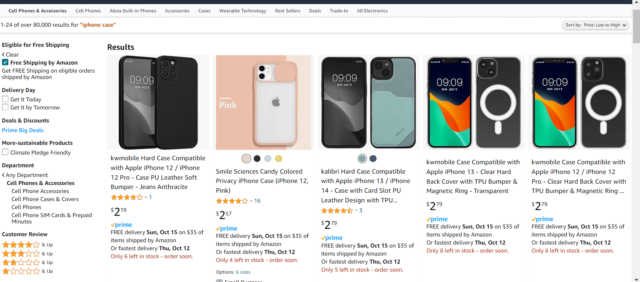
To compare Temu vs Amazon’s prices on Prime Day for phone accessories, I used an iPhone case as my baseline. I searched for generic products only, filtering on both sites sites from “Low to High” to get a fair comparison. I also used the caveat of ticking the free shipping box, as Temu offers free delivery as standard on many of its products, and some of Amazon’s less reputable sellers advertise products for a couple of cents, but then charge you for delivery.
On Amazon, the cheapest iPhone cases are all around $3. Prime members will get them within a day or two, depending on the exact item that’s ordered.
On Temu, the cheapest iPhone cases are all under $1, but what you’re getting for that is pretty basic.
As you’d expect, the Amazon cases have a few more bells and whistles. For example, I found you get this shockproof and MagSafe compatible case for the all-new iPhone 15 for just $2.99. It honestly looks better than anything for sale on Temu, but it’s a couple of bucks more. At this price level, many people will likely pay the extra buck or two to get the case delivered quickly, from a retailer they know and trust.
However, Temu is still cheaper and there’s no getting away from it.
Temu is Much Cheaper for Clothing Essentials
Temu has made its name partly by capitalizing on the current trend for fast fashion. TikTok influencers in particular seem to have taken to the idea of getting a whole new season wardrobe for less than you might pay for an item or two at a bargain bin retailer like Marshalls or TJ Maxx.
First, I used the simplest comparison possible: socks.
That’s cheap, really cheap even. It’s just not Temu cheap, as on the Chinese retailer you can get 10 pairs of plain white socks for just under $4, or 40 cents a pair!
OK, but what about something slightly more “in” right now? Grandma has a racket on socks at Christmas and we don’t want to risk her wrath, so another good comparison was this season’s new must-have Halloween essential for Swifties: a Travis Kelce jersey.
I mean a generic one, and on Amazon it costs about $20 for a Chiefs-style jersey. You’ll have to wait longer than for a lot of other stuff, too, with shipping times being quoted 1+ week. You do get to customize what’s on the back, though, so you can badge it up as Traylor, Swelce, or whatever your favorite nickname for the year’s biggest “are they or aren’t they?” power couple.
On Temu, you’ll save about five bucks and can get one ready-to-go for around $15.
Amazon Bests Temu in Battle of the Brands
One area where Amazon enjoys a clear advantage over Temu is in its availability of brand names. At present, Temu only has access to two Chinese manufacturers, Lenovo and Xiaomi, meaning for many things it’s still Amazon or bust – or at the very least, it’s not a fair comparison.
What’s interesting is that where they do offer the same item, Amazon is roughly equivalent. For this comparison, I looked at the Xiaomi Redmi Note 12, using the same 4G LTE model with 128GB of on-board storage and 6GB of RAM, as phone specs have a real impact on pricing.
On Amazon, the device in Ice Blue is currently available for $171.70, though it’s worth noting in the US it’s locked to T-Mobile, Mint or Tello.
On Temu, the same spec and Ice Blue flavor was priced at $170 but it sold out as I was writing this article. The Mint Green flavor is pricier at $190 and was advertising its last available unit.
This one is too close to call, but on balance I’d actually give Amazon the nod given it seems to have better availability of the Xiaomi phone. This isn’t really a surprise and reinforces the fact that for big name brands, Amazon is head and shoulders above Temu.
Amazon vs Temu: Which is Cheaper on Prime Day?
The examples above show that Temu is generally cheaper than Amazon, even when Amazon is running a major deals event like Prime Day.
However, cheaper doesn’t necessarily mean better. Amazon has a better selection of goods than Temu, especially from named brands, its quality is often going to be superior, and its delivery (and returns) policies are more favorable to shoppers.
The only thing I would actively buy at Temu over Amazon was the white socks I looked at. Being such an generic purchase, I wouldn’t think twice about taking advantage of the frankly ludicrous offer of 40 cents a pair. Then again, I would want to cramp Grandma’s style at Christmas.
About our links
If you click on, sign up to a service through, or make a purchase through the links on our site, or use our quotes tool to receive custom pricing for your business needs, we may earn a referral fee from the supplier(s) of the technology you’re interested in. This helps Tech.co to provide free information and reviews, and carries no additional cost to you. Most importantly, it doesn’t affect our editorial impartiality. Ratings and rankings on Tech.co cannot be bought. Our reviews are based on objective research analysis. Rare exceptions to this will be marked clearly as a ‘sponsored’ table column, or explained by a full advertising disclosure on the page, in place of this one. Click to return to top of page
Ellis Di Cataldo (MA) has over 9 years experience writing about, and for, some of the world’s biggest tech companies. She's been the lead writer across digital campaigns, always-on content and worldwide product launches, for global brands including Sony, Electrolux, Byrd, The Open University and Barclaycard. Her particular areas of interest are business trends, startup stories and product news.
Amazon Is Offering $1 Million for Proof of Aliens on Ring Cameras
Ring, an Amazon-owned security company, wants "unaltered scientific evidence" of alien life from your doorbell for the prize.
Written by
Published on October 13, 2023
Amazon is getting in on alien fever this year by offering Ring camera users $1 million if they are able to capture proof of extraterrestrials on their devices.
Aliens have been all over the news lately, with governments and military officials admitting that some of the wild conspiracy theories over the last few years are actually true.
Subsequently, Ring cameras could end up being a source of truth when it comes to extraterrestrials, and Amazonwants to make sure they reward those at the front lines of discovering life on other planets.
Amazon Offers Reward for Ring Camera Footage of Aliens
Announced in a press release, Amazon is legitimately offering $1 million for “unaltered scientific evidence” of extraterrestrial life captured on Ring cameras from around the US.
“With new sightings and further evidence that life forms might exist beyond Earth’s atmosphere, there’s a possibility that Extraterrestrial activity could be happening right outside your front door.” – Ring spokesperson
Ring, an Amazon-owned security company, is also offering a $500 gift card to the most elaborate fake image of aliens that they receive, so if you’re keen to experiment with Photoshop, you could get a little extra off your Prime Day haul.
Why Is Amazon Offering a Reward for Proof of Aliens?
As one of the most successful ecommerce businesses in the world, Amazon obviously has the resources to cover a $1 million reward in the event a Ring camera user somehow claims the prize.
There’s not much to worry about on Amazon’s side, though, as even the most advanced cameras on military planes haven’t caught images that could be considered undeniable proof.
It’s safe to assume that Amazon is merely looking for a bit of good will to go alongside its Prime Day celebration, which kicks off this week. After all, the press release announcing the reward was titled Halloween Mission Engaged and made mention of a “mothership.”
Considering Ring is still shaking off the PR nightmare of settling with the FTC over a lack of proper privacy protections for users, a little alien fun is likely a welcomed departure from planet Amazon.
Ellis Di Cataldo (MA) has over 9 years experience writing about, and for, some of the world’s biggest tech companies. She's been the lead writer across digital campaigns, always-on content and worldwide product launches, for global brands including Sony, Electrolux, Byrd, The Open University and Barclaycard. Her particular areas of interest are business trends, startup stories and product news.
Study: Remote and Hybrid Work Leads to Better Business Growth
No matter the business size or time period, businesses with flexible work policies are outpacing in-office counterparts.
Written by
Published on October 13, 2023
A new study has found that businesses offering remote and hybrid work are growing faster than those requiring employees to come into the office, dealing a serious blow to the return-to-office movement.
The pandemic made way for a new way of working. Employees were given professional freedom to get work done on their own pace, allowing for work-life balance to flourish and employee well-being to increase substantially.
However, despite study after study showing the benefits of remote and hybrid work, companies are still pushing to get employees back in the office, and it’s having a noticeably negative impact on their recruitment efforts.
Study: Remote and Hybrid Businesses Are Growing Faster Than In-Office Businesses
The study from Flex Index noted that, across basically every company size and time period, companies offering remote and hybrid work policies are growing faster than their in-office counterparts. And in some cases, the numbers are staggeringly in favor of remote and hybrid work.
For example, over the last twelve months, companies with between 500 and 5,000 employees that offer remote or hybrid work have grown twice as fast as in-office business. Over the last three months, they’ve grown three times as fast.
The Flex Report Job Edition 2023 from Scoop Technologies takes data from more than 6,700 companies covering over 100 million employees.
It’s Not Just Tech Either
You might be thinking that this is a unique problem for the tech industry. After all, these businesses drove the adoption of remote work during the pandemic, so surely they’re the only ones impacted in this kind of study.
However, that does not appear to be the case. In fact, the numbers found that, even without the tech industry, remote and hybrid businesses were still outgrowing in-office companies at a staggering rate across all business sizes by at least a full percentage point.
Again, companies between 500 and 5,000 employees remained the starkest of comparisons, with remote work and hybrid work businesses growing their headcount at a rate of 1.5% each, while in-office companies are only growing at a rate of 0.6% over the last three months.
Should Your Business Offer Remote Work?
It ain’t 2019 anymore. Flexible work has become one of the most sought-after perks for top talent in virtually any industry, and if you want to recruit the best of the best, you’re going to need to meet them where they live.
“In some ways, it’s almost like a new frontier of the way that we think about freedom. Flexibility is the new frontier of freedom, and it’s very American. And I think people are very unwilling to give that up.” – Rob Sadow, CEO and co-founder of Scoop Technologies to FOX News Digital
Fortunately, there are plenty of studies that show remote work not only provides work-life balance for employees, but it also improves productivity and even increases revenue. In fact, one study showed that companies offering remote and hybrid work boosted performance by 22%.
The benefits of remote work don’t stop there either. If you’re at all concerned with climate change, remote work is a no-brainer, allowing businesses to reduce their carbon footprint substantially, particularly compared to fully in-office businesses.
All that to say, if you care about employee wellbeing, productivity, revenue, and the planet Earth, your best bet is to keep your employees remote or hybrid for as long as possible.
Ellis Di Cataldo (MA) has over 9 years experience writing about, and for, some of the world’s biggest tech companies. She's been the lead writer across digital campaigns, always-on content and worldwide product launches, for global brands including Sony, Electrolux, Byrd, The Open University and Barclaycard. Her particular areas of interest are business trends, startup stories and product news.
5 High Paying AI Jobs and How to Get Them
From AI engineer to data scientist, these roles are lucrative and available if you have a certain set of skills.
The technology has allowed businesses to streamline basic operations while searching for individuals that can wrangle and rein in AI to work more efficiently towards their aspirational goals.
As a result, AI jobs have become quite lucrative, and if you’re looking to get started with one as soon as possible, we’ll tell you what you need.
High Paying AI Jobs in 2023
1. Machine Learning Engineer
If you know anything about artificial intelligence, you know that machine learning is essentially the way in which these systems learn. They use data and algorithms to gain insights and learn as much like a human as possible. At least, that’s the goal.
Subsequently, engineers that are well-versed in machine learning are a highly sought-after role at many AI companies, and as a result, this role can pay quite handsomely, if you have the right skills for gig.
Ideal skills you’ll need: Software engineering, data analysis, machine learning model development and implementation.
Average salary: $121,000/year
2. Data scientist
You can’t have artificial intelligence without a whole bunch of data, as the technology runs on heaps and heaps information. That’s where data scientists come in handy.
Also known as big data engineers, these professionals use everything in their digital toolbox to collect, analyze, and comprehend massive sets of data.
Ideal skills you’ll need: The ability to see trends and patterns in large data sets, programming knowledge, statistical analysis.
Average salary: $144,000 per year
3. Natural Language Processing Engineer
As you can imagine, a lot of artificial intelligence is based on how we talk, which means it needs to understand human languages.
That’s why natural language processing (NLP) engineers are so helpful. They provide businesses with all the spoken and written language that an AI model might need to understand for everything from voice recognition to virtual assistant commands.
In the same way AI models needs to be able to understand what it hears and reads, they also need to be able to understand what they can see. Computer vision engineers can help here, as they are experts when it comes to visual data.
Computer vision engineers help AI models to understand everything from images to videos, allowing them to unlock a lot of potential for these kinds of businesses. As a result, they’re one of the highest paid AI jobs on the list.
If you feel like you have a general knowledge about AI that could be beneficial to a company trying to get started with the technology, then more power to you!
AI consultants can help businesses roll out AI-powered strategies, implement AI models to glean valuable insights, or just find new ways to use AI to improve your bottom line. They’re the classic jack-of-all-trades of top paying AI jobs, and the salary fits that kind of broad knowledge role.
Ideal skills you’ll need: Breadth of knowledge about AI as a whole, product development and deployment experience, works well with others.
Average salary: $126,000/year
Qualifications You’ll Need for an AI Career
The salaries associated with AI careers might be very appealing, but before you start planning how you’re going to spend your newfound fortune, slow down. Most AI careers require a degree of some kind.
You’ll find that while some entry-level AI roles have a lower barrier to entry, the ones offering big bucks will require a degree related to computer science, or mathematics.
High profile AI jobs will not only require a degree (and ideally a masters, at that), but also a certain number of years in the field. However, taking an entry-level job in AI will let you gain precious experience, but also build your skills as you go.
Many employers will also be looking for additional flair to a candidates resume, such as attending relevant boot camps, and qualifications from supplementary AI courses.
Three Ways to Start Your AI Career
AI is an exciting and rapidly developing field, and there’s no doubt that it will explode over the next few years. There is also the opportunity to earn some serious money in the industry, too.
It might seem a little daunting knowing where to start, but here are some suggestions to set you on the right path:
Become the AI expert where you work
As AI is still a very new industry, many companies are scrambling to play catch-up, and that could well include the company you currently work for. You might think this would be a stopper to your AI career, but actually, it presents an excellent opportunity.
Start experimenting with AI in your role – we can help you with some excellent time-saving prompts. When you’ve got results and are confident, show your manager what you’ve done, and offer to share your findings with other teams. You’ll soon be recognized as the go-to person for AI at your company, which could lead to you having AI courses paid-for, or even being given a new AI role.
Upskill yourself in your spare time
You might think that AI is expensive to study, but in actual fact, there are a huge amount of free AI courses and tools available that you can take advantage of. Many courses are split up into modules, and you can study at your own pace – either during lunch break or in the evenings.
With courses from the likes of Harvard, Google and Microsoft, all available for free, you can pick up the essential skills you need in no time at all.
Play with the AI tools
When it comes to learning, there is no better way than by actually getting hands-on, and many of the big name AI tools, such as ChatGPT and Bard, offer free versions. Get stuck in, have a play around with them and see what they are capable of.
Consider setting yourself a challenge and seeing if you can use AI to help. It could be something as simple as setting up a daily schedule, to coding an app. The more you use these tools, the better you’ll become, and soon you’ll be capable of doing anything you set your mind to.
Ellis Di Cataldo (MA) has over 9 years experience writing about, and for, some of the world’s biggest tech companies. She's been the lead writer across digital campaigns, always-on content and worldwide product launches, for global brands including Sony, Electrolux, Byrd, The Open University and Barclaycard. Her particular areas of interest are business trends, startup stories and product news.
Tech Wants to Add AI to Your Literal Dreams
Prophetic is an AI startup building The Halo, the world’s first wearable device for stabilizing lucid dreams.
Written by
Published on October 13, 2023
Tired of stressing out because you didn’t study for that test in your dream? Well, one startup is looking to help you take control with an AI device that can help you control your dreams.
The advancement of AI technology over the last year has irreversibly transformed the business world. From chatbots around every corner to AI website builders, the tech is spreading to virtually every piece of technology it can get its hands on.
Now, the technology has gone from “in your dreams, pal” to actually in your dreams with a new wearable that could making sleeping that much more interesting.
An AI Wearable for Stabilizing Lucid Dreams
For those that don’t know, lucid dreaming is the process of dreaming while being able to know and understand that you are actually in a dream. This gives you quite a bit of control over the dream, with many reporting that you can do everything from visit your favorite imaginary locations to exploring the galaxy. Some say you can even fly.
With a potential experience this cool, it’s no wonder a startup is looking to capitalize on the potential to make it happen. That’s where Prophetic comes in. The startup has created The Halo, a headband-like wearable that can help you control your dreams.
Naturally, the company is still in the early stages, but you can reserve your Halo now with only a $100 deposit. The service will also some with a subscription, but the first 1,000 deposits will get that for free in the first year.
How Does It Work?
We’re not brain surgeons over here at Tech.co (I know, we were surprised too), so the exact biology of how the Halo actually works is a bit beyond us. Still, the way the cofounders talk about it, the process sounds a lot easier than you’d think.
“Eric came to me, and he told me what he was working on, and I didn’t think the technology was there at that time — we can’t induce dreams, let alone lucid ones, so how could this be possible? The defining moment for me was when I realized that you’re not inducing the dream state itself — someone is already dreaming normally, which happens for most people multiple times a week. You’re simply activating the prefrontal cortex, and it turns lucid.” – Wesley Berry, cofounder of Prophetic to CNBC
As for the specifics of what the Halo will actually do to your brain, Prophetic explains that it basically breaks down to stimulating the prefrontal cortexes with focused ultrasounds while the user is already dreaming.
The Wearable AI Trend
Prophetic is certainly not the first company to utilize AI for wearable technology and it definitely won’t be the last. In fact, the trend has become quite popular, slowing pushing the tech industry into its sci-fi dystopian era.
The most notable of AI-powered wearable technology is the Neuralink brain implant, which is a lot further into testing than many believe possible. The company is founded by Elon Musk (always a good sign) and was just approved for human testing in June.
Prophetic partnered with Card79 to build its prototype Halo, who, fascinatingly enough, designed and built hardware for Musk’s Neuralink device as well. It really is a small world after all.
Ellis Di Cataldo (MA) has over 9 years experience writing about, and for, some of the world’s biggest tech companies. She's been the lead writer across digital campaigns, always-on content and worldwide product launches, for global brands including Sony, Electrolux, Byrd, The Open University and Barclaycard. Her particular areas of interest are business trends, startup stories and product news.
X Plans to Ditch Like and Repost Counters in Feed View
The likes and reposts will still be visible if you click on the post, but the feed view will exclusively show views.
Written by
Published on October 13, 2023
Elon Musk continues to shake things up at the platform formerly known as Twitter, with the controversial CEO announcing that X will soon get rid of likes and repost counters in the feed view.
Musk has been quick to announce big changes to the popular social media platform. Even worse, he’s been following through with a lot of these announcements, altering the very fabric of Twitter/X that made it such a hotbed for discussion.
Now, another big change is coming down the pipeline for the platform, and users continue to ask themselves, “Do I even like X?”
Musk Alludes to No More Likes, Reposts in Feed
If you follow X or Elon Musk news, you know that the source is always the controversial CEO’s own post, and that is indeed the case this time. Replying to a paid subscriber’s post (which means you can’t see it unless you pay for X), Musk noted that “those ugly URL cards with repetitive text were making my eyes bleed,” and that he has a solution.
“We’ll remove all the action buttons with their superfluous interaction counts from the main timeline.” – Elon Musk in an X post
That’s right, the only visible metric for posts will be the “views” counter, another addition since the Musk takeover last year.
Don’t worry, though, the like and repost counters won’t be gone for good. You’ll still be able to see how many people are liking and reposting your tweets, but you’ll have to actually click on it to see the counters in action.
Why Get Rid of Likes and Reposts?
A lot of the changes to X have come directly from Musk, who has been vocal about the reason behind each one. So, why is X getting rid of likes and reports in the feed view?
“This will greatly improve readability.” – Elon Musk in an X post
This isn’t the first time Musk has used readability as a reason to dramatically change the platform. In fact, he announced that the platform would be getting rid of headlines on posts, a change that went into effect just this week.
The headline change has already had some negative consequences, with some users posting articles with fake headlines, confusing readers and manifesting community notes at breakneck speed. So, how could the lack of like and repost counters backfire?
How Will This Impact Users?
While the lack of headlines could cause some issues in the long run, the reality is that a lack of like and repost counters in the feed view likely won’t have a big impact on usage.
In fact, some studies have shown that hiding social media metrics such as likes can actually have a positive impact on mental health, negating the pressure of doing well on your favorite platforms.
Whether or not Musk is aware of this remains to be seen, but rest assured, it certainly won’t be the last big change to X under his leadership.
Ellis Di Cataldo (MA) has over 9 years experience writing about, and for, some of the world’s biggest tech companies. She's been the lead writer across digital campaigns, always-on content and worldwide product launches, for global brands including Sony, Electrolux, Byrd, The Open University and Barclaycard. Her particular areas of interest are business trends, startup stories and product news.
Microsoft Teams Will Soon Be Able to Tell Who Is in Your Meeting
As part of its AI initiative, Microsoft Team's facial recognition feature will be coming to desktops in December.
Written by
Published on October 13, 2023
Microsoft Teams is one step closer to rolling out a “desktop client face enrollment process,” which will allow it to scan the faces of users to determine their identity.
Once the somewhat creepy feature becomes live this December, it will be capable of identifying meeting attendants in person and remotely, through the use of advanced facial recognition algorithms.
This development comes just two months after the web conferencing giant added a slew of AI-driven features to its arsenal, including voice-based transcription capabilities and automated multi-stream videos.
Microsoft Teams to Launch Creepy Facial Recognition Feature
Microsoft Teams’ ever-evolving suite of features is a major reason why it consistently ranks among the top video conferencing solutions on the market. However, the service’s pending facial recognition feature isn’t necessarily catching the attention of the public for the right reasons.
The AI-powered capability, which is still being fine-tuned, will be able to identity and label video call attendees, as long as the users have previously created a face profile with the service.
Creating a face profile involves enrolling your face with the video conferencing tool, which uses advanced facial algorithms to map and log your identity.
According to a Microsoft blog post, the feature will also provide personal experiences during video conferences and meetings and will be especially beneficial to meetings using an Intelligent Camera.
Facial recognition isn’t the only feature coming to the web conferencing service. In August, the company rolled out a variety of advanced features including call delegation enhancements, third-party meeting access, and panoramic video options.
They’ve also expanded their artificial capabilities by launching AI-based file suggestions in chat, voice-based transcription, and live-translated captions.
There’s no disputing that Microsoft Team’s features are industry leading. But it’s not the only web conferencing solution that delivers a great service. Below we compare some of Microsoft Team’s top alternatives including Zoho Meeting, which offers flexible packages for as little as $1 per month, and Zoom, which is the best platform we tested for beginners.
Ellis Di Cataldo (MA) has over 9 years experience writing about, and for, some of the world’s biggest tech companies. She's been the lead writer across digital campaigns, always-on content and worldwide product launches, for global brands including Sony, Electrolux, Byrd, The Open University and Barclaycard. Her particular areas of interest are business trends, startup stories and product news.
Revealed: The Top AI Skills Employers Want You to Have
The AI and short-form video job markets are booming. Here's how you can cash in on the trends.
Written by
Published on October 13, 2023
As AI upskilling becomes an essential strategy for many, freelance company Fiverr has revealed that AI content editing, prompt engineering, and AI video creation are currently the most in-demand artificial intelligence-based skills for freelancers.
This comes as searches for “ChatGPT” and “Jasper” explode in popularity on the platform, overtaking previous social media-based queries “Facebook”, and “TikTok Video“.
AI isn’t the only trend shaking up the business landscape though, with searches for ecommerce solutions like Etsy and Shopify spiking as small business owners are placed under escalating pressure to diversify revenue streams.
Fiverr Reveals Most Desirable AI Skills in 2023
If you’re considering AI upskilling but haven’t worked out your a specialism, take note. Freelancer marketplace Fiverr has just revealed which AI skills are currently being searched the most by employers.
According to the companies 8th Business Trend Index, AI content editing is currently the most searched AI related skill, with traffic for the query skyrocketing by 10,490% in the last six months.
“Prompt engineering” and “AI video” weren’t far behind, with searches for the terms soaring by 7,345% and 3,746% respectively since April 2023.
As businesses scramble to future-proof their processes with AI, the report also found that more general searches for AI increased by 1,088% over the same timeframe, while AI Art was up 6,967%.
“With the wider adoption of AI tools and signs of a leveling economy, the last six months have brought a new sense of momentum.” – Fiverr COO Hila Klein
The growth of the search term “AI Video” also points at the other huge area area of growth outlined in the report – short-form video production. As TikToks wild popularity disrupts the social media landscape, social media apps like Instagram and YouTube have been quick to replicate its bingeable, short-form video format.
This has resulted in a host of new opportunities for video creators and social media marketers, with Fiverr searches for “Youtube Shorts Video” increasing by an astronomical 64,624%, while searches for “Instagram Reel Editor” shot up by 4,760%.
AI Literacy Has Never Been More Important
The results of Fiverr’s survey have distilled what most of us already know – digital upskilling is no longer optional for those committed to getting ahead.
As AI continues to shape the world around us at an alarming rate, staying one step ahead with the relevant skills is paramount. Luckily there are a number of different ways workers can stay one step ahead of the curve.
With employers searching for skills relating to popular chatbots like “ChatGPT” and “Jasper” more than ever, familiarising yourself with these platforms is a simple yet effective way to advance your employment prospects.
It’s easy enough to teach yourself the basics, but if you’re serious about future-proofing your career it’ll be worth looking into AI training courses. These courses cover a wide range of topics around AI, from how the technology can be deployed across industries to its limitations and ethical risks.
Clueing yourself up doesn’t need to come at a cost, either. We compiled a list of the best free AI courses in 2023, including options from leading universities like Stanford and UPenn.
What Else Did Fiverr’s Business Trends Index Report Find?
While AI topics heavily dominated Fiverr’s 8th Business Index, it’s not the only trend picking up steam among the freelance community.
As US consumers continue to cut back on spending, small business owners have been forced to get increasingly creative to stay afloat. As a result, searches for “Etsy Sales” and “Shopify Manager” surged by 5,348% and 1,065% respectively over the past 6 months, as more and more small businesses expand their revenue streams through omnichannel selling.
But if AI or omnichannel selling isn’t your forte, now might be a good time to try your hand at claymation – with search results for the film animation method curiously shooting up by 18,654% across the US throughout the same time period.
Ellis Di Cataldo (MA) has over 9 years experience writing about, and for, some of the world’s biggest tech companies. She's been the lead writer across digital campaigns, always-on content and worldwide product launches, for global brands including Sony, Electrolux, Byrd, The Open University and Barclaycard. Her particular areas of interest are business trends, startup stories and product news.


 This just in! View