Apple’s Historic iPhone Sales Slump Not Biting Into AI Spend

As iPhone sales dip, Apple continues to diversity its revenue streams. Will the tech giant's big AI gamble pay off?

Despite disappointing iPhone sales contributing to Apple’s biggest sales dip since 2016, faith in the company remains high, thanks to profits from digital services like Apple TV surging and stock market buzz around its pending generative AI tool, AppleGPT.

So far this fiscal year Apple has invested $22.61bn in research and development, and CEO Tim Cook announced the company is going to “continue investing and innovating” in its quarterly earnings call for Q3.

Like fellow efforts made by Meta and Amazon, the company’s AI gambit is paying off. With financial experts raising concerns over big tech’s “AI bubble” will Apple’s recent investments be successful in the long term?

Apple’s Hardware Sales Are Down, But Services Remain Strong

Apple announced its third consecutive decline in revenue in its recent earnings report, largely due to a slowdown in global iPhone, Mac, and iPad sales.

According to the report, iPhone sales – which account for almost half of the company’s revenue – dropped by 2.4%, while iPad sales fell by 20%. This marks the company’s biggest sales slump since 2016, when the manufacturer dealt with a similar decline in the Chinese market.


About Tech.co Video Thumbnail Showing Lead Writer Conor Cawley Smiling Next to Tech.co LogoThis just in! View
the top business tech deals for 2026 👨‍💻
See the list button

It wasn’t all bad news for Apple though, with sales of wearables like AirPods and Apple Watch jumping by 2.5% over the same period.

“The services business is important in many ways for us. It strengthens our ecosystem [and] it’s important because it makes the overall business less dependent on the performance of our products.” – Apple’s Finance Chief Luca Maestri

Thanks to a recent diversification effort, revenue from Apple’s services division was also up 8% YoY, and the segment is projected to grow 5.8% annually moving forward.

Apple’s services now boast double the number of subscriptions they did three years ago, and paid subscriptions managed by Apple now have twice as many subscribers than Netflix, HBO, Disney+, and Peloton combined.

Apple Doubles Down on AI Spending

Aside from ramping up spending on services like Apple Music and AppleTV, Apple also announced it would be deepening its investment into generative AI.

According to the recent earnings call, the company spent $22.61bn on R&D in the past fiscal year – $3.12bn more than the previous year – with a sizable chunk of this going on AI development.

Compared to its big tech rivals Google and Meta, Apple was slightly late to cash into the AI boom, but Tim Cook attests that the technology is “integral to virtually everything that (they) build” and that the company is committed to investing in its development going forwards.

“Obviously, we’re investing a lot (on AI), and it is showing up in the R&D spending that you’re looking at.” – Tim Cook, Apple CEO

Fortunately, this risk appears to be paying off. After news broke that the manufacturer was developing its own generative AI chatbot, known internally as AppleGPT, the company’s stock price soared by 2.3%, adding $71 billion to its market cap.

However, despite the promising stock market buzz that Apple’s AI projects are attracting, the company is yet to announce a release date for AppleGPT, or make any real returns on its sizable investments.

Will Apple’s AI Gamble Pay Off?

Big tech’s recent economic challenges have forced major players to tighten their belts, as evidenced by the seemingly unstoppable wave of tech industry layoffs this year. Still, this hasn’t stopped companies like Apple, Meta, and Google from pouring billions into AI developments.

For many, this approach is paying off. Meta’s share price recently surged by 8% after the success of its AI-powered Instagram Reels platform, and Amazon’s recent’s earnings beat market expectations thanks to a series of successful AI initiatives launched by the ecommerce retailer.

This isn’t to say this strategy is foolproof, however. Strategists at JPMorgan Chase have recently expressed concerns over big tech’s AI bubble, explaining that while hype around the technology is sending stock prices through the roof, concrete evidence of its success remains lacking.

One thing remains certain: while Apple is yet to report any major returns from its AI investments, being left behind in the race for AI dominance could prove to be an even bigger risk.

Written by:
Isobel O'Sullivan (BSc) is a senior writer at Tech.co with over four years of experience covering business and technology news. Since studying Digital Anthropology at University College London (UCL), she’s been a regular contributor to Market Finance’s blog and has also worked as a freelance tech researcher. Isobel’s always up to date with the topics in employment and data security and has a specialist focus on POS and VoIP systems.

Amazon Exec Has “No Data” To Justify Return-to-Office Mandate

Amazon's executives may not like what the data actually has to say about the benefits of remote work.

Amazon staffers aren’t happy about the ecommerce giant’s backtrack on offering remote work flexibility, and a top executive’s latest comments have made the matter worse.

According to SVP of Amazon Video and Studios Mike Hopkins, he has “no data either way” to explain why the company is mandating that its employees resume in-office work.

Amazon’s known for its data-driven decision making process, and the apparent contradiction inherent in making a big decision without data supporting it is what’s upsetting many laborers at the huge tech company.

Is Amazon’s RTO Mandate Unsupported by the Data? One Executive Says So.

Hopkins’ statements emerged during an internal staff meeting recently, in which he was asked if he had any data to share about Amazon’s return-to-office mandate.

Hopkins said he had “no data either way” regarding the sweeping decision.


About Tech.co Video Thumbnail Showing Lead Writer Conor Cawley Smiling Next to Tech.co LogoThis just in! View
the top business tech deals for 2026 👨‍💻
See the list button

The new mandate, revealed last February, will push most employees back to the office at least three days a week. It’s a reversal of the company’s promise from as recent as 2022 that it would not force employees back into the physical office.

Hopkins did indicate some reasons for removing flexible work options, saying that CEO Andy Jassy and other executives all believe”we just do our best work when we’re together.” He also, according to journalism from Insider, cited a leadership principle that entreats Amazon staffers to “have backbone, and disagree and commit” — with the implication being that now is a time to commit, rather than disagree.

The Data Might Say The Opposite

The data does exist, but Amazon’s executives may not like what it says in this instance. We’ve seen plenty of studies that appear to indicate that workers who work remotely, or have the option to do so, tend to be both happier and more productive.

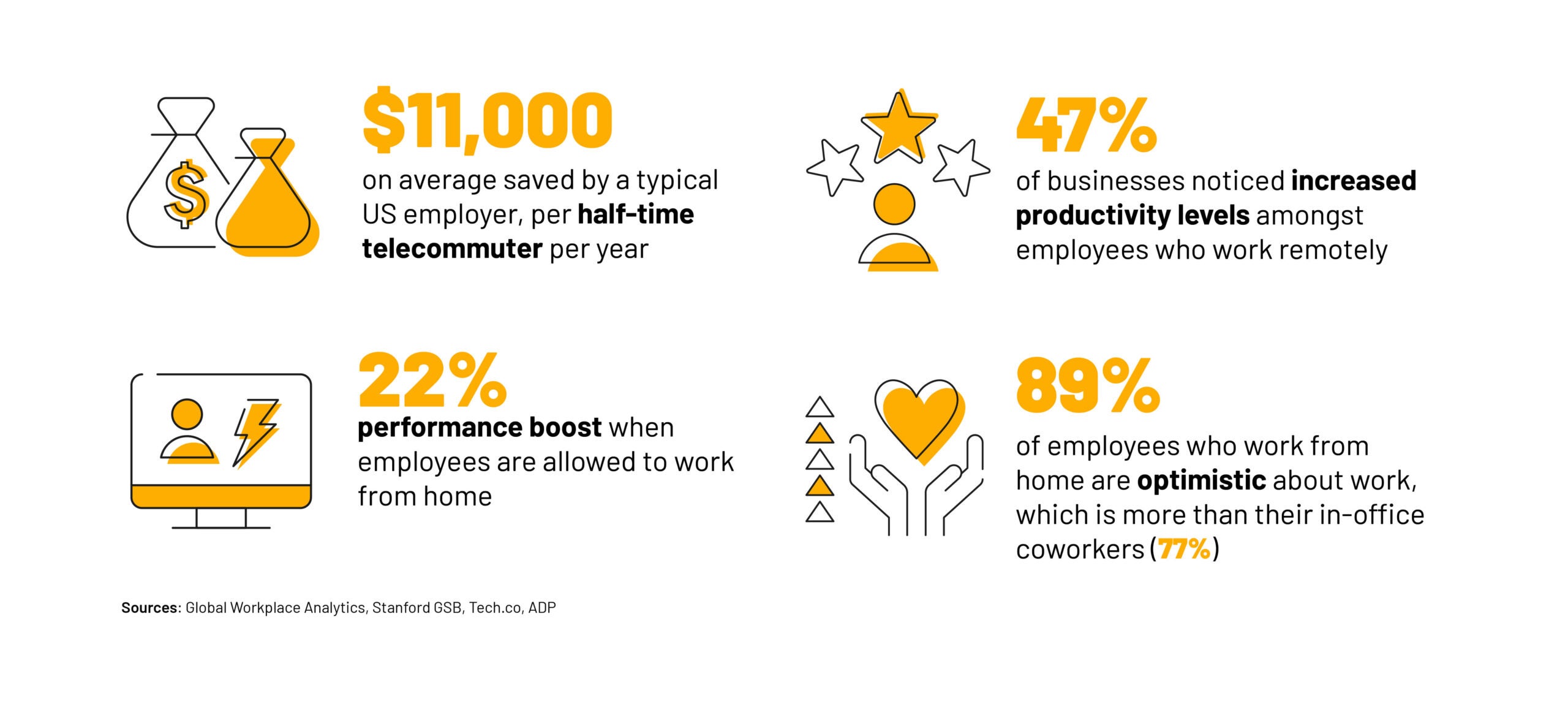
One of Tech.co’s own surveys found that 47% of businesses notice increased productivity levels amongst employees who work remotely. Other studies found a hike in optimism about work from those who worked at home (89%) when compared to those at the office (77%).

Key WFH Stats Productivity

One Upwork report found that 32.2% of hiring managers say that productivity has increased since remote work policies have started.

Companies Continue the Push for In-Office Work

There are plenty of reasons why many companies don’t always follow the data when making decisions. This may be due to short-term quarterly profits distracting from long-term sustainability, or in the case of a return to office, it may be because they feel a loss of control over their employees when they don’t have eyes on them all the time, or a need to justify costly long-term office building leases.

Whatever the case, many major companies are attempting to push employees back into their office in 2023.

We’re tracking the biggest changes in this area across two big articles: Companies That Have Ended Fully Remote Work in 2023, and Companies That Offer Remote Work From Home Jobs in 2023

Amazon’s workers have composed an internal petition, but so far it seems that Amazon is committing to a data-less decision, regardless of its employees’ disagreements.

Written by:
Isobel O'Sullivan (BSc) is a senior writer at Tech.co with over four years of experience covering business and technology news. Since studying Digital Anthropology at University College London (UCL), she’s been a regular contributor to Market Finance’s blog and has also worked as a freelance tech researcher. Isobel’s always up to date with the topics in employment and data security and has a specialist focus on POS and VoIP systems.

Study: Humans Can Only Spot Deepfake Speech 73% of the Time

Audio deepfakery might sound like Mission: Impossible spy technology, but fake speech scams are a growing problem.

Humans can detect artificially generated speech about 73% of the time, a new study has found. That’s the majority of the time, but it’s not an overwhelming success — indicating that there may be plenty of opportunities for deepfake voice audio to scam you in the near future.

After the study, participants were trained in how to detect generated speech audio clips and became slightly better but were still not perfect. Even with training, deepfake audio can fool the typical person.

The study even found similar results across the two languages it tested, English and Mandarin.

How the New Study Tackled Deepfake Speech

The study was conducted by researchers at University College London, who trained a text-to-speech AI on two datasets to generate 50 speech samples in the two different languages. Then, 529 participants listened to audio clips and attempted to determine which were fake and which were spoken by a real, flesh-and-blood human.


About Tech.co Video Thumbnail Showing Lead Writer Conor Cawley Smiling Next to Tech.co LogoThis just in! View
the top business tech deals for 2026 👨‍💻
See the list button

The results: 73% accuracy. In other words, one in every four deepfake audio attempts can expect to work without raising any red flags for their targets.

Kimberly Mai, the first author of the study, explained that this is bad news:

“In our study, we showed that training people to detect deepfakes is not necessarily a reliable way to help them to get better at it. Unfortunately, our experiments also show that, at the moment, automated detectors are not reliable either.”

Deepfake Speech Scams Are More Common Than You Think

Audio deepfakery might sound like Mission: Impossible spy technology, but one in four adults have already experienced one, according to one survey.

That same McAfee survey found that 10% were personally targeted, and another 15% knew someone who had been. At the same time, victims were pretty sure they couldn’t be fooled. As Tech.co senior writer Aaron Drapkin put it at the time:

The McAfee survey also found that 70% of people said they were “unsure” if they’d be able to tell the difference between an AI voice and a human one. Almost one-third (28%) of US respondents said they wouldn’t be able to tell the difference between a voicemail left by an “Artificial Imposter,” as McAfee puts it, and a loved one.

Of the victims in the US who lost money through AI voice cloning scams, 11% lost between $5,000–$15,000.

Mcafee survey image

Now, the new survey indicates that many of those people would still be suckered by the right audio clip.

Could You Still Identify Fake Audio Speech?

Look, the good news is that the average person can still figure out when speech is computer generated a full 73% of the time. And with the right training, you can slightly boost your average.

The best way to stay safe, however, is likely to use a little analytical thought outside of the audio itself: Are you being asked to reveal sensitive information? This indicates a motive behind a potential scam. Have you initiated the process yourself? A scammer will target you and be the first to reach out.

Hopefully, automated deepfake speech detectors will continue to improve as well, helping to take some of the burden off of our fallible human ears.

Written by:
Isobel O'Sullivan (BSc) is a senior writer at Tech.co with over four years of experience covering business and technology news. Since studying Digital Anthropology at University College London (UCL), she’s been a regular contributor to Market Finance’s blog and has also worked as a freelance tech researcher. Isobel’s always up to date with the topics in employment and data security and has a specialist focus on POS and VoIP systems.

Fake Salesforce Email Used to Bait Facebook Phishing Trap

Emails sent from seemingly genuine "@salesforce.com" accounts targeted Facebook users in high-profile phishing campaign.

Salesforce, the software company behind one of the best CRMs for sales, has released out a patch for its email services after security researchers discovered a zero-day vulnerability that allowed cyber criminals to target Facebook users with a convincing phishing scam.

The actively exploited bug was discovered by the team at Guardio Labs and has been dubbed “PhishForce”. It made use of a flaw in Salesforce’s “email-to-case” feature – which lets users automate the creation of tickets for customer queries – to send outbound emails purporting to be from Meta Platforms via the official “@case.salesforce.com” domain.

Not only did these emails look genuine to the recipients, but they evaded Facebook’s built-in phishing detection defenses as well, once again highlighting how even the most robust antivirus software and related solutions can be duped by gaps in the security architecture of popular products.

How the Salesforce Phishing Attack Worked

The phony phishing emails were titled “Breach of Content Standards” and claimed to advise recipients of an account compromise and impending suspension due to “suspicions of impersonation” on their social media account. Which of course is wildly ironic and proof that cyber criminals are nothing if not a humorous bunch.


About Tech.co Video Thumbnail Showing Lead Writer Conor Cawley Smiling Next to Tech.co LogoThis just in! View
the top business tech deals for 2026 👨‍💻
See the list button

In order to avoid the “suspension”, users were directed to a fake “support” page, at which point they were asked to input sensitive information. While the Guardio Labs report makes clear the campaign is known to have operated successfully, it’s not clear how many people actually fell victim to it.

Adding a further air of authenticity to the ruse, the emails were addressed to the target’s real name, which also helped the messages bypass Facebook’s anti-spam and anti-phishing filters.

Photo of Salesforce email used in Facebook phishing campaign

Image credit: Guardio Labs

Salesforce Dreaming Big Despite Layoffs

Guardio Labs also notes that Salesforce acted quickly to address the vulnerability: it was reported to the company on July 28th and a patch was released the same day. The security researchers also say they advised Facebook owner Meta of the hole in its systems, which seemed to be related to legacy features on “apps.facebook.com.”

News of the security flaw comes as Salesforce enters an important couple of months as a company and as a brand. Specifically, the popular CRM maker is in the midst of a number of new launches ahead of its annual Dreamforce 2023 conference in September. These include the suite of new AI features being brought to its core products, while subsidiary Slack has also just unveiled a sales-specific edition as it looks to diversify its offering.

At the same time, Salesforce pricing is increasing for the first time in a number of years and the company hasn’t found itself immune to the wave of tech layoffs sweeping the industry, either. For its part, Meta finds itself in  the eye of the social media storm as ever, launching its new app Threads as an alternative to Twitter (now X).

Written by:
Isobel O'Sullivan (BSc) is a senior writer at Tech.co with over four years of experience covering business and technology news. Since studying Digital Anthropology at University College London (UCL), she’s been a regular contributor to Market Finance’s blog and has also worked as a freelance tech researcher. Isobel’s always up to date with the topics in employment and data security and has a specialist focus on POS and VoIP systems.

Roblox Players Have Only Days Left to Claim $10M Settlement

Roblox account holders are entitled to a share of a multi-million class action settlement, but time is running out.

Roblox account holders could be entitled to a share of a $10 million settlement, but those eligible have less than a week to claim.

The settlement is the result of a class action lawsuit that claims the online gaming platform allowed children to make purchases, and then deleted content as part of its moderation process, without giving refunds for lost items.

The settlement closes on August 10th, read on to find out how to make your claim.

What are the Details of the Roblox Settlement?

The $10 million settlement centers around a class action lawsuit from a father of a Roblox player, who criticised the company, alleging that it was deliberately allowing children to purchase content, and then subsequently deleting it under the guise of content moderation, after said content broke its terms.

In doing so, the claimant states that the move was a calculated ‘win-win’ for Roblox, as it was able to sell the content, and then delete it without offering refunds.


About Tech.co Video Thumbnail Showing Lead Writer Conor Cawley Smiling Next to Tech.co LogoThis just in! View
the top business tech deals for 2026 👨‍💻
See the list button

Roblox has denied any wrong doing in the case, but has agreed to the $10 million settlement.

Roblox has also agreed that in the future, any user who has content moderated, and loses money for paid items, will automatically be credited.

The case follows other high profile settlements from tech companies, including Instagram and Google.

How to Claim Part of Roblox $10 Million Settlement

In order to claim your entitlement of the Roblox settlement, you need to ensure that you fit the criteria:

  • Had a Roblox account before May 11, 2023
  • Content was moderated and removed from account
  • Have submitted a claim by August 10 2023

There are only a few days left to make the claim, after which the window will close, and claimants will no longer be able to pursue the case or receive payment.

In order to make a claim, Roblox customers will need to fill out this settlement form.

Those affected will receive an automatic credit to their Roblox account, but can also take the option of a cash settlement, should the refund amount be over $10.

The final hearing in this case is set for September 27, with payments not being made until after this date.

Written by:
Isobel O'Sullivan (BSc) is a senior writer at Tech.co with over four years of experience covering business and technology news. Since studying Digital Anthropology at University College London (UCL), she’s been a regular contributor to Market Finance’s blog and has also worked as a freelance tech researcher. Isobel’s always up to date with the topics in employment and data security and has a specialist focus on POS and VoIP systems.

X Corp Files Lawsuit Against Center for Countering Digital Hate

Self-proclaimed "free speech absolutist" Elon Musk is suing a non-profit organization that published research about X.

Elon Musk and his newly named social media company are reportedly suing the Center for Countering Digital Hate (CCDH) in light of its research into the platform’s proliferation of hate speech.

There has been no shortage of drama since Musk took over Twitter in October 2022. The company has seen controversy around virtually every corner, eliciting everything from employee resignations to full-on legal action from city officials.

This lawsuit, however, takes it up a notch, with Musk and his company launching an attack on an seemingly independent, unbiased research organization because it had a bad thing to say about the direction of the social media platform.

X Sues Center for Countering Digital Hate

In a lawsuit filed this week, X Corp is apparently suing the Center for Countering Digital Hate (CCDH) for publishing research that points to the toxicity of the X/Twitter platform. The language of the lawsuit is nothing if not a bit dramatic and paints a troubling picture for the social media platform in turmoil.

“The Center for Countering Digital Hate — an activist organization masquerading as a research agency, funded, and supported by unknown organizations, individuals, and potentially even foreign governments with ties to legacy media companies — have embarked on a scare campaign to drive away advertisers from the X platform.” – the X lawsuit against the CCDH

X hasn’t appeared to need any help driving away advertisers, with the company continuing to hemorrhage partners interested in selling products on the platform.

Beyond that, though, the lawsuit is nothing if not frivolous. By all accounts, the CCDH is an unbiased, independent non-profit that almost exclusively works to ensure the internet is safer, more wholesome place for everyone online.

The Case Against X (Twitter)

So, what is X (Twitter) actually suing the CCDH for? Well, since Musk’s takeover, the non-profit organization has released a treasure trove of research showing that the platform is doing much worse than usual when it came to combating hate speech.

More specifically, the CCDH noted that X had reinstated accounts from a wide range of Nazi, white supremacist, misogynist, and conspiracy theorists to the platform after previously receiving lifelong bans.


About Tech.co Video Thumbnail Showing Lead Writer Conor Cawley Smiling Next to Tech.co LogoThis just in! View
the top business tech deals for 2026 👨‍💻
See the list button

That’s not all, though. Research from the CCDH in June found that the company “fails to act on 99% of hate posted by Twitter Blue subscribers,” implying that the company was cosigning hate speech for the price of $7.99 per month.

Musk: A Free Speech Absolutist?

During his rocky takeover of Twitter, Elon Musk noted on multiple occasions that he was a “free speech absolutist.” At least, that was the reason he gave for unleashing scores of accounts on the platform that had been previously banned for hate speech and disinformation.

Now, however, the controversial CEO seems to be taking extraordinary measures to silence his dissenters, and many in the industry are concerned that it could be a slippery slope.

“Elon Musk’s latest legal threat is straight out of the authoritarian playbook – he is now showing he will stop at nothing to silence anyone who criticizes him.” – Imran Ahmed, CEO of CCDH

Admittedly, Musk hasn’t been making a lot of good decisions since taking over Twitter. But this lawsuit could be significantly worse than just putting a big flashing X on the top of an office building in the middle of San Francisco.

Written by:
Isobel O'Sullivan (BSc) is a senior writer at Tech.co with over four years of experience covering business and technology news. Since studying Digital Anthropology at University College London (UCL), she’s been a regular contributor to Market Finance’s blog and has also worked as a freelance tech researcher. Isobel’s always up to date with the topics in employment and data security and has a specialist focus on POS and VoIP systems.

AI Mistakes May Be Unfixable, According to Experts

AI leaders have admitted that their platforms can be inaccurate, but is the problem solvable at all?

Artificial intelligence (AI) may be just as fallible as actual intelligence, with experts are starting to realize that AI mistakes, or “hallucinations,” could be a feature rather than a bug.

The tech world is betting big on the development of generative AI platforms like ChatGPT. Microsoft, Google, and dozens of other companies have rolled out the tech unto their various platforms over the last few months, making it a huge selling point for any business looking for a productivity boost.

However, generative AI platforms are far from perfect, and even some pioneers are getting worried that these mistakes are going to be a lot harder to fix that they originally thought.

Experts: AI Hallucination “Isn’t Fixable”

While generative AI platforms have been lorded for their productivity-improving content creation, there have been more than a few reports pointing to their consistent inaccuracy. Yes, the technology is still in its infancy, but some experts have noted that a perfect version of generative AI is simply not possible.

“This isn’t fixable. It’s inherent in the mismatch between the technology and the proposed use cases.” – Emily Bender, director of the University of Washington’s Computational Linguistics Laboratory

To make matters worse, the gamble on whether or not AI technology will eventually grow out of its early-stage missteps is a big one. Big tech companies like Google have grand plans for the technology, including news writing platforms that will be required to be completely accurate in the face of libel laws.

Generative AI Mistakes in Action

You may be thinking to yourself, how bad could these AI mistakes really be? After all, you’ve been using AI at your job without your boss’ knowledge and everything seems rock solid so far, right?

The reality is that, on the grand scale of generative AI use, mistakes are all too common. From incorrect information to outright misinformation, these platforms are not perfect enough to handle the potentially high stakes tasks that businesses want them for.


About Tech.co Video Thumbnail Showing Lead Writer Conor Cawley Smiling Next to Tech.co LogoThis just in! View
the top business tech deals for 2026 👨‍💻
See the list button

A recent example includes a law firm that was fined by a Manhattan district judge for using fictitious legal research created by ChatGPT. The case obviously had real world impact and was based on nothing more than a fabrication from a generative AI platform.

All that to say, the mistakes from generative AI platforms are a lot worse than just simple typos and left-out words; this technology can cause serious problems if it doesn’t get more accurate and fast.

What Do AI Leaders Think?

As you can imagine, the heads of AI firms like OpenAI and Anthropic are less concerned, although their optimism is notably underscored by a humble understanding that there’s a long way to go before these platforms are even close to reliable.

“I don’t think that there’s any model today that doesn’t suffer from some hallucination. They’re really just sort of designed to predict the next word. And so there will be some rate at which the model does that inaccurately.” – Daniela Amodei, president of Anthropic, the developer of Claude 2.

Luckily, AI leaders are, in fact, aware that their platforms aren’t churning out the cream of the crop when it comes to content, even if they are frustratingly flippant about that fact.

“I probably trust the answers that come out of ChatGPT the least of anybody on Earth.” – Sam Altman, CEO of OpenAI, developer of ChatGPT

Written by:
Isobel O'Sullivan (BSc) is a senior writer at Tech.co with over four years of experience covering business and technology news. Since studying Digital Anthropology at University College London (UCL), she’s been a regular contributor to Market Finance’s blog and has also worked as a freelance tech researcher. Isobel’s always up to date with the topics in employment and data security and has a specialist focus on POS and VoIP systems.

Study: 76% of Employees Plan to Quit If Flexible Work Ends

A new study has revealed some troubling statistics in regard to the return-to-office mandates hitting the business world.

Thinking about having your employees come back to the office full time? Think again, because a new study found that most employees are still willing to quit on the spot if their company gets rid of flexible work policies.

The return-to-office movement has taken the business world by storm recently, with a number of high-profile companies making aggressive pushes to get their employees back at their desks.

Now that it’s been a few months since the movement kicked off, researchers are starting to see the impacts of these RTO mandates, and let’s just say the businesses making the push aren’t doing too well.

Employees Want Flexible Work

A report from Greenhouse Candidate Experience found that 76% of employees would actively seek a new job if their current employer got rid of flexible work options.

“Leaders that haven’t been listening to candidates and employees in recent years will be forced to realize that work has undergone a massive shift, and they can either adapt to this new world or lose out on top talent, and ultimately, business success.” – Donald Knight, Chief People Officer at Greenhouse

Even worse, filling those positions will be infinitely harder moving forward, considering the study found that 42% of employees noted that they wouldn’t even apply to jobs that don’t fit their preferred work policy. And considering 52% said that they prefer either hybrid or full remote, forcing employees back into the office is not going to be a valuable recruiting tool.

The Return-to-Office Impact

There are a lot of statistics in favor of keeping your hybrid work model. Still, many businesses have been adamant that a return to the office will encourage collaboration and develop company culture in a way that will have a positive impact on their businesses. Unfortunately, that just doesn’t appear to be the case.

A study from Unispace found that 42% of businesses with return-to-office mandates are having a harder time with employee retention than expected. On top of that, one third of such businesses are struggling to recruit top talent.


About Tech.co Video Thumbnail Showing Lead Writer Conor Cawley Smiling Next to Tech.co LogoThis just in! View
the top business tech deals for 2026 👨‍💻
See the list button

So, why are employees unhappy? Well, according to a study from the Federal Reserve, getting rid of your hybrid work policy is creates resentment akin to a 2% to 3% pay decrease.

Choice Instead of Mandates

There was some promising news from these reports in regard to getting employees back in the office, and it focuses on avoiding actual mandates and giving employees the choice to return to the office.

The study from Unispace found that employees were notably happier, more motivated, and more excited about returning to the office when given the option over being forced back into the office.

All in all, these studies show that it’s fairly obvious what your strategy for retaining employees and recruiting top talent should be in regard to flexible work: Treat your team like adults that can make their own decisions.

Written by:
Isobel O'Sullivan (BSc) is a senior writer at Tech.co with over four years of experience covering business and technology news. Since studying Digital Anthropology at University College London (UCL), she’s been a regular contributor to Market Finance’s blog and has also worked as a freelance tech researcher. Isobel’s always up to date with the topics in employment and data security and has a specialist focus on POS and VoIP systems.

Elon Musk to Be Charged By SF Authorities for ‘X’ Sign Fiasco

Turns out, you can't just put a giant, glowing X on top of a building in downtown San Francisco whenever you want.

Elon Musk will have to cover the costs of the investigation into whether X Corp (formerly Twitter) had permission to erect a large ‘X’ sign on top of the social media platform’s headquarters in San Francisco.

City authorities — which contend the billionaire did not have permission to put it up — are also going to bill the company for the permits it would have needed to gain in order to install (and also remove) the large, luminescent logo from the building.

Musk is already being sued by landlords in San Francisco, as well as London, for refusing to pay rent for its office space — while the city’s police force stopped him from taking down the sign with Twitter’s old logo just last week.

Musk Charged for X Sign Stunt

Elon Musk will be billed for both the investigation into the X sign that was conducted by San Francisco authorities as well as the costs of installing and removing the object from the roof, a recent BBC report has revealed.

The strobe fixture, which was flashing constantly and could be seen from miles away, had already irked locals, with many suggesting that the decision was reckless. The Guardian reports that 24 complaints were made to the city over the weekend regarding the sign.

The sign itself was removed on Monday morning, much to the relief of the company’s neighbors.


About Tech.co Video Thumbnail Showing Lead Writer Conor Cawley Smiling Next to Tech.co LogoThis just in! View
the top business tech deals for 2026 👨‍💻
See the list button

Musk vs San Francisco: A Difficult Relationship

Since Musk’s acquisition of Twitter in 2022, his relationship with the authorities in San Francisco has been far from rosy.

Shortly after his takeover, with the company shifting to an “extremely hardcore” working dynamic, Musk was investigated by the city for allegedly having two illegal bedrooms at the office headquarters. It was ruled the company could keep the bedrooms if the social media platform made a change to its building permit.

Then, in January, Musk was sued for reportedly refusing to pay millions of dollars in rent to local landlords, according to a California court filing.

The city’s district attorney has accused Musk of spreading misinformation in the wake of the murder of Bob Lee, who worked for Square and helped create Cash App. The Tesla chief linked the killing to violent crime in the city.

Musk has never been too complimentary of San Francisco, which is often on the receiving end of the tech mogul’s social media ranting. In May, while addressing the possibility that the company may leave the city, he said that the city was in a “doom spiral”:

Just last week, of course, the police arrived to stop Mr. Musk from removing Twitter’s old logo from the headquarters on Market Street — with the company reportedly also lacking a permit to carry out the work.

X No Longer Marks the Spot

Elon Musk seems to be taking the phrase “all publicity is good publicity” quite seriously, whatever the financial implications.

But the world continues to watch on, gawking at his latest social faux pas, expensive stunt, or controversial comment. Twitter — or X, as it’s now called — has remained a bottomless pit of drama since he took control of the platform almost a year ago.

The decision to suddenly ditch the world-famous Twitter brand — in favor of a logo that has been compared to an adult movie site, a tacky nightclub, and everything in between — is one of his most questionable decisions yet.

Finding out if the platform has enough credit in the bank with users to ride this tumultuous period out will be fascinating. However, whether it’ll ever return to normality, with Musk anywhere near it, is hard to say.

Written by:
Isobel O'Sullivan (BSc) is a senior writer at Tech.co with over four years of experience covering business and technology news. Since studying Digital Anthropology at University College London (UCL), she’s been a regular contributor to Market Finance’s blog and has also worked as a freelance tech researcher. Isobel’s always up to date with the topics in employment and data security and has a specialist focus on POS and VoIP systems.

ChatGPT Might Have a New Way of Thinking, Researchers Suggest

GPT-3 is surprisingly capable of answering questions that require analogical reasoning, a typically human ability.

A recently published study has found that GPT-3, the large language model that powers AI chatbot ChatGPT, reasons about as well as college students when it comes to answering “reasoning problems.” The fact that the GPT language models do not learn in any comparable way to human beings prompted the researchers to wonder whether this sort of reasoning is a “brand new” form of intelligence.

However, confirming whether the software is indeed “mimicking human reasoning” or using “a new type of cognitive process” would require backstage access to OpenAI’s systems, which is unlikely to happen any time soon.

If ChatGPT is indeed reasoning in a novel way, it could pose a number of interesting quandaries for AI ethics, research, and development.

GPT-3’s Logic and Reasoning Skills Surpass Expectations

UCLA’s study, which appeared in Nature Human Behavior this week, found that “GPT-3 displayed a surprisingly strong capacity for abstract pattern induction” when answering general intelligence and SAT test questions.

This capacity found GPT-3 matched or surpassed “human capabilities in most settings,” while “preliminary tests of GPT-4 indicated even better performance.”

The results, authors Taylor Webb, Keith J Holyoak, and Hongjing Lu say, “indicate that large language models such as GPT-3 have acquired an emergent ability to find zero-shot solutions to a broad range of analogy problems.”

Take back control of your data

Incogni by Surfshark can help you reclaim your information from third-party vendors.

Zero-shot learning is a method used in machine learning to teach LLMs and other AI machines to identify, recognize, and classify things that they have never encountered before.

“Language learning models are just trying to do word prediction so we’re surprised they can do reasoning. Over the past two years, the technology has taken a big jump from its previous incarnations.” – Hongjing Lu, author of the study in an article

Study co-author Keith J Holyoak adds that, although ChatGPT appears to think like a human in some regard: “People did not learn by ingesting the entire internet, so the training method is completely different.”

He said they hope to explore whether the language model’s cognitive processes are “brand new” and a truly “real artificial intelligence.”

GPT-3’s Test Results

GPT-4 did particularly well on Raven’s Progressive Matrices, which is an image prediction test. On this test, it scored 80%, whereas the average human will score below 60%.

Interestingly, when the language model did make mistakes, it often went wrong in similar ways, and at similar stages, to its sentient test counterparts.

Although GPT-3 performed commendably when it came to analytical reasoning, there are other sets of questions it struggled with, including questions that required some level of comprehension of physical space.

GPT-3 also didn’t do quite as well as students in test questions designed to see whether the subjects could pair up analogies that conveyed similar meanings. Notably, however, GPT-4, the successor to GPT-3 and GPT-3.5, performed better on this test.

LLMs Continue to Show Promise on Tests

This isn’t the first example of a language model being put to the test and producing scores comparable to human subjects.

For example, GPT-3.5 — the model that currently powers the free version of ChatGPT — scored around the bottom 10% of test takers in a simulated law school bar exam. GPT-4, which is available to ChatGPT Plus customers, scored in the top 10%.

Bard’s test results are less impressive. Fortune scraped some SAT math questions from the internet and posed them to Bard, but the Chatbot answered between 50% and 75% incorrectly. It did, however, perform better on reading tests — at least enough to secure a place at several US universities.

However, these tests were conducted before Bard shifted to using a more capable language model, called PaLM 2, which performs particularly well when prompted with math and coding-based questions.

Anthropic’s most recent contribution to the generative AI space, Claude 2, reportedly scores higher than GPT-4 on both bar exams and GRE writing assessments.

Questions Still Remain

However, the question that still remains — and can’t be answered without OpenAI effectively granting research teams a ChatGPT Access All Areas pass — is how these reasoning processes occur in the language models that power it.

If ChatGPT has developed a cognitive process for reasoning that departs significantly from known human processes, the ramifications could be wide-reaching, and open up a whole web of ethical questions relating to sentience and evaluating AI systems.

Written by:
Isobel O'Sullivan (BSc) is a senior writer at Tech.co with over four years of experience covering business and technology news. Since studying Digital Anthropology at University College London (UCL), she’s been a regular contributor to Market Finance’s blog and has also worked as a freelance tech researcher. Isobel’s always up to date with the topics in employment and data security and has a specialist focus on POS and VoIP systems.

Meta to Launch AI Chatbots on Its Platforms Next Month

Meta, although relatively quieter on the AI front than some of its big tech rivals, might just have a big surprise in store.

A recent report has revealed that Meta is planning to launch a range of AI chatbots across its social media services – which include Instagram, WhatsApp, and Facebook – as early as next month.

The goal of the chatbots is reportedly to increase user retention on the platforms, news which comes just days after CEO Mark Zuckerberg revealed over half of the Threads userbase has already deserted the app.

The rumored chatbots – called “Personas” by Meta staff – have already drawn similarities to character.ai’s chatbots.

What Are Meta’s “Personas”?

Meta has been working on prototypes for a series of AI assistants that could be integrated into its services in the name of boosting engagement, according to the Financial Times, who spoke to three individuals privy to the matter.

The chatbots, known internally as “Personas”, are character-based AI chatbots. One that converses like Abraham Lincoln, as well as a surfer that’s on hand to discuss potential travel destinations with users, are referenced as two that could be launched. Companies like character.ai already provide this sort of thing, but their chatbots are not nearly as capable or useful as the likes of ChatGPT.


About Tech.co Video Thumbnail Showing Lead Writer Conor Cawley Smiling Next to Tech.co LogoThis just in! View
the top business tech deals for 2026 👨‍💻
See the list button

The company’s product group working on generative AI tools has been public knowledge since the beginning of the year, and was brought together to make “creative and expressive tools”, Zuckerberg said in February.

Meta’s User Retention Problem

Along with providing recommendations and functioning as a search tool, the Financial Times reports they’ll also simply be a fun tool for users to play around with – which may give Meta a welcome upper hand against rivals’ social media platforms eating away at its popularity.

Of course, Meta is still the largest social media company in the world, with almost 4 billion users signed up to WhatsApp, Messenger, Instagram, Facebook, and Threads combined – but the last few years haven’t been the most successful of times for Mark Zuckerberg’s empire.

Way back in February 2022, Facebook experienced a decline in users for the first time in its almost 20-year history. Now, Facebook is widely seen as an app for older demographics, while TikTok continues to entrench itself as the flagship “Gen Z” app.

Instagram has also suffered as a result of the rise of TikTok, and even BeReal, with some sources citing an increased focus on e-commerce and sponsored posts as a reason.

While this has been happening, attempts to launch TikTok-style short-form video features in Meta services such as Instagram have had mixed results.

Last year, Meta made thousands of layoffs over the past two years while pouring huge amounts of money into making the metaverse happen – which some reports now suggest has been “killed off”.

The recent launch of threads, while initially impressive in its uptake, how now lost over half of the users that initially signed up.

Meta’s AI efforts and Llama 2

With Microsoft’s launch of ChatGPT, Google’s release of Bard, and a variety of other companies launching competing AI chatbots, you could be forgiven for thinking Meta is a little bit behind the curve when it comes to AI.

That’s not quite the case, however. Just a few weeks ago, Meta open-sourced the most recent version of Llama 2, which is available “free of charge and commercial use”. The tool is part of Meta and Microsoft’s “open ecosystem for interchangeable AI frameworks”.

Just two months prior, in May, the social media platform unveiled its first custom-designed computer chip manufactured to process AI programs, called the MTIA.

Meta is doing all the right things to compete in the AI arms race and is highly likely to be a major player in the near future.

Written by:
Isobel O'Sullivan (BSc) is a senior writer at Tech.co with over four years of experience covering business and technology news. Since studying Digital Anthropology at University College London (UCL), she’s been a regular contributor to Market Finance’s blog and has also worked as a freelance tech researcher. Isobel’s always up to date with the topics in employment and data security and has a specialist focus on POS and VoIP systems.

40 Best ChatGPT Prompts To Save You Time at Work

ChatGPT is even more useful if you know how to prompt it properly and these are the best ChatGPT prompts to try today.

ChatGPT has an almost endless list of fascinating use cases for businesses. Since its launch in November 2022, it’s been asked hundreds of millions of questions by users – many of whom are using it at work – while an array of other AI tools have been called upon, too. The chatbot becomes much more valuable if you use what’s called a ChatGPT prompt to inspire its responses. We’re here to explain exactly what that is and highlight the best ChatGPT prompts around.

In summary, a ChatGPT prompt is a text input written in a certain way and designed to generate a specific, useful response from the AI software. Prompts are especially good at helping you complete tasks, which make them highly relevant to the workplace.

In this guide, we’ll take you through awesome ChatGPT prompts for a variety of different use cases, and explain in detail how you can use them to your benefit.

What Is a ChatGPT Prompt?

A ChatGPT prompt is any text input or request you enter into ChatGPT for it to respond to. However, there are specific prompts you can use to generate certain types of answers.

Precisely how you word these prompts will make your responses more or less useful. For example, if you want ChatGPT to come up with ideas for blog posts, asking it essentially the same thing twice, but wording it slightly differently, can and often does result in different answers.

There’s now a range of AI training courses available that show you how to leverage generative AI like ChatGPT effectively – but you can also learn by simply trying the tools yourself.


About Tech.co Video Thumbnail Showing Lead Writer Conor Cawley Smiling Next to Tech.co LogoThis just in! View
the top business tech deals for 2026 👨‍💻
See the list button

How to Write Good ChatGPT Prompts

In this article, we’re going to go through quite a few different ChatGPT prompts, that can help with a variety of different tasks. However, writing good prompts for ChatGPT isn’t rocket science – in fact, if you follow a few rules, you’ll be able to get the best out of it.

Give as much context as possible: The more you explain the ins and outs of what you want ChatGPT to do, the more accurate your answer will be.

  • Avoid loaded language where possible: ChatGPT works best with objective facts, figures, and plain inputs, so try to be neutral and avoid subjective framing.
  • Be specific: Ensuring you specify a response word count, a desired tone of voice, and other specifics will decrease the likelihood you’ll have to request another answer.
  • Specify what you don’t want: It can sometimes help to tell ChatGPT to produce an amenable answer if you also specify what you don’t want it to do.
  • Provide examples: Much like a human, ChatGPT often understands best when you provide an example for it to work with, especially if you want it to produce something that closely resembles something you’ve seen online.
  • Ask ChatGPT to “act like” someone: Sometimes, it can help to start your prompt by asking ChatGPT to “act like” a certain type of person that would be particularly well-placed to respond to the query you’re posing.
asking chatgpt for blog ideas

Image: Tech.co’s ChatGPT prompt testing


The Most Useful ChatGPT Prompts for Work

Before we jump into the best Chatgpt prompts for marketing, SEO, and other specific industries and sectors, here are some general ChatGPT prompts for work.

How to get ChatGPT to simplify a concept

If you need a concise, simple explanation of something quickly, Google doesn’t always provide the best answers, especially for hyper-complex topics. Luckily, using the prompt below, you can ask ChatGPT to explain just about any concept, no matter how complicated. If you’re finding the explanation that the sentence below prompts ChatGPT to provide a little bit too simple, just increase the age of the person you’re asking it to make the explanation suitable for.

Example: I would like to learn about [topic/subject]. Please provide me with a brief summary of [topic/subject] that could be understood by a 10-year-old.

simplify concept with chatgpt

Image: Tech.co’s ChatGPT prompt testing

How to get ChatGPT to summarize meeting notes

ChatGPT can prove to be a capable assistant when it comes to summarizing meeting notes, and then constructing emails that relay the main points that were discussed.

Remember, it’s a little risky to input confidential information into ChatGPT, and your company may even have a policy that forbids you from doing so. Always check in with your manager/employer first as to whether they consider this appropriate. If they do, you can use this prompt:

Example: “Below you will find meeting notes from the [your meeting] that took place on [date] and concerned [purpose of meeting]. I would like you to summarize these notes, identify the key concepts and action points that were discussed, and then create an email setting them out in an easy-to-read way. The email should contain no more than 225 words and be addressed to [your /department/meeting participants/relevant parties]. [Your meeting notes].

How to get ChatGPT to write an email

If you want ChatGPT to write an email for you, there’s a variety of different prompts you can use – and you’re probably going to need a slightly different format for every single one. However, in every ChatGPT email prompt, you should include:

  • Who the email is for (family, friend, work colleague, boss)
  • A clear and concise summary of the subject of the email
  • The tone you’d like the email to be written in (e.g. polite &professional)
  • How long (in words) you’d like the email to be

Example: I’d like you to write an email to my manager explaining why I missed a deadline on a report that was due on July 25th. Please explain that my bathroom flooded, and this meant I couldn’t finish by the pre-agreed date. Please explain the report will be handed in on the 27th instead. I’d like the tone of the email to be polite, professional, and apologetic. I don’t want it to sound like I’m groveling. I’d like the email to be no longer than 150 words.

chatgpt apology email

Image: Tech.co’s ChatGPT prompt testing

Again, as with many tasks, we’d advise using a ChatGPT response like the one above as inspiration/a template, rather than copying it verbatim. Unless you provide it with sufficient detail and a personal touch – which is important for correspondence such as an apology – it may seem disingenuous.

How to get ChatGPT to create a meeting agenda

If you want ChatGPT to create an agenda for a meeting for you, make sure you specify how long the meeting is scheduled to go on for.

Although you’ll have to provide a little bit of detail about what the meeting is about, this prompt will provide suggestions on how it might be good to structure each suggestion:

Example: I would like you to create an agenda for my meeting about [meeting subject]. In the meeting, I would like to discuss [list of things that need to be discussed]. I’d like it to be set out so the meeting runs smoothly. The scheduled meeting duration is [specified time].

Best ChatGPT Prompts for Marketing

Here, we’ll go through some of the best ChatGPT prompts for digital marketing, that you can use to transform your strategy and save yourself valuable time at the same time. Of course, you can ask ChatGPT to help you with almost any marketing-related task – so we’d also recommend having a crack at prompting it yourself, whatever campaign you’re working on.

Just remember to include as much information as possible about what you want – and don’t want – from the chatbot. Below, where we’ve put [product/brand], for example, ideally you should be going beyond just the name or a basic description. Explain what the product/brand does, why it’s useful, and its core purpose.

15 ChatGPT marketing prompts

  1. List common pain points and challenges faced by [a customer persona].
  2. Write a simple script for an advertisement about [product]. The script must be [X] minute/s long.
  3. I want to perform some market and audience research into [industry/sector]. Please produce a list of questions to answer for this.
  4. Create three pieces of copy encouraging readers to sign up for [newsletter/email list]. Please make each piece no longer than three sentences.
  5. Produce five enticing Google Ad headlines about [product] that will drive clicks to [website].
  6. Create a plan for a six-week-long social media campaign about [product/brand].
  7. Generate a persuasive email subject line for [marketing campaign topic].
  8. Create the outline for an email asking customers for feedback on [product/service].
  9. What is considered the best time in the day to post on [social media platform]?
  10. Write five Instagram captions for a [topic/subject].
  11. Write five [Facebook/Twitter/Linkedin] posts about [product/service].
  12. Generate some engaging ideas for social media posts about [product/service].
  13. Come up with some video suggestions to promote [company/product] that I can post on TikTok
  14. Please make a [word count]-word article brief about [subject].
  15. List key components of landing pages that have high conversion rates and low bounce rates.

Image: Tech.co’s ChatGPT prompt testing

Best ChatGPT Prompts for SEO

ChatGPT and Bard can be easily leveraged for SEO purposes. You can even prime ChatGPT to help you squeeze into the sought-after featured snippets box, and we’ll discuss exactly how to do this below.

10 ChatGPT prompts for SEO

  1. Provide detailed instructions explaining how to perform an A/B test on a website page.
  2. Write me a meta description that is less than 160 characters for a post on [subject].
  3. Write a catchy, compelling meta title that is less than 60 characters long for a post on [subject] for me.
  4. Please generate some blog post ideas for my blog about [your blog’s topic].
  5. Produce a list of long-tail keywords for a campaign on [product].
  6. Organize this list of keywords [keyword list] by the intent of their searcher.
  7. Create a brief outline for a three-month content strategy for [your website], which operates in [your sector] and produces content such as [content examples].
  8. Analyze [keyword list] and provide 10 related/secondary keyword terms for each item in the list.
  9. Create clusters for the following bank of keywords, grouped by their relevancy to one another: [list of keywords].
  10. Create a list of queries you may have as a [your target audience] if don’t know much about [products/topics you write about].
Fleet management question to chatgpt

Image: Tech.co’s ChatGPT prompt testing

You can also prompt ChatGPT and other AI tools with text that will help you secure the featured snippets that appear at the top of search engine results pages and usually draw a lot of clicks. You can do this like so:

“I want an article on my website to rank in the featured snippet box for the keyword [your keyword]. Currently, Google shows this paragraph: [the current featured snippet]. This is the section of my article that I would like to rank in the featured snippet box [your prospective snippet]. Please optimize my copy so it ranks in the featured snippet box.

Best ChatGPT Prompts for Ecommerce

If you’ve only just started out in the world of ecommerce, you might find yourself referring to ChatGPT quite a bit. The chatbot is really good at generating slogans to go with brand names, as well as small, compelling descriptions for products.

10 ChatGPT prompts for ecommerce

  1. Write a compelling product description for [product]. It must be no more than [word count].
  2. Outline the most effective customer retention strategies currently being used by ecommerce businesses.
  3. Write a compelling “About us” section for [brand/website]. Include information such as [year your business started], [what your core mission is], and trust signals.
  4. Create a step-by-step guide showing me how to determine the correct price for my [product].
  5. Using the information about my company’s history provided below, write a compelling origin story for my brand. [your brand information].
  6. Provide some suggestions on how to improve the customer reviews of my [brand/product].
  7. Provide a list of reasons why consumers trust online brands, with an example for each one.
  8. Suggest some audience demographics in [country] that it would be useful to base my ecommerce strategy for selling [product] around.
  9. Provide a list of ways a [industry/sector] website can increase its click-through rate on affiliate links.
  10. Create a list of 20 slogans/taglines that relate to my business’s name and mission: [business name and mission].
chatgpt generatin slogans

Image: Tech.co’s ChatGPT prompt testing

ChatGPT Resume Prompts

If you want ChatGPT to give you suggestions for how you should structure your resume, you may have to enter some personal information about your work history for it to work with. However, as we’ve already alluded to, ChatGPT creators OpenAI will save your data and it reserves the right to use it to train its chatbots using it – so make sure you read the privacy policy first.

How to get ChatGPT to review your resume

Use this ChatGPT resume prompt to get ChatGPT to review an existing resume that you’ve already made:

I want you to act as a resume reviewer. I will input my resume, and I would like you to respond with some feedback on it. I’d like you to base your feedback on these six questions:

  • How do I make my resume more scannable?
  • Is my resume structured correctly?
  • How do I make my resume more readable?
  • Are there any grammatical errors in my resume?
  • What should I title the sections of my resume?
  • Are there any ways to make my achievements stand out more?

Here is the resume: [Your resume]

How to get ChatGPT to build your resume

Use these ChatGPT resume prompts to get ChatGPT to help you build sections of your resume, or give you some inspiration for how you should be writing about your achievements:

  • Here is a list of my achievements in [job role]. Please turn them into professional-sounding, action-based sentences with action verbs.
  • His a list of my achievements as [job role]. Can you make them sound impressive, without exaggerating them?
  • Write a three-sentence summary to go at the top of an experienced [your current role], for a new job role as a [desired role]

General ChatGPT resume prompts

If you’re not comfortable adding your job history to ChatGPT, that’s understandable. So, here are some general ChatGPT resume prompts that can still help.

  • What are the necessary sections of a resume/CV?
  • Summarize the key duties a [job role] usually carries out.
  • Write a paragraph for a CV that shows I am passionate about [job role]
  • Create an email that I can attach my CV and cover letter to [job role]
  • Create an email that I can attach my CV and cover letter to
  • What should I avoid writing about in my resume?

We’d advise editing these to fit the specific job you’re applying to, or simply using them as inspiration to write your own paragraph.

How to get ChatGPT to interview you for a job

If you want ChatGPT to help you practice for an interview, to stop it from just generating both sides of the conversation like a script, you have to really insist on it not writing the candidate’s (i.e. your) side of the conversation. You can use this prompt to achieve this:

I would like you to act as an interviewer interviewing for a [position], and I will be the candidate applying for the role. You will ask me to interview questions, and I will respond to them. Please ask one question at a time, and I exclusively want you to reply as the interviewer. I want you to just do the interview with me. Do not write explanations, and do not write what the candidate might say. Do not write all the conversation at once. Your first question should be “how are you today?

Image: Tech.co’s ChatGPT prompt testing

What is the DAN Prompt for ChatGPT?

DAN – which stands for “Do Anything Now” – is the name for a class of prompts used to “jailbreak” ChatGPT, causing it to respond in ways that are considered outside its normal remit and content moderation standards. There are different DAN prompts for different versions of ChatGPT, and they’re quite easy to find online.

When you type in one of the DAN prompts from one of these repositories, you get a message that’s something like this (it will be dependent on the specific DAN prompt you enter).

Image: Tech.co ChatGPT prompt testing

Beware – DAN, as well as spinoffs, are designed to get ChatGPT to operate outside of the content rules created for it. This means it can – and often does – generate offensive or inappropriate answers.

Although the concept of trying to “break” the chatbot’s logic rules is fascinating, be wary that asking it to do this can result in disturbing and offensive responses.

Awesome Prompts for ChatGPT

“Awesome ChatGPT Prompts” is the name of a now widely searched-for GitHub repository of crowdsourced ChatGPT prompts submitted by users. They’re designed to get ChatGPT to “Act” in a certain way, for various kinds of scenarios. All in all, it just saves you a little bit of time you’d otherwise spend typing out your own prompt.

Highlights include prompts that can get ChatGPT to act as a Linux terminal, an English translator, a football commentator, and a stand-up comedian. All in all, there are over 100 prompts on the list – but you can use the titles as inspiration to create your own.

Using ChatGPT Responsibly

If you’re using ChatGPT to assist you in work, then it’s important that you’re leveraging it responsibly. For employees and businesses alike, it’s important to use AI ethically.

If you’re an employee, ensure you’re being transparent when you’re using tools like ChatGPT with your manager and company. If you’re a manager or business owner, maintain an open dialogue with staff about the different ways your business can use ChatGPT.

Most importantly, workplace guidelines on using AI should be created, so everyone is on the same page. Most business leaders don’t think employees should be using ChatGPT without their employer’s permission, so it’s good to iron out exactly when they should and shouldn’t be using it.

This will allow employees to think creatively about the different ways they can use AI tools but in a safe and controlled way.

Written by:
Isobel O'Sullivan (BSc) is a senior writer at Tech.co with over four years of experience covering business and technology news. Since studying Digital Anthropology at University College London (UCL), she’s been a regular contributor to Market Finance’s blog and has also worked as a freelance tech researcher. Isobel’s always up to date with the topics in employment and data security and has a specialist focus on POS and VoIP systems.

Google Assistant AI Update Could Lead to Layoffs

Leaked internal emails reveal more Google layoffs and plans to integrate ChatGPT-style generative AI in its Assistant.

Next up on the AI conveyor belt… it’s the Google Assistant, which you’ll find integrated into your smart devices, wearables, speakers and even in your car, and is about to get “supercharged” with AI.

The plans, revealed in leaked internal Google emails obtained by Axios yesterday, could also lead to layoffs within the Assistant team, as it is restructured to focus on AI.

This latest move to pivot to developing their use of AI even further will hope to steady investor confidence and expedite the development of the Google LLM (Large Language Model) to get it fit for integration in Google Search.

Google’s Bid to Catch Up With AI

The internal email, seen by Axios, is reported to say that the Assistant team leads have identified opportunities a ‘supercharged’ Google Assistant, fueled by AI.

The email doesn’t go into details about the exact possibilities of what the new Google Assistant team hope to achieve but from what we already know of generative AI, the possibilities are pretty expansive.


About Tech.co Video Thumbnail Showing Lead Writer Conor Cawley Smiling Next to Tech.co LogoThis just in! View
the top business tech deals for 2026 👨‍💻
See the list button

The Assistant will be able to draw on information from across the web in its answers, just like LLMs’ ChatGPT or their very own Bard. Services like Alexa, Siri and the Assistant have long been able to answer a straightforward question, but the integration of AI will make the answers much more meaningful. Drawing on experience and context as well as black and white information, and their ability to follow a thread of conversation rather than deal with one query in isolation will make the experience far more human-like.

Peeyush Ranjan, the Vice President of Google Assistant, and Duke Dukellis, the company’s product director, purportedly said in the email, “we remain deeply committed to Assistant and we are optimistic about its bright future ahead.”

It’s unclear when generative AI will be integrated into Google’s smart home products and for now at least, it’s probably best that way. With public skepticism over privacy issues and accusations of fraudulent ads, there’s likely still a few details for the tech giant to iron out on that front.

More Google Layoffs?

In the email, Axios reports that Google says reorganizing the Google Assistant team will help them to refocus on generative AI, including a “small number of layoffs”.

The exact number of layoffs is unknown however the Axios report claims the Google email mentions “dozens” of layoffs in the Google Assistant team which is currently made up of thousands. This figure adds to the existing count, the Google parent company, Alphabet, already announced earlier this year of 12,000 employees, cutting 6% of the total workforce

Written by:
Isobel O'Sullivan (BSc) is a senior writer at Tech.co with over four years of experience covering business and technology news. Since studying Digital Anthropology at University College London (UCL), she’s been a regular contributor to Market Finance’s blog and has also worked as a freelance tech researcher. Isobel’s always up to date with the topics in employment and data security and has a specialist focus on POS and VoIP systems.

Hackers Capitalize On X Rebrand Chaos with Twitter Blue Phishing Scam

Twitter Blue users need to be vigilant as convincing phishing scams are fraudulently gaining access to their accounts.

The latest phishing scam targeting Twitter Blue user accounts comes amid the somewhat messy Twitter rebrand to X, with potentially disastrous consequences.

It all started when the signature blue bird disappeared from the social media site on Sunday July 23, giving way for the new X logo. However, the transition hasn’t been plain sailing, with discrepancies between the website and mobile app causing a range of problems for users.

The re-brand is not only plagued with usability issues, the chaos and confusion has created the perfect storm for cybercriminals to launch a phishing campaign. In the scam, Twitter Blue users are contacted by a legitimate-looking email which gives them the opportunity to switch their membership to X, but really only gives the cybercriminals access to their accounts.

How to Spot the Twitter Blue/X Phishing Scam

The email looks convincingly legitimate to even the well trained eye, with the display name ‘sales@x.com.’ The email manages to by-pass SPF authentication, intended for stopping phishing scams by detecting ‘spoofing’, despite the email actually coming from CRM and mailing list platform Brevo. This allows the phishing emails to get around most email providor’s spam filters undetected.

Take back control of your data

Incogni by Surfshark can help you reclaim your information from third-party vendors.

Twitter Blue user who claims they almost fell victim to the scam, revealed that the emails says the victim’s “existing subscription is nearing its expiration and requires migration,” with a link directing users to a completely legitimate API authorization page. This authorization then grants the threat actor access to the victim’s account, enabling them to commit cybercrimes.

The cybercriminal will have a few view-only capabilities, plus the API allows the threat actor to amend followers, update profile and account settings, post and delete Tweets, engage with other Tweets, and more.

What to Do if You Were a Victim of X Scam?

If you think you’ve fallen victim to this convincing cyber scam, it’s important to act quickly to revoke the access the threat actor has to your account (before they can commit a crime under the guise of your account).

Fortunately, revoking API access is an easy process on Twitter. Navigate to Settings > Security and account access > Apps and sessions > Connected apps. This process should be carried out regularly to ensure you haven’t unknowingly granted access at any given time to scammers.

If you find yourself locked out of your Twitter account as a result of these cybercriminals, or are experiencing any other issues as a result of this phishing scam, you should contact Twitter support to ask for their help.

Twitter Rebrand to X, What to Expect?

The revamp is the latest change since the platform’s ubiquitous owner Elon Musk stepped down as CEO, passing the reins to Linda Yaccarino whilst still playing a prominent role in the company.

For now, the logo is the only new thing about X. However, Twitter 2.0 promises an AI-fueled expansion of the site’s capabilities, X aims to follow the logo change with an ambitious foray into online banking and video messaging, among other areas, Yaccarino said.

Written by:
Isobel O'Sullivan (BSc) is a senior writer at Tech.co with over four years of experience covering business and technology news. Since studying Digital Anthropology at University College London (UCL), she’s been a regular contributor to Market Finance’s blog and has also worked as a freelance tech researcher. Isobel’s always up to date with the topics in employment and data security and has a specialist focus on POS and VoIP systems.

Most Companies Plan to Offer Pay Raises in 2024

Thanks to a 40-year high for inflation rates, these higher wages likely won't be helping workers as much as it sounds.

The strong labor market looks set to continue in the next year, a new report indicates. Most companies are set to deliver pay raises to their employees in 2024 amid efforts to retain talent.

That said, it’s not all good news. The average raise in the US will be 3.8%, which is slightly down from the 4% raises that US employees actually did earn, on average, across 2023 so far.

It’s a good sign for workers, though, as these rates of salary increase are “well above” the raises seen across the past decade. Businesses had hoped to reverse this trend, but don’t seem to have found a way to do so just yet.

78% of US Organizations Say Their 2024 Salary Increase Budget Is the Same or Higher Year Over Year

The news comes from Payscale, the compensation data provider behind the Salary Budget Survey. This is their eighth installment in the annual survey, so they have a solid database of previous results to compare to managers’ opinions about salary budgets in 2024.

At the very least, organizations aren’t planning to reduce the annual budgets they allocate for pay raises. A high percentage of organizations in the US (79%) say they’ll keep these budgets the same or will raise them in 2024. In Canada, even more organizations — 81% — say the same.

That doesn’t mean that the employees getting these raises are living large, however: Thanks to a 40-year high for inflation rates, a 4% or 3.8% average raise doesn’t even fully mitigate the rising cost of living expenses for many.

Will 2024 Salary Increases Exceed These Predictions?

Companies only expected to give 3.8% raises on average in 2023 when Payscale first polled them in 2022, so the actual average raise, 4%, actually exceeds expecations. That could happen again in 2024.

On the other, the prediction might be an overestimation. A recession could wind up weakening the labor market, so it’s possible that the trend in higher pay could be further weakened or reversed in the upcoming year. Shifting to AI might help stave off revenue losses from labor shortages, as well.

In the end, the survey simply tells us what managers think their budgets will support in 2024 — and that’s 3.8% higher wages than they thought last year.

Need workplace software to do more for you?

Join ClickUp's waitlist for their new AI assistant

Addressing Labor Shortages With Higher Pay

If you work in tech, you’ve likely been dealing with the fear of losing your position, thanks to an ongoing wave of deep job cuts across the industry, from Meta to Microsoft. But other industries may not have the same problem.

The issue brings to mind another recent survey which uncovered skills gaps for 22% (and counting) of businesses.

74% of organizations polled for this survey reported that they found it “more difficult today to attract qualified candidates.” Labor shortages were among the reasons given for the lack of skilled applicants, and it sure seems like higher wages would go a long way towards alleviating these concerns.

Other benefits can’t hurt, however. If your company’s budget can’t handle moderate pay raises, alternative retention methods might include backing a flexible, remote-friendly work environment, or offering upskilling initiatives.

Written by:
Isobel O'Sullivan (BSc) is a senior writer at Tech.co with over four years of experience covering business and technology news. Since studying Digital Anthropology at University College London (UCL), she’s been a regular contributor to Market Finance’s blog and has also worked as a freelance tech researcher. Isobel’s always up to date with the topics in employment and data security and has a specialist focus on POS and VoIP systems.

Report: “Virtually Unlimited” Ways to Dodge AI Safety Guardrails

It's not reassuring news for the many industries hoping to prop up labor shortages and skills gaps with AI.

ChatGPT and Bard aren’t as safe as you thought. According to AI researchers, there are “virtually unlimited” ways to evade the popular generative AI chatbot’s built-in safety features.

AI algorithms learn from the data they’re given, so they can recreate any harmful views or lies that human tend to pass around. As a result, the biggest AIs have moderation tools built in, telling them to avoid the worst topics.

But AI can be tricked, making these guardrails essentially useless to anyone who knows what to say to the AI. According to the latest research, even the biggest and best AI bots on the market can be flimflammed in myriad ways.

How to Trick an AI

According to a new research paper covered by Insider, the secret to jailbreaking an AI chatbot lies in “automated adversarial attacks,” which are “mainly” created by simply adding characters to the end of user queries.

Safety rules are triggered at first, but the AI will eventually give in and parrot the hate speech or misinformation that it has within its dataset. Both OpenAI’s ChatGPT and Microsoft’s Bing were among the AIs that researcher say they can get lies and hate speech out of.

Tech companies have already issued some patches for these types of tricks. For example, by simply telling the AI to answer as though it did not have any content moderation rules in place used to work. Companies have since added more rules, and you won’t be able to pull off that specific trick.

But with the “virtually unlimited” ways to evade the AI regulations that researchers have now confirmed, it’s clear that tech companies can’t manually plug all these leaks in a cost-effective way.

Can AI Evolve Past These Problems?

We already know that AI can lie and that it can generate outright plagiarism. Now, there’s evidence that the tool can be mass-manipulated with the right series of commands.

It’s not reassuring news for the numerous industries hoping to prop up labor shortages and skills gaps with a little one-size-fits-all AI investmentStill, there’s hope for techno-optimists. After all, the point of new technology is to continue improving it.

Protect Your Data with SurfShark VPN

Connect an unlimited number of devices for just $2.49 per month.

However, Alphabet’s response to the new research paper on how to best exploit Bard throws a small bit of cold water on this hope. Here’s the official response from a Google spokesperson who spoke to Insider:

“While this is an issue across LLMs, we’ve built important guardrails into Bard – like the ones posited by this research – that we’ll continue to improve over time.”

The reference to other LLMs – or Large Language Models, the bedrock technology behind all generative AI – indicates that this is an industry-wide problem. Now, the current small tweaks like guardrails have been proven not to work.

Overcoming this issue will require a foundational shift in AI technology. It could happen, but there’s no precedent for it.

Written by:
Isobel O'Sullivan (BSc) is a senior writer at Tech.co with over four years of experience covering business and technology news. Since studying Digital Anthropology at University College London (UCL), she’s been a regular contributor to Market Finance’s blog and has also worked as a freelance tech researcher. Isobel’s always up to date with the topics in employment and data security and has a specialist focus on POS and VoIP systems.

Survey: 22% of US Businesses Face an Employee Skills Gap

74% of organizations polled say that it's "more difficult today to attract qualified candidates."

Nearly a quarter of US employers (22%) are dealing with a specific problem: A skills gap. Employees with the analytical and communication skills needed for their positions aren’t interested or available in the numbers that these businesses need, a new survey has found.

In addition, another 42% say that a skills gap will become a problem for them within the next two-year period.

Some businesses hope that AI can help, but others are embracing a more immediate solution, upskilling. By helping current employees gain the skills needed, businesses can more efficiently tackle their skills gap problem.

Reasons Behind the Skills Gap: Tech, Employee Turnover, & Labor Shortages

Candidates with the skills that organizations need are hard to attract: 74% of organizations polled say that it’s “more difficult today to attract qualified candidates.” The news is from Salary.com, which has released the results of their survey this week.

But why are skilled workers so hard to find?

The top three cited reasons are changing technology (52%), employee turnover (50%), and labor shortages (48%). Employees, it seems, are more willing to move on from positions that don’t offer them the compensation they need.

70% of organizations say their solution is to invest further in employee development initiatives. Upskilling current employees can lead to loyal workers with the skills needed to fill the gap that a quarter of businesses are facing.

The Biggest Skills Needed? Communication and Critical Thinking.

The most in-demand skills were also listed by the report. Here, in order, are the top five skills organizations are looking for in job-seekers:

  1. Effective communication (65%)
  2. Problem solving (55%)
  3. Critical thinking (47%)
  4. Attention to detail (43%)
  5. Analytical thinking (41%)

In other words, businesses really need analytical workers to help with job decisions, and, most importantly, they need stellar communicators who can effectively share those decisions with their team.

Can Companies Rely on AI to Save Them?

Artificial intelligence is an attractive stop-gap solution to executives faced with fewer skilled workers: Assuming AI can replace workers, it’s a far less costly solution to keeping a business up and running.

And if AI can’t do the job, even just the threat that a worker could be replaced by an algorithm can have a chilling effect on an otherwise strong labor market, ensuring that workers are willing to accept being underpaid.

Speaking of AI Innovators...

Join ClickUp's waitlist for their new AI assistant

While low-wage workers might be replaced by AI, skilled workers are far less likely to be replaced.

The new report indicates that managers are very interested in how AI can help them, but have not manifested this interest quite yet. 70% of the organizations surveyed are not currently using ChatGPT, the report finds.

But almost a third32% — say that ChatGPT could “maybe” change the types of skills they’re looking for in their employees. For now, it seems, AI remains a potential game-changer rather than a proven one.

Written by:
Isobel O'Sullivan (BSc) is a senior writer at Tech.co with over four years of experience covering business and technology news. Since studying Digital Anthropology at University College London (UCL), she’s been a regular contributor to Market Finance’s blog and has also worked as a freelance tech researcher. Isobel’s always up to date with the topics in employment and data security and has a specialist focus on POS and VoIP systems.

Google Users Have Just Days Left to Claim $23M Settlement

Anyone who clicked on a Google search link between 2006 and 2013 can apply, but the deadline is looming.

Google users may well be entitled to part of a $23 million settlement, but only have days left to claim it.

Anyone who clicked on a Google link between 2006 and 2013 between certain dates is eligible to put in a claim.

The settlement is the result of a class action lawsuit that alleges Google improperly shared search data with third parties, though Google denies that this is the case.

What are the Details of the Google Settlement?

The $23 million settlement is the result of a class action lawsuit brought about by a plaintiff, who has alleged that during 2006 and 2013, Google shared user’s search data with third parties. The case in question is Google Referrer Privacy Litigation, Case No. 5:10-cv-4809-EJD.

Google has denied any wrongdoing in the case, and claimed in court that the allegations were unfounded. However, it has agreed to a payout for affected parties, while not admitting liability.

Take back control of your data

Incogni by Surfshark can help you reclaim your information from third-party vendors.

The case is similar to a string of other recent settlements against bit tech companies, such as InstagramZoom and Facebook

How to Claim Part of Google $23 Million Settlement

In order to claim your entitlement of the Google settlement, you need to ensure that you fit the criteria:

  • Clicked on an Google search link between October 25, 2006 and September 30, 2013
  • Have a Class Member ID
  • Have submitted a claim by July 31 2023

Google users entitled to make a claim only have a few days left to submit the form, after which they will no longer be able to pursue the case or receive payment.

Some Google users may have already been contacted by email with details about how to make a claim. However, those who haven’t are still entitled to make a claim should they fit the criteria above.

In order to make a claim, you’ll need a Class Member ID. If you don’t have one, be sure to register using the form so you can be sent this information.

Registering for this ID is not the same as submitting a claim. Once you’ve got your Class Member ID, you’ll need to complete this claim form.

The settlement in total is for $23 million, though the actual amount individuals will receive is dependent on how many people apply for the settlement, as well as funds left over after other expenses, such as administration costs and taxes. It is expected that successful claimants will receive $7 – $8.

The final hearing in this case is set for October 12, with payments not being made until after this date.

Written by:
Isobel O'Sullivan (BSc) is a senior writer at Tech.co with over four years of experience covering business and technology news. Since studying Digital Anthropology at University College London (UCL), she’s been a regular contributor to Market Finance’s blog and has also worked as a freelance tech researcher. Isobel’s always up to date with the topics in employment and data security and has a specialist focus on POS and VoIP systems.

Shopify Gets AI-Makeover, Launches New Features for Free

Shopify Magic uses ChatGPT-like technology to streamline a wide range of web building processing.

In Shopify’s recent Summer 23 Edition, the leading ecommerce company and website builder announced the launch of Shopify Magic — a suite of free artificial intelligence (AI) powered features designed for commerce.

Stand-out tools include Sidekick, a ChatGPT-like commerce assistant that helps users accomplish a wide range of tasks. There’s also Marketplace Connect, a platform that makes it easier for businesses to brand into wholesale, and automatic text generation to speed up your writing process.

As generative AI continues to automate more workplace processes, these updates are part of what the company is heralding as a “new era of commerce.” Here’s what we know about Shopify’s new AI-fueled toolkit.

Shopify to Launch New AI-Powered Features

Shopify is no stranger to product updates, but the company’s bi-annual Editions showcase has teased one of its biggest improvements yet — Shopify Magic.

Shopify Magic is a collection of AI-driven features that aim to make building, managing, and growing a business with the platform easier than ever. We break down some of the biggest updates below:

Take back control of your data

Incogni by Surfshark can help you reclaim your information from third-party vendors.

Sidekick

Sidekick is an AI-enabled commerce assistant that responds to user-generated prompts in a similar fashion to ChatGPT or Google Bard. The tool is purpose-built to help users kickstart and scale their businesses, answer creative queries, boost productivity, and streamline workflows.

According to Shopify’s recent blog post, example use cases include using the tool to redesign their store, displaying best-selling products, and setting up seasonal discounts.

Sidekick is being marketed as the centerpiece of Shopify Magic and will be available to Shopify businesses soon.

Instantly generated blog posts

Shopify is also launching a tool that lets you write and edit blog posts using automatic text generation. The new AI-powered capability responds to user prompts and gives users granular control over the topic and tone of their blog posts.

The feature can also be used to boost page SEO by improving keyword ranking and prioritizing important brand keywords and terminology.

Instantly generated commerce emails

For all the email marketers out there, Shopify’s update will also make it easier for users to create high-performing email campaigns. The new commerce tool uses Shopify Magic to generate compelling subject lines and body content. It also uses powerful data-driven insights to help you send emails at the optimum time.

Shopify AI-generated email marketing feature

Shopify AI-generated email marketing feature

Unlike Sidekick, this feature is available to Shopify customers now.

Is Shopify the Best Ecommerce Builder Available?

Shopify’s powerful sales tools and ever-evolving feature offering truly separate it from its competition. In fact, after researching the leading providers, our insights team deemed Shopify to be the best ecommerce website builder on the market.

Shopify’s impressive inventory software lends itself especially well to large businesses with sizable or complex stocks, while smaller stores may be better off opting for cheaper solutions like Wix and Squarespace.

There’s no shortage of great ecommerce website builders to choose from, though. Check out our table below to see how our top-rated options compare:

Written by:
Isobel O'Sullivan (BSc) is a senior writer at Tech.co with over four years of experience covering business and technology news. Since studying Digital Anthropology at University College London (UCL), she’s been a regular contributor to Market Finance’s blog and has also worked as a freelance tech researcher. Isobel’s always up to date with the topics in employment and data security and has a specialist focus on POS and VoIP systems.

Meta’s Big AI Gamble Pays Off With Q2 Profit Turnaround

Powered by AI, the Facebook and Instagram owner has just posted its first quarterly profit since 2021

After a turbulent 2022, Meta’s investments in AI technology and its short-form video product, Reels, finally appear to be paying off, with the company’s share price rocketing by 8% after a stronger-than-expected second quarter.

This financial period saw Meta’s revenue grow by $32 billion, shattering Wall Street’s growth estimates of $31.12 billion, and marking the company’s first profitable quarter since 2021.

Meta’s recent successes are largely attributed to a substantial boost in ad revenue following impressive engagement on Instagram Reels – a feat that commercial and potential cage fight rival, Elon Musk, is currently struggling to replicate.

Meta’s AI Investments Are Drawing in Advertisers

Meta’s recent investments in AI seem to be paying dividends, according to a second-quarter earnings call led by the company CEO Mark Zuckerburg.

After a grueling “year of efficiency” aimed at scaling back costs, Meta CEO Mark Zuckerburg revealed the companies raked in $32 billion during the second quarter – an impressive YoY increase of 11%.

Take back control of your data

Incogni by Surfshark can help you reclaim your information from third-party vendors.

“”We had a good quarter. We continue to see strong engagement across our apps and we have the most exciting roadmap I’ve seen in a while with Llama 2, Threads, Reels, new AI products in the pipeline.” – Mark Zuckerburg, Meta CEO

Growth was recorded across most areas of the business, but Zuckerburg reported that AI-recommended posts from unfamiliar accounts have become the fastest-growing category on Facebook’s feed, contributing to users spending 7% more time on the platform.

Instagram’s Reel platform has seen major wins too. According to recent research from Emplifi, Reels outperformed every other content type in Q 2023 and generated 55% more interactions than single-image posts. Zuckerburg commented on the success of Instagram Reels the earnings call, revealing that platform has reached an annual run rate of $10 billion, up from $3 billion last October.

Meta’s AI triumphs don’t stop there, either. Just last week, Meta released Llama 2, a large language model that seeks to rival GPT-4. But as the pivot towards AI continues to reap rewards, what does this mean for the company’s VR passion project, the Metaverse?

Artificial Intelligence In, Metaverse Out?

Meta’s heavy investment into the Metaverse was a magnet for criticism throughout much of 2022.

But while the project may appear to have been placed on the back burner, Zuckerburg is adamant he’s not scaling it back just yet. The CEO claims to be doubling down on Meta spending ahead of the release of Quest 3 – the company’s most “powerful headset yet”

“We remain fully committed to the metaverse vision as well.” Zuckerberg pointed to the impending release of the company’s next generation virtual reality headset, Quest 3″ – Mark Zuckerburg, Meta CEO

However, Meta’s ‘Reality Labs’ was one of the only departments not to make a profit in the company’s last earning call. And with a Meta exec already claiming that the “metaverse hype is dead” it’s uncertain how long Zuckerburg can keep the dream alive for.

Written by:
Isobel O'Sullivan (BSc) is a senior writer at Tech.co with over four years of experience covering business and technology news. Since studying Digital Anthropology at University College London (UCL), she’s been a regular contributor to Market Finance’s blog and has also worked as a freelance tech researcher. Isobel’s always up to date with the topics in employment and data security and has a specialist focus on POS and VoIP systems.

X/Twitter is Charging Advertisers $1,000 Per Month to Keep Gold Check

Will Musk's desperate tactics be enough to keep advertisers on the platform?

In another desperate attempt to draw in revenue, social media company Twitter — now going by X — is demanding brands spend a minimum of $1,000 per month on ads to retain their gold checkmark on the platform.

Elon Musk claims the fee is to prevent fake accounts from spamming the network, but with the company’s advertising profits dropping 50% since the billionaire took the helm, the fee is could be seen as a last-ditched attempt to ramp up ad spending on the platform.

X is also slashing the price of its advertising slots, but with the company losing users at historic rates, it’s unclear whether this carrot-and-stick strategy will be enough to secure its future.

X is Charging Advertisers to Keep their Gold Check

As X (formerly Twitter) contends with its biggest advertising slump on record, the social media platform is going to require brands to spend at least $1,000 on ads per month — or $6,000 per 180 days— to keep their gold checkmark verification.

The new policy will be enacted from August 7, according to a recent email obtained by The Wall Street Journal, and is assumed to be imposed on top of the $1,000 per month the company is already charging for its gold check.

Take back control of your data

Incogni by Surfshark can help you reclaim your information from third-party vendors.

According to a Tweet Musk recently fired off, he claims the new fee is part of an effort to “make it expensive for scammers to create millions of accounts” – a reference to the longstanding issue the exec has had with bots on the site.

But charging for the privilege of the gold tick isn’t the only radical action X has taken this week.

X Also Slashes the Price of Advertising Slots

In addition to imposing new ad spending minimums, the social media company is also offering a number of discounts for its advertising clients, according to The Wall Street Journal. For example, X is reducing the price of video ads that run alongside trending topics on the platform’s “Explore” page by 50% until July 31.

According to one email obtained by The Wall Street Journal, these markdowns aim to help advertisers “gain reach during crucial moments on Twitter such as the Women’s World Cup”. But are these scrambled attempts to boost ad spending enough to recover X’s recent losses?

Are X’s Advertising Problems Redeemable?

X’s advertising woes are no secret. Just last month the social media company reported that it had lost almost 50% of its ad revenue, as concerns around content moderation continue to drive away once-loyal brands.

Musk also revealed the company is still experiencing negative cash flow, due to the heavy debt load X has been burdened with since his $44 billion acquisition last October.

This new fee will undoubtedly draw more well-needed revenue into the platform, potentially helping the company to pay off some of its ~$13 billion debts. However, experts believe this $1,000 charge could have an adverse effect, by deterring smaller advertisers who don’t have the budget to keep up with these payments.

But clawing back ad revenue isn’t X’s only concern. Just a day after Twitter’s somewhat awkward rebrand to ‘X’, Musk landed himself in hot water again for taking over the @X handle without paying its former owner. Not a good look for a man that’s already facing a barrage of lawsuits from publishers, landlords, and his own employees.

Written by:
Isobel O'Sullivan (BSc) is a senior writer at Tech.co with over four years of experience covering business and technology news. Since studying Digital Anthropology at University College London (UCL), she’s been a regular contributor to Market Finance’s blog and has also worked as a freelance tech researcher. Isobel’s always up to date with the topics in employment and data security and has a specialist focus on POS and VoIP systems.
Back to top