Thursday Night Football: Amazon Prime’s AI Features Explained

Amazon Prime is entering its second year as the exclusive partner for TNF, and AI features are taking the field.

The NFL season is here, and Amazon is taking its relatively new role as the exclusive partner for Thursday Night Football seriously, announcing that a wide range of AI features will be coming to the broadcast this year.

There’s no denying that AI technology has left a big impact on the business world over the last few months. From integrated features in software like Salesforce to updated curriculum in schools, AI is here in a big way.

Now, it looks like the technology is coming to the sports world as well, with some serious upgrades coming to broadcasts for the 2023 NFL season.

Amazon Prime Announces AI Features for TNF

Last year, Amazon Prime took over the broadcasting responsibilities for Thursday Night Football without too many bells and whistles. The platform stayed relatively true to the format, with largely the same experience that viewers have become accustomed to over the last few years.

Now, however, Amazon Prime is upping the ante with some new features that are powered by AI and machine learning, aimed at improving the overall experience for viewers. The goal is to make the game and, more specifically, strategy more accessible to laymen and experts alike.

“We don’t want to just put math on the screen. It’s about using data to tell a deeper story and to bring our fans insights so that they understand the game better. We think doing that lets people understand the chess match that’s unfolding on the field.” – Betsy Riley, senior coordinating producer at Prime Video.

If you don’t want to watch the big game like this, have no fear. The new AI features will be on display for the Prime Vision with Next Gen Stats broadcast of the game, which will be separate from the standard experience.

Given the relatively shaky roll out of AI features throughout business software, it’s safe to say there will be some growing pains. Still, by the sounds of it, this could be a big leap for the technology to reach even more mainstream users.

Thursday Night Football AI Features Explained

So, what kind of features can you expect to see on Thursday Night Football this year? Here’s a breakdown of some of the AI features that will be available during the broadcast of the 2023 NFL season.

Defensive alerts


About Tech.co Video Thumbnail Showing Lead Writer Conor Cawley Smiling Next to Tech.co LogoThis just in! View
the top business tech deals for 2026 👨‍💻
See the list button

Blitzing is an integral part of any defensive strategy in the NFL, and the ability to know when it’s going to happen can separate a good quarterback from a great quarterback. But what if the audience could get in on the analysis?

With the Defensive Targets feature, Amazon Prime has trained machine learning models on 35,000+ plays to guess when it’s going to happen. Body language, pre-snap position, and general player movements are all taken into account to provide viewers with potentially game-changing plays in real time.

Prime Targets

They say defense wins championships, but it’s pretty hard to win the game without scoring some points on offense. Luckily, these AI features are rolling out on both sides of the ball, and Prime Targets should make some viewers think they can actually play.

With Prime Targets, viewers will be able to see the exact moment a wide receiver or other pass catcher is wide open. A small green bubble will appear around the open player, indicating that the defender has left in the dust.

Key Plays

If you’ve ever missed SportsCenter and wanted to get a comprehensive recap of the game, you know that it’s not nearly as easy as it should be. Fortunately, Amazon Prime is taking this into consideration to provide you with game highlights that actually give you everything you need to know.

Much like Google Bard features that can recap meeting notes, the Key Plays feature will use AI technology to provide a comprehensive set of game highlights, helping you understand what happened without having to actually watch the game (or a 15-minute “recap” on YouTube).

Fourth Down Territory

Going for it on fourth down has become a popular option for NFL coaches, as analytics show that the move can be statistically beneficial in the right scenarios.

Now, viewers will be able to understand exactly when those scenarios arise with the Fourth Down Territory feature. This will provide live odds and statistics based on how likely a team is to convert on fourth down.

Field Goal Target Zones

There’s nothing more exciting than the end of an NFL game when a team is only losing by three points. Currently, broadcasts show that field goal target line, the spot on the field at which the kicker is at least somewhat likely to make the kick.

The Field Goal Target Zones feature will add to that functionality, providing multiple lines on the field, displaying the likelihood of each location. This way, you’ll know exactly how stressed you need to be about your team hitting a double doink before halftime.


Written by:
Conor is the Lead Writer for Tech.co. For the last eight years, he’s covered everything from tech news and product reviews to digital marketing trends and business tech innovations. He's a feature, reviews, and news contributor for Android Police, and he has hosted tech-focused events for SXSW, Tech in Motion, and General Assembly, to name a few. He also cannot pronounce the word "colloquially" correctly. You can email Conor at conor@tech.co.

Elon Musk Threatens to Sue ADL Over Twitter/X Lost Revenue

The social media platform is down 60% in ad revenue, and Musk believes it's because of ADL reports on hate speech.

Elon Musk continues to make more enemies than friends as the CEO of Twitter/X, threatening to sue the Anti-Defamation League (ADL) over the social media platform’s lost revenue from advertisers.

It’s no secret that X, the platform formerly known as Twitter, has been struggling since Musk took over. From lost ad revenue to major glitches, the platform has certainly seen better days.

Now, Musk is blaming some of those problems on the ADL for reporting that X is now inundated with hate speech, which honestly is pretty hard to argue with.

Musk Threatens Lawsuit Against ADL

Announced — where else — on X, Musk threatened to sue the ADL for defamation, naturally noting the irony of the situation with this patented attempt at being funny.

“To clear our platform’s name on the matter of anti-Semitism, it looks like we have no choice but to file a defamation lawsuit against the Anti-Defamation League … oh the irony!” – Elon Musk in a post

The ADL responded to comments by stating they don’t reply to legal threats, but they did acknowledge the renewed attacks on the organization, as well as the #BanALD hashtag that has now started trending on X.

Why Does Musk Want to Sue the ADL?

Over the last few months, Elon Musk has made some notable changes to X. The most significant change in the eyes of the ADL is that the platform reinstated a wide range of permanently banned accounts for hate speech and antisemitism. Subsequently, the organization published reports noting that the platform is allowing hate speech to proliferate unchecked.

This report, as well as general pressure from the ADL, has made ad revenue for X plummet, which is grounds for this lawsuit, at least according to Elon Musk.

“Our US advertising revenue is still down 60%, primarily due to pressure on advertisers by ADL (that’s what advertisers tell us), so they almost succeeded in killing X/Twitter!” – Elon Musk in a post

This isn’t the first time Musk has taken issue with independent organizations calling out X for hate speech. In fact, Musk already launched a lawsuit against the Center for Countering Digital Hate (CCDH) last month for the exact same thing.

Is Twitter Going Down?

Let’s be honest, it’s not looking good for the platform formerly known as Twitter. For starters, hemorrhaging ad revenue alone is enough to take down any company, let alone one that so heavily relies on that income to keep operating.

As a result, the company is currently valued at only $4 billion, compared to the $44 billion it was purchased for by Musk in October 2022.


About Tech.co Video Thumbnail Showing Lead Writer Conor Cawley Smiling Next to Tech.co LogoThis just in! View
the top business tech deals for 2026 👨‍💻
See the list button

That’s not all, though. Musk has also taken on dozens of lawsuits in pursuit of a profitable platform, and the company has shirked a wide range of responsibilities, including paying rent and not erecting illegal signs on their roof.

Suffice to say, the company is floundering with little sign of recovery, and with even Musk admitting the platform may fail, the days may be numbered for X.

Written by:
Conor is the Lead Writer for Tech.co. For the last eight years, he’s covered everything from tech news and product reviews to digital marketing trends and business tech innovations. He's a feature, reviews, and news contributor for Android Police, and he has hosted tech-focused events for SXSW, Tech in Motion, and General Assembly, to name a few. He also cannot pronounce the word "colloquially" correctly. You can email Conor at conor@tech.co.

Study: Remote Workers Willing to Move for Cheaper Homes

The increased cost of living around the world has spurred remote workers to move where they can afford a better life.

A new study found that remote workers are increasingly willing to move in search of affordable housing, further solidifying the paradigm shift caused by the pandemic.

Remote work has been a boon for workers since 2020. The flexible working hours have increased employee wellbeing, allowing employees to take care of their families, run important errands, and generally get some of semblance of work-life balance.

Additionally, this new study shows that remote work has empowered employees to evade the rising prices of everything, including housing, to build the stable financial lifestyle that continues to elude so many.

Study Reveals Remote Work Trends

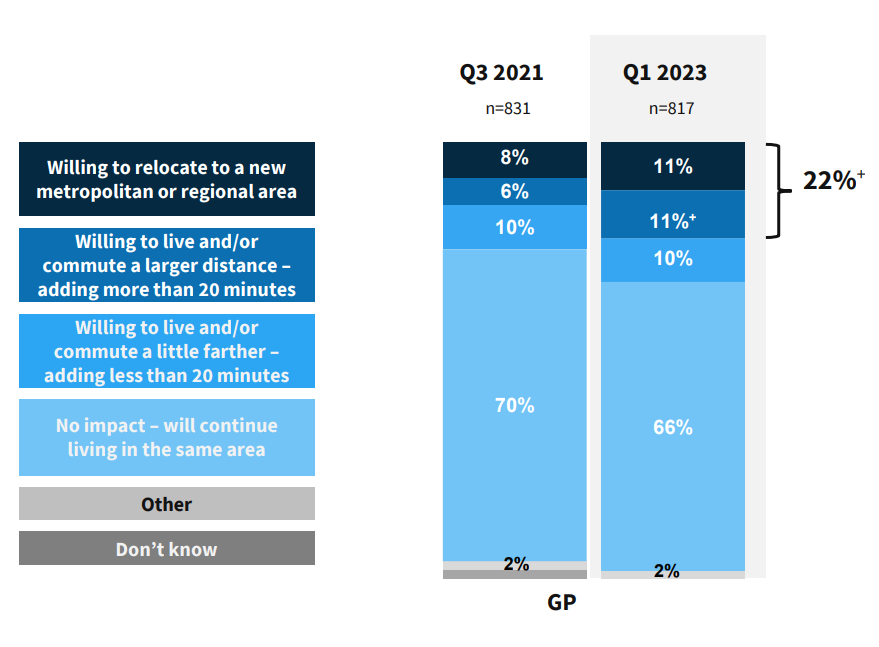
A new study from Fannie Mae has uncovered a wide range of remote work trends that have changed since the peak of the pandemic. One of the most significant stats is that remote workers are increasingly willing to move in order to find more affordable housing.

In fact, the change has been quite substantial in such a short period of time. In 2023, 22% of employees noted that they were willing to move cities while remote working for the purpose of moving to a more affordable area, while only 14% said the same in 2021.


About Tech.co Video Thumbnail Showing Lead Writer Conor Cawley Smiling Next to Tech.co LogoThis just in! View
the top business tech deals for 2026 👨‍💻
See the list button

Remote Work Relocation Graph

More importantly, this sentiment is shared across all income and age groups, although younger employees — those between the age of 18 and 34 — were notably more willing and experiencing a higher increase. Those workers were only 18% open to moving for affordable housing in 2021, as opposed to 30% in 2023.

Why Are Remote Workers More Willing to Move?

So, what exactly is the reason for this shifting trend? Well, the researchers from Fannie Mae have one theory:

“We believe this greater willingness to live farther from the workplace may be an indication that some workers are feeling more secure about their remote work situation or their ability to find another job if their current employer were to change its policies.” – Fannie Mae researchers

That may very well be the case, although other studies about the decreasing prevalence of remote work opportunities might undermine that theory, or at least leave these employees in trouble if anything goes wrong.

In all likelihood, the main driver of this willingness to move is sky high housing prices that have gripped the entire country. Rent is higher, mortgages are higher, home prices are higher, and the availability of new homes is dwindling by the day. As a result, workers are willing to do whatever it takes to be more financially stable.

The Value of Remote Work

With all the return-to-office mandates being announced — and receiving substantial backlash — you might think that it’s time to get your employees back in the office. However, as this study and others have shown, this can have a negative impact on the financial and mental wellbeing of your employees, and therefore, the bottom-line of your business.

For starters, remote work continues to be a high priority for top talent, which means that your recruiting efforts are going to take a serious hit if you’re back in the office.  On top of that, remote workers are reportedly 22% happier than in-office employees, so if you want a satisfied workforce, working from home is an excellent option.

All that to say, remote work continues to prop up the problematic business world that refuses to raise wages in line with cost of living. And taking it away from your employees isn’t going to help, particularly if you rush the decision.

Written by:
Conor is the Lead Writer for Tech.co. For the last eight years, he’s covered everything from tech news and product reviews to digital marketing trends and business tech innovations. He's a feature, reviews, and news contributor for Android Police, and he has hosted tech-focused events for SXSW, Tech in Motion, and General Assembly, to name a few. He also cannot pronounce the word "colloquially" correctly. You can email Conor at conor@tech.co.

How To Install and Use ChatGPT Plugins Like Canva

Graphic design tool Canva now has a ChatGPT plugin, making it easier than ever to generate visuals for social media and more.

Along with learning some of the best ChatGPT prompts, a simple way to turbocharge your AI abilities is adding plugins to the popular chatbot – and one of the biggest to date has just arrived in the form of Canva.

Canva is a graphic design tool that’s especially useful for creating visuals for social media, Now, it’s even easier to use Canva thanks to a ChatGPT plugin that lets the OpenAI chatbot do most of the heavy lifting for you, adding to the list of potential ways to make money with ChatGPT.

Here’s how to install the Canva ChatGPT plugin and use it once you’re up and running.

How To Install the New Canva ChatGPT Plugin

Before you get started installing plugins on ChatGPT, one thing to know is that you’ll need to be running the premium ChatGPT Plus version of the platform. It costs $20 a month and, among other things, gives you access to the latest GPT-4 model. Currently, free ChatGPT users have a waitlist for getting access to plugin functionality.

If you’re all set up and logged in on a Plus account, then you should find it straightforward to get the Canva plugin for ChatGPT. Here’s how.


About Tech.co Video Thumbnail Showing Lead Writer Conor Cawley Smiling Next to Tech.co LogoThis just in! View
the top business tech deals for 2026 👨‍💻
See the list button

  1. Open ChatGPT in your browser
  2. Navigate to the Plugin section by hovering over the GPT-4 icon and clicking ‘plugins’
  3. Click the arrow next to the GPT-4 button, then go to the Plugin Store
  4. Search for Canva
  5. Click ‘Install’

That’s all there is to it. This process will work for installing ChatGPT plugins in general, with Slack, Zapier and Expedia just some of the other big name platforms that now have direct integrations with the popular AI platform.

How To Use the Canva Plugin on ChatGPT

Now that you’ve got the Canva ChatGPT plugin installed, you can start using it. Fortunately, this is every bit as easy as installing the add-on in the first place.

Just follow these simple steps.

  1. In the ChatGPT prompt box, describe what you what to create. For example: “I am a B2B technology website. Create me a Twitter/X banner.”
  2. ChatGPT will create a number of options for the visual you have requested.
  3. Click on the link above the one you want to use to open it in Canva
  4. Once redirected, you can finalize the design in Canva, share and download it

As you can see from the example above, Canva is a particularly useful tool for digital marketing, branding, and promotional purposes.

With AI-generated content already one of the social media trends taking 2023 by storm, Canva’s new ChatGPT plugin offers further proof of AI’s potential in the workplace.

Written by:
Conor is the Lead Writer for Tech.co. For the last eight years, he’s covered everything from tech news and product reviews to digital marketing trends and business tech innovations. He's a feature, reviews, and news contributor for Android Police, and he has hosted tech-focused events for SXSW, Tech in Motion, and General Assembly, to name a few. He also cannot pronounce the word "colloquially" correctly. You can email Conor at conor@tech.co.

Microsoft is Killing a Much-Loved Windows App That’s 28 Years Old

Microsoft has revealed plans to shelve legacy app WordPad, encouraging those who still use choose a different app.

Microsoft has announced that it’s finally killing off WordPad, a basic word processor that has been included in every version of its flagship operating system Windows since 1995.

The company is encouraging users to make the switch to Microsoft Word or NotePad, which are used for similar tasks.

The software has been an optional feature since 2020, but now, it won’t be updated and won’t appear in any subsequent versions of Windows.

So Long, WordPad

“WordPad is no longer being updated and will be removed in a future release of Windows,” Microsoft confirmed in a documentation about soon-to-be deprecated features.

“We recommend Microsoft Word for rich text documents like .doc and .rtf and Windows Notepad for plain text documents like .txt.” the company added.

wordpad

The writing has been on the wall for some time. In 2020, the Windows 10 Insider Build 19551 was released, becoming the first version of Windows where you could uninstall WordPad in the “Optional Features” area.

This might not be the last we ever see of WordPad, however – famously, Microsoft deprecated MS Paint only to revive it and eventually give it a makeover.

Cortana also Axed

Cortana has also been nudged onto the chopping block recently, seemingly a victim of Microsoft’s continued and increasing focus on next-generation AI tools.

Cortana is Microsoft’s digital assistant app, first released to the public almost a decade ago, back in 2014. It will officially end life as a standalone app by the end of the year.

There are several apps where Cortana will remain available during a transitional period, however, including Outlook on mobile, Teams on mobile, and Microsoft Teams Rooms.


About Tech.co Video Thumbnail Showing Lead Writer Conor Cawley Smiling Next to Tech.co LogoThis just in! View
the top business tech deals for 2026 👨‍💻
See the list button

NotePad Gets an Upgrade

Just a few days prior to the announcement that WordPad would be deprecated, a significant upgrade to Notepad’s features was announced.

A Windows Insider blog post authored by Dave Grochocki details that “Notepad will start automatically saving your session state allowing you to close Notepad without any interrupting dialogs and then pick up where you left off when you return.”

Notepad will also “automatically restore previously open tabs as well as unsaved content and edits across those open tabs.”

These updates will make it a significantly more capable program that, along with the more powerful Microsoft Word, will satisfy any particularly disgruntled WordPad fanatics.

Written by:
Conor is the Lead Writer for Tech.co. For the last eight years, he’s covered everything from tech news and product reviews to digital marketing trends and business tech innovations. He's a feature, reviews, and news contributor for Android Police, and he has hosted tech-focused events for SXSW, Tech in Motion, and General Assembly, to name a few. He also cannot pronounce the word "colloquially" correctly. You can email Conor at conor@tech.co.

Microsoft Reveals AI-Powered Backpack as School Year Begins

The wearable tech has a lot of interesting, useful and imaginative features, but there are also some privacy concerns.

Although the timing is likely to be a coincidence, ChatGPT bankrollers Microsoft has had its patent for an AI-powered backpack approved with back-to-school season in full swing.

The backpack has a variety of interesting features, including voice and audio capabilities, as well as sensors that can extract information about the surrounding environment.

Will the backpack usher in a new era of functional, wearable digital assistants – or will it suffer the same fate as many other wearable tech products that haven’t taken failed spectacularly?

Everything You Need to Know About Microsoft’s AI Backpack

Microsoft’s patent for an AI-powered backpack with a slew of novel features was approved last week by the US Patent and Trademark Office.

According to the patent application, the AI-powered backpack “may include sensors, such as a microphone and camera”, and will be able to recognize “contextual voice commands” that include a “non-explicit reference to an object in an environment”.

The first diagram in the patent application shows it being worn by a skier, who is advised by the backpack to avoid a nearby out-of-bounds area.


About Tech.co Video Thumbnail Showing Lead Writer Conor Cawley Smiling Next to Tech.co LogoThis just in! View
the top business tech deals for 2026 👨‍💻
See the list button

Another shows a person looking at a poster for an upcoming concert, and booking tickets by asking the backpack.

It says further along in the patent that the product may include a GPS unit, a compass for sensing cardinal direction, a thermometer and a barometer.

According to the application, the backpack would also include biometric sensors that can measure heart rate, blood pressure, and blood sugar levels.  The backpack may even be able to be aware of its own contents via RFID tags.

Privacy concerns

Although the backpack seems to be built with the capacity to collect a lot of biometric data about wearers, there are some privacy stipulations mentioned.

Microsoft suggests, for instance, that the backpack could encrypt user data, have stringent rules around how long it can store it, and only perform specific functions with express consent from the wearer.

This is just a prototype, of course – and it would be somewhat surprising if Microsoft was planning on storing every user’s data locally.

Wearable Tech: A Hit and Miss Story

“Wearable tech” is a category of products that includes some of the world’s most fascinating technological inventions, but is also littered with catastrophic failures.

The Logbar Ring – designed to give users the power to control a range of technological appliances via hand gesture commands – is often described as one of the worst products ever made.

But it’s not just small wearable tech products that haven’t succeeded – who can forget Google Glass, which failed to secure widespread uptake due to poor battery life, sub-par functionality and a hefty price tag.

Whether Microsoft’s AI-powered backpack would go down well isn’t clear from the patents.

There’s an argument that it could have niche appeal for extreme sports junkies. As the diagram in the patent suggests, skiers may benefit from safety information and data about the surrounding terrain.

However, as is the case with other types of wearable tech, there are a myriad of privacy concerns that the manufacturers will have to deal with.

Besides, would you really ask your backpack to book a concert ticket, or would you just whip out your mobile phone? And would you feel comfortable speaking out loud, in public, to your backpack?

However capable the backpack ends up being, there will be challenging obstacles that this type of tech would have to face if it went to market.

Written by:
Conor is the Lead Writer for Tech.co. For the last eight years, he’s covered everything from tech news and product reviews to digital marketing trends and business tech innovations. He's a feature, reviews, and news contributor for Android Police, and he has hosted tech-focused events for SXSW, Tech in Motion, and General Assembly, to name a few. He also cannot pronounce the word "colloquially" correctly. You can email Conor at conor@tech.co.

Why You Haven’t Received Your Facebook Settlement Payment Yet

If you applied for a portion of Meta's multi-million dollar lawsuit settlement, you won't be getting your money just yet.

Facebook users who claimed a portion of the $725 million settlement fee that the social media site was ordered to pay as part of a privacy settlement will have to wait a little longer to find out exactly how much they’ve been repaid.

The payments cannot be released until the settlement is given final approval by a judge, with the hearing due to take place on September 7 in San Francisco.

Facebook Settlement: Final Approval Required

Although it may seem like the Facebook settlement lawsuit is all wrapped up, there are still some final steps that need to be taken before Meta will start to send everyone’s payments.

At the hearing scheduled for September 7, a judge will determine whether the settlement is a fair and reasonable outcome, and decide whether the fees paid to lawyers as part of the settlement should be approved.

However, even if the settlement is granted final approval, there could still be some things that hold up payments being sent. For instance, Meta could appeal the settlement, and in the process, hold up the payments for years.


About Tech.co Video Thumbnail Showing Lead Writer Conor Cawley Smiling Next to Tech.co LogoThis just in! View
the top business tech deals for 2026 👨‍💻
See the list button

Why Is Facebook Paying Users Back?

Facebook is settling a $725 million class action lawsuit that alleges that the social media platform shared its users’ private information with third parties without their consent.

Among the third parties was Cambridge Analytica, which gained access to information pertaining to 87 million Facebook users via the platform’s shady data practices.

The timeframe to be eligible for a payment is huge. Anyone who used Facebook between May 24, 2007, and December 22, 2022, may be eligible for a slice of the settlement pie.

How Much Will I get From the Facebook Settlement?

The deadline to apply for part of the settlement has long passed, and if you haven’t done so already, unfortunately, it’s no longer possible to.

However, if you did apply in time and you’re currently awaiting a payment from the social media giant, you’ll probably be sent around $7, according to some educated estimates.

However, there’s a points system for deciding precisely how much each individual will get paid, and the longer you’ve held your account, the more ‘points’ you’ll be awarded.

The claims website did note, however, that the lawyers involved in securing the settlement may take up to 25% of the total fee – which amounts to over $180 million. This would reduce the total size of the money available for claimants significantly.

Even so, it’s worth keeping a close eye on the outcome of the settlement’s final approval hearing on September 7.

Written by:
Conor is the Lead Writer for Tech.co. For the last eight years, he’s covered everything from tech news and product reviews to digital marketing trends and business tech innovations. He's a feature, reviews, and news contributor for Android Police, and he has hosted tech-focused events for SXSW, Tech in Motion, and General Assembly, to name a few. He also cannot pronounce the word "colloquially" correctly. You can email Conor at conor@tech.co.

Salesforce and IBM Are Now Friends With AI Benefits

In a major enterprise deal, Salesforce and its AI tools will now be offered as part of IBM's Garage consultancy product.

Salesforce has announced a partnership with IBM that will make the popular CRM software provider’s suite of enterprise AI tools available to customers of both companies.

Specifically, the IBM Consulting arm of Big Blue will now offer implementation of Salesforce’s AI tools – which include Sales GPT, Service GPT, Salesforce Einstein, Slack GPT and Marketing GPT – as a feature of its Garage digital transformation proposition.

In practice, this means that businesses that turn to IBM’s consultancy expertise will now be helped to deploy Salesforce and all of its AI powers, in a landmark tie-up for both sides.

What Does IBM Get From New Salesforce Partnership?

IBM’s end of the bargain is, first and foremost, that its 160,000-strong army of human consultants will be helping businesses get up and running with Salesforce and its shiny new AI capabilities. Which obviously sounds like a great deal for Salesforce!

There’s more to it than just that, though. For its part, IBM will be hoping to use the process of Salesforce adoption to promote its Watsonx enterprise AI platform, which helps companies use the “data locked in backend systems” to more effectively inform software systems like, well, Salesforce.


About Tech.co Video Thumbnail Showing Lead Writer Conor Cawley Smiling Next to Tech.co LogoThis just in! View
the top business tech deals for 2026 👨‍💻
See the list button

Big Blue will go a step further and also push its industry-specific Data Classifier as a solution to help companies map their data and make it more usable by AI tools like, well, Salesforce again. So it’s far from a one-way street.

Salesforce and IBM: Friends With Benefits

In many ways, it’s a logical progression for IBM and Salesforce’s existing relationship. Big Blue has used Salesforce alongside Watsonx to improve its own sales and services processes over the years, so it’s like going from friends to friends with benefits for the two enterprise powerhouses. Or diversifying their partner ecosystems, if you prefer.

The new offering will be available immediately through IBM Consulting and its products, namely IBM Garage. Pricing is quoted on an individual client basis by IBM.

For its part, Salesforce pricing will remain unchanged by the tie-up, having already increased in August for the first time in years.

Salesforce Dreams Big Ahead of Dreamforce

It has been a big week for Salesforce overall, with the CRM giant gearing up for its annual Dreamforce conference by announcing impressive Q2 2024 results.

It roundly beat expectations for both revenue and profit to the tune of 11% year-on-year growth, offering further proof that larger-than-life CEO Marc Benioff’s recent strategy of mega bucks acquisitions (Slack and Tableau) alongside internal belt tightening (it’s part of the tech layoffs club) is paying dividends, at least for investors.

It’ll cap it all off with the annual shindig that is Dreamforce from September 12-14, where presumably much of those $8.60 billion earnings have been spent paying Foo Fighters to top the bill.

Written by:
Conor is the Lead Writer for Tech.co. For the last eight years, he’s covered everything from tech news and product reviews to digital marketing trends and business tech innovations. He's a feature, reviews, and news contributor for Android Police, and he has hosted tech-focused events for SXSW, Tech in Motion, and General Assembly, to name a few. He also cannot pronounce the word "colloquially" correctly. You can email Conor at conor@tech.co.

OpenAI Prompts Teachers To Use ChatGPT at School This Year

OpenAI has released a new "Teaching with AI" guide designed to help teachers embrace ChatGPT in the new academic year.

OpenAI, the company that owns ChatGPT, has released an official guide for using its wildly popular chatbot in the classroom.

The new “Teaching with AI” guide is intended to arm educators with all the information they need to start using ChatGPT in their work. It includes practical starting points like suggested ChatGPT prompts, as well as background information such as how ChatGPT works and an explanation of some of its limitations.

It also features a handful of real world examples of teachers using ChatGPT with their students, highlighting how the chatbot could be used to stand in for a debate partners, help non-English speakers with their grammar, and – maybe controversially – build tests.

Schools Pull Major AI U-Turn Before New Year

Of course, ChatGPT being used in schools is nothing new. For students, generative AI tools have essentially replaced the bright yellow Cliff Notes books of the past, providing them with a “helping hand,” shall we say, when studying for tests and writing essays. As new technologies go, it has been controversial at times, especially given how hard it is to accurately detect ChatGPT plagiarism.

More recently, though, schools have started to jump on the bandwagon. With the new academic year now upon us, some US schools are promoting ChatGPT in the classroom. It’s a U-turn compared to the spring semester, when all the buzz in education was about banning ChatGPT.


About Tech.co Video Thumbnail Showing Lead Writer Conor Cawley Smiling Next to Tech.co LogoThis just in! View
the top business tech deals for 2026 👨‍💻
See the list button

With its new Teaching with AI guide, OpenAI seems to want to seize on the recent positive momentum shift and continue moving away from the ide that it basically helps students cheat more easily.

Examples of ChatGPT in Schools

While we were skeptical at first, some of the examples given by OpenAI of ChatGPT being used in schools are actually pretty interesting. Arguably the most insightful use case comes from Geetha Venugopal, a high school computer science teacher at the American International School in Chennai, India.

She reports that she uses ChatGPT to help students develop their critical reasoning and fact checking skills, noting that the chatbot’s occasional unreliability encourages them to confirm information with primary sources and carefully consider what kind of information they can trust on the internet.

Beyond that, the guide also highlights how teachers can ask ChatGPT to take on the persona of a student and help them create more accessible quiz questions and lesson plans.

Guide Backed Up By New FAQ

In addition to the Teaching with AI guide, OpenAI has also bolstered its informational arsenal with a dedicated new Educator FAQ section. In this, it directly addresses some of the more obvious questions surrounding AI detectors and plagiarism, saying point blank that such tools do not yet work to a reliable standard.

“While some (including OpenAI) have released tools that purport to detect AI-generated content, none of these have proven to reliably distinguish between AI-generated and human-generated content,” it writes.

The company is referring to its own failed Text Classifier plagiarism tool, which was recently pulled due to its unreliability. Instead, the company is now simply promoting an open conversation between teachers and students surrounding AI use as the best line of defense against out and out plagiarism.

We’d broadly second that, as our experiences suggests a well-trained human eye should be able to spot many instances of AI plagiarism – and there are plenty of great free AI training courses you can try to improve your overall knowledge of the booming technology.

Written by:
Conor is the Lead Writer for Tech.co. For the last eight years, he’s covered everything from tech news and product reviews to digital marketing trends and business tech innovations. He's a feature, reviews, and news contributor for Android Police, and he has hosted tech-focused events for SXSW, Tech in Motion, and General Assembly, to name a few. He also cannot pronounce the word "colloquially" correctly. You can email Conor at conor@tech.co.

5 Ways You Can Genuinely Make Money With ChatGPT

ChatGPT is great at lots of things - but can it help you make some cold, hard cash? We've found five ways to do just that.

Since its release in November 2022, millions of businesses around the world have used ChatGPT, finding inventive ways to both save time and improve their bottom line with its impressive capabilities. Now, with its limitless potential widely understood, everyone wants to learn how to make money with ChatGPT.

You can make money using ChatGPT in a variety of ways, from building out your website’s sponsored content to writing and selling an eBook on Amazon. There are specific prompts for ChatGPT that will help with these tasks and make them a little easier to achieve.

In this guide, we go through some of the different ways you can make money with ChatGPT, as well as some additional ways you can utilize the chatbot and other AI tools to help you obtain a higher income.

How to Make Money With ChatGPT

There are a variety of different ways you can use ChatGPT to help you make money, and turn tasks that would have previously taken hours into five-minute jobs. Here are some ways you can make money with ChatGPT covered in this article:

We’ll level with you here – if you find any source telling you that you can quickly make money out of ChatGPT, then unfortunately, it’s too good to be true.

ChatGPT isn’t going to spit out a winning business idea for you in seconds or build you an app from scratch. Even if it could, you’d have to develop it for weeks, months, or maybe even years to make some money. You’re not going to start making money right away, and you’re going to have to put in a little effort. But that’s not to say it isn’t game-changing.

What ChatGPT can do is significantly reduce the time it takes to make money online across a variety of different means and fill skills gaps (like basic coding skills) that may be stopping you from making money via a given means. Plus, AI tools are great at supporting you if you already pursuing a way to make money (such as trading or building a website).

That’s why we’ve focused on how ChatGPT can both kickstart and support small but real ways you can make money online.

Building an HTML website with ChatGPT

You can make money out of a simple, single-purpose HTML website that you can code using ChatGPT. Once you put the site live, all you have to do is run Google ads on the site, and it’ll be monetized for you.

First up, you need to come up with a simple, single-purpose idea. This could be anything from a percentage calculator to a word counter or a random number generator. You can use tools that measure search volumes or search trends to check if your idea has a significant amount of traffic and whether it’s worthwhile pursuing. The higher the search volume, the better.

Then, send ChatGPT some instructions like the ones we entered below to get it to return the code you need to build an HTML website:

Then, you can ask ChatGPT for instructions on how to get your website live. From there, you can leave your site to see how it does, or build it out to include more content – which might help it rank higher in the long run. Remember, if you get stuck at any point, simply ask the chatbot for more information.

Building a website with ChatGPT

First off, we’ll cut to the chase – building a more complex website than the one we mentioned just above is actually much easier with a provider like Wix or Hostinger than it is with ChatGPT at the moment, if you’re not a coding whizz with some prior website-building experience. This might not be the case for long, but right now it is.

However, once you get your website up and running, you can start using ChatGPT for almost every other job you’ll need to complete in order to actually make money out of your website. You can get ChatGPT to quickly:

  • Generate article titles for your website
  • Draft emails to product manufacturers you’d like to partner with
  • Generate article copy for different websites
  • Create content clusters around specific topics
  • Write author bios, about us pages, slogans, etc.
  • Write product descriptions for your online store

Remember, the more helpful and well-written the content on your site is, the better it’ll rank and the more people will see it. ChatGPT will ensure your copy is at a competent level, but we’d still suggest editing it after it generates it for you. Here’s some article ideas we generated for a food blog using ChatGPT, which would have otherwise taken hours to brainstorm.

ChatGPT article ideas

ChatGPT means you can build out a fully-fledged website in days, rather than weeks or even months. Of course, you’ll still have to work out how to monetize it – and you could do this by:

  • Writing sponsored product reviews/affiliate partnerships
  • Selling physical or digital products/ecommerce
  • Using Google Adsense/advertisements
  • Selling a service that you can offer (e.g. digital PR)

However, it’s important to remember that, if you want to run Adsense on your site, you’re following Google’s guidelines and providing genuinely useful content – which, as we’ve said, means some editing will likely be in order.

Writing and selling an eBook with ChatGPT

ChatGPT is good at lots of things – and one of those things is writing stories. To generate a book quickly and efficiently, break it down into blocks. ChatGPT may function better if you ask it to write a single paragraph at a time, rather than an entire book at once.

You can also elicit longer responses by simply typing “continue” when ChatGPT stops, giving you more control over how long you want your eBook to be. Alternatively, you could ask the chatbot to write a short story or children’s book aimed at a younger audience.

Remember to make your chapter prompts as detailed as possible, and give ChatGPT as much to work with as you can. This will enrich your story and ensure that it stays on the right track. We provided quite a basic prompt below, and even then, ChatGPT churned out a detailed story.

Writing a book with chatgpt

After your eBook is written, you can sell your book through Amazon’s Kindle Direct Publishing (KDP) program which allows anyone to sell and market a book.

However, you will need to edit your copy before uploading it as ChatGPT is known to hallucinate. You’ll also need a cover image, which you can make on Canva or Book Bolt. Instructions on how to quickly publish your book on Amazon’s KDP platform are provided by the tech giant.

Creating a Chrome extension with ChatGPT

ChatGPT can quite capably write Chrome extension scripts in seconds, as long as you’re clear with your prompt and you’re not asking it to code something incredibly complex. We asked ChatGPT to create a simple Chrome extension, and this is what it came up with:

Of course, ChatGPT probably won’t be able to build you a Chrome extension like Honey or Loom. However, it can be used for programming more basic things, like editing the recipes you find on Google. But think imaginatively – SearchEngineJournal, for instance, used ChatGPT to create a Chrome extension that identifies SEO elements on a page. It’s actually quite competent in this context.

ChatGPT will also be able to provide you with instructions on how to prime your Chrome extension to be uploaded as well as how to actually upload your Chrome extension to the Chrome Web Store.

It used to be really simple to make money out of Chrome extensions. Google used to let developers charge money and sifted off a 5% transaction fee. Unfortunately, however, that program depreciated a couple of years ago, so developers have to find alternative ways to make money via extensions.

Luckily, there are still other ways you can make money via Chrome extensions. For example, you could create a free extension, ask for an email address to download it, and then use that list to send out recommendations for related products. You could also create your own landing page for the extension and then take payment via a third-party provider rather than Google itself.

Creating a YouTube Channel with ChatGPT

As you’re probably already aware, YouTube channels can make money if they’re part of the YouTube Partner Program.

Google (which owns YouTube) has a page that explains the different ways you can make money via this Program, and the different thresholds for earning.

ChatGPT can actually help you with almost all of the stages of creating a YouTube Channel and populating it with content, such as:

  • Finding the niche you want to create content about
  • Brainstorming a relevant and catchy channel name
  • Coming up with ideas for videos you could make
  • Writing the scripts for the videos you’re making

You can use other AI tools to help you make the video content to go along with your scripts. If you focus on making informative, interesting content that gives people a reason to come back, then you’re going to have a better chance at making money on the platform.

Improving Your Job Prospects Using ChatGPT

You can also use ChatGPT to your advantage in work settings in a number of different ways, which can indirectly make you money by improving your chances in the job market.

  • Use ChatGPT to Refine Your Resume
  • Leverage Your ChatGPT Skills to Secure Better Jobs
  • Use ChatGPT to Brainstorm Business Ideas/obtain advice

Use ChatGPT to refine your resume

Of course, aside from setting up your own project, another way to make more money is to get a higher-paying job. If you’re on the hunt for one of those, you can use ChatGPT to refine your resume. It can make suggestions relating to the structure of your resume.

However, remember that you’re going to be inputting sensitive information about your career and life into ChatGPT, which has very little public information about how it stores data. It’s not necessarily unsafe, but we’d recommend reading OpenAI’s privacy policy before you ask it to make recommendations based on your resume.

If this sounds like something you might be interested in, head over to our page that runs through the best ChatGPT prompts, as there’s a whole section dedicated to prompts that can help you refine your resume, and practice answering interview questions.

Leverage your ChatGPT Skills to secure better jobs

It feels like there are only two types of business that now exist: those already letting their employees use AI to save valuable time, and those that want to, but aren’t quite sure exactly how it can help. There are very few businesses out there that see no way AI tools could help them in their day-to-day operations.

The key takeaway from this is that businesses are looking for employees who know how to get the best out of ChatGPT, Bard, and other AI tools.

So, using the tools in your day-to-day life to achieve tasks such as building a resume, or taking an AI training course, will signal to any prospective employers that you’re a future-proof hire.

Use ChatGPT to brainstorm business ideas

If you’re an entrepreneur and you’ve got a business idea, you could use ChatGPT to help you with background research on your business. For example, you could ask ChatGPT:

  • If another business has tried this before, and whether it was successful
  • Whether there are any legal requirements or issues with your idea
  • What your strategy should be for launching your idea

Granted, you’ll probably get more useful advice from people who have experience starting and growing businesses, but if you’re heading over to Google to answer some of the above questions, you may find turning to ChatGPT saves tiy a little bit of time.

How to Make Money With Other Chatbots and AI Tools

There are ways to make money with ChatGPT alternatives – as well as other AI tools – via affiliate programs. ChatGPT doesn’t have an affiliate program itself, but many of its competitors do.

You will need your own website or blog, but if you’re already creating content for free, this could be a way to monetize your site. Alternatively, you could use a website builder with AI capabilities to quickly design a website for you.

ChatSonic, for example, has an affiliate program through which partners can earn up to 30% of a sale for every paid customer they refer. Jasper AI, which is a generative AI tool geared towards small and medium-sized businesses, also runs an affiliate program. Anyword, on the other hand, will pay you up to $1,149 for a single conversion.

Other AI tools, like Quillbot, have similar affiliate programs within which partners can earn different amounts of commission depending on the plans that users buy.

If you’d like to capitalize on the number of individuals and businesses currently looking for AI tools, then this could be a way forward – even if it doesn’t involve ChatGPT.

How to Make Money With ChatGPT: FAQS

Yes – there are various ways you can make money from ChatGPT. It can code Chrome extensions, HTML webpages, and other assets that you can then go on to monetize. Another popular method for making money out of ChatGPT is getting it to write eBooks which you can then publish on Amazon. However, it’s most useful to view ChatGPT as a tool that can support you on these ventures, rather than something that will give you a money-generating, fully-fledged idea in minutes.

Yes – you can, for example, call in ChatGPT’s support to help you build a website, run advertisements on the site, and then earn money without doing anything at all. However, setting up the website still takes some time and it’ll take more time after that for it to get indexed by Google and rank for the key word you’re targeting.

No! If you’re thinking about investing in companies producing artificial intelligence tools, then you’re certainly not too late to the party – AI is going to have a transformative impact on businesses for years to come. In terms of using ChatGPT to make money, it’s also not too late – new ways to do so are cropping up all the time. However, it’s not an easy process – you’ll still have to put effort into building a website or creating a YouTube channel if you want to use ChatGPT to make money.
Written by:
Conor is the Lead Writer for Tech.co. For the last eight years, he’s covered everything from tech news and product reviews to digital marketing trends and business tech innovations. He's a feature, reviews, and news contributor for Android Police, and he has hosted tech-focused events for SXSW, Tech in Motion, and General Assembly, to name a few. He also cannot pronounce the word "colloquially" correctly. You can email Conor at conor@tech.co.

How To Stop Facebook Using Your Personal Data To Train AI

A new Facebook privacy option lets you ask the social network not to use your data to train AI. Here's where to find it.

Meta has quietly introduced a Facebook privacy setting where you can request to restrict your data from being used to train its generative AI models. Here’s what you need to know about the new option, including how to access it and stop Facebook using your data to train AI.

If you’re unhappy about how much data Facebook collects and how it’s used, the alternative has long been to delete Facebook entirely. However, if it’s having your data scraped to train AI models that you specifically object to, then this looks like a useful new privacy feature.

How much mileage you get from your opt out request may vary depending on your location, but it’s worth a shot and at least partially addresses one of the AI ethics issues that has arisen as the technology booms in 2023.


How To Find Facebook’s New AI Privacy Setting

We say Facebook has “quietly” launched its new AI privacy option because the page you need is buried in the platform’s Privacy Center. It’s not easy to find, but there are two ways you can do it.

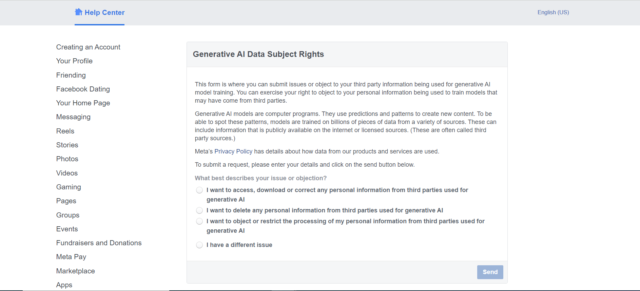
The easiest is to take the shortcut and jump straight to the Generative AI Data Subject Rights form here. However, you can also do it manually on the site by following these simple steps:

  1. Click on your account icon in the top right-hand corner
  2. Select “Settings & privacy” then go to “Privacy Center”
  3. On the left-hand nav menu, click “Other policies and articles”
  4. Select “How Meta uses information for generative AI models”
  5. Scroll down and click “Learn more and submit requests here”

Once you’ve arrived at the Generative AI Data Subject Rights form, you can then select what kind of request you want to make.


About Tech.co Video Thumbnail Showing Lead Writer Conor Cawley Smiling Next to Tech.co LogoThis just in! View
the top business tech deals for 2026 👨‍💻
See the list button

How To Opt Out of Your Facebook Data Training AI

You’ll find three main options on the Generative AI Data Subject Rights page related to how personal information “from third parties [is] used for generative AI”.

In short, you can now ask Facebook to:

  • Access, download or correct personal information
  • Delete personal information
  • Restrict the processing of personal information

The third option, “I want to object or restrict the processing of my personal information from third parties used for generative AI”, is the one you should select if you want to ask Facebook to stop using your data to train its AI models. The first two let you see what data has already been used and delete what’s currently on file, respectively.

There’s also a fourth and final option to report “a different issue”, if you want to make a bespoke request.

Screenshot of Facebook's Generative AI Privacy Page

Will Facebook Actually Stop Using My Data To Train AI?

That’s the big question. You’ll have noticed that what you’re actually doing here is asking Facebook to stop using your data to train generative AI tools like Llama 2 – it’s not a straight “opt out”, but rather a request.

Whether or not Facebook grants it remains to be seen and much will depend on where you’re located. Some places, like the EU and UK, have more robust data privacy laws than others. The likelihood is that Facebook users there will have their request granted.

It’s less clear how willing the company will be in the US, where data protection laws are less strict. Our team in both the US and UK have filed the above requests and will update this article as soon as we learn more, including what kind of rough timeframe Meta is operating on with its responses.

In the meantime, don’t forget that you can easily boost your data privacy by using one of the best cheap VPNs, which effectively let you anonymize your online activity by encrypting your data and rerouting your IP address.

Written by:
Conor is the Lead Writer for Tech.co. For the last eight years, he’s covered everything from tech news and product reviews to digital marketing trends and business tech innovations. He's a feature, reviews, and news contributor for Android Police, and he has hosted tech-focused events for SXSW, Tech in Motion, and General Assembly, to name a few. He also cannot pronounce the word "colloquially" correctly. You can email Conor at conor@tech.co.

Now X/Twitter Wants Your Biometric Data and Employment History

The new TOS goes into effect on September 29, so you'll have until then to keep your biometric data to yourself.

Data privacy is important to many people in the tech industry. To them, we say: It’s time to get off of X/Twitter.

A new privacy policy is arriving for X, the social media platform formerly known as Twitter, and it gives the company the right to scoop up a ton of sensitive personal data.

Your biometric information, your school history, and your employment history are just a few of the details on the list.

What X/Twitter’s New Terms of Service Require

The new TOS goes into effect on September 29, so you’ll have until then to keep your biometric data secure, since the current privacy policy will leave it alone.

Here’s a small slice of the updated TOS, which can be read in full here:


About Tech.co Video Thumbnail Showing Lead Writer Conor Cawley Smiling Next to Tech.co LogoThis just in! View
the top business tech deals for 2026 👨‍💻
See the list button

  • Biometric Information. Based on your consent, we may collect and use your biometric information for safety, security, and identification purposes.
  • Job Applications / Recommendations. We may collect and use your personal information (such as your employment history, educational history, employment preferences, skills and abilities, job search activity and engagement, and so on) to recommend potential jobs for you, to share with potential employers when you apply for a job, to enable employers to find potential candidates, and to show you more relevant advertising.

The new policy doesn’t get any more specific than that for many of the categories of data that it wants you to allow it access to. What kind of biometrics can be harvested? Face scans, for unlocking the app? How long will they keep your employment history? Can it be bought or sold to third parties?

These questions have kept IT professionals concerned all across the tech industry for decades. Facebook’s lax standards on which companies it allowed to access user data have been tied to shadowy political movements around the world, for instance.

Other tech companies including Google, YouTube, Fitbit, and many telecom giants have all gotten in hot water for their data collection policies. So has Twitter, even under its previous owners and its less intense TOS.

Last year, the TikTok head of global security, Roland Cloutier, stepped down over questions about what one report termed the platform’s “excessive” levels of data harvesting. It’s a serious concern that remains a hot topic.

What’s Next for X/Twitter?

Say what you will about the social media platform, there’s no escaping the exhaustingly rapid-fire news cycles that X/Twitter manages to stay in the center of.

Recently, we’ve seen news about: The announcement that headlines will be removed from news articles posted on the service, the $350,000 that the DOJ fined the company for delaying a data handover, a bill from San Francisco city authorities for installing a since-removed “X” sign on its building, and a lawsuit from the oldest news agency in the world over failing to pay for its services.

And that’s just news that broke this month.

I guess if we think about the screentime we’ve collectively donated in order to read all these stories as a type of biometric data, we’re losing plenty of it to X/Twitter already.

Written by:
Conor is the Lead Writer for Tech.co. For the last eight years, he’s covered everything from tech news and product reviews to digital marketing trends and business tech innovations. He's a feature, reviews, and news contributor for Android Police, and he has hosted tech-focused events for SXSW, Tech in Motion, and General Assembly, to name a few. He also cannot pronounce the word "colloquially" correctly. You can email Conor at conor@tech.co.

Microsoft Is Unbundling Teams and Office… But Only in Europe

Enterprise customers can soon get Teams all by itself for €5 per month, following a years-long EU antitrust probe.

Microsoft is allowing European customers to buy its Teams business communication platform without shelling out for a bundle that includes the rest of the Microsoft Office suite.

Why won’t US customers get the same benefit? Well, it’s happening in the wake of an EU antitrust probe, and there isn’t a US counterpart forcing Microsoft’s hand.

The change will go live starting on the first day of October this year, and any Microsoft customer based in the EU will be able to take advantage in a few different ways.

How Can Customers Save Money (Aside From Being European)?

Once the unbundling option is available to the public across the EU, enterprise users will be able to buy Teams all by itself for €5 (that’s about $5.4) per month.

Meanwhile, the EU enterprise customers who were already paying for everything will now have the option to drop €2 or about $2.2 per month off of the price tag for Microsoft 365 and Office 365 — as long as they chose to drop access to Teams.


About Tech.co Video Thumbnail Showing Lead Writer Conor Cawley Smiling Next to Tech.co LogoThis just in! View
the top business tech deals for 2026 👨‍💻
See the list button

Small businesses and “frontline workers” in the EU will also be able to get similarly unbundled deals, although no exact prices have been revealed.

In a blog post announcing the unbundling, the tech giant’s vice-president for European government affairs, Nanna-Louise Linde, explained the reasoning behind the change, saying “We believe these changes balance the interests of our competitors with those of European business customers, providing them with access to the best possible solutions at competitive prices.”

Competitors Like Zoom and Slack Now Have an Opportunity

The real winners here are the competitors that Microsoft seems to have been trying to shut out from its software suite: Zoom, Slack, and other huge communications platforms often used by businesses.

Customers can now easily keep using other Microsoft products while skipping Teams in favor of their favorite video or chat communication service.

The EU investigation was actually triggered by Slack, in fact, since that company was the first to allege, back in 2020, that Microsoft had illegally restricted Teams by packaging it up with the rest of its business software.

Which Web Conferencing Tool Is Actually the Best?

If you really want to ditch Teams, our top pick for video conferencing apps specifically is RingCentral, due to its high call limits, customizability, and decent price tag.

But we’ve got more guides for the discerning customer, as well: Check out the Best Video Conferencing Equipment for a look at the hardware setups that can power video or audio meetings, or dip a toe in the options available for the Best Conference Call Services.

We analyze options like Zoho Meeting, GoTo Meeting, and Webex alongside trusted names like Zoom — all to track down the best pros, the worst cons, and the most accurate prices to expect.

Written by:
Conor is the Lead Writer for Tech.co. For the last eight years, he’s covered everything from tech news and product reviews to digital marketing trends and business tech innovations. He's a feature, reviews, and news contributor for Android Police, and he has hosted tech-focused events for SXSW, Tech in Motion, and General Assembly, to name a few. He also cannot pronounce the word "colloquially" correctly. You can email Conor at conor@tech.co.

Shopify Now Supports Amazon’s “Buy With Prime” Button in Its Stores

Once installed, the feature can be used only by US-based merchants who already use Amazon's fulfillment network.

Shopify and Amazon are two big competitors in the ecommerce industry, which is why their new team-up might raise a few eyebrows: Shopify merchants can now add a “Buy with Prime” option to their Shopify stores.

The tool helps customers buy Shopify products with their Amazon wallet.

This helps the customer, who receives a faster, easier checkout process (including that famous fast and free Amazon delivery). It helps Shopify, since they get the money. And it even helps Amazon, which gets to cement its Amazon wallet payments system as a one-stop solution for any online shopping.

How the New “Buy With Prime” Button Works

The button is an app, released by Amazon and soon to be available through Shopify’s integrations store. Once installed, the feature can be used only by US-based merchants who already use Amazon’s fulfillment network.

These stores can offer Buy With Prime to users within their Shopify Checkout, and it will be processed by Shopify Payments.


About Tech.co Video Thumbnail Showing Lead Writer Conor Cawley Smiling Next to Tech.co LogoThis just in! View
the top business tech deals for 2026 👨‍💻
See the list button

Shopify notes in its announcement that this allows merchants to “maintain 100% control of their brand and their customer data in Shopify’s admin,” and Shopify president Harley Finkelstein sums up the benefits, saying that more choice “means more opportunities to succeed as an entrepreneur; and that’s what we are powering here at Shopify.”

That final line is admirable — even if it doesn’t seem to have always been Shopify’s official stance.

Is the Shopify/Amazon Rivalry a Thing of the Past?

Shopify and Amazon have long competed over the same audience base: Small-time ecommerce store operators. In fact, just one short year ago, Tech.co covered Shopify’s very vocal objections to the very tool that it now supports. Here’s how I explained it at the time:

“Shopify is laying down the law: Ecommerce sellers must use Shopify Checkout and can’t opt for Amazon’s ‘Buy With Prime’ checkout integration. In fact, using anything other than Shopify Checkout is against the ecommerce giant’s terms of service.

Shopify’s reasoning cites several security concerns — the potential for stolen data and the lack of Shopify’s own fraud protection. Is Shopify concerned about security or more interested in keeping Amazon from growing its lucrative stake in the ecommerce space? Whatever the case, the two companies remain giants in the industry, so this isn’t a clash that any small business owners who sell online can ignore.”

At the time, Shopify went as far as to warn users if they had the Amazon button, saying “You have a code snippet on your storefront that violates Shopify’s Terms of Service.” Fast forward a year, and Shopify has fully reversed this decision. But why?

There’s one likely explanation, embodied in the adage “if you can’t beat them, join them.” Amazon is a the 800-pound gorilla of ecommerce, and it wants to expand into offering up Amazon wallet funds across the internet, even if the shopper isn’t on Amazon.com itself. Shopify initially resisted, but a smaller slice of the ecommerce pie is better than nothing.

Customers and Merchants Both Benefit From Extra Payments Flexibility

This change works out well for merchants, who can combine the wide-reaching scope of Amazon’s payments system with the undeniable benefits of operating a Shopify store.

After all, we rank Shopify as the number one website builder for anyone who needs to sell products online, thanks to features, ease of use, and pricing.

Some recent policy changes at Shopify and Amazon are keeping the pressure on small-time ecommerce owners with extra hoops to jump through such as added fees and reduced benefits. But their new collaboration indicates that customers and sellers can still benefit when the two decide to work together.

Written by:
Conor is the Lead Writer for Tech.co. For the last eight years, he’s covered everything from tech news and product reviews to digital marketing trends and business tech innovations. He's a feature, reviews, and news contributor for Android Police, and he has hosted tech-focused events for SXSW, Tech in Motion, and General Assembly, to name a few. He also cannot pronounce the word "colloquially" correctly. You can email Conor at conor@tech.co.

Meta Deletes Thousands of Facebook and Insta ‘Spamouflage’ Accounts

In a new report, the social media giant reveals that it has thwarted a huge covert influence operation linked to China.

Meta has deleted thousands of fake accounts being leveraged by a Chinese network to spread disinformation across its social media platforms, which has been dubbed “the largest known cross-platform covert influence operation in the world”.

The accounts – many of which have operated on Facebook and Instagram for years – were mainly targeting users in Australia. Meta said there was ample evidence that the campaign extended across YouTube, Medium, X/Twitter, and various other sites. 

The operation has been tracked for over four years, referred to as “Spamouflage Dragon” or just “Spamouflage” by social media analytics firm Graphika and the Australian Strategic Policy Group since 2019, who were among the first to spot it.

Meta Deletes Thousands of Fake Accounts

Meta has deleted over seven thousand Facebook accounts and almost one thousand pages present on the social media platform, as well as 15 Instagram accounts and 15 Facebook groups, the company said in its Q2 Adversarial Threat Report, released this week.

Over half a million people followed at least one of these pages or groups, while around $3,500 was spent on advertising across the accounts.

The campaign primarily targeted users in Australia, as well as Taiwan, the US, Australia, the United Kingdom, Japan, and Chinese speakers living abroad, Meta told the Guardian.


About Tech.co Video Thumbnail Showing Lead Writer Conor Cawley Smiling Next to Tech.co LogoThis just in! View
the top business tech deals for 2026 👨‍💻
See the list button

What Was Spamouflage Designed to Achieve?

Spamouflage has been running since around 2018, according to the research teams and analytics firms that have been tracking operations since then.

The content being posted by the spam network was incredibly low quality and largely consisted of flattering commentary of China, negative portrayals of US and UK policies, and attacks on journalists and activists who have publicly criticized China.

Graphika’s 2019 report – which includes extensive examples of YouTube accounts used by these sorts of spam networks – shows how propaganda was interspersed with waves of unrelated content, in an effort to “dilute” the posts.

In its own report, Meta notes that the method of releasing specific articles across a myriad of different platforms simultaneously decreased the chances that the article would be flagged for takedown.

It was after this reporting that the operation sought to diversify its channels, moving from larger platforms like Facebook to blogging networks like Medium, as well as platforms like SoundCloud.

Operations were carried out by a number of different actors across a range of locations in China. However, content direction – as well as internet infrastructure – seems to be coming from a more centralized location. The report also found at least one shared location where a lot of activity seemed to be originating.

Spamouflage Doesn’t Appear to Have Been Successful

Unlike other disinformation campaigns, the quality of the posts was extremely low. One, for instance, suggested that Queen Elizabeth II’s death had been quickened due to former UK Prime Minister Liz Truss’s appointment.

Another post attempted to spread the false accusation that Covid-19 actually originated in the US – which included a fake research paper riddled with spelling mistakes.

With this in mind, it’s hard to say that the campaign had any quantifiable impact on the social media users it was supposed to be targeting.

What’s more, Meta says that many of the 560,000 accounts following pages maintained by the spam network were themselves bots, which would likely have been the case when the pages were acquired. A lot of the engagement on the posts – such as comments – were often left by accounts linked to the network itself.

Although it seems the operation failed to have the desired effect, it’s a grim reminder of the ways that social media networks can be leveraged during disinformation operations by political actors and that these sorts of tactics will persist for years to come.

Written by:
Conor is the Lead Writer for Tech.co. For the last eight years, he’s covered everything from tech news and product reviews to digital marketing trends and business tech innovations. He's a feature, reviews, and news contributor for Android Police, and he has hosted tech-focused events for SXSW, Tech in Motion, and General Assembly, to name a few. He also cannot pronounce the word "colloquially" correctly. You can email Conor at conor@tech.co.

OpenAI Launches ChatGPT Enterprise for Large Businesses

ChatGPT Enterprise is being marketed as an AI Swiss army knife for businesses, but is it enough to keep OpenAI profitable?

Artificial research company OpenAI has just launched ChatGPT Enterprise — a business-focused chatbot with enhanced privacy and data analytics features, as well as unlimited access to GPT-4.

The package, which has been in development for just under a year, also boasts faster load times and broader context limits than standard ChatGPT, making it more adept at keeping track of recent conversations.

This new product is being marketed as a powerful one-size-fits-all chatbot for larger businesses. But with a recent report from Analytics India Magazine predicting that OpenAI could go bankrupt by 2024, is the launch of ChatGPT Enterprise enough to bring the company out of the red?

OpenAI Releases Swiss Army Knife for Businesses: ChatGPT Enterprise

Silicon Valley AI lab OpenAI has just released ChatGPT Enterprise, in the company’s biggest move since the launch of its flagship chatbot.

According to OpenAI’s chief operating officer Brad Lightcap, the chatbot has been designed to help employees learn new concepts and skills — like coding and data analysis — and runs up to twice as fast as the paid version of ChatGPT.


About Tech.co Video Thumbnail Showing Lead Writer Conor Cawley Smiling Next to Tech.co LogoThis just in! View
the top business tech deals for 2026 👨‍💻
See the list button

With the research company recently getting in hot water for its opaque data collection practices, Lightcap has also reassured businesses that user data will be encrypted and that no information will be used to train language models GPT-3 or GPT-4.

“We do not train on your business data or conversations, and our models don’t learn from your usage.” – OpenAI blog post

The product launch is focusing on large corporations, but the company says it will be releasing another version for smaller businesses soon. Since the chatbot is tailored towards bigger enterprises, prices for the service will be determined on a case-by-case basis, unlike with the ChatGPT’s Plus plan that costs $20 per month.

ChatGPT Enterprise has been in development for several months and was developed with the help of over 20 companies. Beta users include major names like Block, The Estée Lauder Companies, PwC, and Canva.

This product draws many comparisons to Bing Chat Enterprise, an AI-powered business chatbot that was launched six weeks ago. This awkwardly places OpenAI in direct competition with Microsoft, its commercial partner, and biggest financial backer.

But what exactly does ChatGPT Enterprise do differently — and why should businesses opt for the new release over ChatGPT’s free service or ChatGPT Plus?

How Does the Chatbot Differ From Other ChatGPT Tiers?

ChatGPT Enterprise offers a number of business-orientated perks compared to its free and Plus chatbot tiers, including:

  • Unlimited access to Advanced Data Analysis (FKA Code Interpreter)
  • New admin console with single-sign-on options and domain verification
  • Priority access to GPT-4 (including no usage caps and x2 loading speeds)
  • Credits to OpenAI’s API platform
  • Longer context windows (32,200-tokens) for processing longer inputs
  • Enhanced customizability options
  • Enterprise-grade security and privacy protocols
  • Sharable chat templates to build common workflows

Read OpenAI’s recent blog post to learn more about the company’s new Enterprise solution.

Is ChatGPT Enterprise Enough to Rescue OpenAI?

ChatGPT became the fastest-growing app globally back in 2022. But as the initial buzz surrounding AI simmers down and users flock to copycat alternatives, the future of the AI powerhouse no longer looks secure.

According to a recent report from Analytics India Magazine, it’s costing the company an eye-watering $700,000 per day to keep its flagship product, ChatGPT, running. Combine this with the chatbot’s dropping user numbers — which fell by 21% from May to Juneand you’ve got a recipe for bankruptcy on your hands.

However, the company’s not ready to throw in the towel just yet. OpenAI is still benefiting from a very lucrative partnership with Microsoft and still serves around 200 million active users.

Moreover, with almost half of businesses reporting to use ChatGPT in some capacity, and this percentage expecting to rise going forward, it’s likely that OpenAI’s new Enterprise chatbot could be a major golden goose for the AI lab.

Written by:
Conor is the Lead Writer for Tech.co. For the last eight years, he’s covered everything from tech news and product reviews to digital marketing trends and business tech innovations. He's a feature, reviews, and news contributor for Android Police, and he has hosted tech-focused events for SXSW, Tech in Motion, and General Assembly, to name a few. He also cannot pronounce the word "colloquially" correctly. You can email Conor at conor@tech.co.

Is ChatGPT Down? Thousands Report Strange New Issue Today

ChatGPT is down for a number of users around the world today - and what's even more interesting is the issue itself.

Multiple reports suggest ChatGPT is down, with issues plaguing users of both the standard chatbot and the API today (Tuesday, June 2024).

ChatGPT updated its status page at 00:21 PDT to inform users that they’re investigating a major outage. It was updated again an hour later to say that OpenAI has identified the issue and is working to mitigate it. However, it’s now been several hours since ChatGPT went down, and the issue is still reportedly unresolved, according to the OpenAI product status page.

When ChatGPT is down, it can be irritating. While you wait for OpenAI to fix ChatGPT, there are lots of things you can do if ChatGPT is down. This includes trying out some of the other chatbots on the market that have similar capabilities, such as Google Bard and Claude 2.

November ChatGPT Outage Runs Into “Thousands”

Over 3,000 users in the United States reported issues with ChatGPT via downdetector.com over the last 24 hours, with thousands of their UK counterparts doing the same. Worldwide, a huge number of people seemed unable to access ChatGPT. Users in other countries are also reporting issues.

Downdetector graph

Source: Downdetector.com

However, we’ve just tried to log back into ChatGPT and, at the time of writing, there seems to be no issue on our end. However, OpenAI says in its status update that the outage is only impacting a proportion of the chatbot’s users for now. Some sources have claimed the chatbot has become incredibly slow, taking minutes to answer basic queries.

ChatGPT Down: A Brief History of Recent Outages

ChatGPT had a pretty clear end to 2023. There were only a couple of short, partial outages during the months of September and October, followed by a reasonably high-profile outage in November which took the chatbot offline for some time.

The most recent major outage occurred in May 2024, which impaired ChatGPT’s ability to access the internet and meant that users were unable to access the chatbot’s full capabilities for more than eight hours. This was the first major outage since April 2024, which wasn’t as severe and lasted only three hours.


About Tech.co Video Thumbnail Showing Lead Writer Conor Cawley Smiling Next to Tech.co LogoThis just in! View
the top business tech deals for 2026 👨‍💻
See the list button

When Will ChatGPT Be Back Online?

OpenAI said at the time that they are still working on a fix for this outage – but it seems like it’s taking a little longer to get a grip on the problem than usual. It’s unclear at the moment what the exact nature of the problem might be, so it’s hard to predict when it’ll be up and running for everyone.

Stay tuned, as we’ll continue to update this article with the latest news on ChatGPT going down as it becomes available.

Written by:
Conor is the Lead Writer for Tech.co. For the last eight years, he’s covered everything from tech news and product reviews to digital marketing trends and business tech innovations. He's a feature, reviews, and news contributor for Android Police, and he has hosted tech-focused events for SXSW, Tech in Motion, and General Assembly, to name a few. He also cannot pronounce the word "colloquially" correctly. You can email Conor at conor@tech.co.

Amazon CEO’s Ultimatum to Remote Staff: “It’s Probably Not Going to Work”

Jassy is digging his heels in when it comes to his RTO mandate, but still doesn't have the data to back it up.

Amazon CEO Andy Jassy is remaining firm on his return to office (RTO) crackdown, telling remote workers that “it’s probably not going to work out for you at Amazon” as the “time for disagreeing” is over.

These comments were made at a “fishbowl” meeting that took place earlier this August, around three months after the CEO ordered all white-collar workers back into the office three days a week.

This is the latest development in Amazon’s turbulent RTO saga, with the e-commerce retailer falsely accusing employees of not complying with the policy earlier this month, after admitting they have “no data” to justify the new mandate.

Amazon CEO Shows Remote Employees the Door

Amazon CEO Andy Jassy is, once again, making his stance on remote work very clear.

After a very public back and forth between Amazon employees and company execs, the managing director recently told workers who weren’t willing to make it into the office three days a week to find work elsewhere, according to sources from Business Insider.


About Tech.co Video Thumbnail Showing Lead Writer Conor Cawley Smiling Next to Tech.co LogoThis just in! View
the top business tech deals for 2026 👨‍💻
See the list button

“We are going back to the office at least three days a week, and it’s not right for all of our teammates to be in three days a week and for people to refuse to do so.” – Andy Jassy to Amazon employees

The comments were made earlier this month during an internal meeting referred to within Amazon as fishbowl meetings. “It’s past the time to disagree and commit”, Jassy expressed in the call “and if you can’t disagree and commit, I also understand that, but it’s probably not going to work out for you at Amazon”.

Jassy’s words might sound harsh, but they shouldn’t come as a surprise. The New York native first unveiled his RTO plan at the beginning of the year, and in July, leaked messages revealed that if company employees refused to relocate to an office hub, they would be forced into a “voluntary resignation”.

Jassy Calls RTO Policy a “Judgement Call”

In the same fishbowl chat, Jassy also dodged questions about what data backed the mandate, despite Amazon being a company famed for making data-driven decisions.

This further antagonized current Amazon employees, with many turning to Slack to vent their frustrations. “The whole answer sounds like he’s defending making decisions without data”, one employee wrote.

Jassy instead described the policy decision as a “judgment call” instead – akin to the launch of the company’s Web Services cloud unit. He also mentioned he spoke to “60 to 80” other CEOs before making up his mind, with “virtually all of them” favoring in-person work to remote and hybrid alternatives.

However, for Amazon’s sprawling US workforce, who have long campaigned for flexible working conditions, these justifications simply aren’t good enough.

Amazon’s Tumultuous Return to Office Effort

After Amazon first urged workers to come back into the office, employees were quick to resist.

Protests began immediately after Jassy’s Feb 17 announcement, and within weeks 30,000 workers signed a petition to formally challenge the action. Unfortunately for the company’s remote workforce, this proposal was dismissed, and the ecommerce retailer marched ahead with the May return.

More protests erupted when the company’s May 31st deadline came around, with 2,000 global employees staging a walkout to challenge the policy, and issues with the company’s Climate Pledge.

Demands for flexible working have surged since the Covid-19 pandemic. However, despite shifting employee preferences, an increasing amount of businesses are rolling back liberal working policies, citing productivity concerns in a challenging macroeconomic environment.

As Jassy has made abundantly clear, remote working no longer fits in with his vision of the company. And with major companies like Disney, Meta, and Starbucks following suit, it’s likely we’re going to see a lot more RTO mandates going forward.

Written by:
Conor is the Lead Writer for Tech.co. For the last eight years, he’s covered everything from tech news and product reviews to digital marketing trends and business tech innovations. He's a feature, reviews, and news contributor for Android Police, and he has hosted tech-focused events for SXSW, Tech in Motion, and General Assembly, to name a few. He also cannot pronounce the word "colloquially" correctly. You can email Conor at conor@tech.co.

Study: Hybrids Jobs Are on the Rise as Remote Work Declines

Remote and hybrid work remain effective perks that can boost productivity, increase revenue, and attract top talent.

Flexibility is the name of the game when it comes to working accommodations, as a new study found that job listings featuring “hybrid work” are notably on the rise, while “remote work” and “work from home” are on the decline.

The business world has gone through substantial changes over the last few years, with the pandemic dramatically shifting the dialogue around commuting and in-office jobs.

While the return-to-office movement has been pushing for a return to normal, employees have enjoyed the freedom so much that hybrid jobs have become an increasingly standard practice for businesses looking to attract top talent.

Hybrid Jobs Increase, Remote Work Decreases

According to a report from GlobalData titled Global Hiring Activity – Trends & Signals, the term “hybrid work” has seen a 29% increase in job listings since last year.

“Overall interest in hybrid roles has remained intact as companies seem to be trying to strike a balance between complying with return-to-office requirements and offering work flexibility as well. Businesses across certain industries are weighing more on offering flexibility in work, resulting in an uptick in hybrid roles.” – Sherla Sriprada, business fundamentals analyst, GlobalData

However, while fully remote positions still allow businesses to take advantage of top talent across the world, the terms “remote work” and “work from home” have actually decreased year-over-year, which signals the effectiveness of the return-to-office movement that has left some employees ready to quit their jobs for more flexible accommodations.

The Value of Remote and Hybrid Work

Whether you believe in-office work is more collaborative or just want to stop wasting money on office rent, the push to get employees back to their commutes has been strong. Still, what many business owners don’t realize is that remote and hybrid work remain effective perks that can improve productivity, increase revenue, and attract top talent.

For one, a Tech.co study found that 47% of businesses noticed an increase in productivity when allowing employees to work remotely. Another study found that performance was boosted by 22% at businesses that implemented flexible work policies.


About Tech.co Video Thumbnail Showing Lead Writer Conor Cawley Smiling Next to Tech.co LogoThis just in! View
the top business tech deals for 2026 👨‍💻
See the list button

Remote and hybrid work can also be a good way to make sure your team is filled with the best of the best, as flexible work accommodations remain one of the top priorities of job applicants in 2023. In fact, some employees have noted that they would even take a pay cut if it meant keeping remote or hybrid working policies in place.

The Return to Office Backlash

Not only is promoting remote and hybrid work policies a boon for most businesses, but the inverse can actually be detrimental to your bottom line, particularly if you rush the decision. 80% of business owners wish they took more time and had more data before announcing return-to-office mandates.

If you really want to make retention a priority at your business, a return-to-office mandate is likely not the best way to go about it. One study found that 76% of employees would quit if hybrid work was taken away.

The increase in hybrid work job listings should be a big indicator of your future strategy. While fully remote work may be on the way out for a lot of businesses, getting rid of the popular perk entirely is not advised and will likely have a negative impact on your business.

Written by:
Conor is the Lead Writer for Tech.co. For the last eight years, he’s covered everything from tech news and product reviews to digital marketing trends and business tech innovations. He's a feature, reviews, and news contributor for Android Police, and he has hosted tech-focused events for SXSW, Tech in Motion, and General Assembly, to name a few. He also cannot pronounce the word "colloquially" correctly. You can email Conor at conor@tech.co.

Watch Out for This New Phishing Scam on X/Twitter

The online world can be a stressful place when it comes to protecting your data.

The new verification system on X/ Twitter is still causing problems for users, as blue-check scammers have been found to target customer service complaints on the platform.

X has been through its fair share of controversy since the tumultuous take over by Elon Musk in October 2022. The perplexing name change, the X sign fiasco, and the refusal to pay rent of all marred the transition, sending users and advertisers to other competitors.

Now, it looks like the blue check debacle isn’t even completely solved yet, as phishing attempts have been prevalent thanks to the paid-for verification system.

How the Scam Works

Reaching out to brands via X has become a common trend in recent years, with the public attention sometimes getting customer service reps to respond faster to urgent requests. However, this new scam takes advantage of this trend by responding in order to phish valuable information from unsuspecting users.

It starts with the scammer responding to customer service requests, disguised as the brand in question. What makes the scam so believable is that scammers can now purchase an $8 per month blue check from Twitter, making it seem like they are a legitimate source of customer service.


About Tech.co Video Thumbnail Showing Lead Writer Conor Cawley Smiling Next to Tech.co LogoThis just in! View
the top business tech deals for 2026 👨‍💻
See the list button

Once you’ve started a conversation, the scammer (still disguised as the brand) will request contact and financial information to provide you with a refund to your card. Unfortunately, there is, of course, no refund. Instead, your information will be used to steal money or simply sold to third parties on the dark web.

How to Avoid Getting Scammed

One of the impersonated companies responded to The Guardian when asked for comment, explaining the best way to avoid falling victim to this scam:

“If there are ever any doubts about the legitimacy of a request, customers should always err on the side of being safe and contact our official customer service team. If a customer does opt to contact us using Twitter, they should always check they are using our verified account which has a gold badge to indicate authenticity.” – a spokesperson for Booking.com

There are a few ways to protect yourself from phishing scams in general too. For starters, always verify where you are sending money or financial information before you click the button. Also, keep an eye out for spelling mistakes, grammatical errors, and other clear indicators that you aren’t speaking to a legitimate business.

How to Protect Yourself Online

Generally speaking, the online world can be a stressful place when it comes to protecting your data. There are, unfortunately, a lot of nefarious actors out there attempting to use digital illiteracy to make a quick buck.

Fortunately, there are some tools that you can use at your business to ensure that your team is as secure as possible. After all, you don’t want to be compromised and have a financial hit of, on average, more than $10 million for a data breach.

The best place to start is a VPN, which can help encrypt your team’s internet traffic, even in secured databases from your company. On top of that, a good password manager can ramp up your security in a big way, particularly considering most data breaches stem from poor password security.

Simply put, being vigilant when it comes to online security is your best bet, but a little bit of help can go a long way in shoring up your defenses.

Written by:
Conor is the Lead Writer for Tech.co. For the last eight years, he’s covered everything from tech news and product reviews to digital marketing trends and business tech innovations. He's a feature, reviews, and news contributor for Android Police, and he has hosted tech-focused events for SXSW, Tech in Motion, and General Assembly, to name a few. He also cannot pronounce the word "colloquially" correctly. You can email Conor at conor@tech.co.

Study: Most Employees Aren’t Worried About AI Taking Their Jobs

Experts say that 80% of jobs will be impacted by AI, but employees don't seem to concerned about getting fired.

Robots don’t scare us! At least, that’s how the majority of workers feel, as a new study found that most employees aren’t really worried about generative AI technology like ChatGPT taking their job.

Since launching in November 2022, ChatGPT and its many alternatives have made a big impact on the business world. From coding to responding to emails, the technology has been integrated into a wide range of business operations to save time and money.

Luckily, employees don’t seem too worried about the prospect of generative AI taking their jobs. But should they be?

Study: Most Employees Don’t Think Their Job Is at Risk from AI

A new survey from Workhuman, titled the Human Workplace Index, found that 58.4% of employees aren’t worried about AI taking their job. Additionally, 21.2% said they weren’t sure if their jobs were at risk.

This means that only 20.4% of respondents believe that their job is at risk due to generative AI technology, a surprisingly high number given the transformative nature of platforms like ChatGPT.


About Tech.co Video Thumbnail Showing Lead Writer Conor Cawley Smiling Next to Tech.co LogoThis just in! View
the top business tech deals for 2026 👨‍💻
See the list button

Employees do seem to be aware that it will have some impact, even if their jobs aren’t at risk, according to them. 41% believe that the use of generative AI tech will become part of workplace training and 34.4% believe that the use will be generally encouraged at businesses around the world.

Fear of AI Is Varied

Still, there are obviously some employees that are concerned about the risk of AI taking their job, but they aren’t worried for the same reasons.

In fact, the survey found that 55.4% of concerned employees believe that AI will outright replace their jobs, while 41.7% believe AI will make their industry or role more competitive and 30.4% believe generative AI is generally decreasing the value of their work.

The real question remains, though: Are they right to be worried or is the fear of AI overblown?

Will Employees Lose Their Jobs to AI?

There’s no sugarcoating it, employees are going to lose their jobs when it comes to generative AI. In fact, some experts have put the numbers at nearly 80% of jobs being significantly impacted by the technology in the near future.

Heck, even the founder of OpenAI, the company behind ChatGPT, has been quoted waxing poetic about the potential impacts of generative AI technology on the workplace.

“A lot of people working on AI pretend that it’s only going to be good; it’s only going to be a supplement; no one is ever going to be replaced. Jobs are definitely going to go away, full stop.” – Sam Altman, CEO of Open AI in an interview

Suffice to say, the impacts of generative AI are going to get more and more substantial as time goes on. Let’s just hope all these worry-free employees are right when it comes to the security of their positions.

Written by:
Conor is the Lead Writer for Tech.co. For the last eight years, he’s covered everything from tech news and product reviews to digital marketing trends and business tech innovations. He's a feature, reviews, and news contributor for Android Police, and he has hosted tech-focused events for SXSW, Tech in Motion, and General Assembly, to name a few. He also cannot pronounce the word "colloquially" correctly. You can email Conor at conor@tech.co.
Back to top