Twitter’s Finances Are Still in Red After 50% Drop in Ad Revenue

As rival apps flourish, Twitter’s cash flow still remains negative despite estimations made in March.

Since Elon Musk took the helm at Twitter HQ the social media company has lost almost half of its advertising revenue, according to a Tweet recently fired off by the tech entrepreneur on Sunday.

This advertiser exodus, combined with steadily rising debts which now amount to $13 billion, is keeping Twitter’s cash flow in the red, despite rash cost-cutting measures like multiple rounds of layoffs, office closures, and slashed employee paternal leave.

The company’s rocky financial situation is exacerbated by the recent release of ‘Twitter killer’ Threads — Meta’s text-based conversation app that has already surpassed 150 million downloads.

Twitter Fails to Meet Ad Revenue Targets

Nestled in between a series of controversial memes and hot takes, Elon Musk recently Tweeted that Twitter is still experiencing negative cash flow, due to a ‘~50% drop in advertising revenue’, and that they need to reach positive cash flow before having the ‘luxury of anything else.’

The Tweet also refers to Twitter’s heavy debt load, which has been growing incrementally since the billionaire took over the platform last October, and currently sits at around $13 billion.

Take back control of your data

Incogni by Surfshark can help you reclaim your information from third-party vendors.

Musk explained that “Twitter Spaces” – the company’s new live audio conversation platform – has yet to turn a profit and that the business wasn’t able to hit advertising revenue targets in June. However, he attests that “July is a bit more promising”.

These dismal financial projections fly in the face of Musk’s previous assertion that the company would be cashflow positive in June, and indicate a rocky start for new CEO Linda Yaccarino who has been implementing a series of fresh measures to try and attract advertisers back to the platform.

Twitter’s Financial Worries Deepen

Musk’s updates on Twitter’s grave financial situation come just three days after the Tesla CEO was struck by a $500 million class action lawsuit over unpaid severance payments.

The lawsuit, which was filed by Twitter’s former “Head of Total Rewards” Courtney McMillan, alleges that the company owes former workers around half a billion in severance pay, and that Musk was well aware of the established severance plan before making major reductions to the company’s headcount.

This case mirrors a similar lawsuit filed last month that takes aim at Twitter’s exec board for failing to pay workers bonuses that they were entitled to last year. Both cases accuse the company of not following through with payments promised to employees, and failing to communicate changes to affected workers.

If Twitter is forced to make these payouts, the damages will pile on the $13 billion of debt it amassed from its acquisition last year – making it even harder for the company to meet bill payments they’ve routinely been falling behind on.

Is Twitter Hanging on By a Thread?

Unfortunately for the blue bird, finances aren’t the only concern threatening the company’s survival in 2023.

Twitter is also facing rising competition from Meta-owned Threads, an insurgent text-based social media app that has already welcomed over 150 million users. Threads’ format and function are remarkably similar to Twitter’s – with both apps providing users with a way to share short messages, photos, and videos on public timelines.

Threads also has the additional benefit of being directly integrated with Instagram, allowing the photo-sharing app’s one billion users to sign up to the platform easily, and creating a verification process that’s much more legitimate and streamlined than Twitter.

This isn’t to say that Twitter is out of the race completely, however. The town-hall-style platform still offers a number of useful features that Threads lacks – including instant messaging and hashtags – and according to the troupe of Tweets Musk sent out last Sunday, the app’s usage is currently up 3.5% week on week.

Written by:
Isobel O'Sullivan (BSc) is a senior writer at Tech.co with over four years of experience covering business and technology news. Since studying Digital Anthropology at University College London (UCL), she’s been a regular contributor to Market Finance’s blog and has also worked as a freelance tech researcher. Isobel’s always up to date with the topics in employment and data security and has a specialist focus on POS and VoIP systems.

Twitter Finally Starts Sharing Ad Revenue with Creators

Elon Musk delivers on his promise to give a slice of the ad revenue pie to verified creators.

Twitter has announced that it will begin sharing a portion of its ad revenues with verified creators who are signed up for Twitter Blue, the company’s premium subscription service.

To be eligible for the program, creators must have at least 5 million impressions on their posts in each of the last 3 months and have a Stripe payment account. Once they are eligible, creators can choose to opt in to the program and start earning a share of the revenue from ads that are displayed in their replies.

The amount of revenue that creators earn will depend on a number of factors, including the number of impressions their posts receive, the type of ads that are displayed, and the overall engagement of their audience. It’s the latest move by the social media giant to steady the ship and stop creators dumping the platform in favor of one of the many Twitter alternatives that now exist.

A Major Win for Twitter Creators

The launch of the ad revenue sharing program is a major win for creators on Twitter, who have been calling on the platform to find a way to help them monetize their content for years. Now, Twitter says that creators can expect to earn “a few cents” per impression with the company’s total first payout amounting to $5 million, cumulative from February.

As well as potentially helping to attract new creators, the move seems designed to help encourage existing ones to continue making content for the platform, as the fierce new Twitter vs Threads rivalry shows no signs of going away. 

Take back control of your data

Incogni by Surfshark can help you reclaim your information from third-party vendors.

Moreover, by showing support for its top creators and incentivizing them to make more and better content, Twitter will no doubt be hoping to spur on increased engagement across its entire user base.

How Much Do Twitter Creators Earn?

Good question. A Forbes report highlighted that one of the platform’s most-followed accounts, Internet hall of fame (@InternetH0F), enjoyed a whopping payout of $107,274. Elsewhere, writer Brian Krassenstein, who has about 750,000 followers, claims that Twitter paid him $24,305. On the lower end of the scale, a creator with about 230,000 followers claims to have earned $2,236.

Of course, there are some potential downsides to the program. For example, some creators may worry that the ads will clutter up their replies and make it harder for them to engage with their audience. Additionally, the program is only available to verified creators, which means that smaller creators may not be able to benefit from it.

However, the launch of the ad revenue sharing program is a generally being received as positive step for Twitter during a challenging time headlined by billionaire owner Elon Musk stepping aside as Twitter CEO, with former NBCUniversal ads boss Linda Yaccarino taking the reins.

Most Divisive Content Paying Dividends?

However, some Twitter creators have voiced concern that the most engaging tweets are those that divide opinion and attract extreme views. 

As Farzad Mesbahi tweeted: “The more haters you have in your replies the more money you’ll make on Twitter.” To which tech tycoon Elon Musk casually rebutted: “Poetic justice.”

Another concern is that as 5 million monthly impressions is such a high bar to reach, Twitter creators will be pushed to further sensationalize their content. “Will this turn into ‘click bait headlines’ but in the form of tweets?” asks Emmet Peppers, who holds a blue tick and describes themselves as an investor.

Only time will tell, but for big name Twitter creators with the necessary reach, today is undoubtedly a good day.

Written by:
Isobel O'Sullivan (BSc) is a senior writer at Tech.co with over four years of experience covering business and technology news. Since studying Digital Anthropology at University College London (UCL), she’s been a regular contributor to Market Finance’s blog and has also worked as a freelance tech researcher. Isobel’s always up to date with the topics in employment and data security and has a specialist focus on POS and VoIP systems.

FTC Investigating ChatGPT Creator Over Personal Data Misuse

Questions are being asked by the government agency about OpenAI's use of web scraping and collecting personal data.

Microsoft-backed startup OpenAI will be probed by FTC, in investigation into claims the company misused personal data.

The Federal Trade Commission (FTC), the US’s top competition watchdog, is investigating growing suspicion that the Artificial Intelligence company, OpenAI, broke the law by scraping public data and publishing false and defamatory information.

In what is the biggest regulatory stumbling block since the launch of ChatGPT in late 2022, the 20-page letter demands OpenAI produce the records about how they address risks related to its AI models. The agency is investigating whether the company engaged in unfair or deceptive practices that resulted in “reputational harm” to consumers.

The FTC is reportedly concerned about the potential for ChatGPT to be used for harmful purposes, such as spreading misinformation or creating deepfakes. There have been multiple reports of the chatbot producing inaccurate and libelous statements about real individuals. 

An Effort to Clean Up the Wild West of the Internet?

According to a report by The Guardian, the FTC’s investigation into ChatGPT is part of a larger effort by the agency to regulate new and emerging technologies. The FTC has been particularly concerned about the potential for AI to be used for harmful purposes. In 2022, the FTC issued a report warning about the risks of AI-powered deep fakes.

The FTC’s investigation into ChatGPT is still in its early stages, but it highlights the growing concerns about the potential for AI to be used for harmful purposes.

Take back control of your data

Incogni by Surfshark can help you reclaim your information from third-party vendors.

The FTC has demanded to know whether OpenAI used an illegal process called “web scraping”  to obtain the information from the internet or purchased it from third parties. It also asks for the names of the websites that data has been taken from, as well as any steps taken to prevent personal information from being included in the training data.

The Washington Post was first to report the investigation. The FTC declined comment. OpenAI has also been contacted for comment.

What Does Investigation Mean for Consumers and Business?

The FTC’s investigation into ChatGPT is a reminder that AI is a powerful tool that can be used for both good and bad. Consumers and businesses alike need to be aware of the potential risks of AI and take steps to mitigate those risks.

Here are some tips for using AI safely and responsibly:

  • Be aware of the potential for AI to be used for harmful purposes.
  • Do your research before using any AI-powered product or service.
  • Make sure that you understand the terms of service for any AI-powered product or service that you use.
  • Be transparent about your use of AI with your customers and employees.
  • Don’t share personal or sensitive data

What’s Next for ChatGPT?

It is too early to say what the future holds for ChatGPT. However, the FTC’s investigation is likely to have a significant impact on the development of the chatbot AI.

If the FTC finds that ChatGPT poses a significant risk to consumers, OpenAI may be required to make changes to the chatbot AI. These changes could include limiting the types of conversations that ChatGPT can have, or requiring users to provide more information about themselves before using the chatbot AI.

The FTC’s investigation is also likely to raise awareness of the potential risks of AI. This could lead to more businesses and consumers being cautious about using AI-powered products and services.

Written by:
Isobel O'Sullivan (BSc) is a senior writer at Tech.co with over four years of experience covering business and technology news. Since studying Digital Anthropology at University College London (UCL), she’s been a regular contributor to Market Finance’s blog and has also worked as a freelance tech researcher. Isobel’s always up to date with the topics in employment and data security and has a specialist focus on POS and VoIP systems.

Apple Password Manager Now Available in Third-Party Browsers

Apple's password manager breaks free of Safari, and comes to Chrome, Edge, and other browsers.

Apple has just released a new update to macOS Sonoma that brings its Password Manager to Chrome, Microsoft Edge and other browsers.

This update means that Mac users who prefer to use Google Chrome, Microsoft Edge, or another browser can now take advantage of Apple‘s powerful password manager.

We explain how to install the MacOS Sonoma Beta, and how to use Apple’s password manager from any browser.

What Does the Apple Password Manager do?

On July 12, tech giant Apple announced the first public beta of macOS Sonoma — the next major update for macOS that will be available to everyone this fall. The macOS Sonoma update comprises various new features, including the Apple Password Manager development.

In addition to the Chrome extension, Apple has also released an iCloud Passwords extension for Microsoft Edge. This extension is available from the Microsoft Edge Add-ons store.

Protect your online profile

Incogni by Surfshark can help you reclaim your information from third-party vendors.

The extension will automatically autofill passwords and one-time codes, and it will also generate strong passwords for new websites.

In addition to the convenience factor, Apple Password Manager also offers a number of security benefits. Apple’s password manager uses end-to-end encryption to protect your passwords, and it also includes features like two-factor authentication and password auditing. This makes it a very secure way to store your passwords.

The Apple Password Manager becoming available on third-party browsers makes it possible for Mac users to use Apple’s password manager no matter which browser they prefer. Plus, it makes it easier for users to switch browsers without having to worry about losing their passwords.

Read our ultimate guide to creating strong passwords

How to install the MacOS Sonoma Beta

If you are interested in using Apple Password Manager in public Beta, here are the steps you need to follow:

  1. Go to Apple’s beta software portal.
  2. If you haven’t installed a public beta before, sign up with your Apple ID.
  3. Click macOS.
  4. Download the macOS Public Beta Access Utility.
  5. Run the .PKG file to sign up for beta updates.
  6. Open Software Update and install the beta.

How to Use Apple Password Manager on Any Browser

  1. Make sure that you are running macOS Sonoma or later.
  2. Install the iCloud Passwords Chrome extension or the iCloud Passwords Microsoft Edge extension.
  3. Sign in to your iCloud account in the extension.
  4. Start using your Apple passwords in Chrome or Microsoft Edge.

Other New Features from the macOS Sonoma Update

The Apple Password Manager update was not the only new feature for Mac users to look forward to this fall: 

  • This update includes interactive widgets for the desktop, making widgets more useful and more prominent. You can even use your iPhone widgets on your Mac’s desktop through a new Continuity feature.
  • There is also a new game mode designed to limit distractions while playing games.
  • Apple is also getting more serious about teleconferencing, with a new overlay feature that cuts out the speaker, playing them in front of a dynamic background. There are also new effects like fireworks.
  • The new desktop browser is also getting improved wallpapers, including a shot of Sonoma. Safari’s getting a bunch of new features, including locking for private browsing and web apps that can be added to the system’s dock.
  • There will be new functionality to keep your work and personal browsing profiles separate, along with increasing privacy safeguards
Written by:
Isobel O'Sullivan (BSc) is a senior writer at Tech.co with over four years of experience covering business and technology news. Since studying Digital Anthropology at University College London (UCL), she’s been a regular contributor to Market Finance’s blog and has also worked as a freelance tech researcher. Isobel’s always up to date with the topics in employment and data security and has a specialist focus on POS and VoIP systems.

Knowledge Workers Burned Out from Juggling Multiple Apps

The overwhelming majority of knowledge workers want their work lives to be simpler - starting with fewer workplace apps.

New survey data from project management software provider Wrike shows that more than three-quarters of knowledge workers are overwhelmed by the volume of apps they’re using and yearning for a “single source of truth” at work.

The vast array of software applications used by the average employee contributes to what Wrike calls the “Dark Matter” of work, the day-to-day tasks and processes that managers and supervisors often have little visibility over.

The proliferation of applications – known as  SaaS (Software as a Service) sprawl – leads to app fatigue, and in turn, creates the demand for centralized digital locations for planning, tracking and collaborating.

Employees Want A Single Source of Truth at Work

Wrike’s 2023 Efficiency Report sought responses 1005 business leaders and 2,002 knowledge workers across the UK and US, with a focus on individuals working in companies with more than 250 employees.

Out of those surveyed, 58% said they want to use fewer software apps to do their job, while 76% of workers report that a “single source of truth” would help reduce work-related stress.

51% said they’d feel happier if this single source of truth was leveraged in their workplace, while 52% said they’d feel more productive.

Remove Your Data From the Web Today

Incogni by Surfshark can help you reclaim your information from third-party vendors.

What’s more, the vast majority believe it would have a positive effect on cross-team collaboration (80%), and help achieve results (81%).

The lack of a single source of truth is also affecting visibility over work. According to Wrike’s data, workers believe the person in charge of their team only has visibility over 55% of the work that they do, leaving 45% unaccounted for.

Business leaders are under any false impressions about how much they’re privy too, either – they report, on average, that they only have visibility over 58% of the work that their team does.

Do We Use Too Much Software?

Business leaders said that, on average, their teams are using five to six (5.36) fewer applications than they were in 2022. This has, according to the business leaders involved in Wrike’s report, led to an 11% improvement in operational efficiency.

However, employees report that, on average, they’ve only been able to cut three to four (3.78) applications out of their working day over the past 12 months. This is probably due to the fact that “app integrations have not increased significantly” between 2022 and 2023, the report notes.

But precisely how many applications are being used by businesses?

Although recent data from large-scale studies on this topic is sparse, a 2021 report that analyzed data on 30,000 applications used by 91 companies found that “most departments use between 40-60 applications”.

Are Work OS Programs the Future?

The proliferation of software applications in workplaces is referred to as SaaS sprawl – in other words, a messy combination of unapproved and often poorly integrated applications, all fulfilling singular, one-dimensional functions.

“Knowledge workers are overwhelmed with the number of apps and communication tools they use at work in addition to increased workloads,” Wrike concludes in its report. “They are crying out for clear, streamlined, and consolidated processes.”

App fatigue is real and can have real downsides for businesses, along with increased stress for employees.

For instance, if employees feel like they’re already using an endless list of SaaS applications, then they might be reticent to consider a new one, even if there’s strong evidence that it will positively improve processes or generate ROI.

This is where project management apps like Wrike, as well as other productivity and work management platforms like monday.com, come into play. They’re specifically designed to function as all-in-one solutions, which is why so many companies are turning to them to simplify their day-to-day work processes.

Increasingly, these applications have begun to market themselves as “Work OS” programs – a relatively new concept, building on the popularity of productivity platforms. In the same way as your computer only needs one operating system, you only need one Work OS – and it might be the key to relieving work-related stress.

Written by:
Isobel O'Sullivan (BSc) is a senior writer at Tech.co with over four years of experience covering business and technology news. Since studying Digital Anthropology at University College London (UCL), she’s been a regular contributor to Market Finance’s blog and has also worked as a freelance tech researcher. Isobel’s always up to date with the topics in employment and data security and has a specialist focus on POS and VoIP systems.

What Is xAI? Elon Musk Reveals New Startup To Rival OpenAI

The billionaire is building a new AI startup to rival OpenAI - a company he co-founded eight years ago.

Despite a packed schedule of obnoxious tweeting, lawsuits, and organizing a cage match with Meta CEO Mark Zuckerberg, Elon Musk has found time to launch a new AI company called xAI.

Initially pinned as a generative AI startup for Twitter when it first hit the headlines back in April, the xAI website seems to suggest that the new startup will remain separate from the social media platform, as well as Musk’s collection of other technology companies.

The billionaire SpaceX chief certainly knows how to build an AI company, having co-founded ChatGPT owner OpenAI back in 2015, only to sell his stake three years due to a perceived conflict of interest with his electric vehicle company Tesla.

xAI: What We Know so far

xAI, as the company’s website states, has been set up to “understand the true nature of the Universe”. The one-page site includes very little information other than a list of current team members, all of whom are male.

According to Ars Technica, back in April, Musk secured a range of Graphic Processing Units (GPUs) from computer hardware behemoth Nvidia, necessary for building the large language models that power chatbots like Bard and ChatGPT.

The xAI website states that xAI will operate as a separate company from X Corp, “but will work closely with X (Twitter), Tesla, and other companies to make progress towards our mission”.

Remove Your Date From the Web Today

Incogni by Surfshark can help you reclaim your information from third-party vendors.

The site also says that xAI is “actively recruiting experienced engineers and researchers” in the San Francisco Bay and includes a sign-up form.

“Due to the number of applications we receive, we don’t have the capacity to respond to every individual application” the form reads. “If we would like to learn more about your skills and experience, we will be in touch within 3 weeks of receiving the application.”

Twitter Spaces Event Reveals More About xAI

Musk hosted a Twitter Spaces event this week, during which he discussed the new AI project in more detail.

In the event, Musk said he wanted to create a “maximally curious” artificial intelligence system, that would be “pro-humanity” in the sense that human existence is much more interesting than “non-humanity” – or in other words, human destruction.

The comments allude to the billionaire’s previously-expressed fears regarding the rapid pace of development of AI systems. Another Twitter Spaces event is set to be held on July 14th and will feature further discussion of the project.

Musk was one of several signatories who signed a letter demanding a research pause – which was published just two weeks after the billionaire registered the firm name “X.AI Corp” in Nevada, according to business records seen by the Financial Times.

Will xAI Rival OpenAI?

Bankrolled by Microsoft and following the release of ChatGPT, OpenAI has become the most well-known company developing artificial intelligence systems (specifically chatbots) on the planet.

Although the market has a number of interesting players – with DeepMind being the other clear frontrunner – but they rely heavily on funding Google, as do OpenAI from Microsoft. Google has also bankrolled Anthropic, an AI startup that just released Claude 2, another ChatGPT alternative.

Musk certainly has the capital, experience with AI companies – and now the hardware – to build a model capable of competing with the likes of ChatGPT and Bard.

Viewed through an optimistic lens, his public comments thus far suggest an ethical, reasoned approach to generative AI – two things that seem absent from his recent decision-making on social media and in the Threads vs Twitter war in particular.

Written by:
Isobel O'Sullivan (BSc) is a senior writer at Tech.co with over four years of experience covering business and technology news. Since studying Digital Anthropology at University College London (UCL), she’s been a regular contributor to Market Finance’s blog and has also worked as a freelance tech researcher. Isobel’s always up to date with the topics in employment and data security and has a specialist focus on POS and VoIP systems.

Musk Hit with $500M Lawsuit from Former Twitter Employees

With competitors gaining ground, will the $500m legal filing prove to be the straw that breaks the bird's back?

A class action lawsuit alleging that Elon Musk owes former Twitter employees $500m in unpaid severance pay has been lodged against the social media company.

The news follows Meta-owned Twitter rival Threads surpassing the 100-million user mark in its first five days on the app store, breaking the record set by ChatGPT in November.

Although Musk’s Twitter experiment has made the headlines almost daily since his 2022 takeover, but there’s an eerie feeling that the walls really are closing in this time as the platform fights fires on all fronts.

Twitter’s Half-a-Billion Dollar Unpaid Severance Bill

Twitter’s former “Head of Total Rewards” Courtney McMillan has filed a class action lawsuit alleging that Twitter owes former employees around $500m in unpaid severance pay, according to several news outlets.

The lawsuit, filed in a San Francisco court, also claims that Musk was aware of the severance plan in place at the social media site before slashing the social media site’s headcount from 7,500 to just 1,800.

Some senior employees that were laid off were supposed to be due at least half a year’s worth of base salary, the complaint alleges, along with an additional week for every year they’d been at the company.

Remove Your Data From the Web

Incogni by Surfshark can help you reclaim your information from third-party vendors.

It’s also alleged that Musk misled staff by giving them the impression that he would honor the severance arrangements already in place.

Twitter’s financial woes have littered the headlines since Musk’s takeover back in November, after which the company was sued in January for refusing to pay rent on its London and San Francisco offices, with the amount due totaling more than $136,000.

Walls Close in on Musk

Getting slapped with a $500m class action lawsuit isn’t exactly ideal at the best of times, not least days after a much larger, rival social media company releases a direct competitor.

Meta timed it well, too, announcing the new app shortly after Musk imposed a limit on the number of accounts that could read posts. Musk has now blocked links to Threads on Twitter.

This is just one example of several poorly-judged changes platform changes Musk has actioned in the past nine months.

Others include removing two-factor authentication for non-paying users and making verification ticks a Twitter Blue subscription feature, the latter of which had to be halted due to a wave of imposter accounts.

Advertisers have walked away from the platform in droves, while a number of studies have shown that hate speech on rose on the platform after Musk’s takeover – although both Twitter and Musk himself strongly dispute this.

What isn’t disputed, however, is that Musk laid off significant proportions of the teams moderating content and monitoring misinformation, reinstated hundreds of banned accounts, and facilitated a slew of top executives being laid off, while many others resigned.

Is this the Start of the End for Twitter?

Although Musk’s social media activity and fire-stoking persona didn’t suggest Twitter would be a roaring success after his $44 billion acquisition of Twitter back in October, few could have thought it would go this horrifically.

It’s always hard to predict exactly when a social media site that has formed such an essential part of the fabric of online discourse will fade away completely – but the avalanche of legal issues and rival apps paints a bleak picture for the billionaire.

Social media platforms tend to die long deaths – MySpace, which exists in relative obscurity, still pools millions of visitors in 2023 – unless they’re culled by their owners.

The staying power of a site the size of Twitter is perhaps among the strongest of sites that were splattered onto the blank social media canvas that was the 2000s internet. It remains at the center of public debate, and breaking news, from all over the world makes its way through its digital corridors, unlike any other platform we currently have available.

Not long ago, it seemed untouchable, but now, daily headlines point to a litany of problems, and the latest lawsuit from disgruntled workers is yet another large thorn in its side.

Written by:
Isobel O'Sullivan (BSc) is a senior writer at Tech.co with over four years of experience covering business and technology news. Since studying Digital Anthropology at University College London (UCL), she’s been a regular contributor to Market Finance’s blog and has also worked as a freelance tech researcher. Isobel’s always up to date with the topics in employment and data security and has a specialist focus on POS and VoIP systems.

Survey: 62% of Workers Say Employers Aren’t Combating Stress

Over a third of respondents said that stress symptoms affected them "very often," citing high workloads and low pay.

Stress: It’s a killer. Workplace-related stress has proven to be a problem for the majority of workers in 2023, a new survey has found.

In addition, 62% of workers pointed the finger at their employers, saying that they were not doing enough to reduce this stress. That’s a big chunk of unhappy workers, which can have a big impact on an organization’s bottom line.

Here’s what to know about employee stress in today’s workplaces, and how managers can best help out.

Working in 2023: Higher Workloads, Fewer Raises, and Less Stability

Workers cited a variety of reasons behind their increasing stress levels: A lack of pay increases, a jump in work responsibilities, pressure from their managers, and concerns over the stability of their jobs.

Recruitment agency Robert Walters Group is behind the new survey, which HR Dive recently covered. More than 2,500 respondents weighed in, with over a third of these respondents saying that stress symptoms affected them “very often.”

Peter Milne, managing director of Robert Walters North America, stated his views on who might be able to response to this concern.

“Workplace stress is something everyone in a business has a hand in creating — however it is down to senior leaders, HR and line management, depending on organization size and reporting lines, to set the tone for how it is handled.” -Milne

Those surveyed seem to agree: 45% of employees said those responsible for easing workplace stress levels were “senior leaders and HR,” while 19% said line managers held responsibility.

Have Tech Layoffs Boosted Stress Levels?

It makes sense that employees are stressed over a lack of stability. At least, it makes sense that those in the tech industry are: They’ve been subjected to waves of layoffs in the last year.

Since late 2022, tech giants like Meta, Microsoft, Twitter, Amazon, Salesforce, and many more have slashed their workforces. Some companies even cut loose up 10,000 or more employees at a time.

In total, the numbers have reached 93,000 US tech layoffs across all of 2022, and kept rising in 2023 to reach more than 153,000 employees and counting, according to Crunchbase.

Protect Your Data with SurfShark VPN

Connect an unlimited number of devices for just $2.49 per month.

Some cmpanies have cited an “uncertain economy” for the reason behind the layoffs, while others have held that they plan to suppliment lost labor with cheaper AI tools. Whatever the case, the result is a weaker labor market, as employers feel unable to move to new positions in other downsizing companies.

But all those job cuts lead to increased stress for all employees, and surveys such as this one from Robert Walters Group are one of the biggest indicators that cracks are beginning to show in the labor force that powers every successful commerce operation.

Here’s hoping senior management can figure out how to ease their workers’ minds and increase their pay before they reduce their revenues along with their headcount.

Written by:
Isobel O'Sullivan (BSc) is a senior writer at Tech.co with over four years of experience covering business and technology news. Since studying Digital Anthropology at University College London (UCL), she’s been a regular contributor to Market Finance’s blog and has also worked as a freelance tech researcher. Isobel’s always up to date with the topics in employment and data security and has a specialist focus on POS and VoIP systems.

Shopify Announces Sidekick, a New AI Assistant for Merchants

Sidekick can help explain sales trends, help edit your website theme, or answer frequently asked questions.

Artificial intelligence continues to expand: Shopify has a new AI chatbot assistant to aid merchants with questions.

The tool, called “Sidekick,” can complete tasks for merchants to save them time, as well as answer questions about details like sales trends within a store. With it, Shopify joins other business software companies that have recently rolled out an AI assistant, from Zoom and its new Intelligent Director tool to Dropbox, which recently announced a pivot to AI tools.

The Shopify AI feature is “coming soon,” according to the announcement, although no more specific timeline has been revealed.

How Shopify’s Sidekick Tool Works

The Sidekick tool will live in a sidebar to the right of the traditional Shopify dashboard. Merchants using the Shopify website builder can open it up and type directly into a chat box in order to hold a conversation with the bot.

The company’s CEO, Tobi Lutke, broke the news with a Twitter video:

Examples of how Sidekick can help include explaining sales trends, thanks to Sidekick’s access to your website’s data, as well as answering frequently asked questions with information from Shopify’s online knowledge base. It can also help edit your website theme.

The Rise of AI as Tech Buzzword

The tech world cycles through popular trends on a frequent basis, and the AI revolution is definitely the trend of the year (so far). ChatGPT has earned the most headlines, with Google’s Bard and other options also in the running: The winner could deeply impact dozens of industries.

Plenty of other companies have launched or revamped their own AI tools in recent months, capitalizing on the buzzy AI trend. Salesforce is one big example: The CRM platform’s AI tool Einstein has been around for years, but a new “Einstein GPT” version was announced in March of this year.

Shopify Isn't the Only AI Innovator

Join ClickUp's waitlist for their new AI assistant

But the concept of an “artificial intelligence” can refer to plenty of wildly different technologies, from chatbots to simple automations that have existed for decades. It’s a big bucket, which could be interpreted to mean that the term in general is more useful as a branding exercise than as a claim of a quantifiable benefit.

Are AI Assistants Worth the Hype?

Tech trends don’t always last. The Metaverse is already facing PR struggles despite being years away from launching. NFTs don’t seem likely to come out of their downward spiral — interestingly, Shopify is among the companies that launched NFTs around this time last year.

Ultimately, Shopify’s new AI tool will have to be judged on its own capabilities. There’s no reason to assume it won’t be useful, though: Time-saving tools are always helpful, particularly for the often-overwhelmed small business managers who operate the ecommerce websites that Shopify powers so well.

Written by:
Isobel O'Sullivan (BSc) is a senior writer at Tech.co with over four years of experience covering business and technology news. Since studying Digital Anthropology at University College London (UCL), she’s been a regular contributor to Market Finance’s blog and has also worked as a freelance tech researcher. Isobel’s always up to date with the topics in employment and data security and has a specialist focus on POS and VoIP systems.

Watch Out ChatGPT, There’s a New Chatbot on the Block

AI startup Anthropic has made Claude 2 available to US and UK users in open beta.

This week, Claude 2 — the latest rival to OpenAI’s ChatGPT — was released by AI startup Anthropic.

Powered by a large language model, the chatbot will respond to questions and prompts in natural language. It can also summarize text, write topics, and assist in coding. 

So, if ChatGPT is down and you’re scratching your head for another option, this “safe and steerable” alternative may fit the bill. Let’s take a look at it.

Who’s Behind This Ethical Chatbot?

Anthropic considers itself an AI safety and research company. Founded by former senior members of the OpenAI team, Daniela and Dario Amodei, it aims to be ethically driven in comparison to its generative AI counterparts and has a primary focus on “reliable, interpretable, and steerable” AI systems.

Claude 2 is the second version of its chatbot model, which had previously only been available to businesses via integration with products like Slack and Zoom. Anthropic claim that Claude 2 is easier to converse with than its predecessor and can produce even longer responses. 

Keep Your Personal Data Private

Incognito by Surfshark can help you stay safe and remove your data from the web

The risks of chatbots’ misinformation, hallucinations, copyright infringements, and completely made-up sources are raising more and more concerns. However, Anthropic has also said Claude 2 is “less likely to produce harmful outputs.” In a blog post it stated:

“We’ve been iterating to improve the underlying safety of Claude 2, so that it is more harmless and harder to prompt to produce offensive or dangerous output.”

Interestingly, it was reported that Google had invested in Anthropic back in February 2023.

How To Start Using Claude 2

For those in the US and UK, Claude 2 is available now in open beta. Simply head to Claude.ai and enter an email address or sign in with Google.

You’ll get a reminder that the chatbot is currently in beta and some of its features may not be available for free users. There will then be a handful of pages reminding users that the chatbot shouldn’t be used to give “legal, financial and medical advice,” absolving Anthropic and Claude 2 of any misuse. 

It’s also worth remembering that some of your conversations with Claude 2 could be reviewed and used to improve Anthropic’s safety systems.

After all the formalities you’ll get to the chatbot itself, which features a clean and simple user interface. Once at this stage, you’re ready to get going with Claude 2, and Anthropic has even provided suggested prompts, like “summarize this PDF document in a bullet point outline.”

Plans to roll out the chatbot globally are in the works and should happen in the next few months.

Is Claude 2 Any Good?

New chatbots and AI text generators are all well and good, but if they don’t hit the mark performance-wise then their chances of success against the likes of ChatGPT and Bard are pretty slim. 

According to Anthropic, Claude 2 scored 76.5% on the multiple-choice section of the Bar exam. It also features coding skills that outweigh its predecessor, scoring 71.2% on a Python coding test, compared to it’s predecessor’s 56% on the same test.

While it seems a legitimate competitor to the current AI heavyweights, having the most robust and intelligent performance is, of course, not at the top of the agenda for this “responsible and ethical” alternative. Anthropic has even created measures to ensure its chatbot is less vulnerable to corrupt uses.

“We have an internal red-teaming evaluation that scores our models on a large representative set of harmful prompts, using an automated test while we also regularly check the results manually.” – Anthropic, in a statement

While it’s a case of “time will tell” as to whether Claude 2 joins ChatGPT and Bard as the primary chatbots of choice, its introduction has just certainly things a lot more interesting.

Written by:
Isobel O'Sullivan (BSc) is a senior writer at Tech.co with over four years of experience covering business and technology news. Since studying Digital Anthropology at University College London (UCL), she’s been a regular contributor to Market Finance’s blog and has also worked as a freelance tech researcher. Isobel’s always up to date with the topics in employment and data security and has a specialist focus on POS and VoIP systems.

You Can Now Take Paid Appointments In Google Calendar

Google Calendar launches new feature that allows professionals or freelancers the ability to take paid appointment bookings.

Google Calendar has just launched a new feature that allows professionals and freelancers the ability to take paid appointment bookings. This functionality is likely to be useful for SMEs and entrepreneurs or those in the service industry who work in paid blocks, such as tutors and therapists.

The update is seen as an improvement on the tool’s appointment scheduling functionality. It also highlights the company’s focus on increasing processes and productivity for its business users, having last month scrapped passwords for business accounts in favour of passkeys.

Paid Appointments Will Cut The Risk Of No-Shows

In a blog post, the Google Workspace team explained that it had partnered with Stripe for the new feature. To start accepting payments, service providers can connect their existing Stripe account to Calendar or open up a new one from inside the tool.

From there, users can update their appointment schedule by ticking the ‘require payment when booking’ box. Below this is the option to set a price and currency. Users will be able to set and manage their own cancellation and refund policies, which will appear on the booking form, but Google won’t assist on that side of things.

Control your personal data online

Incogni by Surfshark can help you reclaim your data from third-party vendors.

The customer booking an appointment will visit the booking page, select a preferred time and then enter their credit card details to reserve the slot. The primary benefits of this feature aim to reduce the number of customers who book an appointment but don’t turn up, as well as streamlining payment management – both costly situations for any business.

Google also confirmed it won’t be charging any platform fees, and nor will it store or process any payment information.

When are Calendar Bookings Rolling Out?

A rollout can be expected across the next few days, for users subscribed to Business Standard, Business plus, Enterprise Standard, Enterprise Plus, Education Fundamentals, Education Standard, Education Plus, the Teaching and Learning Upgrade edition, Nonprofits and Workspace Individuals.

Calendly, the schedule management app, has had a similar paid feature for over a year now. However, for those using Google Calendar exclusively, this update is likely to be a welcome one.

Calendar Features Celebrate A New Working Era

The paid appointment booking tool joins another new Google Calendar feature, which allows users to show their working location – either at home or in the office – throughout the day. Recently introduced, this functionality has proved useful for hybrid workers and is a signifier of the monumental shift to flexible working.

After the COVID-19 pandemic, a surge in American entrepreneurship was seen with over 5 million new business applications received in 2022 – the second largest figure on record. With tech companies continuing to develop tools that acknowledge this new working landscape, they’re also seemingly expediting it and making life easier for SMEs and entrepreneurs in the process.

Written by:
Isobel O'Sullivan (BSc) is a senior writer at Tech.co with over four years of experience covering business and technology news. Since studying Digital Anthropology at University College London (UCL), she’s been a regular contributor to Market Finance’s blog and has also worked as a freelance tech researcher. Isobel’s always up to date with the topics in employment and data security and has a specialist focus on POS and VoIP systems.

Twitter Blocks Links To Rival Threads, as Traffic Dips

As Threads soars in popularity, Twitter puts a stop on linking to the platform while downplaying reports of traffic decline.

If you’ve been searching for tweets that link to Threads, chances are you’re not going to find them. This week the platform was recently discovered to be “selectively blocking” the content, meaning those looking to locate a user’s Threads profile or surface a conversation will find it impossible. 

The speculated aim of this move seems to be in response to Twitter’s declining user numbers. While Twitter CEO Linda Yaccarino has celebrated the platform’s recent boom in traffic, reports elsewhere show it actually declined by 5% during Threads’ first 2 days.

In comparison, the Meta rival has topped 100 million users in 5 days, topping ChatGPT’s record for taking two months to reach that scale.

When Did Twitter Start “Selectively Blocking” Searches?

While it’s not known exactly when this block came into effect, it was discovered and reported on Monday 10 July by technologist and blogger Andy Baio.

In a Threads post he explained that he’d tried to undertake a search on Twitter using “url:threads.net” but it shared no results. This is in comparison to a typical search using the operator “url:” which usually would have usually pulled in any tweets linking to a specific website.

A simpler search without “url:” will return tweets that include threads.net or Threads usernames, but not direct discussions.

Keep Your Data Safe

Incognito by Surfshark can help you reclaim your data from third-party vendors

This Isn’t Twitter’s First Time At The Block Button

When it comes to blocking other platforms and websites from its searches, Twitter has form. When Substack launched its Twitter-feed style Substack Notes feature, the platform began censoring those links too. This resulted in users not being able to reply to, like or retweet any posts that simply mentioned “substack”.

Musk defended these restrictions by claiming that Substack was trying to capitalize on Twitter’s database to enhance their own platform. 

The current block on Threads doesn’t do this, but at this point who knows what new restrictions are on the horizon.

Similar frustrating blocks have been felt, with Musk stopping huge amounts of third-party apps from using Twitter’s API by putting in a paywall.

The Twitter vs Meta Rivalry Rolls On

Despite this blocking controversy, Yaccarino this week announced a boom in traffic on the platform. The CEO stated it experienced its “largest usage day since February” in what could be considered a move to reassure advertisers who have been spooked about the platform’s robustness of late.

These comments also follow speculation and reports that Twitter traffic has tanked since Threads’ meteoric rise.

However, Yaccarino’s figures don’t tally up with the data seen by web analytics firm Similarweb. Cited by CNBC, Twitter’s web traffic was shown to have declined by 5% in the first 2 days that Threads was available for general use. Data also showed that web traffic was down 11% compared to the same time last year. 

While the heated Twitter vs Threads rivalry continues to burn, with Meta seemingly coming out on top, it’s worth considering that this gain could simply be that typical user excitement for a new app.

The true test of Threads’ long-term future will be seen when the initial buzz of its launch has died down, and in Twitter’s ability to retain users and win back advertisers.

Written by:
Isobel O'Sullivan (BSc) is a senior writer at Tech.co with over four years of experience covering business and technology news. Since studying Digital Anthropology at University College London (UCL), she’s been a regular contributor to Market Finance’s blog and has also worked as a freelance tech researcher. Isobel’s always up to date with the topics in employment and data security and has a specialist focus on POS and VoIP systems.

Threads vs Twitter: Differences Between Social Media Platforms

Threads is the Twitter alternative from Meta that is gaining popularity fast. So, what's the difference between the two?

There’s a new social media platform in town! Threads — the Twitter alternative from Meta — launched this month, becoming instantly popular and amassing hundreds of millions of followers in just a few days.

There are plenty of other Twitter alternatives out there since Elon Musk acquired the social media company, all fighting for the users that have jumped ship since the controversial CEO took over. But if you want to know what separates Threads and Twitter, you’ve come to the right place.

Whether you’ve downloaded the new social media app or not, you’re likely a bit confused about whether or not Threads and Twitter are different at all. In this guide, we’ll explain how these two social media platforms differ, so you can decide which one is right for you.

Threads vs Twitter: Head-to-Head

Here’s how Twitter and Threads match up on basic features like post length, photos, and trending pages.

Check out our What Is Threads? guide for more detailed information

Note: These metrics are based on free Twitter users; Twitter Blue subscribers are able to post videos with no time limit, post longer Tweets, and edit posts.

Threads is growing faster than Twitter

While Twitter admittedly has a 17-year head start on Threads, the Meta-owned social media platform has taken off in the short time since its launch. In fact, as of writing, Threads has grown to 100 million followers, becoming the fastest social media platform in history to achieve that goal.

Twitter, on the other hand, is having trouble holding onto their current users, let alone attracting new users. In fact, a study in May found that 25% of users expect to ditch Twitter within the year. Suffice it to say, Threads is on the rise, and Twitter is on the decline.

Twitter has more features than Threads

As you likely saw from the table above, Twitter is still well ahead of Threads when it comes to actual functionality. Twitter has a discovery page, a following page, hashtags, and direct messaging, all of which has yet to come to Threads in any capacity.

Still, Threads is barely a week old, and the resources behind Meta are obviously substantial. Considering Zuck and the CEO of Threads have both confirmed new features are on the way, it’s safe to say that this win for Twitter may be short lived.

Threads has a better verification system than Twitter

One of the biggest problems with Twitter since Musk’s takeover was the verification fiasco, in which the platform did away with standard verification and instead made the blue check purchasable for all users. This caused utter confusion and led to a wide range of misinformation regarding brands and notable celebrities.

Threads, on the other hand, has not only kept the standard verification system, but also carried it over from Instagram, so if your account is verified on the popular photo-sharing app, you’ll also be verified on Threads.

Twitter is more toxic than Threads

We can all admit that Twitter is a bit toxic, and recently, it’s not just because it’s amassed 17 years’ worth of trolls. Musk also fired many of the social media platform’s content moderators, leaving users to be particularly unkind to anyone they come across with little consequence.

Compared to Twitter, Threads is a breath of fresh air, with individuals and brands engaging in a friendly way, so far. Admittedly, the positivity can be a bit much, but it’s certainly better than being called a racial slur for supporting a particular sports team.

Threads is a part of Meta, and Twitter isn’t

While Threads is admittedly a pleasant departure from the depravity of Twitter, let’s not forget that its parent company Meta has been far from perfect when it comes to protecting user data. In fact, the Threads privacy policy has already come under fire from many, citing the same problematic tracking behavior found on Facebook and Instagram.

Twitter certainly isn’t perfect either, though, with the company’s security executives resigning due to the platform’s poor privacy practices. Still, if you check the data safety features in the Google Play Store or the Apple App Store, you’ll see that Twitter is tracking far less than its competitors.

Threads Features Pending

Twitter may have more functionality for now, but it’s important to remember that, as of writing, Threads is only a week old. There’s more than a 100% chance that Meta is going to continue to add and improve Threads to be a full-fledged Twitter alternative.

Even better, Mark Zuckerberg and Threads CEO Adam Mosseri have confirmed that some new features will be coming, noting specifically that they are “on the list.” Here are some of the features likely coming to Threads in the near future:

  • The ability to edit posts
  • Support for multiple languages
  • Simple account switching
  • Improved desktop functionality

All that to say, in its short existence, Threads has proven to be a viable alternative to Twitter, and there’s a good chance it’s only going to get better. Check back here for more updates as the social media platform becomes part of everyday life.


Written by:
Isobel O'Sullivan (BSc) is a senior writer at Tech.co with over four years of experience covering business and technology news. Since studying Digital Anthropology at University College London (UCL), she’s been a regular contributor to Market Finance’s blog and has also worked as a freelance tech researcher. Isobel’s always up to date with the topics in employment and data security and has a specialist focus on POS and VoIP systems.

China Might Require Licenses to Release Generative AI Platforms

Want to launch an AI model to the public? If you're based in China, you may have to get a license for that in the future.

It looks like generative AI is finally going to get reined in a bit, at least in China, as the country is reportedly making plans to more effectively regulate the burgeoning technology.

Generative AI platforms like ChatGPT and Google Bard have been on the rise lately, with businesses around the world taking advantage of the productivity-increasing systems.

However, many concerns about AI have been raised, and meaningful regulations have been slow to materialize. That may change in China, though.

China May Require License for AI Development

According to a report from the Financial Times, the Cyberspace Administration of China (CAC) — the primary regulatory organization in the country — is considering imposing stricter regulations around the use and development of generative AI platforms.

More specifically, these new rules would require businesses to acquire a license before releasing an AI model to the public. The primary goal of these measures is content control, as the country is well-known for its censorship of the internet to better control its people.

Your Data Belongs to You

Incogni by Surfshark can help you reclaim your data and protect your identity.

The new licensing regulations could be finalized “as early as next month,” according to the report.

Tech Ambition vs Content Control

As the Financial Times pointed out, the generative AI discussion is particularly difficult for Chinese officials. The country is currently in a mad dash for tech supremacy, competing with the west for AI dominance, battling the likes of Microsoft and Google to become the go-to AI solution for businesses around the world.

However, the country is fervently committed to controlling all the information available to its citizens, and the report noted that China wants to ensure that the information available will “embody core socialist values,” and should not “subvert state power, advocate the overthrow of the socialist system, incite splitting the country or undermine national unity.”

As a result, these regulations aren’t as clear cut as they usually are in China. After all, regulations in other parts of the world have had a negative impact, with ChatGPT nearly threatening to leave Europe due to potential EU regulations.

Regulating Generative AI Platforms

There are a lot of benefits to generative AI platforms like ChatGPT. Businesses have reported improvements in revenue and productivity due to the use of these systems, and employees are even using them to make work easier (sometimes without their bosses knowing).

Still, there are plenty of potential downsides that could lead to global problems down the line. The systems are primed to spread misinformation, prone to plagiarism, and companies and countries alike have even banned the tech outright from employee use.

All that to say, a little regulation is probably a good thing in the long run, but it’s safe to assume that China is doing it for all the wrong reasons. After all, if your primary concern is what information your citizens can get access to and not whether the technology will ruin the economy by impacting 80% of all jobs, your heart probably isn’t in the right place.

Written by:
Isobel O'Sullivan (BSc) is a senior writer at Tech.co with over four years of experience covering business and technology news. Since studying Digital Anthropology at University College London (UCL), she’s been a regular contributor to Market Finance’s blog and has also worked as a freelance tech researcher. Isobel’s always up to date with the topics in employment and data security and has a specialist focus on POS and VoIP systems.

Threads Update Will Include Chronological Feed of Followers

Threads is a brand new social media platform, which means users can expect a myriad of new features coming soon.

The updates are already in the works for Threads, the Twitter rival from Meta, including a chronological feed that exclusively shows posts from people you actually follow.

Threads has exploded in popularity since launching last week, amassing an impressive 100 million followers in the short period of time. The influx of users has shaken up the social media world, particularly over at Twitter, where the Musk-headed company has struggled on everything from content moderation to ad revenue.

Threads is far from perfect, with a wide range of features still in development, but one of the more requested upgrades has already been confirmed.

Threads CEO Confirms Upcoming Update

In a Threads exchange last week, CEO Adam Mosseri confirmed that a chronological feed that only shows posts from users that you follow is “on the list” of future updates coming to the popular social media platform.

If that isn’t convincing enough, Mark Zuckerberg — the CEO of Meta, the parent company of Facebook, Instagram, and now Threads — posted the “thumbs up” emoji in response to the request, which should be all the proof you need that this feature is coming soon.

Get Your Data Back

Incogni by Surfshark can help you reclaim data from third party vendors.

No timeline has been revealed for this feature’s roll out, but given the speed with which Threads has become popular and the resources available to its parent company Meta, it’s safe to assume you’ll see a chronological feed of just your followed users sooner rather than later.

What Other Features Will Be Added to Threads?

While a home feed is one of the most requested features to add to Threads, it certainly isn’t the only one that is coming down the pipeline. Mosseri and Zuckerberg have hinted at a few other additions that will be rolling out over the course of the platform’s lifetime, including:

  • The ability to edit posts
  • Support for multiple languages
  • Simple account switching

That’s not all, though. Threads, like its photo-focused compatriot Instagram, is lacking when it comes to desktop functionality, prohibiting posting if you aren’t in the app. Fortunately, Mosseri notes that they are “working on it,” so you should be able to avoid work on your laptop as well as your phone.

Will Threads Kill Twitter?

Given the surge in popularity only a week into its existence, there are many wondering if Threads could actually be the Twitter alternative to take down the social media platform once and for all.

It’s certainly much more plausible than it was even a few years ago. Twitter has seen its fair share of issues since Elon Musk took over, from advertisers fleeing the platform to content moderation taking a serious hit. Heck, the company isn’t even paying rent, which could lead to evictions from its headquarters.

Threads is already facing a bit of controversy, though, which may make the ascent to top dog that much more difficult. For starters, the privacy policy is drawing criticism, considering it follows many of the problematic practices of the other Meta apps like Facebook and Instagram. On top of that, Twitter has already threatened a lawsuit against Meta for essentially copying the app to steal users.

All that to say, we’re in the early stages of the Twitter vs Threads discussion, so it’s hard to say which one will come out on top. Either way, it’s shaping up to be quite the battle.

Written by:
Isobel O'Sullivan (BSc) is a senior writer at Tech.co with over four years of experience covering business and technology news. Since studying Digital Anthropology at University College London (UCL), she’s been a regular contributor to Market Finance’s blog and has also worked as a freelance tech researcher. Isobel’s always up to date with the topics in employment and data security and has a specialist focus on POS and VoIP systems.

Apple Issues Urgent Security Update, then Withdraws It

Not long after Apple launched its security update, it withdrew it again after Safari compatibility complaints.

Apple issued an emergency Rapid Security Response (RSR) to address a malicious zero-day vulnerability spotted in fully-patched iPhones, iPads, and Macs – and then withdrew it after it appeared to have caused a serious bug in Safari.

The update from Apple, for devices running on iOS 16.5.1, iPadOS  16.5.1, or ‌macOS Ventura‌ 13.4.1, was designed to protect users from the CVE-2023-37450 vulnerability.

The urgent RSR patch has only been issued once before in the company’s history. It is likely that it will be reissued as soon as the safari bug has been addressed.

Apple Releases Emergency Security Update, then Withdraws It

Apple released an urgent security patch to address a zero-day vulnerability that has been spotted on the latest versions of iOS, iPadOS, and macOS software.

The bug, known as CVE-2023-37450, puts un-patched users at risk of malware attacks by making it possible for bad actors to gain arbitrary code execution on targeted devices.

Stay safe and keep your personal data private

Incogni by Surfshark removes your data from the web for you

“This Rapid Security Response provides important security fixes and is recommended for all users” – Apple’s security update

The vulnerability was first reported by an anonymous security researcher after being found in Apple Safari’s WebKit browser engine, and is currently believed to be being exploited.

However, Apple withdrew the update shortly after it was originally issued.

Why was Apple Security Update Withdrawn?

The update appears to have been removed after users reported issues with using Safari after installing the latest patch – specifically, sites including Facebook, WhatsApp, Instagram, Zoom and others issued warnings about not being supported by the Safari browser.

Following this, Apple pulled the Rapid Security Response, presumably to iron out the Safari bug.

The update is an important one, and as such Apple is expected to reissue it as soon as the bugs have been resolved.

What is Apple’s Rapid Security Response?

Apple has patched ten zero-day vulnerabilities so far in 2023, including three bugs earlier this month which were exploited to deploy Triangulation spyware on iPhones, and two bugs in April which involved high-risk targets.

However, Apple’s Rapid Security Response is a new type of patch that has only been deployed two times in total.

According to Apple’s own statement, its new RSR response delivers “important security improvements between software updates” and may also be used to mitigate some security issues more quickly, such as issues that might have been exploited or reported to exist in the wild.”

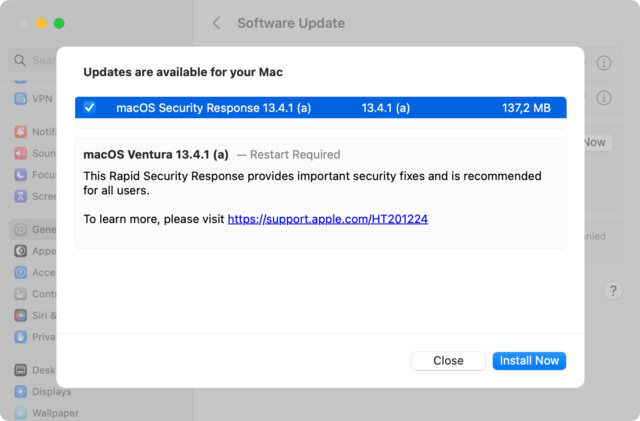
Apple Rapid Security Responses alert on MacIn contrast to general security patches, RSR appears to be deployed in high-stakes, urgent situations, when targets are already being exploited. They also require users to make updates themselves, instead of making changes to the software automatically.

How To Get the Security Update When Reissued

Fortunately, installing Apple’s RSR security update is straightforward. If you have an iPhone or iPad, all you need to do is follow the steps below:

  1. Open your “General Settings”
  2. Go to “Software Update”
  3. Depending on your device, click “Download and Install” when you see “iOS Security Response Update 16.5.1 (a)” or “iPadOS Security Response Update 16.5.1 (a)

Mac user? Follow these steps instead:

  1. Open up “System Settings” on Apple’s menu, and select “General”
  2. Go to “Software Update” and select  “macOS Security Response Update 13.4.1 (a)” as available

After you click download, the hardware will then reboot to complete the installation.

Written by:
Isobel O'Sullivan (BSc) is a senior writer at Tech.co with over four years of experience covering business and technology news. Since studying Digital Anthropology at University College London (UCL), she’s been a regular contributor to Market Finance’s blog and has also worked as a freelance tech researcher. Isobel’s always up to date with the topics in employment and data security and has a specialist focus on POS and VoIP systems.

Microsoft Axes Office and Remote Workers in New Layoffs

The latest Microsoft job cuts are in addition to the 10,000 announced earlier in the year.

Microsoft has announced it will be letting go of 276 Washington-based workers, as the software company restructures parts of its business just 11 days into its new financial year.

These recent cuts, which have affected customer service, sales, and support roles, build on the 10,000 global layoffs it announced on January 18 as the company continues to offset mammoth hiring efforts that took place throughout Covid-19.

While the US employment rate remains stable at large, Microsoft’s latest dismissals are the latest in a long line of layoffs to plague the tech sector in 2023. Here’s what we know so far.

Microsoft Announces Another Round of Layoffs

According to an internal announcement Microsoft released on Monday morning, the software provider and OpenAI partner has announced another round of layoffs at the start of their financial year, as part of a strategic restructuring effort.

While the big tech company hasn’t announced the number of cuts publically, a filing with Washington state’s Employment Security Department revealed that 276 Seattle-based workers have been affected in total.

Take back control of your data

Incogni by Surfshark can help you reclaim your information from third-party vendors.

Unlike previous layoffs, which have affected a broad range of divisions including marketing and the Internet of Things (IoT), these cuts have exclusively targeted customer service, support, and sales roles.

“We will continue to prioritize and invest in strategic growth areas for our future and in support of our customers and partners.” – Microsoft spokesperson

A Microsoft spokesperson said that these “organizational and workforce adjustments” are a necessary part of running their business, but explain that they will continue to invest in “high growth areas” of the business.

Microsoft Doubles Down on AI Investment

This isn’t an uncommon strategy for Microsoft. When the Washington-based company announced it would be cutting 10,000 roles in January 2023 — equating to around 5% of its total workforce — its CEO Satya Nadella claimed they would continue hiring in “strategic areas”.

These hiring efforts appear to be largely focused on AI, as the tech giant enters a new phase of its partnership with ChatGPT owner OpenAI, and continues to ramp up its responsible AI program, which is part of its concerted effort to address the ethical implications of AI.

“Moving forward, we know we need to invest even more in our responsible AI ecosystem by hiring new and diverse talent, assigning additional talent to focus on responsible AI full time, and upskilling more people throughout the company.” – Natasha Crampton, Chief Responsible AI Officer at Microsoft

In a blog post released in May, Microsoft’s Chief Responsible AI Officer Natasha Crampton announced that investing in teams is necessary for the program to succeed — alongside building governance models and establishing committed leadership for responsible AI.

However, despite Crampton’s desire to hire “new and diverse talent” to support Microsofts burgeoning “AI ecosystem”, no official hiring timeline has been announced.

Written by:
Isobel O'Sullivan (BSc) is a senior writer at Tech.co with over four years of experience covering business and technology news. Since studying Digital Anthropology at University College London (UCL), she’s been a regular contributor to Market Finance’s blog and has also worked as a freelance tech researcher. Isobel’s always up to date with the topics in employment and data security and has a specialist focus on POS and VoIP systems.

As Threads Hits 100 Million Users, Musk Ramps Up Rivalry

Threads now has over 100 million users and is the fastest growing app ever, even if it still lacks a distinctive identity

Threads, the new social conversations app from Mark Zuckerberg and Meta, has soared past the 100 million user mark less than a week after being released.

Rollout of Threads started on June 5 in the Americas and June 6 in the rest of the world, excluding most European countries where it has yet to be approved by EU regulators. Passing the 100 million milestone just five days after launch is no small feat for the platform, which has instantly been hailed as one of the best Twitter alternatives despite missing some key features in its current incarnation.

In fact, it makes Threads the fast-growing app ever according to the data. For reference, global sensation Pokémon Go is estimated to have topped 100 million installs about a month after its launch back in 2016, while ChatGPT took nearly two months to clear the same mark in more recent memory.

The Instagram Threads Story So Far

Shortly after its launch last week, Meta CEO Mark Zuckerberg was on Threads with regular updates about the app’s adoption. According to the Facebook and Instagram supremo, Threads got 2 million users in its first two hours; 5 million sign-ups in four hours; and had passed 10 million users in seven hours. After approximately a day, Zuckerberg estimated that more than 30 million people had signed up for the new social media platform.

Attracting that kind of traction is such a short period of time is a major achievement, albeit one that’s made a little bit easier by the fact that “signing up” for Threads is largely a case of linking an existing Instagram account. It’s not to say the launch of app has been all plain sailing, either, as already the Threads privacy policy is taking its fair share of heat.

Remove Your Data From the Web

Incogni by Surfshark can help you reclaim your information from third-party vendors.

So too is  a slightly threadbare Threads feature set. Users have been as quick to point out Threads’ shortcomings as they have to download it, including things like the lack of a web interface, no Following feed (and a misfiring algorithm instead only suggesting posts), and the absence of direct messaging functionality. None of that has stopped it being anointed the “Twitter Killer,” however, and further escalating the war of words between Meta CEO and his counterpart at Twitter, Elon Musk.

Zuckerberg vs Musk Just Won’t Go Away

In many ways, Musk vs Zuckerberg needs no introduction. Most rivalries veering towards PPV fight infamy don’t. Yet in the context of Threads and Twitter, there are some genuine points of intrigue. Shortly after the launch of Threads, Twitter bosses wrote to Meta and warned it against using “trade secrets” in the development of its new platform. Musk, of course, was more blunt in his outward appraisal of the situation, saying: “Competition is fine, cheating is not.”

Central to the cease-and-desist letter are accusations that ex-Twitter employees poached by Meta have brought various bits of intellectual property with them. It might be difficult to prove, given that the idea of text-based online discussion is almost as old as the internet itself, going back at least as far as the Usenet and BBS forums of yesteryear.

That hasn’t stopped Musk from seeking to further escalate his public dispute with Zuckerberg. Over the weekend, the Tesla and SpaceX billionaire was characteristically active online, saying that Threads is “just Instagram minus the pics” before later tweeting: “Zuck is a cuck.” The latter snippet is being interpreted as an archaic attack on Zuckerberg’s masculinity, as it potentially alludes to the medieval insult “cuckold.”

Threads Still Missing That Killer Feature

If Threads wants to kill off Twitter, its rapid adoption suggests it’s well placed to do so. However, it’s unlikely to render the rival platform null and void unless it brings something new to the party and can carve out an identity of its own, beyond being “Twitter before Twitter was ruined.” In other words, Musk isn’t actually that wide of the mark: Threads is basically just another text-based social app, albeit one that promises more proactive community moderation and friendlier vibes as a result.

Its “killer feature,” if it has one at this early stage of its existence, is the promise of integration with the fediverse. What is the the fediverse, we hear you ask? The portmanteau of “federated” and “universe” is a relatively new concept that basically refers to a loose networks of decentralized servers sharing data with one and other.

In relation to social media, it basically means that not only will Threads let you share and interact with people across Meta’s stable of apps, like Facebook and Instagram, but also third-party ones, with Mastodon being the first integration that has been mooted. This kind of distinctive feature is something that would not only convert disenfranchised Twitter users into Threaders, but also help win over the TikTok demographic – and the all-important advertising clout that comes with them.

Unfortunately, like much of Threads, it seems fediverse integration isn’t quite catwalk ready at this stage.

Written by:
Isobel O'Sullivan (BSc) is a senior writer at Tech.co with over four years of experience covering business and technology news. Since studying Digital Anthropology at University College London (UCL), she’s been a regular contributor to Market Finance’s blog and has also worked as a freelance tech researcher. Isobel’s always up to date with the topics in employment and data security and has a specialist focus on POS and VoIP systems.

OpenAI, Meta Hit With Copyright Infringement Lawsuit Led by Sarah Silverman

The comedian and author leads a trio of writers suing OpenAI and Meta for copyright infringement

OpenAI and Meta are being sued for copyright infringement in US District Court by a trio of authors including the comedian Sarah Silverman.

At the heart of the lawsuit are allegations that OpenAI’s GPT-3.5 and GPT-4 and Meta’s LLaMA Large Language Models (LLM) were trained using copyrighted works illegally scraped from book torrenting websites.

As well as Silverman’s works, including her 2010 memoir Bedwetter,  books by Chris Golden (Ararat) and Richard Kadrey (Sandman Slim) are also cited as examples of the LLMs summarizing copyrighted works without attribution.

Sarah Silverman vs OpenAI and Meta Explained

While closely linked, the lawsuits being levelled by the authors against OpenAI – which owns ChatGPT – and Meta are actually two separate filings.

The main exhibits cited against OpenAI are ChatGPT responses to prompts for summaries of the works of Silverman and her co-plaintiffs. Here, the primary issue cited is the fact that these digests are produced without “any of the copyright management information Plaintiffs included with their published works.”

Remove Your Data From the Web

Incogni by Surfshark can help you reclaim your information from third-party vendors.

In the complaint against Meta, the authors claim that the datasets used by the Facebook, Instagram and Threads owner to train its LLaMA model include illegally acquired materials gleaned from “shadow library” websites such as Bibliotik, a torrenting website for books that works similar to how the infamous Pirate Bay network does for movie and TV show downloads.

Multiple Literary Lawsuits Leveled at OpenAI

The dual-actions featuring Sarah Silverman and her works are just the latest literary lawsuits to be leveled at OpenAI in quick succession.

Having teamed up in November 2012 under the LLM Litigation banner, California area lawyers Joseph Saveri and Matthew Butterick are spearheading the legal actions on behalf of both Silverman’s trio and two more authors, Paul Tremblay and Mona Awad. Filed at the end of June, Tremblay and Awad’s lawsuit similarly accuses of the OpenAI language models underlying ChatGPT of “ingesting” their copyrighted works when collecting data across the internet to help train the chatbot.

In addition to these claims, Saveri and Butterick are also overseeing lawsuits on behalf of developers (vs. AI coding platform GitHub Copilot, in which Microsoft is named a co-defendant) and artists (vs. AI image generator Stable Diffusion).

OpenAI Lawsuits

Separate to these, OpenAI is facing a further $3 billion class action lawsuit from a group of anonymous individuals who claim that the “secret scraping” of data conducted to train ChatGPT models amount to nothing less than “data theft.”

Overall, initial enthusiasm for AI technology and its flag-bearer seems to be waning for the first time. ChatGPT use has declined for the first time since its public launch, while real questions are starting to emerge over how ChatGPT saves your data.

These are just some of the many ethical issues starting to emerge around artificial intelligence and companies like OpenAI, with the lawsuits starting to flood in from the creative industries potentially just the the tip of the iceberg. Who will have the last laugh? If not the robots themselves, then it really does seem to be anyone’s guess.

Written by:
Isobel O'Sullivan (BSc) is a senior writer at Tech.co with over four years of experience covering business and technology news. Since studying Digital Anthropology at University College London (UCL), she’s been a regular contributor to Market Finance’s blog and has also worked as a freelance tech researcher. Isobel’s always up to date with the topics in employment and data security and has a specialist focus on POS and VoIP systems.

Twitter Threatens Meta with Lawsuit Over New Threads App

Musk vs Zuckerberg takes fresh twist as Twitter goads Meta with legal action over new Threads app

Elon Musk’s Twitter has written a letter to Meta CEO, Mark Zuckerberg, demanding it stop the misappropriation of “trade secrets” in relation to Meta’s new rival app, Threads.

The text based conversation app Instagram Threads, known simply as Threads, has been openly billed as one of the best Twitter alternatives by Zuckerberg. Meta officially launched the new platform in 100 countries on July 5 to a largely positive reception. Zuckerberg announced the app surpassed 30 million users in its first 24 hours, but is now facing legal threats.

In the letter to Zuckerberg, Alex Spiro, a lawyer for Twitter said the company “has serious concerns that Meta Platforms (Meta) has engaged in systematic, willful and unlawful misappropriation of Twitter’s trade secrets and other intellectual property” according to a report first published by news outlet Semafor

Twitter intends to “strictly enforce its intellectual property rights” and instructs Meta to “take immediate steps to stop using any Twitter trade secrets,” the letter reads. 

Meta Accused of “Cheating” by Twitter

The crux of the issue in the cease-and-desist letter is Twitter’s claim that Meta has poached a large number of former employees in the past year. Some of these ex-Twitter employees are said to have “had and continue to have access to Twitter’s trade secrets and other highly confidential information” and “many” of whom have “improperly” kept Twitter documents or electronic devices.

The letter continues: “With that knowledge, Meta deliberately assigned these employees to develop, in a matter of months, Meta’s copycat ‘Threads’ app with the specific intent that they use Twitter’s trade secrets and other intellectual property in order to accelerate the development of Meta’s competing app, in violation of both state and federal law as well as those employees’ ongoing obligations to Twitter.”

It’s unclear at this time what evidence Twitter has to back up its claims that these former employees stole trade secrets and used them in the development of Threads. Musk took to his platform to condemn Meta on Thursday, in a tweet which read: “Competition is fine, cheating is not.” 

Meta Defends New “Twitter Killer” Platform

Meta was quick to refute claims of any wrongdoing. In a Threads post, Meta’s communications director, Andy Stone said: “No one on the Threads engineering team is a former Twitter employee — that’s just not a thing.”

People around the world (excluding the European Union for the time being) can now get Threads in seconds using their Instagram account or by downloading the app. 

Threads benefits from an in-built user base thanks to its seamless access via Instagram which already has millions of active monthly users. The ease in which a Threads account can be created has clearly led to its early success, garnering the title of the most rapidly downloaded app of all time.

Get Your Data Back!

Incogni by Surfshark can help you reclaim your information from third-party vendors.

A Final Nail in the Coffin for Twitter?

Launched in 2006, Twitter now faces an uncertain future, with a string of public mishaps, layoffs and lawsuits since the Tesla and SpaceX chief, Elon Musk took the helm in October 2022.

This lawsuit is yet another in a string of legal cases the social platform is currently battling, the only difference being that it was initiated by Twitter themselves. 

Tesla CEO Elon Musk completed the deal to acquire Twitter at his original offer price of $54.20 a share at a total cost of roughly $44 billion. 

However, the social media platform has reportedly seen an ad sales slump and drop in users. Will Meta’s Threads platform be the final nail in the coffin for Twitter? Only time will tell. 

Written by:
Isobel O'Sullivan (BSc) is a senior writer at Tech.co with over four years of experience covering business and technology news. Since studying Digital Anthropology at University College London (UCL), she’s been a regular contributor to Market Finance’s blog and has also worked as a freelance tech researcher. Isobel’s always up to date with the topics in employment and data security and has a specialist focus on POS and VoIP systems.

OpenAI Announces GPT-4 General Release For Developers

Having revealed its next-gen chatbot model in March, OpenAI has now made GPT-4 available to developers for the first time.

Despite one or two recent blips in usability, OpenAI is pushing on with development of its next-gen chatbot model and has just announced the general availability of GPT-4.

In a blog post, the company announced that all existing OpenAI API developers, who have a “history of successful payments”, will be able to access the latest text-generating model. 

Plans to open up GPT-4 access to new developers are in the works, too, and expected to go live by the end of July. This is likely to be followed by OpenAI, who owns ChatGPT, raising availability limits “depending on compute availability”, which it has struggled with recently as the demand for generative models rapidly increases.

Developers Have Been Ready For Quite Some Time

According to the OpenAI blog, millions of developers have been calling for access to the GPT-4 API since March 2023. With the capabilities of the model outweighing anything these devs have used before, it’s little wonder the demand has grown.

The system’s predecessor, GPT-3.5, only accepted text, so developers are understandably keen to explore the possibilities of a model that can generate code, and accept image and text inputs.

However, before you get too excited it’s worth knowing that the image-understanding functionality won’t be available right away. This is still in testing with the AI-powered virtual assistance app Be My Eyes. It’s not yet known when this capability will go live.

Much like previous GPT models, GPT-4 has been trained using publicly available data, such as content from web pages, as well as data licensed by OpenAI itself.

Get Your Data Back!

Incogni by Surfshark can help you reclaim your information from third-party vendors.

It’s All Hands on Deck For Refining The Models

With reports of ChatGPT’s fake news seemingly surfacing every other day, we know the system isn’t perfect. As well as being unable to introduce security vulnerabilities into the code it creates, it’s becoming well known for its hallucinations and information errors.

OpenAI is well aware of these hindrances and has said it will allow developers to “fine-tune” GPT-4 and GPT-3.5 Turbo – one of the original models that powers ChatGPT – with their own data. The caveats are, they must have been able to do it with several other of the system’s text-generating models, and they won’t be able to get hands-on until later this year.

The APIs keep Coming, But Older Models Will Disappear

Not content with making GPT generally available, OpenAI have also opened up the APIs for DALL-E 2 – the company’s image-generating model – and Whisper – its speech-to-text model.

However, you can expect to see older models of the system – such as GPT-3 – becoming unavailable. It’s understood they can’t keep up with computer capacity and will be replaced with a new, more efficient “base GPT-3” model. OpenAI has stated it’ll provide developer support with the transition.

“In the coming weeks, we will reach out to developers who have recently used these older models, and will provide more information once the new completion models are ready for early testing,” OpenAI said in a statement. 

Developers will have until January 4th 2024 to manually upgrade their old models.

Written by:
Isobel O'Sullivan (BSc) is a senior writer at Tech.co with over four years of experience covering business and technology news. Since studying Digital Anthropology at University College London (UCL), she’s been a regular contributor to Market Finance’s blog and has also worked as a freelance tech researcher. Isobel’s always up to date with the topics in employment and data security and has a specialist focus on POS and VoIP systems.
Back to top