Here’s Why Instagram, Facebook, and TikTok are Changing for Millions of Users Today

The EU Digital Services Act is coming into effect this week, prompting huge changes to the social media platforms we all use.

The EU Digital Services Act takes effect today, which means significant changes to the functionality of social media platforms like Instagram and Facebook, TikTok, Snapchat, and YouTube, as well as a string of online stores and search engines.

Although the act first passed way back in November 2022, the group of large companies that have to comply with it now were given several months to make the required changes to their platforms.

What Is the EU Digital Services Act?

The Digital Services Act is a wide-reaching new law designed to hold digital platforms – including social media networks, search engines, and online stores like Amazon – accountable for a wide range of activity.

Included in the act are rules designed to prompt a crackdown on illegal content on social media platforms and illegal products being sold in online stores.

Disinformation – specifically, Russian propaganda – is also in the EU’s crosshairs.


About Tech.co Video Thumbnail Showing Lead Writer Conor Cawley Smiling Next to Tech.co LogoThis just in! View
the top business tech deals for 2026 👨‍💻
See the list button

There are new protections for children in the context of targeted advertising and the systems used to recommend content on social media. Digital platforms within the EU’s 27 member states will no longer be able to target ads based on data relating to their race or gender, either.

Manipulative practices used by shopping websites to coax consumers into buying products – such as hiding delivery information and costs – are also being clamped down on.

What Platforms Are Affected?

Right now, a total of 17 platforms and two search engines are affected by the act, all of which have at least 45 million active users. Along with Google and Bing (the two search engines), the platforms affected are:

Alibaba AliExpress, Amazon Store, Apple AppStore, Booking.com, Facebook, Google Play, Google Maps, Google Shopping, Instagram, LinkedIn, Pinterest, Snapchat, TikTok, Twitter, Wikipedia, YouTube and Zalando.

However, from February 2024, it will apply to all digital platforms, regardless of their size. Twitter is also cooperating with the EU Commission and agreed in June to comply with its laws pertaining to the spread of disinformation.

What Changes Will This Cause to Social Media Platforms?

For users of social media platforms like Instagram and Facebook in the EU, a lot is going to change. Here are the biggest differences they’ll experience on the platforms.

Firstly, on a number of social media platforms, users will be able to switch off the automated recommendations that dictate what they see on their feeds on these apps.

As well as this, Instagram users will be able to choose to only view content from accounts they follow by opting out of the ranking systems that show users new content.

On TikTok, on the other hand, the “For You” page for each user will be populated with a string of viral videos from across the globe, and will no longer be determined by what a user has just been watching. Snapchat will also allow users to opt out of being shown content that is personalized using their data.

Of course, outside of the EU’s member states, the user experience on these platforms will remain much the same. But legislation of this kind can – and often does – prompt other countries to act too.

In a country like the US, the political will to curtail the power of big tech companies and manage the effects of their platforms is present on both sides of the political aisle.

However, with the US lacking a federal counterpart to the EU’s GDPR, it might be some while before we see anything like these sweeping changes occur on this side of the Atlantic.

Written by:
Aaron Drapkin is Tech.co's Content Manager. He has been researching and writing about technology, politics, and society in print and online publications since graduating with a Philosophy degree from the University of Bristol six years ago. Aaron's focus areas include VPNs, cybersecurity, AI and project management software. He has been quoted in the Daily Mirror, Daily Express, The Daily Mail, Computer Weekly, Cybernews, Lifewire, HR News and the Silicon Republic speaking on various privacy and cybersecurity issues, and has articles published in Wired, Vice, Metro, ProPrivacy, The Week, and Politics.co.uk covering a wide range of topics.

Apple Makes Dramatic U-Turn on Right-to-Repair Law in California

The tech giant has opposed bills of this kind in a number of different US states over the last decade - but not this time.

Apple has made a somewhat dramatic shift in position to back California’s proposed right-to-repair bill. Under the law, the tech giant will have to provide instructions and parts for repairing products like iPads, iPhones and Macs.

Although Apple already has a repair program in place that provides tools for consumers to fix their devices at home, it has historically opposed laws of this nature. In fact, it opposed this very same law in California when it was first introduced back in 2018.

Apple Gives Blessing to Right-To-Repair in California

In a letter to California State Senator Susan Talamantes Eggman, seen by TechCrunch, Apple says that it’s throwing its support behind the right-to-repair bill proposed by the Democrat politician.

The company believes in the right of consumers to have the ability to repair their devices without compromising their safety or privacy, the letter said.

However, CNBC reports that there is one catch – Apple said it wouldn’t support the bill if it permitted repair shop workers to disable its antitheft security measures installed on many of its devices.


About Tech.co Video Thumbnail Showing Lead Writer Conor Cawley Smiling Next to Tech.co LogoThis just in! View
the top business tech deals for 2026 👨‍💻
See the list button

What Is SB-244, and How Will It Help Consumers?

SB-244, which enacts the Right to Repair Act, requires manufacturers to “make available, on fair and reasonable terms, to product owners, service and repair facilities, and service dealers, the means, as described, to effect the diagnosis, maintenance, or repair of the product, as provided”.

Manufacturers of electronic appliances ranging from microwaves to mobile phones will have to make replacement guides and parts available for products that retail at over $100. This would include the majority of Apple’s products, such as iPads, Macs, and iPhones.

It will also require third-party repair shops that aren’t registered with the manufacturer to provide written notices to consumers informing them of that fact prior to working on their devices.

Apple’s Product Repair Stance Softens

Apple has certainly relaxed its position on consumers’ rights to repair their technology products in recent years, first announcing a self-service repair program in 2021 and opening it up to consumers in the US in 2022.

In the past, however, the company has fiercely opposed right-to-repair laws in various states across the US, making their support for SB 244 all the more surprising.

For instance, in 2017 the company put significant lobbying efforts into trying to kill New York’s proposed “Fair Repair Act”, which would have allowed third parties to access information that would show them how to repair products without paying manufacturers.

The company also joined forces with HP and Honeywell to lobby a Nevada statehouse law that would require manufacturers to provide device parts and instructions to third-party repair shops. Apple was reportedly concerned about the potential exposure of personal user data during repairs.

Apple has historically opposed such laws because of the AppleCare+ insurance program it offers to customers. Other concerns include the company losing its grip on quality assurances, as there would be no guarantee that the parts used to repair its products would be made to the same standards.

The backing of the California law, however, suggests a change of tack.

Written by:
Aaron Drapkin is Tech.co's Content Manager. He has been researching and writing about technology, politics, and society in print and online publications since graduating with a Philosophy degree from the University of Bristol six years ago. Aaron's focus areas include VPNs, cybersecurity, AI and project management software. He has been quoted in the Daily Mirror, Daily Express, The Daily Mail, Computer Weekly, Cybernews, Lifewire, HR News and the Silicon Republic speaking on various privacy and cybersecurity issues, and has articles published in Wired, Vice, Metro, ProPrivacy, The Week, and Politics.co.uk covering a wide range of topics.

Top Android Phones Set to Pack Serious AI Power in 2024

New chipset announcements from MediaTek and Qualcomm point to AI featuring heavily on next year's Android flagships.

MediaTek has unveiled its next flagship chipset, providing further proof that upcoming Android phones will feature built-in generative AI functionality for the first time. More specifically, the next-gen MediaTek Dimensity 9300 will be optimized to support Meta’s new Llama 2 large language model, or LLM for short.

Llama 2 is Meta’s answer to GPT-4, which is the LLM from OpenAI, who owns ChatGPT. In other words, it’s the technology behind the AI chatbots everyone is talking about (and using) these days. Prior to MediaTek’s announcement, Qualcomm made similar headlines with its 2024 flagship SoC (system-on-a-chip), the Snapdragon 8 Gen 3, which will also bake native Llama 2 support into its architecture.

If the AI space was already exploding, the potential implications of next year’s biggest Android releases — including the Samsung Galaxy S24 and OnePlus 12 — coming with native generative AI are even bigger. Here’s why.

MediaTek 9300 and Snapdragon 8 Gen Lead Mobile AI Charge

The Dimensity 9300 SoC is the new hardware in question and has just been revealed by MediaTek, ahead of deployment in many of 2024’s most premium Android phones. To backtrack, SoCs are the fingernail-sized chips that act as both the brains and the brawn for modern mobile devices. Smartphones and tablets, yes, but also all the connected car and smart home tech that’s now commonplace.


About Tech.co Video Thumbnail Showing Lead Writer Conor Cawley Smiling Next to Tech.co LogoThis just in! View
the top business tech deals for 2026 👨‍💻
See the list button

Like the Snapdragon 8 Gen 3, the MediaTek Dimensity 9300 will start to feature in high-end Android flagships in late-2023 and really come into its own in 2024. Combined, these two chipsets will dominate the high-end Android market next year, though it’s actually likely the Snapdragon that will feature in the best of the best and devices like the Samsung Galaxy S24 and OnePlus 12. Nevertheless, with MediaTek historically powering premium efforts from the likes of Oppo, Motorola, Vivo and Xiaomi.

Now, why is this such a big deal? Well, in short it’s because SoC-level support for models such as Llama 2 will allow smartphones to more effectively perform AI powered tasks, such as execute ChatGPT prompts. This in turn opens up a whole new world of possibilities for AI, especially for businesses, which we’ll now take a closer look at.

What AI Coming to Android Phones Actually Means

At present, if you use your phone to access ChatGPT or one of the many ChatGPT alternatives out there, the computing is handled exclusively by cloud data centers. This means everyone is relying on the same shared infrastructure for all their AI needs and is one reason why ChatGPT is down due to capacity limitations sometimes.

With an AI-ready chip, much of the compute load for such tasks will be able to be performed locally on your handset. This means you’ll essentially have exclusive use of the available power of your device and everything AI should run a lot faster and smooth, as well as the obvious privacy benefits of not sending your AI requests via the cloud.

This in turn opens up a world of new possibilities for AI on your phone. In terms of everyday use, this could mean the direct integration of AI powers into smart assistants and the development of native AI apps for handsets and other mobile devices. For businesses specifically, it should mean that any AI tools they use should be able to be relied upon, even on-the-go.

Why AI Android Phones Matter to Businesses

Think of how quickly AI has appeared in popular business products and you start to get the idea. For example, nearly all of the best sales CRMs and best project management software solutions have started introducing new AI features, but businesses can’t truly embrace such functionality unless they know it’s going to be reliable in all environments.

The latest developments in the mobile market, in which chipmakers are signaling their intent to offer support for AI at a native level, offer the clearest sign yet that this will soon be the case.

Moreover, Android is the world’s most popular mobile operating system, with a market share of over 70% according to most statistics. Such dominance just can’t be ignored in a business context, especially when provisioning devices at a corporate level. Of course, Android security remains its Achilles heel in the eyes of business decision makers. If nothing else, the platform’s rapid-fire adoption of cutting-edge AI chips (and the features that will follow) will have rival Apple working overtime to get its rumored AppleGPT chatbot ready for future iPhones.

Written by:
Aaron Drapkin is Tech.co's Content Manager. He has been researching and writing about technology, politics, and society in print and online publications since graduating with a Philosophy degree from the University of Bristol six years ago. Aaron's focus areas include VPNs, cybersecurity, AI and project management software. He has been quoted in the Daily Mirror, Daily Express, The Daily Mail, Computer Weekly, Cybernews, Lifewire, HR News and the Silicon Republic speaking on various privacy and cybersecurity issues, and has articles published in Wired, Vice, Metro, ProPrivacy, The Week, and Politics.co.uk covering a wide range of topics.

Tesla’s Value Crashes by $200bn (But Elon Musk’s Fake Followers Don’t Care)

Elon Musk's sometimes trivial recent troubles have been compounded by a much more serious one: Tesla's tumbling value.

It has been another rough week for Elon Musk, with news of Tesla’s value plummeting by nearly $200 billion coming hot on the heels of revelations that nearly half of the renegade tech tycoon’s millions of X followers could be examples of one of the more controversial social media trends – fake accounts.

These developments further add to Musk’s current troubles, many of which are rooted in his chaotic rebranding (and general stewardship) of Twitter, now known as X. Recent “highlights” for the erstwhile microblogging giant include being fined by the DOJ, sued by the world’s oldest news agency, and perhaps most infamously, charged by the authorities in San Francisco over an obnoxious new glowing HQ sign.

All of which has led Musk to publicly admit that X might fail for the first time, even before analysts started questioning Tesla’s financial future.

Tesla Value Falls, Worse May Still Be To Come

OK, we get it: Elon Musk is rich. The world’s richest man. A man so rich his spare change alone would probably break the best accounting software. Yet Tesla’s recent stock market troubles surely can’t be ignored by the South African billionaire, especially if they’re set to continue.


About Tech.co Video Thumbnail Showing Lead Writer Conor Cawley Smiling Next to Tech.co LogoThis just in! View
the top business tech deals for 2026 👨‍💻
See the list button

Tesla could seemingly do no wrong in 2023, reaching a high on the stock market in mid-July of $291. However, it has since dropped as low as $215 per share, with even a recent bounce back only seeing it recover to around $235, as of the time of publication.

In the big picture, this amounts to nearly a fifth of the company’s value, with $200 billion wiped off of Tesla’s market cap since last month. To put this into context, that’s roughly equivalent (in billionaire terms, at least) to Musk’s entire $227 billion personal fortune.

Worse still, Wall Street pundits such as Gordon Johnson have pointed out the fact that Tesla inventory is “exploding” at present, which could force the electric car maker to slash prices – something likely to trigger further short-term stock market instability. All that said, Tesla’s long-term outlook is still an extremely rosy one according to Wall Street, with most analyst talk being of “when” rather than “if” the EV trendsetter will hit $1,000.

Are Elon Musk’s X Followers Fake?

Musk’s current business challenges are well publicized, but the tech tycoon is undeniably savvy when it comes to these things. In all honesty, he may not even have broken a sweat when it comes to Tesla’s recent Wall Street woes. Reports suggesting that a large proportion of his X followers are fake is another matter entirely, as it’s the sort of thing the firebrand may take more personally.

The revelation is based on data gleaned by German-based software developer Travis Brown and crunched by Mashable. It shows that of Musk’s over 150 million followers on X (formerly Twitter), the vast majority are inactive. This is signaled by the fact that nearly 112 million of them (73%) have less than 10 followers, with more than 65 million having none at all (42%).

The conclusion drawn is that the vast majority of Musk’s followers are either fake, inactive, or what’s known as “lurkers” – people who created an account simply to consume content, but are not an active part of the community. In terms of the out-and-out fake or bot run accounts following Musk, 38 million of them had the default “X” logo as their profile image – something that’s commonly associated with illegitimate handles.

Unfortunately, it’s also commonly associated with X (and its avian-themed predecessor) in general, which is why the hunt for Twitter alternatives has been such an enthusiastic one.

Tesla Faithful Keep on Truckin’

It’s not all doom and gloom for Tesla fans, though.

In between presumably culling his X account of bogus followers, Elon Musk has shared the first photo of a Tesla Cybertruck prototype – and it looks as much like the Batmobile as ever.

Musk has famously said he believes it’s Tesla’s “best ever” product in the past, and the photo dropping will no doubt help reignite excitement for the Cybertruck’s launch, with the company previously promising a delivery event by the end of Q3 2023.

Written by:
Aaron Drapkin is Tech.co's Content Manager. He has been researching and writing about technology, politics, and society in print and online publications since graduating with a Philosophy degree from the University of Bristol six years ago. Aaron's focus areas include VPNs, cybersecurity, AI and project management software. He has been quoted in the Daily Mirror, Daily Express, The Daily Mail, Computer Weekly, Cybernews, Lifewire, HR News and the Silicon Republic speaking on various privacy and cybersecurity issues, and has articles published in Wired, Vice, Metro, ProPrivacy, The Week, and Politics.co.uk covering a wide range of topics.

Google Workspace Is Getting Major AI-Powered Security Upgrades

Google has revealed a number of new security features for its Workplace suite of collaboration and productivity tools.

Google has announced a ream of security upgrades for the Google Workspace suite of cloud productivity and collaboration tools, citing recent spikes in ransomware statistics and other alarming cybersecurity data.

Updates include new automation features powered by AI, as well as the strengthening of its existing zero trust model. The changes will further bolster data protection for businesses on Workspace, while threats like Google Chat scams continue to proliferate.

Google Workspace is the umbrella under which popular apps like Gmail, Google Drive, and Google Docs live, as well as add-ons such as Google Voice. While empowering employees with one of the best password managers will help protect sensitive data stored on Workspace, now Google is upping the ante with these new security features.

Google Logo
Google Workspace: Free for 14-Days Set up custom email, share files securely online, video chat from any device and more.
Get started

Zero Trust and DLP: A Match Made in Heaven?

If there was a flagship update among the new Google Workspace security features just announced, it would be the merging of zero trust and data loss prevention (DLP) strategies.

What do these two bits of infosec jargon actually mean? Zero trust is an approach to cybersecurity based on the principle of “never trust, always verify,” which in practice means the implementation of additional security controls beyond the initial log-in to a network or account. Think of how many times your boarding pass and passport gets checked before you’re actually let on a flight, in addition to the main TSA airport security controls, and you start to get the idea.

There's a reason we rate Google Voice the top international calling app

Our impartial research found Google Workspace offers the best security for businesses versus other VoIP providers.

DLP is more self-explanatory and refers to services or features that that help to prevent data loss. At the heart of Google’s latest Workspace updates are new features that combine the two principles to fortify its defenses.

How Google Is Using AI to Boost Workspace Security

For starters, AI can now automatically apply labels to documents stored in Google Drive. Workspace admins will set the conditions for how different types of documents are labelled, and any additional security measures that are applied to certain categories thereafter. AI will take care of the grunt work, though, and this feature is already available in preview.

In addition, Google Drive offer new context-aware DLP controls to Workspace admins, starting later this year. Most Gmail users have probably been asked to complete two-step verification when logging in on a new device, and the idea here is similar. Admins will be able to configure different security protocols for a variety of different situations, including device type, location, user privilege level and more. However, admins won’t be able to run riot with their new powers, as a further tweak will see Google requiring multi-party approval for select sensitive admin actions.

Lastly, Google has hinted at enhanced Gmail DLP measures. These haven’t been revealed in full, but the company has said that it’s currently testing how AI could be used to block certain sensitive actions (such as email filtering or forwarding) under specific conditions. As above, these could be related to location (in the office), though bear in mind that this is pure speculation on our part. Some of the Google Workspace upgrades aren’t set to land until 2024, the company added, and this looks likely to be one of them.

Data Sovereignty Co-Stars Alongside Data Loss Prevention

Alongside new data loss prevention measures, data sovereignty is also spotlighted by Google Workspace’s latest updates.

Basically, Google will be giving you (or your company) a whole heck of a lot more power to decide where your data is handled. Currently, the internet giant lets you choose where you data is stored (the US or EU), but going forward you’ll also be able to choose where your data is processed. In practice, this means where the physical CPUs doing the tango with your data are located.

Similarly, you’ll also be able to choose where the servers storing your encryption/decryption keys are located. This new capability comes alongside new client side encryption (CSE) improvements, such as baked in support for the Gmail and Google Meet apps.

Finally, companies will now have the power to choose if Google support techs are based in the US or EU. As is the case with the other choices Google will be offering you, this is relevant beyond pure patriotism because of the EU’s more robust approach to data governance and protection.

Try Google Workspace for free

Access the complete business suite including Meet and more, for 14 days, no strings, no charge

Written by:
Aaron Drapkin is Tech.co's Content Manager. He has been researching and writing about technology, politics, and society in print and online publications since graduating with a Philosophy degree from the University of Bristol six years ago. Aaron's focus areas include VPNs, cybersecurity, AI and project management software. He has been quoted in the Daily Mirror, Daily Express, The Daily Mail, Computer Weekly, Cybernews, Lifewire, HR News and the Silicon Republic speaking on various privacy and cybersecurity issues, and has articles published in Wired, Vice, Metro, ProPrivacy, The Week, and Politics.co.uk covering a wide range of topics.

9 Reasons to Worry About the Rise of “Buy Now Pay Later” Tech

Loan overextensions and data farming are just the start: Here's what should concern you about the booming BNPL industry.

Buy now, pay later” services are huge right now: Apps will offer you installment plans on anything from a TV to a T-shirt.

Klarna, Afterpay, and Affirm are a few big names making millions off of extending a little credit to customers with a plan to pay it back in even-smaller installments over the next few weeks or months.

But whenever a market grows that fast, regulatory concerns will rear their heads. And it turns out that plenty of researchers and regulators are keeping an eye on the booming BNPL business.

BNPL Isn’t Bad, Just a Little Questionable

BNPL tools have some big benefits: They’re more managable than credit card repayments, getting approved is simple, and you won’t pay any interest if you successfully meet all payment deadlines (and the majority do succeed).

But the benefits and downsides to BNPL tools are right there in the name. Sure, everyone loves getting something now, but sooner or later you’ll still have to pay for it.


About Tech.co Video Thumbnail Showing Lead Writer Conor Cawley Smiling Next to Tech.co LogoThis just in! View
the top business tech deals for 2026 👨‍💻
See the list button

And by separating the buying from the paying, a business using BNPL tools might create a false impression in the buyer’s mind that they’re getting a better “deal” on something, which might make them continue spending more and more.

The customer will eventually pay up, but that mental trick puts them at risk. Which is one reason of why Consumer Reports and similar regulatory watchdogs are blowing the whistle now.

What Could We Improve? Nine Problem Areas

Protecting users from overextending themselves on loans is possibly the biggest BNPL policy recommendation being floated in recent weeks.

Also in the running: Protections from data-harvesting, a popular Silicon Valley practice that government regulators have been chipping away at reducing since even before the Facebook Cambridge Analytica fiasco drew everyone’s ire back in 2018.

The full list of concerns is a lot longer than those two, however.

Consumer Reports Senior Policy Counsel Jennifer Chien recently published a white paper on the matter, highlighting that the “free and seamless” nature of a BNPL service puts it smack-dab in the “unforeseen risk” category for consumers everywhere.

Here’s the list of nine problematic BNPL provider practices to address, according to Chien:

  • Wide variance and poor transparency in pricing structures
  • Multiple and excessive fees
  • Automatic repayments and use of credit cards for repayment
  • Limited assessment of repayment capacity
  • Inconsistent credit reporting
  • Exploitation of behavioral biases
  • Data harvesting and data privacy
  • Challenges with returns

There are answers for all these issues, from better transparency to credit reporting and stronger data privacy. But we’ll need to keep advocating for regulation in the industry to get there.

Buy the Future Now: Pay for It Later

There are currently 79 million BNPL users in the US, according to stats from earlier in this year — an increase of 56.1% over 2022. The BNPL business has cooled slightly in 2023, but some projections still say that about half of all Gen Zers will be using BNPL by 2025.

In other words, we’re on track as a society to continue putting off our bills even further into the future.

In a world where potential catestrophy lurks around those future corners, that’s not great news. You might be safe from that tropical storm in California or the Maui wildfires, but sooner or later, you’ll face your own potential climate disaster.

Adding a bunch of bills to your budget isn’t the best preparation — even if they’re all really tiny.

Written by:
Aaron Drapkin is Tech.co's Content Manager. He has been researching and writing about technology, politics, and society in print and online publications since graduating with a Philosophy degree from the University of Bristol six years ago. Aaron's focus areas include VPNs, cybersecurity, AI and project management software. He has been quoted in the Daily Mirror, Daily Express, The Daily Mail, Computer Weekly, Cybernews, Lifewire, HR News and the Silicon Republic speaking on various privacy and cybersecurity issues, and has articles published in Wired, Vice, Metro, ProPrivacy, The Week, and Politics.co.uk covering a wide range of topics.

Are Shopify and Amazon Squeezing Ecommerce Store Owners?

Shopify is cutting a big perk, while Amazon plans to add a new seller fee. It's a rough time to be an indie ecommerce store.

Inflation, shrinkflation, rising real estate rental costs, and even the collapse of marketing channels like Twitter: Ecommerce store owners have it tough in 2023. Now, a few recent developments are making it even harder.

First — if a leak is to be believed — Shopify has plans to cut access to its merchant “success managers” from its Plus tier, blocking thousands of Shopify store owners from a big benefit to that particular subscription plan.

On top of that, Amazon has just this week unveiled a new upcharge: Sellers who opt out of “Fulfillment by Amazon” will be charged 2% extra in order to fulfil orders themselves. 

Shopify’s Cutting Success Managers

The leaked information comes from Insider, which broke the news about the change coming to Shopify Plus, the service’s highest priced plan at $2,000 per month.

Plus is primarily used by business making less than $10 million in revenue a year — that’s not chump change, but it does mean that this update will impact the relatively small-but-successful retailers.


About Tech.co Video Thumbnail Showing Lead Writer Conor Cawley Smiling Next to Tech.co LogoThis just in! View
the top business tech deals for 2026 👨‍💻
See the list button

Merchant success managers are the in-person consultants that offer one-on-one advice to businesses concerning how to launch and operate an online store. These managers are Shopify employees, so while they’re one of the biggest perks to paying for Shopify Plus, they’re also an expense that only gets larger as Shopify’s customer base grows. In-person meetings can’t be scaled up like a new AI or an ad network.

According to an internal email, the new plan is to cut Plus merchants entirely and replace them with two options, depending on how much a Plus user is earning.

Those making less than $2 million in sales per year will only have Shopify’s help center and its Support staff for aid, while those making between $2 and $10 million will have access to a “merchant success team” for targeted solutions to a set number of specific concerns, such as “monetized product adoption and merchant growth scenarios.”

Following the leak, Shopify has publicly confirmed that this change is indeed their plan for the near future, although it has yet to set a date for the change.

Amazon’s Adding New Seller Fees

Amazon has an upcoming change of its own, and it certainly looks like a similarly seller-unfriendly move: Rolling out in October, Amazon will now start charging users of its Seller Fulfilled Prime program an additional 2% fee on every sale — a fee they could avoid if they instead opted Amazon’s own logistics services rather than shipping themselves.

But a lot of these sellers have paper-thin margins, due in part to a hefty Amazon commission fee that may be around 15% already.

Plus, adding an incentive to make users ship through your own service brings up antitrust concerns — at a time when the FTC is already tinkering with an antitrust suit against the ecommerce giant.

“We’re sitting here waiting for the FTC to take action against Amazon for antitrust issues, and this fee shows Amazon is not scared at all.” – Seller Jason Boyce told Bloomberg

Verdict: Ecommerce Stores Are in for Tough Times

Amazon seems to be heavily focused on boosting profits in 2023, with changes ranging from mass layoffs to shuttering its unprofitable physical locations and even cutting its Amazon Smile charity program.

Shopify is similarly interested in scaling its ecommerce website services, and cutting back on benefits that cost too much to keep its profits from steady growth.

None of these incentives are new to the cutthroat business world, of course. But, as the greater economy and supply chains continue to chug along with more effort than in decades past, you could be forgiven for a little disappointment. After all, this looks like another clear case of massive companies passing all their financial insecurities right along to small operations with even less financial leverage and stability.

Written by:
Aaron Drapkin is Tech.co's Content Manager. He has been researching and writing about technology, politics, and society in print and online publications since graduating with a Philosophy degree from the University of Bristol six years ago. Aaron's focus areas include VPNs, cybersecurity, AI and project management software. He has been quoted in the Daily Mirror, Daily Express, The Daily Mail, Computer Weekly, Cybernews, Lifewire, HR News and the Silicon Republic speaking on various privacy and cybersecurity issues, and has articles published in Wired, Vice, Metro, ProPrivacy, The Week, and Politics.co.uk covering a wide range of topics.

Proton Has a New VPN Plan for Businesses

As the broader business world expands its remote and flexible workforce, you need to keep your internet connection secured.

The popular VPN service Proton VPN has just announced a new plan: VPN for Business.

The plan will add a virtual private gateway and dedicated servers to Proton’s typical VPN offering, increasing security for a few more bucks a month.

We’ve already compiled a list of all our top business VPN recommendations, and they’re a great way to layer on a little extra security to help keep your sensitive data private amid surging cyberattacks. Here’s what to know about the latest VPN to consider.

Proton VPN for Business

The new Proton Business plan offers “advanced network security and access management with dedicated secure gateways.” That’s a step up from the service’s basic plan, Essentials, which offers “essential network monitoring.”

A third plan, Enterprise, continues to exist for those businesses that need an even more advanced solution. It encompasses “tailor-made solutions” for organizations so large that they have specific security needs to address and the budget to pay for it.


About Tech.co Video Thumbnail Showing Lead Writer Conor Cawley Smiling Next to Tech.co LogoThis just in! View
the top business tech deals for 2026 👨‍💻
See the list button

Costs for the Business plan are $8.99 per user per month, up from $5.99 per user per month for Essentials. That’s not a huge hike and it indicates that Proton VPN could be planning to position Business as their main plan moving forward.

Should I Get Proton VPN Business?

The amount of bonus features that Proton VPN Business offers aren’t bad: Dedicated IP addresses / servers, a private gateway, 24/7 support, and instant deployment are all included.

But the plan also boasts a few less-common VPN benefits: Anti-censorship and protections from both malware and man-in-the-middle attacks.

Plus, Proton uses public audits regularly, so everyone can verify that it puts its money where its encrypted VPN tunnel is.

Staying Safe Online With VPNs

As the broader business world continues expanding its remote and flexible workforce, keeping your internet connection secured is more important than ever.

VPNs aren’t the only solution on the market — you can also consider a remote access software or a company-wide password management tool — but a trusted business VPN is a simple way to boost security.

NordLayer is our top pick, since it comes with a complete network security system in addition to a VPN: When it comes to business security, more is more. It’ll cost you $7 per user per month, making it a little cheaper than Proton’s new business plan.

Check out our full guide to the best business VPNs for more. Or try our guide to the best free VPNs, which features Proton VPN in a lot more depth. 

Written by:
Aaron Drapkin is Tech.co's Content Manager. He has been researching and writing about technology, politics, and society in print and online publications since graduating with a Philosophy degree from the University of Bristol six years ago. Aaron's focus areas include VPNs, cybersecurity, AI and project management software. He has been quoted in the Daily Mirror, Daily Express, The Daily Mail, Computer Weekly, Cybernews, Lifewire, HR News and the Silicon Republic speaking on various privacy and cybersecurity issues, and has articles published in Wired, Vice, Metro, ProPrivacy, The Week, and Politics.co.uk covering a wide range of topics.

ChatGPT Is on the Lesson Plan When Kids Go Back to School

Last year, schools were pushing back on generative AI technology. But now, teaching it has become a more pressing priority.

Some colleges are taking a different approach to generative AI technology this school year, as administrators have decided that teaching students how to use ChatGPT is more beneficial than trying to ban it.

In November 2022, ChatGPT stormed into our lives. The generative AI technology saw businesses transform overnight to make way for this new productivity tool. However, schools saw it as a bit of a problem, as the tech could be effectively used to accomplish many academic tasks in just a few seconds.

Now, with the new school year about to start, the strategy has changed, with a number of institutions opting to embrace the technology and its future potential rather than condemning it.

Shift Trends on ChatGPT in Education

How do we know that more and more schools are embracing ChatGPT than banning it? One school administrator by the name of Lance Eaton put together a Google Doc resource that tracks AI policies across colleges and universities in the US.

While initially used to more effectively ban the technology in schools, shifting trends have shown that more and more institutions are teaching students how to use ChatGPT, rather than trying to stymie its use.

“It’s really helped educators see how others are adapting to and framing AI in the classroom. AI is still going to feel uncomfortable, but now they can now go in and see how a university or a range of different courses, from coding to sociology, are approaching it.” – Lance Eaton, administrator at College Unbound in Rhode Island

More than 70 colleges and universities have added their policies to the publicly available Google Doc, and it’s always accepting more with a simple form that allows administrators to add theirs to the list.

Initial Backlash to ChatGPT in Education

If you can think back just a few short months, you’ll remember that this newfound acceptance of ChatGPT is a big shift from the initial backlash to the technology in 2022 for educational institutions.

“Earlier on, we saw a knee-jerk reaction to AI by banning it going into spring semester, but now the talk is about why it makes sense for students to use it.” – Lance Eaton to CNN

Schools weren’t the only organizations banning ChatGPT and other generative AI technology either. Government bodies and big businesses have also banned ChatGPT in the past, with the likes of Apple, Samsung, and Verizon all putting some kind of restrictions on the tech for their employees.

How to Teach ChatGPT

Whether you’re a teacher that wants to take a proactive approach to ChatGPT or a business owner that wants your employees taking advantage of the groundbreaking tech, the ability to teach ChatGPT doesn’t have to be as difficult as it sounds.

For starters, setting some boundaries is key. You obviously don’t want to encourage students to cheat on tests or use it to expedite essays, so establishing clear rules about ChatGPT use in your classroom will be your best bet right out of the gate.


About Tech.co Video Thumbnail Showing Lead Writer Conor Cawley Smiling Next to Tech.co LogoThis just in! View
the top business tech deals for 2026 👨‍💻
See the list button

Beyond that, ChatGPT is all about prompts, so finding prompts that enhance your teaching is where you want to start. You can have ChatGPT generate reading for your class, create review questions for exams, and even develop writing prompts for essays.

Simply put, generative AI technology isn’t going anywhere, and it’s better to encourage the future generation to get on board, because chances are, they’re already using ChatGPT.

Written by:
Aaron Drapkin is Tech.co's Content Manager. He has been researching and writing about technology, politics, and society in print and online publications since graduating with a Philosophy degree from the University of Bristol six years ago. Aaron's focus areas include VPNs, cybersecurity, AI and project management software. He has been quoted in the Daily Mirror, Daily Express, The Daily Mail, Computer Weekly, Cybernews, Lifewire, HR News and the Silicon Republic speaking on various privacy and cybersecurity issues, and has articles published in Wired, Vice, Metro, ProPrivacy, The Week, and Politics.co.uk covering a wide range of topics.

Elon Musk Plans to Get Rid of Headlines on X/Twitter

Posting news articles on X would just display a lead image, making room for more posts on your feed, according to Musk.

More changes are coming to X, as controversial CEO Elon Musk confirmed this week that he plans to remove headlines from news articles shared on the social media platform.

The platform formerly known as Twitter has gone through quite the transformation lately. Between the new name, the view counts, and the blue checkmarks on troll accounts, the social media platform continues to endure radical changes under new management.

Now, Musk looks to make another big modification to X that could have a serious impact on how news is shared on the platform.

Musk Confirms Plans to Ditch Headlines

Where else but X would Elon Musk confirm another huge change to his embattled social media platform. In response to an X New Daily post that outlined the new change, Elon Musk all but confirmed that headlines were on their way out at X.

“This is coming from me directly. Will greatly improve the esthetics.” – Elon Musk in an X post

The news was originally broken by Fortune, and according to the source, the change is being directly pushed by Musk in hopes of making X look a bit better by reducing the height of posts, while also combating clickbait on the platform.

What Will Happen to Headlines on X?

As of right now, sharing a news article on X creates a “Card,” which shows the lead image of the article, as well as the headline, the link, and the meta description, a short summary of the article that doesn’t count against character limit on the platform.

After this change, though, that will no longer be the case. Instead, news articles posted to X would display nothing more than the lead image and the link, doing away with all additional text that comes along with the article.


About Tech.co Video Thumbnail Showing Lead Writer Conor Cawley Smiling Next to Tech.co LogoThis just in! View
the top business tech deals for 2026 👨‍💻
See the list button

Subsequently, if you want to share an article with any context on the X, you’ll need to add it yourself, which could be the reason why Musk is making a push to get this change made.

Why Does Musk Want to Get Rid of Headlines?

As noted above, Musk is directly responsible for this change. According to the controversial CEO, getting rid of headlines is in service of a more aesthetically pleasing platform, as well as combating clickbait on the website.

However, given the waning popularity of X and the increasing call for more engagement to attract advertisers, this could very well be a ploy to force users into posting more often. Musk even called on journalists to post news articles directly onto X, likely in hopes of accomplishing the same end.

Musk has had a troubled relationship with news organizations, even being accused of throttling links to the New York Times by the Washington Post earlier this week. Whether this plan to get rid of headlines is a shot at news organizations around the world, or just a plan to make X look a bit more readable remains to be seen, but let’s be honest, nothing is what it seems when it comes to Musk.

Written by:
Aaron Drapkin is Tech.co's Content Manager. He has been researching and writing about technology, politics, and society in print and online publications since graduating with a Philosophy degree from the University of Bristol six years ago. Aaron's focus areas include VPNs, cybersecurity, AI and project management software. He has been quoted in the Daily Mirror, Daily Express, The Daily Mail, Computer Weekly, Cybernews, Lifewire, HR News and the Silicon Republic speaking on various privacy and cybersecurity issues, and has articles published in Wired, Vice, Metro, ProPrivacy, The Week, and Politics.co.uk covering a wide range of topics.

You Have Only a Few Days Left to Claim Facebook’s $725M Settlement

If you've used Facebook at any point after 2007, we tell you the steps you need to take to receive a pay out.

If you’re a US Facebook user that’s been active on the social media platform in the past 16 years, you’ll be eligible to claim part of a $725 million settlement – as long as you file a claim before this Friday’s deadline.

Facebook’s parent company Meta agreed to payout this sum after being found guilty of leaking data to third parties without the consent of its users, in an investigation kickstarted by the Cambridge Analytica scandal.

If you’re considering making a claim, we discuss the details of Facebook’s settlement, including how much compensation you could be paid, when you could get it, and how to make a claim.

The Facts Behind Facebook’s Multi-Million Settlement

Meta, a company with a somewhat patchy privacy record, has agreed to pay up $725 million to US users to settle a slew of lawsuits brought against the platform.

The litigation began after Facebook was involved in a global privacy scandal where third-party app Cambridge Analytica illicitly obtained the data of 87 million Facebook profiles. Types of information gathered varied but included birth dates, contact details, and even private messages.


About Tech.co Video Thumbnail Showing Lead Writer Conor Cawley Smiling Next to Tech.co LogoThis just in! View
the top business tech deals for 2026 👨‍💻
See the list button

Data acquired by Cambridge Analytica was used to provide political assistance to Donald Trump’s and Ted Cruz’s presidential campaigns, and the now-defunct firm has since claimed its interference helped pave the way for Trump’s 2017 victory.

Meta denied any liability or wrongdoing under the privacy settlement, according to the class action website. However, to resolve proceedings, the Silicon Valley company agreed to pay out a multi-million dollar sum to its US user base.

How to Cash In On Facebook’s $725M Settlement

Interested in claiming your entitlement? Read on to learn more about how to make a claim.

Am I eligible for Facebook’s settlement?

If you’re a US resident that’s used the platform between May 24 2007, and December 22 2022, you will be eligible to make a claim.

How do I make a claim?

To fill out your claim online, go to the Settlement Website and click on “Submit Claim”. You can access and edit your claim in the future by providing the Notice ID and Confirmation Code provided at the top of the notice.

If you want to make a claim manually, you can print out the claim and mail it to this address: Facebook Consumer Privacy User Profile Litigation, c/o Settlement Administrator, 1650 Arch Street, Suite 2210, Philadelphia, PA 19103.

What information do I need to provide?

As part of the claim process, you’ll need to provide the following information:

  • Your full name
  • Your address
  • Your email address
  • Your phone number
  • Your Facebook name
  • Whether or not you lived in the US and was a Facebook user between May 24 2007 and December 22 2002
  • The payment type you’d prefer (e.g. PayPal, Venmo, Mastercard)

What’s the deadline for Facebook’s settlement?

The deadline to file a claim is on August 25 2023. Claims filed after this date will not be processed.

How much money could I receive?

Since the settlement amount for each individual is dictated by how many people fill in the claim, it’s not clear how much compensation you could receive.

As a rough benchmark, Google users that claimed a part of the company’s recent $23 million settlement are expected to receive anywhere from $7 to $8. Due to the size of Facebook’s settlement, its likely claimants will receive larger payouts in comparison.

What’s more, if you’ve been on Facebook for a long period of time, you’ll be entitled to more compensation than users that have spent a shorter time on the platform.

When could I receive compensation?

According to a FAQ sheet on the settlement website, payments will be distributed “as soon as possible if the Court grants Final Approval of the Settlement and after any appeals are resolved.”

No official date has been released, but claimants should expect to receive compensation no sooner than September 7 as this is when the final approval hearing takes place.

Written by:
Aaron Drapkin is Tech.co's Content Manager. He has been researching and writing about technology, politics, and society in print and online publications since graduating with a Philosophy degree from the University of Bristol six years ago. Aaron's focus areas include VPNs, cybersecurity, AI and project management software. He has been quoted in the Daily Mirror, Daily Express, The Daily Mail, Computer Weekly, Cybernews, Lifewire, HR News and the Silicon Republic speaking on various privacy and cybersecurity issues, and has articles published in Wired, Vice, Metro, ProPrivacy, The Week, and Politics.co.uk covering a wide range of topics.

Elon Musk Admits X “May Fail” After Glitch Wipes Out Old Photos

With X's latest technical malfunction wiping millions of photos from the site, even owner Musk is questioning its future.

Elon Musk has said that social media app X, formally known as Twitter, “may fail” after a technical glitch deleted all photos and links posted on the platform before 2014.

Collateral damage includes the most retweeted photo on the site, Ellen DeGeneres’s famous Oscar selfie, which has since been restored.

Since Musk reduced Twitter to a skeleton team, technical hitches on the platform have been rife – with users reporting a range of issues including deleted Tweets, slow loading times, and malfunctions with the app’s direct messaging feature.

X Glitch Deletes All Photo’s Posted Before 2014

In X’s latest public snafu, all photos and links posted on the platform before December 2014 were temporarily erased over the weekend due to what many are assuming to be a technical glitch.

All links, photos, and videos posted before this date were replaced with broken short links, prompting many users to criticize the newly rebranded company and express thoughts about leaving the platform.


About Tech.co Video Thumbnail Showing Lead Writer Conor Cawley Smiling Next to Tech.co LogoThis just in! View
the top business tech deals for 2026 👨‍💻
See the list button

Included in this wipeout, was Ellen DeGeneres’s famous 2014 Oscar Selfie, which featured a cluster of celebrities including Brad Bitt, Bradley Cooper, and Jenefer Lawrence. While the photo has since been restored, lots of archival content is still missing from the platform.

As the social media company falls further into debt, many users suspect the glitch may have been a measure aimed at cutting costs. However, the timing and nature of the incident seem to be linked to a move Twitter made in 2014 when the site altered the metadata for non-text posts like links and native attachments.

Elon Musk Admits That X May Fail

In the wake of X’s latest technical issue, Elon Musk took to the platform admitting the platform “may fail, as so many have predicted”.

However, in the same breath he claimed that there are no other great social networks right now, and that he’s trying to make the newly rebranded X “at least one”.

While Musk may be prone to hyperbole, his latest Tweet — which was viewed by over 50 million people — displays some long-overdue awareness about the fate of the social media platform.

Since the multi-billionaire first took the helm at then-called Twitter, technical issues like glitches and outages have played a major role in dragging down user experience on the app.

In 2023 alone, glitches recorded on the website have logged users out involuntarily, deleted Tweets, prevented users from sending messages to each other, and blocked users from accessing their own timelines.

These malfunctions are hardly surprising though. Since Musk acquired the company he’s fired over 80% of X’s staff, including teams policing hate speech and misinformation and software engineers responsible for the smooth running of the site.

As X’s cost-cutting rampage continues, it’s expected that the platforms’ functionality will only deteriorate further going forwards. But while X’s fate may be sealed, what about Musk’s assertion that there are no great social networks left?

Are There Really No Great Social Media Apps Left?

Twitter’s user numbers may be dropping rapidly, but its cultural imprint and roster of influential users do separate it from alternatives like Cohost, BlueSky, and Post.

But this doesn’t mean other platforms don’t stack up. Zuckerburg’s insurgent app Threads reached 100 million users in under a week, proving that the market is indeed ready for a viable competitor.

Apps like Mastodon provide a great antidote to X’s toxicity and top-down hierarchy too, with the German-born social media site offering a unique decentralized structure that allows each server to create its own rules and regulations.

Truth be told, whether or not these alternatives will ever be as popular as X remains yet to be determined. But with so many capable social media apps available, and new options popping up regularly, it’s highly likely that X won’t be the hottest platform on the block for much longer.

Written by:
Aaron Drapkin is Tech.co's Content Manager. He has been researching and writing about technology, politics, and society in print and online publications since graduating with a Philosophy degree from the University of Bristol six years ago. Aaron's focus areas include VPNs, cybersecurity, AI and project management software. He has been quoted in the Daily Mirror, Daily Express, The Daily Mail, Computer Weekly, Cybernews, Lifewire, HR News and the Silicon Republic speaking on various privacy and cybersecurity issues, and has articles published in Wired, Vice, Metro, ProPrivacy, The Week, and Politics.co.uk covering a wide range of topics.

Tesla’s Huge Data Breach Was Caused by Internal Whistleblowers

Tesla has begun notifying the 75k individuals impacted by May's 'Tesla Files', and is prosecuting those responsible.

Tesla’s May data breach — which compromised the information of over 75,000 people — has been found to be caused by “insider wrongdoing”, according to a notice from the Maine attorney general.

A recent investigation found that two former employees violated Tesla’s data protection policies by sharing sensitive information with a German media outlet, and a lawsuit has since been filed against them by the Musk-owned company.

Tesla has also begun notifying workers about the breach, which compromised 100 gigabytes of personal employee data — including Musk’s own social security number. Here’s what be know so far.

Tesla’s Data Breach Linked to Whistleblowing Incident

Tesla, the Musk-owned electric car manufacturer, has begun notifying current and former employees that were impacted by a large-scale data breach that took place in May.

According to a data breach notification published by the Office of the Maine Attorney General, 75,735 people were exposed to the leak commonly known as the “Tesla Files”, including its current CEO, billionaire, and X-boss Elon Musk.


About Tech.co Video Thumbnail Showing Lead Writer Conor Cawley Smiling Next to Tech.co LogoThis just in! View
the top business tech deals for 2026 👨‍💻
See the list button

 “The investigation revealed that two former Tesla employees misappropriated the information in violation of Tesla’s IT security and data protection policies and shared it with the media outlet.” – Tesla’s letter to the Maine Attorney Genrnal 

A letter issued to the Maine Attorney General by the Austin-based manufacturer also reveals that the breach was a result of “insider wrongdoing” by former Tesla employees.

According to the letter, three whistleblowers disclosed the private information to the German business newspaper Handelsblatt in May, breaching Tesla’s security and data protection policies as a result. Fortunately for those affected, no misuse has been detected, and Handelsblatt told the company they don’t intend to publish any sensitive data.

But this doesn’t mean the whistleblowers are getting away unscathed. Following the investigation, the company filed a lawsuit against the former employees responsible for the violation and seized the devices containing company data. But what information was handed over?

What Information Was Compromised?

100 gigabytes was handed over to the Handelsblatt newspaper on May 25. According to the media organization, the Tesla files included:

  • More than 100,000 names of current and former Tesla employees
  • Private email addresses
  • Phone numbers
  • Salary information
  • Customer bank details
  • Secret details from production
  • Social security numbers (including Elon Musk’s)

How To Prevent Data Breaches Happening at Your Company

While Tesla’s security scare was caused by internal whistle-blowers rather than external threats, data breaches pose very real concerns to companies looking to protect private company, employee, and customer information.

According to cybersecurity firm IT Governance, almost half a billion data breaches were recorded in 2022 alone. And a recent report from The Identity Theft Resource Center (ITRC), revealed that the number of data breach victims shot up by 153% in the first half of 2023, from 62 million to 157 million.

There are a number of practical measures business owners can take to safeguard company data, though. Since weak account credentials are commonly exploited by cybercriminals, maintaining strong password security and using tools like password managers is an effective way to fortify your first barrier of defense.

Deploying all company devices with antivirus software is another necessary way to prevent threats from accessing private accounts. Finally, with a shocking 82% of cyber breaches being caused by employee error, educating your workforce about how to look out for cyber swindles like phishing attacks and Denial-of-service attacks is action businesses need to be making in 2023.

Written by:
Aaron Drapkin is Tech.co's Content Manager. He has been researching and writing about technology, politics, and society in print and online publications since graduating with a Philosophy degree from the University of Bristol six years ago. Aaron's focus areas include VPNs, cybersecurity, AI and project management software. He has been quoted in the Daily Mirror, Daily Express, The Daily Mail, Computer Weekly, Cybernews, Lifewire, HR News and the Silicon Republic speaking on various privacy and cybersecurity issues, and has articles published in Wired, Vice, Metro, ProPrivacy, The Week, and Politics.co.uk covering a wide range of topics.

LinkedIn Reveals the Top 5 AI Skills We’re Adding to Our Profiles

From Computer Vision to Natural Language Processing, many of us are shouting about our new skillsets online.

A new survey from LinkedIn has shed light on employee’s scramble to be seen as AI-savvy, as the emerging technology takes hold and becomes more common place at work.

Among the skills we’re adding to our profiles, ‘Question Answering’, ‘Classification’ and ‘Computer Vision’ were all among the top AI-related skills mentioned.

We explain just what these mean, and why having AI skills is seen as vital to employers in 2023.

Top Five Growing AI-related Skills

In its recent survey into AI in the workplace, published this week, LinkedIn identified the five fastest growing AI-related skills that users are adding to their profiles.

The most popular AI skills are listed as:

  1. Question Answering +332%
  2. Classifcation +43%
  3. Recommender Systems +40%
  4. Computer Vision +32%
  5. Natural Language Processing +19%


About Tech.co Video Thumbnail Showing Lead Writer Conor Cawley Smiling Next to Tech.co LogoThis just in! View
the top business tech deals for 2026 👨‍💻
See the list button

If these terms don’t mean much to you, then don’t panic too much, there’s still time to catch up. Maybe it’s time to sign up for a free AI training course?

Question Answering is an AI model that can, as you might expect, receive a question from a user in human language, interrogate a database, and respond with the correct answer.

Classification in AI relates to how models group and sort data, anything from recognising the difference between a spam email and a legitimate one, to much more complex sorting, such identifying hate speech one a social media platform.

Recommender Systems, as the name suggests can be used to make recommendations to people. One of the most common, everyday examples you’ll see of this is on Amazon, where data about individuals browsing and shopping habits are fed into the algorithm, and used to suggest products that the user may be interested in.

Computer Vision is the process by which AI makes sense of images, video, audio and so on, and extracts relevant information from them. You have probably come across this when searching your image gallery for a certain photo. Search for the term ‘cat’, and you’ll be presented with all the snaps you’ve taken of furry felines, as AI can identify in the images.

Natural Language Processing, or NLP, is one of the core components of AI platforms such as ChatGPT. It’s the ability to understand prompts and commands written in human language.

AI Skills as a Recruitment Tool

While AI in the workplace is still a relatively young concept, the effect it has had on companies in that short space of time can’t be understated.

In its survey, LinkedIn consulted with executives, and found that AI is very much at the forefront of their minds. 44% stated that they intend to increase their use of AI in their organizations in the next year. 47% also agreed that using generative AI would increase productivity.

However, despite the negative predictions earlier in the year about huge job losses as a result of AI, even from Open AI CEO, Sam Altman, only 4% of those surveyed claimed they would reassess roles and reduce headcount as a result of AI.

AI’s Impact Will Vary Depending on Industry

In its study, LinkedIn notes that while the scope for AI and what it can help workers achieve is huge, the effects won’t be universal.

For example, LinkedIn gives on example of a teacher. It estimates that 45% of a teacher’s role could be complemented with generative AI, through tasks such as lesson planning, training and curriculum development. However, it also argues that more than half a teachers time is spent working with students, which an AI is unlikely to be able to replicate.

Conversely, LinkedIn also gives the example of software engineer roles, which it argues could be augmented up to 96% with AI. With the vast majority of coding time removed, engineers could spent more time developing new skills and learning new systems.

LinkedIn’s picture of AI in the workplace is generally positive. Employers want it, employees can learn it, and it will afford everyone more time. If you’ve got any AI skills in your back pocket, we’d suggest adding them to your LinkedIn profile, and if you’ve yet to jump into the world of AI, check out a free course.

Written by:
Aaron Drapkin is Tech.co's Content Manager. He has been researching and writing about technology, politics, and society in print and online publications since graduating with a Philosophy degree from the University of Bristol six years ago. Aaron's focus areas include VPNs, cybersecurity, AI and project management software. He has been quoted in the Daily Mirror, Daily Express, The Daily Mail, Computer Weekly, Cybernews, Lifewire, HR News and the Silicon Republic speaking on various privacy and cybersecurity issues, and has articles published in Wired, Vice, Metro, ProPrivacy, The Week, and Politics.co.uk covering a wide range of topics.

These Are the US States Moving Towards a 4-Day Work Week

Some US states are trialling 4-day weeks in an effort to promote employee wellbeing, with some companies already committed.

While the heated debate about working remotely rages on, a new workplace disruptor is slowly emerging – the 4-day week.

Thanks to several large trials in the US, UK and Canada, it’s a movement that’s picking up speed, and some US states have already committed to cutting a day out of the working week.

We take a look at which states are switching to a 4-day week, and what it could mean for you.

The Rise of the 4-Day Work Week

The 5-day work week is commonplace today, but it wasn’t until Henry Ford implemented it in his factories in 1926 that it gained traction, being codified into law in 1940. Now, nearly 100 years since Ford decided to shorten the work week for his employees, we’re on the cusp of moving to a 4-day work week.

While the concept isn’t new, there’s certainly never been more conversation about it, as well as detailed research into the benefits of working a four day week. The results have been overwhelming, to say the least.


About Tech.co Video Thumbnail Showing Lead Writer Conor Cawley Smiling Next to Tech.co LogoThis just in! View
the top business tech deals for 2026 👨‍💻
See the list button

In a recent Canadian trial, researchers found that revenue increased by 15%, and all 41 companies involved decided to continue with the approach after the trial had ended.

In a separate global study, companies reported that employees were happier, less burned out, and it was easier to attract new talent.

This explains why many companies have already switched to the 4-day week, including Shopify, Kickstarter and Basecamp.

Even Amazon and Microsoft have been experimenting with the shorter work week.

US States With, or Proposing, a 4-Day Work Week

  • California
  • Massachusetts
  • Missouri
  • Pennsylvania
  • Texas
  • Vermont…maybe?

California

In July 2023, Rep. Mark Takano (D-Calif.) put forward legislation that argued for a 32 hour week for Californians.

“I am introducing this legislation to reduce the standard workweek to 32 hours because – now more than ever – people continue to work longer hours while their pay remains stagnant.” – Rep Takano

Under the legislation, companies would need to compensate employees who worked over the proposed 32 hour threshold, under the Fair Labor Standards Act (FLSA).

The bill is being reintroduced by Takano after an earlier attempt in 2021.

Massachusetts

In April 2023, Rep. Josh Cutler (D-Duxbury) and Rep. Dylan Fernandes (D-Falmouth) filed legislation for a 4-day week pilot across Massachusetts, that would last for two years.

The voluntary program is intended to allow companies to offer employees a 4-day week, with no reduction in pay, in exchange for tax credit.

“This bill creates new incentives for Massachusetts businesses to explore shifting to a four-day work week which can offer a myriad of benefits, including boosting worker satisfaction and productivity, and reducing absenteeism and commuting time.” – Rep. Cutler

Missouri

Missourians have a good shot of getting a 4-day work week…but only if they’re a teacher. In August, the state announced that it was switching to a 4-day week for a third of its schools, affecting around 98,000 students.

The move has been made primarily with staff in mind, with 62% of teachers in the state leaving by their fifth year. It is hoped that the move will increase teacher retention, and some schools in the area have already reported a rise in the number of applications, as a direct result of the 4-day week.

The move is one that is being mirrored across other states in the US, in an attempt to retain staff.

Pennsylvania

Democratic Rep. G. Roni Green stated in August that she is looking to introduce 4-day week legislation in Pennsylvania, to enable workers more downtime, and allow them to focus on mental and physical health.

Green’s planned legislation would see businesses with more than 500 employees reduce work hours  from 40 to 32, without a reduction in staff pay.

Small businesses would be unaffected.

Texas

Like Missouri, Texas has been adopting a 4-day week for its students, if not the general working populace. Currently around 60 school districts in Texas operate a 4-day week, with similar logic to Missouri in that it aids teacher retention.

However, not everyone is onboard. In April, Republican senator Donna Campbell put forward a bill to mandate a 5-day week for Texas schools, stating “students cannot afford to lose any more precious hours of instructional time”. The bill drew considerable criticism from teacher’s groups.

Vermont…Maybe?

Before any Vermonters get too excited, we should say that the state has not made an official move to a 4-day week yet, but it’s hard to ignore Vermont senator’s, Bernie Sanders, passion for the concept.

He penned a 2023 opinion piece for the Guardian, where he rallied against corporate greed, and pushed for a 32 hour week. In the article, Sanders states that since the introduction of the 40-hour work week under the Fair Labor Standards Act in 1940, US workers have become 480% more productive, and that a shorter working week is long overdue.

“It’s time that working families were able to take advantage of the increased productivity that new technologies provide so that they can enjoy more leisure time, family time, educational and cultural opportunities – and less stress.” – Senator Bernie Sanders

Given Sanders’ passion for the 4-day week, it’s not to hard to imagine Vermont taking steps toward the 4-day week at some point in the near future.

Is a 4-day workweek coming to your state? Learn how to implement one here.

States That Have Failed to Introduce a 4-Day Work Week

  • Hawaii
  • Maryland
  • Utah
  • Washington

Hawaii

In 2022, Hawaii explored the prospect of a 4-day work week for state employees.

In the bill put forward by lawmakers, references are made to not only the mental and physical health benefits, but also the environmental impact, citing a diminished number of Friday commuters.

The proposal was not approved.

Maryland

In January 2023, senators in Maryland proposed the ‘Four Day Work Week Act of 2023,’ designed to incentivize private and public employers to trial a reduced day week, and provide up to $750,000 in tax credits.

In March the proposal was pulled after concerns that it would not pass due to the associated costs, and concerns about ‘institutionalizing’ the 32-hour week.

However, the bills sponsor, Del. Vaughn Stewart, has stated that he intends to try again in 2024, after sourcing more research.

Utah

Way back in 2008, Utah conducted a 4-day week experiment, although the terms were slightly different to the bills we see proposed today.

Instead of cutting from a 40-hour week to a 32-hour one, the pilot saw employees squeeze the 40-hour week into four 10 hour days.

The pilot ran until 2011, when it was closed due to not saving as much money as originally hoped.

Washington

Back in 2020, senator Joe Nguyen proposed a 4-day week for Washington. Under bill 6516, employees would be entitled to work four days instead of five, and those that worked over their 32 hours would be entitled to overtime, at a rate of at least 1.5 times their hourly rate.

The bill was very similar to those being proposed in 2023 by the likes of Maryland and California, although unfortunately, in this case, it didn’t go anywhere.

4-Day Work Week Benefits

The four-day work week is possibly the most exciting way companies are trying to boost productivity and attract top talent in 2024. With promising results in some trials this could mean a win not just for wellbeing, but also for workplace inclusivity and diversity. Four-day weeks could allow more parents and carers to secure full-time jobs that work for them, and input on business strategy.

Given that we know a more diverse workforce is a more successful workforce, we certainly hope to see more trials and success stories across the 50 states, very soon.

Written by:
Aaron Drapkin is Tech.co's Content Manager. He has been researching and writing about technology, politics, and society in print and online publications since graduating with a Philosophy degree from the University of Bristol six years ago. Aaron's focus areas include VPNs, cybersecurity, AI and project management software. He has been quoted in the Daily Mirror, Daily Express, The Daily Mail, Computer Weekly, Cybernews, Lifewire, HR News and the Silicon Republic speaking on various privacy and cybersecurity issues, and has articles published in Wired, Vice, Metro, ProPrivacy, The Week, and Politics.co.uk covering a wide range of topics.

Which Countries Want Their Employees to Look the Busiest?

70% of survey respondents say that reducing meetings and emails would boost their productivity.

Forget being productive. The truly important thing, as any retail middle manager will tell you, is to look productive.

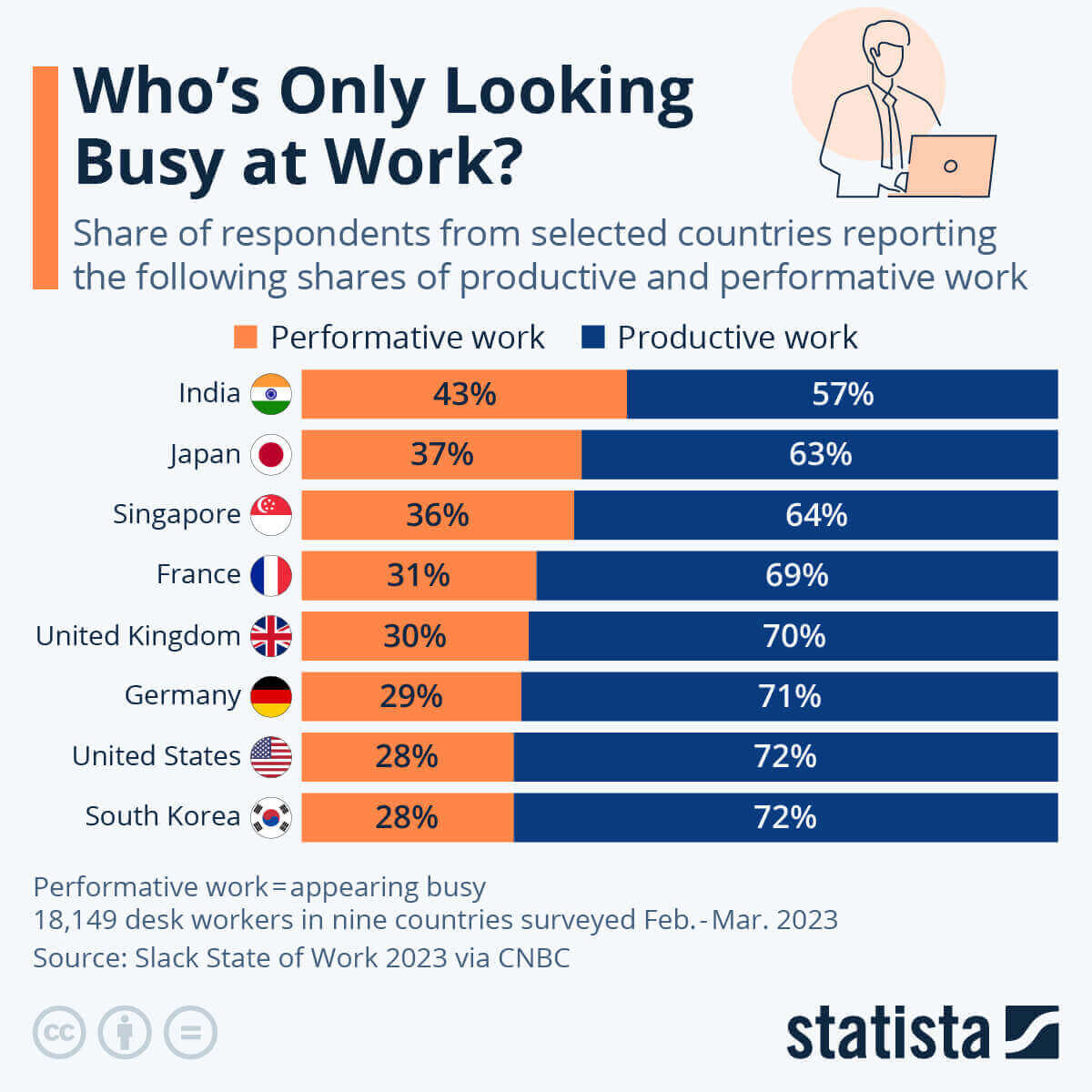
Now, a new survey of nine different countries has logged the time spent at work doing performative work and compared it against the time spent on real work.

The result: A look under the hood at which countries support a workplace culture that emphasizes surface-level busy-ness rather than one about getting down to business.

Performative work chart

India, Japan, and Singapore Prioritize Performative Work

Workers in India self-reported the most time spent on performative work (an average of 43%) rather than productive work (57% of their time).

Data from the survey, which polled more than 18,000 desk workers across February and March of this year, recently debuted in Slack’s State of Work 2023 report. 


About Tech.co Video Thumbnail Showing Lead Writer Conor Cawley Smiling Next to Tech.co LogoThis just in! View
the top business tech deals for 2026 👨‍💻
See the list button

The two most productive countries were US and South Korea, which both reported the same ratio of time wasted vs time well-spent: 28% to 72%.

What’s Keeping Us From Peak Productivity?

Slack’s report didn’t stop there. Respondents who said their productivity has been dropping listed four different main reasons why they weren’t getting as much done. They might:

  • Experience too many unnecessary meetings and emails (70% say that fewer meetings and emails would improve their productivity)
  • Feel unsupported by their managers and disconnected from their colleagues
  • Lack access to effective tools and technology
  • Grapple with information silos and switching between disconnected apps

Connecting with your employees and helping them cut down on meetings might go a long way towards boosting real productivity.

And, since meetings are the biggest issue, reducing unneeded meetings with the right web conferencing software could be a huge help as well.

Is a “Return to the Office” Encouraging Performative Work?

Remote work thrived when the Covid-19 pandemic hit in 2020, but bosses have been pushing for a return to the office every since.

In 2023, that retrenchment towards physical office jobs is in full swing, with the list of companies that have reversed their flexible remote work policies packed with big names, from Starbucks and General Motors to Disney, Walmart, Amazon, and Meta.

But has it helped productivity? Last year, we reported that US productivity rates had fallen by the sharpest rate since 1947, following a record growth in 2021.

And earlier this month, Amazon’s SVP of Amazon Video and Studios Mike Hopkins said he had “no data either way” to justify the company’s in-office work mandate. Even more recently, a study this week found that 80% of employers say they regret rushing the return-to-office push.

Perhaps remote work can help emphasize actual results, and help the US continue to resist the siren call for performative work.

Written by:
Aaron Drapkin is Tech.co's Content Manager. He has been researching and writing about technology, politics, and society in print and online publications since graduating with a Philosophy degree from the University of Bristol six years ago. Aaron's focus areas include VPNs, cybersecurity, AI and project management software. He has been quoted in the Daily Mirror, Daily Express, The Daily Mail, Computer Weekly, Cybernews, Lifewire, HR News and the Silicon Republic speaking on various privacy and cybersecurity issues, and has articles published in Wired, Vice, Metro, ProPrivacy, The Week, and Politics.co.uk covering a wide range of topics.

Survey: More Job Recruiters Are Looking for Skills, Not Degrees

"Since 2019, the share of recruiter searches on LinkedIn that include a skills filter has grown by 25%."

Job listings that don’t mention any degree requirements have reached a massive 90% total, one new HR-related survey has found.

That’s good news for anyone that wants a fair playing field for a skills-based job position — although it might be a bit of a bummer for anyone with a little or a lot of student debt.

Formal educations have long served as barriers for many, and as an easy way for recruiters to cull their stack of applicants. Now, the job economy is moving in a different direction.

75% of Recruiting Professionals Say Skills-First Hiring Is on the Rise

LinkedIn issued the survey that uncovered the shift away from formal education signifiers.

The social platform’s Future of Recruiting report 2023 found that skills-based hiring is on the rise, and could be the future of job placement around the globe.


About Tech.co Video Thumbnail Showing Lead Writer Conor Cawley Smiling Next to Tech.co LogoThis just in! View
the top business tech deals for 2026 👨‍💻
See the list button

LinkedIn recruiter survey chart.

Not only has the number of job ads in the UK that don’t mention a need for a degree jumped up 90% year over year in 2022, but the number of US job listings that don’t require a four-year degree hopped up to 20% from around 15% during the same period.

“Since 2019, the share of recruiter searches on LinkedIn that include a skills filter has grown by 25% — and today, recruiters are 50% more likely to search by skills than they are to search by years of experience.” ~LinkedIn

Businesses Must to Know What Skills Their Workers Actually Need

Part of a shift towards focusing on skills over certifications? Businesses need to make sure they know just what those skills are.

“Part of having a skills-first strategy is going beyond just hiring to ensure you’re looking at the larger picture. First, you need to understand the skills that your business needs. Then understand what skills your employees have, or that they can develop, and what skills you need to hire for so that you build your talent strategies accordingly.” ~Jennifer Shappley, VP, Global Talent Acquisition at LinkedIn

That’s easy to agree with — a full 94% of recruiting professionals did just that as part of the recent survey.

Not quite as many (84%) say that working towards understanding employee skills is “currently a priority” at their own company, however, suggesting that there’s a little more work to be done on this front.

A Healthy Job Market Might Be Pushing Recruiters Towards the Skills-Based Search

Tech jobs are still being slashed left and right, following a trend that first kicked off just about a year ago, but employment is actually pretty high in the overall economy.

That strong job market might even be the impetus behind the trend away from degree requirements: Recruiters need to fill job positions, so they’ve dropped some of the barriers that had been filtering out perfectly good workers.

As a result, some workers are finding jobs that would have otherwise passed them over. You don’t need a degree to see the economic benefits to taking a skills-based approach to job searching.

Written by:
Aaron Drapkin is Tech.co's Content Manager. He has been researching and writing about technology, politics, and society in print and online publications since graduating with a Philosophy degree from the University of Bristol six years ago. Aaron's focus areas include VPNs, cybersecurity, AI and project management software. He has been quoted in the Daily Mirror, Daily Express, The Daily Mail, Computer Weekly, Cybernews, Lifewire, HR News and the Silicon Republic speaking on various privacy and cybersecurity issues, and has articles published in Wired, Vice, Metro, ProPrivacy, The Week, and Politics.co.uk covering a wide range of topics.

The UK’s New AI Traffic Cam Spots Nearly 300 Violations in 3 Days

This new traffic camera is only the latest example of AI innovations impacting everyone's daily lives.

We already know that artificial intelligence is set to take thousands of jobs. But is AI about to disrupt your morning commute as well?

A new free-standing traffic camera powered by AI has spotted and photographed almost 300 violations in the first three days of use.

The camera, which is used in the UK as part of a trial program, caught 117 people on their phones while driving, as well as 180 instances of people failing to use their seatbelts while driving.

What to Know About the New Traffic Cam Trial

The new camera’s very first trial run took place recently in south west England, where road safety tech firm Acusensus teamed up with Vision Zero South West.

They installed it in one of the busiest roads in the area, and made sure that every offense was double-checked for accuracy by a human reviewer, according to one report.


About Tech.co Video Thumbnail Showing Lead Writer Conor Cawley Smiling Next to Tech.co LogoThis just in! View
the top business tech deals for 2026 👨‍💻
See the list button

The same team had tested a different setup with a larger camera for a 15-day trial last year, but the new system is billed as a free-standing option which can be moved around easily to different roads in any given area.

This new traffic camera is only the latest example of AI innovations impacting everyone’s daily lives. In this case, we might all need to start keeping seat belts buckled and our phones in our pockets when behind the wheel — unless we’re ready to start paying a mind-boggling amount of traffic tickets.

Will AI Traffic Cameras Really Start Ticketing Me?

But there are more than a few speed bumps that AI cameras will need to get over before that actually becomes a reality, if it ever does.

First, it’s just a trial, and hasn’t yet locked in a larger roll-out within the UK. In addition, the trial took place in the UK, so there’s no immediate reason to assume it will expand to the US.

At the same time, we already live in a world in which plenty of our private data is already scraped and can easily be used by the police to crack down on infractions, whether because the police department is unlawfully retaining data or because companies like Facebook offer it up on a platter. Adding AI cameras that can watch everyone at all times might just be dramatically increasing all that private data that’s already being abused.

AI dash cams are definitely helping commercial fleets today, but that doesn’t mean an execess of AI cameras is just as good.

AI Chatbots Have Already Been Fighting Traffic Tickets for Years

Ironically, there’s already an AI tool designed to help the average joe fight traffic tickets: We covered DoNotPay back in 2016, when the “robot lawyer” successfully got around 160,000 parking tickets thrown out in London and New York.

Theoretically, we can trigger an AI battle in which the automated cameras issues tickets and the automated lawyers refute them.

In reality, we might be headed towards a more relaxed version of that highly automated future. We may seen more AI traffic cameras and may have more AI options to help address them. Concerns about a more highly regulated distopian future may well be warranted, however, and if you feel strongly enough about avoiding a world in which an automated camera surveils you from every single street corner, make some noise. ChatGPT might be able to do the first draft.

Written by:
Aaron Drapkin is Tech.co's Content Manager. He has been researching and writing about technology, politics, and society in print and online publications since graduating with a Philosophy degree from the University of Bristol six years ago. Aaron's focus areas include VPNs, cybersecurity, AI and project management software. He has been quoted in the Daily Mirror, Daily Express, The Daily Mail, Computer Weekly, Cybernews, Lifewire, HR News and the Silicon Republic speaking on various privacy and cybersecurity issues, and has articles published in Wired, Vice, Metro, ProPrivacy, The Week, and Politics.co.uk covering a wide range of topics.

How To Spot Google Chat Scams in 2025 (With Screenshots)

Google Chat scams take on many forms. Here are six common scams circulating the platform today.

Google Chat, formerly known as “Google Hangouts”, is a chat-based messaging app that gives businesses and regular users a space to collaborate and catch up for free. The app is wildly popular, boasting over 10 million downloads on Google Play alone. But as with other platforms like LinkedIn, its large, predominantly professional user base also makes it a magnet for cyber scammers.

Unlike messaging apps like Signal, Google Chat’s security reputation isn’t great. Conversations on the platform are largely unmonitored and accounts can be reached by anyone with a Gmail email address –  making users more vulnerable to unwanted advances. Falling prey to scams on Google Chat isn’t inevitable, though.

We’ve spoken to real businesses that have fallen victim to Google Chat scams to save you from making the same mistakes. From your standard-issue phishing attacks to less typical cases of sextortion, here are six scams to be aware of on Google Chat, and advice on how to avoid them.

incogni logo
Receiving Scam Messages? Incogni will help you remove your phone number, email address and other personal information from the internet.
Take Back Control of Your Data

What are Google Chat Scams?

Google Chat scams refer to any type of cybercrime that takes place on the Workspace platform. Scams take a variety of forms: some grifters send chat requests to users directly, while others try and move conversations to Google Chat from social media sites to take advantage of the app’s lackluster security settings.

Due to the platform’s overwhelmingly professional clientele, Google Chat scams tend to mirror cons spotted on other sites like LinkedIn. But cons aren’t just focused around the nine till five, with romance and sextortion scams also becoming more prevalent on the app in recent years.

Here’s our summary of the most common scams currently circulating Google Chat:

Google Chat Phishing Scams

Unsurprisingly, the most popular scam to be aware of on Google Chat is phishing – a social engineering practice where criminals masque as reputable sources in an attempt to lure sensitive information from victims.

Due to its low barrier to entry and relatively high success rate, phishing scams are now the most common type of cyber attack in the US, and Google Chat’s public access makes it one of the easiest platforms for phishers to target.

Nikita Sherbina from the SaaS company Aiscreen.io almost fell victim to the hustle after receiving a seemingly innocuous message that claimed to be from a well-known client.

“The message contained a link that appeared to be a shared document, but upon closer inspection, it led to a fraudulent login page” Sherbina tells Tech.co. Fortunately, her IT department was quick to shut the request down, but not all Google Chat users are this luckily.

Google chat scam

A phishing scam spotted at the University of Miami. Source: miamioh.eduDaily

Google Chat user Rhett Stubbendeck from LeverageRx fell victim prey to the ruse after receiving a “seemingly innocent notification appeared from a very trusted financial institution”.

“What happened afterwards was very unsettling”, he tells Tech.co. “My business accounts were compromised, which gave access to unauthorized parties and gave way to potential data breaches.” 

How to avoid this scam: While the rise of generative AI is making phishing requests increasingly hard to decipher from the real deal, telltale signs include an inflated sense of urgency, requests for private information, and misspelled or suspicious-looking email addresses.

Learn more about some red flags to look out for in our guide to avoiding phishing emails.

Google Chat Technical Support Scam

Another common tactic plaguing Google Chat is IT support scams.

Also known as technical support scams, this type of fraud involves fake IT teams reaching out to users and claiming they’ve found a problem with their device. The scammer will then urge the target to install applications to safeguard their systems, or click on a link to resolve the problem.

Humayun Saleem, a marketing consultant for Clashify, told us about a time when his colleague was targeted by this type of scam.

“The scammer claimed their computer was compromised and offered assistance for a fee” Saleem told us. Luckily, his teammate realized it was a scam before any damage was done. 

“My colleague wisely ignored the message, highlighting the importance of skepticism and verifying the legitimacy of such claims.”

Similarly to LinkedIn, this scam is pervasive on Google Chat as the platform primarily caters to professional communities. There are a number of tell-tale signs that indicate requests may be illegitimate, though.

How to avoid this scam: Legitimate tech platforms like Google Chat won’t contact you on the app to notify you about errors on your account.

Real IT teams rarely ask you to click on links to resolve issues, either. So if you’re notified about a technical issue on your account try and reach out to service providers directly before following through with any requests.

Google Chat Fake Job Offers

As layoffs sweep across the US, cybercriminals are using fake interview scams to exploit willing candidates looking for work.

Typically, scammers will do a little background research before setting up the honey trap. This may involve logging your employment history on LinkedIn or googling your name to see what sector you’re currently working in.

A scam job offer on Google chat

Fake job interview taking place on Google Chat. Source: reddit.com

It’s common for fake recruiters to reach out to you via LinkedIn or email first, before setting up an “interview” on Google Chat where they’ll continue the charade and try to entice you about the proposed job offer. The perpetrator will then request some type of fee in order for you to move forwards with the process.

Liam Lucas, CEO and Founder of the digital tech company Off Road Genius told us about a time he nearly fell prey to a fake job offer scam.

“I’ve encountered fake job offers where the scammer promises a high-paying job in return for a fee” Lucas shared. In his case, the fee that was demanded was “purportedly for background checks or training materials”, but luckily he declined the bogus offer before any hard-earned cash was exchanged. 

How to avoid this scam: Real recruiters will never demand payments before moving you along the onboarding process. Be wary of any company that makes such requests, and do your background research before getting excited about a new job opportunity.

Google Chat Romance Scams

While Google Chat may be an unlikely place to find love, the platform is a popular destination for romance scams, a type of crime where grifters feign a romantic interest with targets before attempting to extort them.

Romance scams are typically orchestrated by international criminal groups who scope out victims on dating sites like Tinder or Bumble. After establishing a rapport with targets, bad actors will try and move the courting process over to platforms with weaker security protocols like Google Chat.

According to Australian psychologist Monica Whitty, perpetrators will then try to develop hyperpersonal relationships with the victim until they feel like they’re ready to depart with their money.

Google chat scam

Romance scammer posing as a military doctor. Source dailymail.co.uk

Due to the scam’s reliance on emotional manipulation and deception, Whitty explains the ruse often causes a “double-hit” among victims, as those targeted are left with financial damages alongside the abrupt loss of a personal relationship.

Unfortunately for susceptible singletons, instances of romance scams have shot up 91% since Covid-19, with women making up two-thirds of reported victims.

How to avoid this scam: If someone you meet online asks to move the chat over to third-party messaging apps like Google Chat, immediately question their movies. Also, don’t share financial information or any other personal details before meeting up in person.

Google Chat Sextortion Scams

Sextortion is a type of blackmail where criminals threaten to publish private, sexual content if victims don’t meet their demands.

While cases of sextortion are on the rise across most platforms, Google Chat’s current settings – which don’t allow users to delete chat history for both parties – make it the platform particularly well-suited to scammers looking to engage in this type of crime.

Like romance scams, the particularly distressing type of scam is normally established on dating platforms before being moved to apps like Google Chat. Then, after both parties are using the platform, the scammers will work on building trust, before eventually requesting compromising images, videos, or information from the target.

But it’s not just those handing over sensitive materials that are at risk. It’s becoming increasingly common for sextortion scammers to create sexually explicit content from benign images of victims using photo editors and AI technology – opening the scam up to a much wider pool of potential prey.

How to avoid this scam: Be weary of user that suddenly steer the conversation towards sexual themes and refrain from sharing explicit content with unverified accounts.

If you suspect someone is blackmailing you on Google Chat, document all potential evidence, instantly report the suspect to the platform, and contact the authorities.

Google Chat Bogus Giveaways

Everyone loves a freebie. But with this type of online crime, the only party getting a reward is the scammers.

Google Chat giveaway scams take place when cybercriminals reach out to users on the platform, claiming that they’ve won a payout, product, or service. The grifter will pretend to be a credible organization and ask targets to hand over financial information in order for the prize to be released.

The scam can take many forms, but Google Lotto and Google Pop-up scams are especially common on the platform. Both types of fraud target Google users and ask them to complete a survey or enter personal information to claim their winnings.

Google fake prize scam

Google Chat prize scam. Source: support.google.com

Not all bogus giveaways claim affiliation with Google, though.  Tina Grant, tech manager at aerospheres, told us about a personal experience a relative had with this type of scam.

“They eventually got him to share is credit card details for “security verification” and to pay for “shipping”. They completed a $2,800 transaction on his card.” – Tina Grant, Tech Manager at aerospheres

“(My dad) was told he won an Apple hamper from his bank and being someone who always wanted to use Apple but never really “got to it”, he decided to reply” Grant revealed. Unfortunately for her father, he parted with $2,800 before realizing the prize was a hoax. 

How to avoid this scam: Unfortunately, if a giveaway seems too good to be true, it probably is. If you haven’t entered a competition or sweepstakes, any claim that you’ve won a prize should be a giant red flag – especially if they’re requesting personal information.

Google Chat Crypto Scams

While our understanding is that crypto scams aren’t as common on Google Chat as they are on other platforms – and they’re certainly less prevalent than tech support or fake giveaway scams referenced above – they’re still worth watching out for.

Cryptocurrency has been providing criminals with the perfect cover for their scams for several years now, as they take advantage of the many legitimate (but arguably still questionable) investment tip-offs and opportunities lining our social media and email inboxes, along with the ones we see pushed by trading influencers online on a near-daily basis.

In Google Chat crypto scams – as well as crypto investment cons taking place on other platforms – lucrative investment opportunities with near 100% returns and next to no risk are often advertised as a simple way to get rich quickly. The way the value of cryptocurrencies like Bitcoin has grown over time, as well as the hype around new, exciting digital currencies like Ethereum, make it strangely easy for cyber criminals to convince the average punter that their tip-off is genuine.

How to avoid this scam: The ol’ if it’s too good to be true, it probably is line is worth trotting out here for a reality check. If an investment opportunity really is low-risk and can guarantee a purported high reward, why is it being farmed out to people’s message, social media, and email inboxes, and not front page headlines? No one should be making any investments off the back of unsolicited text messages.

Is Google Chat Safe?

Google Chat offers several built-in security features like end-to-end encryption and automatic phishing detection, giving users a decent guarantee of protection. Like many messaging apps, the provider uses Transport Layer Security (TLS) to encrypt messages sent between devices and its servers.

However, Google Chat’s low barrier to entry and external domain messaging options make it a lot less scam-proof than other messaging platforms like Signal and Telegram. This doesn’t mean you’re destined to be duped, though. By practicing due diligence, avoiding suspicious-looking links, and keeping personal information to yourself, you stand a solid chance of remaining safe on the app.

It’s also worth knowing how Google uses your data when you use Google Chat. On a help and support page, the tech giant explains that “features like Smart Reply and spam detection, as well as a smarter product experience” can only be provided if the company can access and use chat data.

“To improve Chat’s performance and reliability,” and to help with troubleshooting in case of issues while you use Chat” Google continues, “we collect performance data and crash analytics. We also use this info to help prevent abuse of our services and for analysis.”

This is all pretty standard stuff, and Google also says on the same page that Google Chat data isn’t used for advertising. However, the company can and will access your chats in response to a legal order from the government – so bear this in mind when using the platform.

Protecting Yourself from Online Scams

In 2024, many of the online scams you’ll see lurking about are specifically tailored to the platforms they’re being spread on. In other words, cyber criminals know that generic correspondence won’t work. This means scams are constantly changing, and often, the ones you receive via email look very different from the ones you get sent over SMS or Google Chat. This makes them pretty tough to spot at times.

However, there are still some rules to follow to avoid all phishing scams. Firstly, we’d avoid clicking any links you receive via text message purporting to link you to a legitimate company’s page. Supposedly missed a “delivery”? Log in with your reference number on your email address. Are your accounts being “deleted”? Contact the company directly. Remember, you can always open a separate line of communication with any company if something feels off.

Additionally, treat email SMS, and other correspondence trying to inject a sense of urgency into your decision-making with extreme caution. While legitimate companies like the often-impersonated PayPal might want you to “sign up now” for a limited-time offer, that’s very different from a “representative” of a company suggesting your account will be suspended immediately if you don’t hand over personal information, or pay a fee.

Another thing you can do to protect yourself is to ensure you’re never reusing passwords across accounts. Although this is more of a form of damage limitation for when your credentials for one site are compromised, it’ll ensure the cyber criminal in question is unable to get into any of your other accounts with your information. If you’re reusing the same password over and over again, one breach is all it takes to expose everything.

Google Chat Scams FAQs

Anyone with a gmail address can join Google Chat and reach out to users. This makes the platform prone to scams like phishing attempts, fake job offer scams, and fake giveaway scams.

Google Chat is a legitimate messaging platform and part of the Google Workspace family. However, despite being a reputable app, its low barrier to entry makes it more prone to cases of cybercrime than apps like Signal.

Google Chat has a solid reputation due to its affiliation with the Google Workspace family. However, this combined with the app’s accessibility and high user numbers, makes Google Chat an attractive platform for scammers to con their victims.
Written by:
Aaron Drapkin is Tech.co's Content Manager. He has been researching and writing about technology, politics, and society in print and online publications since graduating with a Philosophy degree from the University of Bristol six years ago. Aaron's focus areas include VPNs, cybersecurity, AI and project management software. He has been quoted in the Daily Mirror, Daily Express, The Daily Mail, Computer Weekly, Cybernews, Lifewire, HR News and the Silicon Republic speaking on various privacy and cybersecurity issues, and has articles published in Wired, Vice, Metro, ProPrivacy, The Week, and Politics.co.uk covering a wide range of topics.

The Best Free AI Training Courses for 2024: Upskill Yourself Today

The best AI training courses you can actually enroll in for free, from the likes of Google, Microsoft, Harvard, and others.

With businesses finding new, inventive ways to make money with ChatGPT every day, it’s no surprise that AI training courses are becoming increasingly sought after.

Workers in all sorts of industries are looking to future-proof their jobs and upskill themselves in line with the rapid technological changes occurring. Luckily, companies like Microsoft and Google offer free AI training courses, as do some higher education institutions.

In this guide, we cover the best AI training courses currently available, as well as the benefits of learning about AI in the current job market. We’ve largely focused on free courses that offer immediate, foundational learning opportunities that you can start applying to your job role or career straight away, rather than paid degree courses that cost hundreds or thousands of dollars.

The 8 Best Free AI Training Courses for Generative AI

Here, we’ve compiled a list of the best free AI training courses that focus on generative AI and how you can harness it, as well as foundational concepts in artificial intelligence. A lot of these courses are designed to be introductory sessions and geared toward beginners.

  1. Google’s Generative AI Learning Path (5 Courses)
  2. Microsoft’s “Transform Your Business With AI” Course
  3. Google’s “Machine Learning Foundational Course”
  4. LinkedIn’s “Career Essentials In Generative AI” Training Course
  5. “IBM: AI Foundations for Everyone” Training Course
  6. Digital Partner’s “Fundamentals of ChatGPT” Training Course
  7. DeepLearning.AI’s “AI for Everyone” (Coursera)
  8. Phil Ebner’s AI Crash Course (Udemy)

1. Google’s Generative AI Learning Path (5 short Courses)

One of the more generous courses available in terms of actual hours of learning, Google’s Generative AI Learning path has five short courses on it. All courses take one day to complete.

Seven of the courses are classified as introductory, including “Introduction to Generative AI”, “Introduction to Large Language Models” and “Generative AI Fundamentals”.

There are three courses within the learning path described as intermediate, including “Encoder-Decoder Architecture” and “Attention Mechanism: Overview”.


About Tech.co Video Thumbnail Showing Lead Writer Conor Cawley Smiling Next to Tech.co LogoThis just in! View
the top business tech deals for 2026 👨‍💻
See the list button

The first two introductory courses cover a lot of immediately applicable content, such as how to use prompt tuning to get the best out of large language models. There’s also a course on the responsible usage of AI.

Although there’s no official qualification, you will be awarded a completion badge that you can attach to your digital resume. Google has also recently expanded its paid certificates program which can be accessed through Coursera and has made its free courses available in 18 additional languages.

2. Microsoft’s “Transform Your Business With AI” course

This Microsoft learning path is designed, as the tech giant says, to help businesspeople acquire “the knowledge and resources to adopt AI in their organizations”, and explores “planning, strategizing, and scaling AI projects in a responsible way.”

Microsoft says the objectives for this course are to become familiar with existing AI tools, understand basic AI terminology and practices, and use prebuilt AI to build intelligent applications.

To enroll in this course, which is 2 hours and 40 minutes long, Microsoft says you’ll need a “basic understanding” of IT and business concepts. Modules included in the pathway are:

  • Leverage AI tools and resources for your business (55 mins)
  • Create business value from AI (21 min)
  • Embrace responsible AI principles and practices (48 mins)
  • Scale AI in your organization (36 mins)

3. Google’s “Machine Learning Foundational Course”

Along with the foundational AI course mentioned above, Google also provides an introductory course on machine learning that’s available for free. You can access the course with your Google Workspace or personal account, and there’s actually a surprising amount of material included, considering it’s free.

Included as part of the material is a “crash course” to machine learning, a section on “problem framing” and a course on how to prepare your data for machine learning workflows. Included are freely accessible videos explaining core concepts, provided by machine learning experts. You’ll then be able to “check your understanding” at the end of each section with a quiz.

While this course is a little more advanced than the other Google course to make this list – and has a bit more of a business focus – it’s worth checking out if your company is looking for new ways to implement AI/machine learning in the workplace.

4. LinkedIn’s “Career Essentials In Generative AI” training course

LinkedIn’s AI Career Essentials Course is made up of five different videos, with a total run time of around four hours. Each video is hosted by a different AI expert, covering a range of core concepts and ethical considerations relating to AI models.

One of the videos provides a detailed explanation of how to streamline your work with Microsoft Bing Chat, while another discusses the key differences between search engines and reasoning engines. Although there’s no accreditation or certification, completing this course will earn you a badge of completion from LinkedIn, which can be displayed on your profile.

The fifth video in the series, entitled “an Introduction to Artificial Intelligence” is an hour and a half long and provides a simplified overview of the best AI tools for businesses, which is handy for those who haven’t taken the plunge yet and implemented a tool in work.

5. IBM’s “AI Foundations for Everyone” training course

IBM offers a course entitled “AI Foundations for Everyone” through Coursera, of which over 2,000 people have already signed up for in just February 2024. You can audit the course for free, which will give you access to all of the materials and some of the assignments, but you won’t be graded or get a certificate at the end. For that, you’ll need a Coursera subscription.

It’s geared toward beginners and you don’t need prior experience to enroll, and the schedule is flexible so you can learn at your own pace. Along with AI fundamentals, the course will also ensure you’re familiar with IBM’s own AI services, which help businesses integrate artificial intelligence into their existing infrastructure.

IBM says that, by the end of the course, participants will have had “hands-on interactions with several AI environments and applications”.

The course has three modules: “Introduction to Artificial Intelligence”, “Getting Started with AI using IBM Watson”, and “Building AI-Powered Chatbots Without Programming”. Each module takes between nine and eleven hours to complete.

6. Digital Partner’s “The Fundamentals of ChatGPT” training course

Digital Partner’s course entitled “The fundamentals of ChatGPT” is a great option for anyone who wants to take a free, accredited course that covers the basics of Generative AI. As of February 2024, more than 8,000 learners have completed the short course.

During the course, you’ll spend time learning about OpenAI’s role in global AI development, and be able to learn about how ChatGPT works, its advantages and limitations. There’s also a variety of examples included within the course that will show you how to leverage ChatGPT for different tasks, and you’ll learn more about the difference between ChatGPT and ChatGPT Plus.

Modules include “Working With ChatGPT”, “ChatGPT and Its Shortcomings” and “Training a GPT Model”. This free course is available on alison.com, and is published by a digital marketing firm called Digital Partner. The course is CPD accredited and a certificate will be awarded upon completion of a small assessment at the end of the 1.5-3 hour program.

7. DeepLearning.AI’s “AI for Everyone” (Coursera)

Not to be confused with IBM’s similarly-named online AI training course, DeepLearning.AI’s “AI for Everyone” short course is worth enrolling in just to see what the fuss is all about. 1.2 million people have enrolled in this course and more than 40,000 have reviewed it, with an average score of 4,8/5 in February 2024 – perhaps because it’s run by lecturer Andrew Ng, an instructor with over 40 courses published on the site.

This course is split up into four broad modules: What Is AI?, Building AI Projects, Building AI in Your Company, and AI in Society. All four of the modules take less than an hour to complete, so you could feasibly complete the course in a day if you’re prepared to take the quizzes designed to recap each module.

Like most Coursera courses, you’ll be able to audit the course and access all the materials for free, although you’ll have to sign up for a paid account if you want the relevant accreditation once you complete the course.

8. Phil Ebner’s ChatGPT, Midjourney, Firefly, Bard, DALL-E” AI crash course

While some good courses on Udemy will guide you through the ins and outs of MidJourney and other AI generation tools, Phil Ebner covers the most ground, and more than 30,000 students have already enrolled in the course, which has a 4.6/5 rating on Udemy.

The course is almost two hours long and also includes content that will help you better use tools like ChatGPT to generate text responses as well as images.

The “AI for Visual Creativity” section, however, will show you how to use both MidJourney and Dall-E to create “photorealistic images, illustrations, and digital art in a variety of styles. With OpenAI’s Sora video generator seemingly just around the corner, there’s never been a better time to learn the basic principles of AI video generation and the tools that can do it.

On Udemy, you don’t receive certificates of completion for free courses, but if you’re just looking to upskill yourself free of charge, this course is definitely worth a look.

The 6 Best Free AI Training Courses for Programmers, Developers & Tech Experts

Up next, we have more advanced courses geared towards programming and development.

  1. Harvard University’s “Introduction to Artificial Intelligence with Python”
  2. DeepLearning.AI’s “ChatGPT Prompt Engineering For Developers” (Coursera)
  3. Intro to TensorFlow for Machine Learning (Udacity)
  4. Georgia Tech’s Reinforcement Learning (Udacity)
  5. Become an AI-Powered Engineer: ChatGPT, GitHub Copilot (Udemy)
  6. Great Learning’s “ChatGPT for Beginners” training course

1. Harvard University’s “Introduction to Artificial Intelligence with Python”

Harvard University offers a self-paced, 7-week course on the “concepts and algorithms at the foundation of modern artificial intelligence”.

The time commitment of between 10-30 hours a week – but it’s completely free to enroll and you’ll be supported as you complete projects and attend lectures. However, you need to have taken Harvard’s “Introduction to Computer Science” course first to enroll.

2. DeepLearning.AI’s “ChatGPT Prompt Engineering For Developers” (Coursera)

This course will help you utilize OpenAI’s API to write more effective prompts, learn how large language models can be used to carry out tasks like text transformation and summarizing, and teach you how to program and build a custom AI chatbot.

The course is run by AI expert and DeelLearning.AI co-founder Andrew Ng and OpenAI’s Isa Fulford, and it’s only an hour long. DeepLearning.AI says the course is “free for a limited time”. A basic understanding of Python is needed, but aside from that, it’s beginner-friendly.

3. Intro to TensorFlow for Machine Learning (Udacity)

This course teaches participants how to build deep-learning applications with TensorFlow, one of the most popular open-source Python software libraries.

The estimated completion time for the course is approximately two months, and you should have some experience with Python syntax, including variables, functions, and classes, as well as a grasp of basic algebra.

If you take the course, providers Udacity say, you’ll get “hands-on experience building your own state-of-the-art image classifiers” as well as other types of deep learning models.

4. Georgia Tech’s Reinforcement Learning (Udacity)

This Georgia Tech course is free on Udacity and focuses on exploring “automated decision-making from a computer-science perspective”.

At the end of the course – which takes approximately four months to complete, but is also described as self-paced – participants will recreate a result from a published paper on reinforcement learning.

However, it is recommended you have a graduate-level machine-learning qualification and some prior experience with reinforcement learning from previous studies. Experience with Java is also required.

Although there’s no official certificate awarded for completing the course, you can earn a nano degree program certificate by completing Udacity’s 4-month long “Deep Reinforcement Learning”, although this costs $1116.

5. Become an AI-Powered Engineer: ChatGPT, Github Copilot (Udemy)

In this course, students will learn how to create high-quality pieces of code using ChatGPT and integrate it with other text editors. It also covers how to use GitHub Copilot.

This might be a free tutorial, but the course has much better reviews than some of the other AI courses available on Udemy, with 56% of watchers who left a review giving the course five stars, and a further 24% giving it four stars at the time of writing.

The course will be best suited to developers who want to leverage AI tools for coding responsibilities in general, and also, to become more efficient in their coding practices.

6. GreatLearning’s “ChatGPT for Beginners” training course

This is a completely free, two-hour long beginners-focused ChatGPT course. It’s one of the only beginner’s courses on the internet that includes a section on coding prompts, although it also covers quite a bit of other ground, including email prompting.

There are no prerequisites needed for this course, and it has an average rating of 4.61/5, with 75% of reviewers giving the course 5 stars.


The 6 Best Free College AI Courses and Training

A number of universities and colleges offer AI-focused courses.

  1. Stanford University’s “Machine Learning” Course (Udacity)
  2. Vanderbilt University’s “Prompt Engineering for ChatGPT” (Coursera)
  3. Georgia Tech’s “Machine Learning” Course (Udacity)
  4. The Open University’s “AI Matters” Course (OpenLearn)
  5. University of Pennsylvania’s “AI For Business” (Coursera)
  6. University of Helsinki’s “Elements of AI” and “Ethics of AI” Course

1. Stanford University’s “Introduction to Artificial Intelligence” course (Udacity)

This foundational online program, which takes around 10 months to complete at a rate of 10 hours a week, focuses on fundamental AI concepts and practical machine learning skills but is classified as an intermediate course.

The course, which is split into two umbrella sections (“Fundamentals of AI” and “Applications of AI) is completely free if you sign up for Udacity (which also doesn’t cost anything). Unlike Coursera courses, you have access to the full range of materials and teaching, rather than just the ability to audit. It consists of 22 different lessons and a string of interactive quizzes.

2. Vanderbilt University’s “Prompt Engineering for ChatGPT” (Coursera)

Jules White, Vanderbilt University’s associate dean for strategic learning programs and associate professor of computer science, has launched a free online course available through Coursera focusing on prompt engineering.

It goes through the most effective approaches for prompt engineering, covering summarization, simulation, programming, and other useful ways you can harness the power of ChatGPT with your inputs. It’s got one of the highest approval ratings we’ve seen for an AI training course, scoring 4.8/5 with an approval rating of 98% as of February 2024.

The course takes around 18 hours to complete and is made up of an introduction to prompts and three separate sessions on prompt patterns, as well as a 2-hour module on examples. You can either audit this course for free, which means you get access to all the materials but no proof you’ve completed it, or pay for a Coursera subscription (roughly $59 per month). However, you won’t have to pay anything on top of that fee for this course.

3. Georgia Tech’s “Machine Learning” course (Udacity)

In collaboration with Georgia Tech, Udacity has made an intermediate machine-learning course available for free, which takes around 4 months to complete, although the course listing says you can do it at your own pace.

The course is offered as part of an online master’s degree at Georiga Tech, but taking this course won’t earn you credit toward this degree. It includes information on Supervised and Unsupervised Learning, which are two different types of machine learning, and covers how they’re used in AI systems.

However, having a “strong familiarity with Probability Theory, Linear Algebra, and Statistics” and prior experience with statistics is helpful. Students should also have some experience with programming.

4. The Open University’s “AI Matters” course (OpenLearn)

The Open University is a UK-based institution that offers a free course through its learning portal OpenLearn entitled “AI Matters”.

In the course, you’ll learn about the “historical, social, political and economic issues in AI”, explore the benefits and limitations of the technology, and discuss ethical risks relating to AI.

The course is six hours long, and you’ll be eligible for a “statement of completion” from the organization, which has university status in the UK.

5. University of Pennsylvania’s “AI For Business” (Coursera)

The University of Pennsylvania’s “AI for Business” specialization is made up of four different, free courses:

  • AI Applications in People Management
  • AI Fundamentals for Non-Data Scientists
  • AI Applications in Marketing and Finance
  • AI Strategy and Finance

In 2023, the University of Pennsylvania’s website detailed that the course itself costs $39 to complete, and you could enroll in the four individual modules for free. Each module took around two hours a week to complete.

However, in 2024, they’ve upped the price to $79. However, we’d recommend accessing it via Coursera – the modules take around 7-9 hours to complete, and if you purchased the 7-day free trial, it could be done in that time. You can also audit the course for free, which means you won’t have proof of completion.

6. University of Helsinki’s “Elements of AI” and “Ethics of AI”

The University of Helsinki has two, free online courses available. The course entitled “Ethics of AI” is geared towards “anyone who is interested in the ethical aspects of AI”, the university says.

The course will familiarize you with common questions that arise in AI ethics and the various ways to approach them.

Elements of AI” is a broader course with 6 chapters, focusing on topics such as “neural networks”, “machine learning” and “AI problem solving”.  All you need to do to access the course materials is sign up.

The Benefits of Learning About AI

Of course, completing an AI training course can have several benefits. From a personal learning perspective, it’s one of the best ways you can spend your time – AI is here to stay, and getting a better grasp of how it works might just help you out in the near future.

Plus, the things you learn about AI will be applicable to a wide variety of job roles in almost every sector of the economy, so it’s arguably a safer bet than completing a course on a niche or industry-specific topic.

What’s more, right now, businesses are looking for people who understand how generative AI tools like ChatGPT work, and how to leverage them effectively. Employees that are conscious of the limitations of AI tools and able to generate useful responses using prompts are going to become more sought after than employees without these skills.

Completing an AI training course is going to look good on your CV, which will help if you’re applying for a new job. Evidence that you’ve taken the initiative to explore an emerging technology is definitely something an employer will find desirable.

Of course, if you don’t have much of a budget – or you’re not entirely sure what AI training course would be the best use of your time – then trying out some free options is a great place to start.

The Benefits of Developing Your Soft Skills in an Automated World

If you’re looking for AI training courses to enhance your understanding of something that’s going to dominate the business world for years to come, you’re already one step ahead of the crowd.

Completing an AI course isn’t the only way to prepare yourself for the seismic changes to the global economy that will occur as AI is harnessed by more businesses.

One other thing you can do if you want to upskill yourself is to develop your soft skills. These are the “human” skills that AI tools like ChatGPT don’t have. Businesses are always going to need humans to organize, prioritize, and take responsibility for planning and executing projects.

With AI taking control of more and more repetitive administrative tasks, having strong soft skills is going to be increasingly important to stand out in a pool of highly-qualified job applicants or colleagues jostling for promotion.

Developing your soft skills can consist of taking an accredited course – but they are more than often improved by taking experiences, especially in the workplace. It’s vital, then, to put yourself forward for opportunities and experiences that will let you expand your communication, organization, and general leadership skills. You can be taught to work a piece of software in a week, but you can’t click your fingers and make someone a proficient public speaker or project manager.

FAQs

Yes – Google has a free AI learning path that has ten courses you can complete for free. Each course takes around one day to complete. The modules provide an introduction to generative AI, and although there’s no official qualification, you will get a completion badge which you can add to your resume.

AI proofing your job can be done in two ways. Firstly, make sure you’re competent at using the latest generative AI tools like ChatGPT. This is especially vital if many of the tasks you’re completing on a day-to-day basis could, in theory, be completed by AI. Secondly, ensure you’re investing in the development of soft skills that AI tools may never have, such as the ability to effectively and appropriately manage employees.

Yes – you can learn how to harness the powers of AI on your own, through online guides, tutorials, and courses. There are quite a lot of resources out there now that will show you how to get the most out of generative AI tools like ChatGPT. However, if you want to learn how more complex skills, such as programming a large language model, you may need to seek out a paid course

Yes – Microsoft has a free training path available that consists of four short modules, which cover how to leverage AI effectively in business settings and how to scale AI projects in a responsible, impactful way.

Coursera will give users a 7-day free trial of the platform, during which they can sign up to any courses they like and start learning. After that, it’ll cost you $59/month for Coursera plus – but you’ll be able to access the platform’s free courses for as long as you want. Coursera will also let you audit courses for free, which means you’ll get access to the material, but no certificate at the end.
Written by:
Aaron Drapkin is Tech.co's Content Manager. He has been researching and writing about technology, politics, and society in print and online publications since graduating with a Philosophy degree from the University of Bristol six years ago. Aaron's focus areas include VPNs, cybersecurity, AI and project management software. He has been quoted in the Daily Mirror, Daily Express, The Daily Mail, Computer Weekly, Cybernews, Lifewire, HR News and the Silicon Republic speaking on various privacy and cybersecurity issues, and has articles published in Wired, Vice, Metro, ProPrivacy, The Week, and Politics.co.uk covering a wide range of topics.

Can Twitter Actually Slow Down Links to Sites Elon Musk Hates?

For some time this week, Twitter seemed to be throttling links to rival social media sites and specific news publications.

X, the social media network formerly known as Twitter, has been accused of delaying links to websites that Elon Musk is known to dislike.

In test run this week by the Washington Post, links to websites such as the New York Times, Instagram, and Threads were reportedly delayed by around five seconds.

Although the billionaire and self-proclaimed free speech absolutist is yet to comment on the claims, is it even possible to slow down links in this way? We take a closer look.

What Has Twitter/X Been Accused of Doing, and Who Is Impacted?

The Washington Post has claimed this week that Twitter/X is slowing down the loading speed of links accessed through the platform by up to five seconds, a practice commonly referred to as “throttling.”

However, the Post says that a lot of loading speeds returned to normal shortly after the article was published.

Substack, Facebook, Threads, Blue Sky, Reuters, and the New York Times all reportedly experienced link delays. Elon Musk has, in the past, criticized all of them publicly for a variety of different reasons.


About Tech.co Video Thumbnail Showing Lead Writer Conor Cawley Smiling Next to Tech.co LogoThis just in! View
the top business tech deals for 2026 👨‍💻
See the list button

Is It Possible Twitter Is Slowing Down Links to Sites Musk Hates?

In a technical sense, it’s entirely possible that the Washington Post is correct, and that Twitter/X is tinkering with loading times for specific sites.

When you click on a link on Twitter/X, you’re redirected to it through a domain called t.co, which Twitter/X uses to shorten links posted on the platform. This is where the Post says the link delays were originating from.

How quickly or slowly traffic passes through that domain is at the whim of Twitter. The platform will have full control over this. However, it’s important to remember that no one working at Twitter/X has confirmed or denied that this was intentional, despite repeated requests for comment.

But Is it Legal?

There’s no explicit or direct legal obligation for Twitter/X — or any other website for that matter — to ensure that external links load within a specific timeframe.

Whether there’s a duty to treat all links the same, however, and not discriminate against specific companies or organizations, is another question entirely. Such a practice may violate certain consumer protections and specific pieces of antitrust legislation. It’s unclear at the moment how strong the legal arguments for either side would be.

It’s Only a Few Seconds — Is That Even a Big Deal?

Yes. It might only be a few seconds in real terms, but when it comes to user experience and website analytics, that’s a long time.

For instance, when a website’s load time increases from one to three seconds, bounce rates increase by about 32%. If a page takes longer than three seconds to load, Google says, then 53% of users abandon the page altogether.

For sites impacted by the link delays, this could result in a major loss of traffic and subsequent advertising revenue.

Although this is unlikely to impact a site the size of the New York Times — at least in the short term — it certainly doesn’t send positive signals to smaller publications and ecommerce businesses deciding which social media platform to make their home.

Written by:
Aaron Drapkin is Tech.co's Content Manager. He has been researching and writing about technology, politics, and society in print and online publications since graduating with a Philosophy degree from the University of Bristol six years ago. Aaron's focus areas include VPNs, cybersecurity, AI and project management software. He has been quoted in the Daily Mirror, Daily Express, The Daily Mail, Computer Weekly, Cybernews, Lifewire, HR News and the Silicon Republic speaking on various privacy and cybersecurity issues, and has articles published in Wired, Vice, Metro, ProPrivacy, The Week, and Politics.co.uk covering a wide range of topics.
Back to top