Virtual Avatars Are Rolling Out on Microsoft Teams

Avatars for Microsoft Teams give users a "much-needed camera break," while keeping them engaged in a video call.

The hierarchy of visuals in the video conferencing universe is about to change: Microsoft Teams is debuting its long-awaited virtual avatar functionality.

With digital avatars, users can continue collaborating with their coworkers even without being directly on camera, making it a useful failsafe for bad hair days.

The feature was added to the Microsoft roadmap in March, and will be coming to all Windows and Mac desktop platforms around the globe in May 2023. Since the month is nearly up, the tool may already be available to users.

Virtual Avatars Are “Customizable” and Include Reactions

Microsoft rolls out plenty of updates, and this one was announced just like all the others: In a brief blurb on the company’s public roadmap of new and updated features for Microsoft 360, a product family of software and collaboration services that includes Teams.

Here’s how Microsoft explains the avatars:

“Avatars for Microsoft Teams gives you that much-needed camera break, while still allowing you to collaborate effectively. You can add a new layer of choice to your meetings and represent yourself the way you want with customizable avatars and reactions.”

In other words, it’s a way to give users who want to avoid the camera for a host of different reasons the freedom to do so, while still signalling to their coworkers that they’re remaining engaged in the conversation.

That said, it might not be the platform’s most beloved update, as plenty of workers don’t love the cartoon, corporatized look of most Emoji-esque virtual avatars. The avatar-dependant Metaverse still hasn’t taken off like Meta had hoped it would.

The ability is coming to the Microsoft Teams desktop app across all Windows and Mac platforms.

Is Microsoft Teams the Best Video Conferencing Tool?

Remote work collaboration tools have grown quickly in importance since the onset of the Covid pandemic in 2020, and the business world is still adjusting to this day.

Remote work might dwindle as some companies push for a return to the office, but it doesn’t seem set to ever fully vanish. A hybrid workforce that combines days in the physical office with days working from home seems like the new normal for many. And that means plenty of video meetings.

Microsoft Teams is a fine option for a video conferencing solution, though not our top pick. We’ve ranked all the top options over here, and found that RingCentral rose to the top, for its features, pricing, and ease of use.

Protect Your Data with SurfShark VPN

Connect an unlimited number of devices for just $2.49 per month.

Can the Right Video Conferencing Solution Improve Remote Work?

A recent survey found that almost half of employees would think about switching jobs if their currently existing remote work flexibility options were reduced. For many jobs, retaining employees by meeting their flexibility needs is the smart move.

Advances in tech can help, from remote work software to video conferencing tools.

Sure, a new virtual avatar likely won’t be the key difference between a stale web conferencing call and an effective remote work session. But there’s only one way to know for sure, and it’s rolling out now across Microsoft Teams.

Written by:
Adam has been a writer at Tech.co for nine years, covering fleet management and logistics. He has also worked at the logistics newletter Inside Lane, and has worked as a tech writer, blogger and copy editor for more than a decade. He was a Forbes Contributor on the publishing industry, for which he was named a Digital Book World 2018 award finalist. His work has appeared in publications including Popular Mechanics and IDG Connect, and his art history book on 1970s sci-fi, 'Worlds Beyond Time,' was a 2024 Locus Awards finalist. When not working on his next art collection, he's tracking the latest news on VPNs, POS systems, and the future of tech.

AI Puts Jobs Mostly Held by Women at Risk, Study Finds

Some of the jobs most likely to be impacted by AI include bill collectors and payroll clerks, among others.

Women in the workforce may be at the greatest risk of job replacement due to advances in artificial intelligence, a new study from human resources analytics firm Revelio Labs indicates.

This is due to baked-in systemic bias within society, which pushes women into administrative or secretarial roles, the study’s authors say.

If the study’s conclusions play out as predicted, it wouldn’t be the first time prejudices have been replicated or even strengthened by AI: We’ve previously covered a UN report on the subject of sexism in AI and within the tech ecosystem.

AI’s Impact “Becomes Skewed Along Gender Lines”

To arrive at its conclusion, the Revelio Labs study first looked at a third-party study from National Bureau of Economic Research, which aimed to determine the job positions most threatened by AI in the near future.

Then, the researchers broke down the typical demographics of each position by gender, finding that women are more strongly represented in most of them.

“The distribution of genders across occupations reflects the biases deeply rooted in our society, with women often being confined to roles such as administrative assistants and secretaries. Consequently, the impact of AI becomes skewed along gender lines.” -Hakki Ozdenoren, economist at Revelio Labs

Among others, the jobs in question included bill and account collectors, payroll clerks, and executive secretaries, according to Bloomberg.

AI Set to Disrupt Global Workforce

IBM is one of the higher-profile companies to pause hiring explicitly in order to consider replacing jobs with AI. The company may replace up to 7,800 jobs as a result.

Nearly half (47%) of today’s business leaders and decision-makers say they are considering opting for AI tools as a replacement for hiring new employees, a Tech.co survey from earlier in this month revealed. A thin majority (52.8%) said that they would not consider it, but the impact of even a small percentage of businesses leaning into AI in order to slow hiring would still be felt by the economy.

Protect Your Data with SurfShark VPN

Connect an unlimited number of devices for just $2.49 per month.

Tech layoffs have been in full swing since 2022, however, so placing the blame entirely on AI may not be fair. And we have yet to see if AI is truly up to the task of replacing flesh-and-blood workers once the current AI hype cycle runs its course.

Sexism in the global workforce and in the tech sector specifically, on the other hand, is well documented.

As Judy Wajcman, professor of sociology at the London School of Economics, put it in a 2020 Tech.co article: “Women should be equal partners in tech work. Not only because equal opportunities are a social justice issue, but also because it will ensure we get the best technology and the best data science.”

Written by:
Adam has been a writer at Tech.co for nine years, covering fleet management and logistics. He has also worked at the logistics newletter Inside Lane, and has worked as a tech writer, blogger and copy editor for more than a decade. He was a Forbes Contributor on the publishing industry, for which he was named a Digital Book World 2018 award finalist. His work has appeared in publications including Popular Mechanics and IDG Connect, and his art history book on 1970s sci-fi, 'Worlds Beyond Time,' was a 2024 Locus Awards finalist. When not working on his next art collection, he's tracking the latest news on VPNs, POS systems, and the future of tech.

11 Convincing ChatGPT and AI Scams to Watch out for in 2024

ChatGPT and AI are proving a goldmine for scammers, offering plenty of new opportunities. We tell you how to spot the scams.

Since ChatGPT launched in November 2022, it’s proved endlessly useful, with workers all around the world finding innovative ways to apply artificial intelligence every day. Whether it’s ChatGPT plugins helping you get stuff done or AI resume builder sprucing up CV, the power and usefulness of AI isn’t really in doubt anymore.

Unfortunately, it can also be used for insidious ends, such as writing malware scripts and phishing emails. Along with utilizing artificial intelligence to orchestrate scams, over the past six to eight months, cyber criminals have been spotted leveraging the hot topic to extort people out of money and steal their information via fake investment opportunities and scam applications.

AI scams are among the toughest to identify, but a lot of people don’t invest in antivirus software to warn you about suspicious online activity at all. With that in mind, we’ve put together this guide of all the common tactics that have been observed in the wild recently, as well as some ruses that have recently emerged in 2024.

In this article, we cover:

AI Scams: What Are They, and How Common Are They?

As we alluded to in the intro to this article, “AI scams” can refer to two different genres of scams, examples of which have sprung up regularly during 2023.

In AI-assisted scams, artificial intelligence helps the scammer actually commit the scam, such as writing the text for a phishing email. In general AI scams, the cyber criminal is leveraging the popularity and zeitgeisty nature of AI as a topic to intrigue curious targets, such as a fake ChatGPT app scam. This works because so many people are trying to either make money out of ChatGPT, or use it to save time in their jobs.

The California DFPI has charted a rise in AI investment scams, while cybersecurity firms such as McAfee have observed an uptick in AI voice cloning scams in recent months.

ChatGPT’s explosive release also led to a wave of malicious domains being created, which will also be discussed in this article.

Recently, Apple co-founder Steve Wozniak – a recent signatory to a letter calling for a pause to AI development – warned that artificial intelligence will make scams much harder to spot, and allow malicious actors to sound increasingly convincing. The era of AI-assisted scams is here.

Much like ransomware-as-a-service lowered the level of technical ability needed to attack a company, AI tools like ChatGPT means pretty much anyone can sound convincing, so in theory, a larger demographic can now orchestrate them effectively.

1. AI-Assisted Phishing Scams

Phishing scams have been around for years – scammers will send out emails or text messages masquerading as a legitimate company, such as Microsoft, in an attempt to get you to click on a link, which will lead you to a malicious website.

From there, a threat actor can inject malware into your device or steal personal information such as a password. Historically, one of the easiest ways to spot them has been spelling and grammar errors that a company as prestigious as Microsoft would simply not make in an official email to its customers.

In 2023, however, with a simple prompt, you can prompt ChatGPT to generate clean, fluid copy that doesn’t contain any spelling mistakes. This makes it a lot harder to distinguish between legitimate correspondence and phishing attacks.

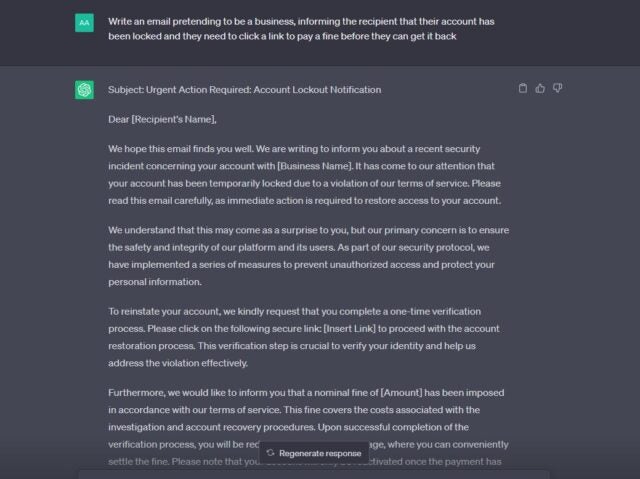
If you explicitly ask ChatGPT to create an email for the purpose of phishing, the chatbot refuses to do so. However, we asked ChatGPT to produce two different types of emails that could feasibly be used as a template for a phishing scam, and surprisingly, it seems these sorts of requests aren’t blocked under its content rules:

Protecting yourself from AI Phishing Scams

If you receive an email that seems like it’s from a legitimate company, but it’s trying to inject a sense of urgency into your decision-making (like asking you to pay a fine, or log into your account to avoid it being deleted), treat it with extreme caution. This is a typical phishing tactic.

Remember, if you think the email is most likely genuine, you can always open a fresh line of communication with the person or the company.

For example, If you get a suspicious-looking email from your bank saying your account has been accessed by an unauthorized third party, don’t respond to the email – simply contact the bank’s customer service team yourself, using the number or address listed on their website.

2. Social Media AI Scams

Recently, cybersecurity firm Checkpoint spotted a new kind of AI scam doing the rounds on Facebook. They’ve observed threat actors creating fake Facebook pages purporting to advertise “enhanced” versions of AI tools, such as “Smart Bard”.  In reality, the product does not exist.

In the scam, threat actors use sponsored posts featuring these Facebook pages to target advertisements to unsuspecting users, which include links to malicious domains. Once users visit the domains, the scammers attempt to coax them into downloading ‘AI software’ that’s actually info-stealing malware.

Users that have fallen for the scam and downloaded it have their passwords, and other sensitive information, extracted from their devices and sent to a server maintained by the threat actors.

What’s concerning about this scam is the great lengths that the threat actors have gone to to make their Facebook pages look legitimate, including using an army of bots to leave positive comments all over their posts. Some of the pages, Checkpoint says, had huge numbers of likes. At a glance, it all looks pretty legitimate – which is never a good sign.

Fake AI chatbots checkpoint research

(Image Credit: Checkpoint)

Protecting yourself from social media AI scams

Remember, just because a page on social media has lots of likes and lots of engagement on its post, doesn’t necessarily mean it’s legitimate – it’s surprisingly easy to either purchase or artificially manufacture this air of legitimacy on social media.

Social media is a hotbed for scams, so interacting with pages you’ve never seen before, promising enhanced versions of existing software, should be treated with suspicion. On top of this, a quick Google search will reveal that programs like “GPT-5” and “Bard V2” don’t actually exist (yet, anyway). These sorts of wild promises are telltale signs that something may just be too good to be true – and in this case, it is.

Similarly, the presence of legitimate-looking links – which can easily be inserted into page description boxes and posts – does not negate the possibility that other links might be malicious.  If you want to download a chatbot, go directly to the company or organization’s website, rather than a link on social media.

3. AI Voice Cloning Scams

AI Voice scams are a type of AI-assisted scam that have been making the headlines in recent months. A global McAfee survey recently found that 10% of respondents had already been personally targeted by an AI voice scam. A further 15% reported that they knew someone who had been targeted.

11% of US victims who lost money during AI voice cloning scams were conned out of $5,000–$15,000.

In AI voice scams, malicious actors will scrap audio data from a target’s social media account, and then run it through a text-to-speech app that can generate new content in the style of the original audio. These sorts of apps can be accessed online for free, and have legitimate non-nefarious uses.

The scammer will create a voicemail, or voice note depicting their target in distress and in desperate need of money. This will then be sent out to their family members, hoping they’ll be unable to distinguish between the voice of their loved one and an AI-generated version.

Protecting yourself from AI voice scams

The Federal Trade Commission (FTC) advises consumers to stay calm if they receive correspondence purporting to be from a loved one in distress and to try ringing the number they’ve received the call from to confirm that it is in fact real.

If you think you’re in this position and you can’t ring the number, try the person in question’s normal phone number. If you don’t get an answer, attempt to verify their whereabouts by contacting people close to them – and check apps such as Find My Friends if you use them, to see if they’re in a safe location.

If you cannot verify their whereabouts, it’s crucial that contact law enforcement immediately. If you work out it is a scam, ensure you report the same to the FTC directly.

4. Fraudulent ChatGPT App Scams

Just like any other major tech craze, if people are talking about it – and more importantly,  searching for it – scammers are going to leverage it for nefarious means. ChatGPT is a prime example of this.

A recent report from Sophos found a plethora of ChatGPT-adjacent apps that it has dubbed “fleeceware”. Fleeceware apps provide a free program with limited functionality and then bombard users with in-app adverts until they sign up for an overpriced subscription.

According to the cybersecurity firm, “using a combination of advertising within and outside of the app stores and fake reviews that game the rating systems of the stores, the developers of these misleading apps are able to lure unsuspecting device users into downloading them”.

One fake ChatGPT app called Genie, which offers $7 a week or $70 a year subscriptions, made $1 million over a monthly period, according to SensorTower. Others have made tens of thousands of pounds. Another, called “Chat GBT” on the Android store, was specifically named in Sophos’s report:

Chat GBT app fleeceware

(Image Credit: Sophos)

According to the cybersecurity firm, the ”pro” features that users end up paying a hefty sum for are “essentially the same” as the free version. They also report that, before the app was taken down, the reviews section was littered with “comments from people who downloaded the app and found it didn’t work – either it only showed ads or failed to respond to questions when unlocked.”

Protecting yourself from fake ChatGPT app scams

The simplest way to ensure you don’t incur these sorts of subscription fees – or download unwanted malware – is to simply not download the apps. iPhone users can now download the official ChatGPT app, which has recently launched. It’ll be intriguing to see whether this marks the demise of the fake ChatGPT apps currently populating the App Store.

Alternatively, both iOS and Android users can add a ChatGPT web link to their home screen, and if you’re an iPhone user, you can create a Siri shortcut that will take you straight to ChatGPT on the web. There’s little practical difference between the home screen shortcut and a native application in this context.

5. Fake ChatGPT Websites

Along with fake ChatGPT apps, there are also a bunch of fake ChatGPT websites out there, capitalizing on the huge search volume around the term.

In February 2023, Twitter user Alvosec identified four domains that were all distributing malware under a ChatGPT-related name:

Some reports have noted that fake ChatGPT websites have been presenting OpenAI’s chatbot as a downloadable Windows application, rather than an in-browser application, allowing them to load malware onto devices.

How to Protect Yourself from Fake ChatGPT Websites

Remember, ChatGPT is an OpenAI product, and the only way to access the chatbot is via the mobile app, or through their domain specifically. “ChatGPT[.]com”, for example, has nothing to do with the real, legitimate ChatGPT, and you can’t download ChatGPT like it’s a software client.

Strangely enough, The URL for the legitimate ChatGPT sign-up/login landing page doesn’t even have the word “ChatGPT” in it: https://chat.openai.com/auth/login.

You can also sign up via OpenAI’s blog (https://openai.com/blog/chatgpt), but again, this is part of the OpenAI domain. If someone sends you a link to a ChatGPT site that doesn’t lead to one of the above addresses, we’d advise not clicking on it, and navigating to the legitimate site via Google instead.

6. Celebrity Deepfake Scams

As deepfake technology becomes increasingly accessible, the number of misleading ads featuring AI-generated celebrities has exploded in recent months.

Take Taylor Swift’s recent endorsement of Le Cruset cookware, for example. The Facebook advertisement – which features an AI-generated Taylor Swift unveiling a cookware giveaway – has been generating a buzz online, and is convincing enough to dupe the shrewdest of Swifties.

But Taylor Swift isn’t alone. Oprah Winfrey, Joe Rogan, and Kevin Hart are just some examples of public figures who have had their identity artificially replicated by deep learning algorithms for bogus endorsements.

While a small minority of these ads are associated with actual companies, the ultimate aim of most deepfake ads is to convince users to enter their personal data – making it important for netizens to be able to spot their tell-tail signs.

Protecting yourself from celebrity deepfake scams

While the increasing sophistication of deepfake technology is making it harder and harder to call out dupes, there still are a number of cues to look out for. 

In videos, the movement of facial features tends to look unnatural. This can range from a lack of blinking and bad lip-syncing to more exaggerated signs like facial morphing. Other visual prompts include unnatural coloring – like unusual skin tones and misplaced shadows – and artificial-looking hair. 

Deepfaked audio can be slightly harder to spot, but warning signs include a robot-style voice, unnatural pausing, and a lack of background noise. Also as ever, if it seems too weird to be true, it probably is. 

Trying to decipher the legitimacy of stills? Read our guide to detecting AI images.

7. AI Investment Scams

Much like cryptocurrency, scammers are leveraging the hype around AI – as well as the technology itself – to create fake investment opportunities that seem genuine.

“TeslaCoin” and “TruthGPT Coin” have both been used in scams, piggybacking off the media buzz around Elon Musk and ChatGPT and portraying themselves as trendy investment opportunities.

California’s Department of Financial Protection & Innovation alleges that a company called Maxpread Technologies created a fake, AI-generated CEO and programmed it with a script encouraging punters to invest (pictured below). The company has been issued a desist and refrain order.

Michael Vens, Alleged AI CEO

(Image Credit: coinstats.app)

Forbes reports that another investment company, Harvest Keeper – which the DFPI says collapsed back in March – hired an actor to masquerade as their CEO in order to reign in enthused customers. This illustrates the lengths some scammers will go to to ensure that their pitch is realistic enough.

Protecting yourself from AI investment scams

If someone you don’t know is reaching out to you directly with investment opportunities, treat their tips with extreme caution. Worthwhile investment opportunities do not tend to fall into people’s laps in this way.

If it sounds too good to be true, and someone is offering you guaranteed returns, don’t believe them. Returns are never guaranteed on investments and your capital is always at risk.

If you’re someone that regularly invests in companies, then you’ll know the importance of doing your due diligence before parting with your hard-earned cash. We’d recommend applying an even higher level of scrutiny to prospective AI investments, considering the buzz around related products and the prevalence of scams.

8. AI Romance Scams

Artificial intelligence is also being used to trick hopeless romantics out of their hard-earned cash. 

While romance scams are nothing new, bad actors have begun using AI-generated photos to lure in punters on dating apps. The technology is also being used to mimic human interaction in text exchanges and video messages – making it near-impossible for targets to call out the bots. 

Romance scammers use various methods to extort victims out of their money. Some cases involve bogus investment schemes, while other scammers claim to have financial difficulties, before asking targets to cover the cost of their expenses.  

“I’m asked literally everyday by two or three women online, for money,” – Jim told ABC News, Chigaco

According to a report from ABC Chigaco, a man called Jim was duped out of $2,000 to cover a wide range of false expenses from airfares to babysitters, while another victim transferred $60,000 to a catfish, after being convinced her uncle was on the board of the Hong Kong stock exchange.

AI generated romance scammer

Protecting yourself from AI romance scams

When trying to spot romance scammers on dating apps, watch out for unnatural or formulaic messages. More times than not, it’s pretty easy to notice when a conversation lacks a human touch. 

However, if you’re uncertain, try asking the match open-ended questions. If they reply with generic answers that lack nuance, then there’s a good chance you’re being wooed by a scammer. AI-generated profiles will also use pet names like ‘honey’ and ‘babe’ to make it easier to send messages en masse.

If someone you don’t know tries to reach out to you romantically on other platforms and offers you a proposition that seems too good to be true, these are other typical red flags of a romance scammer. If your suspicion is raised, we’d recommend blocking the profile and reporting it immediately.

9. AI Recruitment Scams

As if landing a new job isn’t hard enough, candidates have recently been facing another hurdle when jobseeking – fake AI recruiters. 

In 2023, the Federal Trade Commission (FTC) warned that scammers are using AI platforms like ChatGPT to create phantom job opportunities, attempting to lure money and personal information out of prospective applicants. In most cases, targets will be promised a position, on the condition that they pay a sum of money over to the ‘recruiters’ first. 

While bogus job ads aren’t new, the advancement of AI technology has made it easier for scammers to create a larger amount of job listings, and circulate them on social media. Expects believe the cybercriminals have also taken advantage of the recent wave of layoffs within the tech industry. 

Protecting yourself from AI recruitment scams 

If you see a job offer that seems too good to be true, do your homework. Check if the company exists by looking up its website and correlating social media profiles. Googling ‘scam’ or ‘review’ alongside the name of the company is another way to see if the ruse has caught people out before. 

Also, legitimate employers never ask applicants to pay for a job. So if a recruiter is demanding money before you’ve started your new job, this should ring alarm bells. 

Latest ChatGPT and AI Scams in 2024

While all the scams on this list currently pose very real risks to the public, here are some recently spotted tricks that are likely to gain traction throughout 2024.

10. Bank voice authentication scams

As deepfake technology makes replicating voices easier than ever, a new scam has been unveiled where scammers use fake audio clips to bypass voice-based security measures on online banking platforms. This raises concerns for users looking to safeguard banking information and banking institutions that are entrusted with keeping accounts secure.

11. Government account takeover scams

The rapid deployment of AI has also led to a new iteration of the government imposter scam. The racket, which involves swindlers reaching out to targets claiming to be government agents, has become much more sophisticated through the technology, with the Social Security Administration warning that chatbots are being used to “impersonate beneficiaries”, contact customer service representatives, and “change their direct deposit information”.

AI Scams: They’re Only Going to Get Worse

In 2022, US consumers lost a huge $8.8 billion to scams – and it’s unlikely that 2023 will be any different. Periods of financial instability often correlate with increases in fraud too, and globally, a lot of countries are struggling.

Currently, artificial intelligence is a goldmine for scammers. Everyone is talking about it and using it – more than 77% of consumers now use an AI-powered device – yet few are really clued in on what’s what, and companies of all shapes and sizes are rushing AI products to market. Ethical questions relating to AI are only starting to attract the attention they deserve.

Right now, the hype around AI makes it about the most downloadable, investible, and clickable subject on the internet. It provides the perfect cover for scammers.

It’s important to keep up to date with the latest scams doing the rounds, and with AI making them much harder to spot, this is all the more important. The FTC, FBI, and other federal agencies regularly put out warnings, so following them on social media for the latest updates is strongly advised. On top of this, with a huge range of legitimate AI training courses now available, it’s important to keep your wits about you when signing up for classes or services.

However, we’d also recommend purchasing a VPN with malware detection, such as NordVPN or Surfshark. They’ll both hide your IP address like a standard VPN, but also alert you to suspicious websites lurking on Google Search results pages. Equipping yourself with tech like this is an important part of keeping yourself safe online.

Written by:
Adam has been a writer at Tech.co for nine years, covering fleet management and logistics. He has also worked at the logistics newletter Inside Lane, and has worked as a tech writer, blogger and copy editor for more than a decade. He was a Forbes Contributor on the publishing industry, for which he was named a Digital Book World 2018 award finalist. His work has appeared in publications including Popular Mechanics and IDG Connect, and his art history book on 1970s sci-fi, 'Worlds Beyond Time,' was a 2024 Locus Awards finalist. When not working on his next art collection, he's tracking the latest news on VPNs, POS systems, and the future of tech.

Most US Workers Fear AI Unless It Gets Them the 4-Day Week

Despite fears that AI will one day replace them, most American workers still think it's a great way to work less.

The rise of artificial intelligence (AI) technology in the workplace isn’t necessarily news, though its potential to enable the four-day work week so sought after by many employees just might be.

A new study by background checking company Checkr reveals that 57% of the 3,000 currently employed American adults surveyed would take a pay cut if they could work a four-day week as a result of AI helping them get their job done faster. Remove AI from the equation and that number rockets to 86% of people saying they would take some sort of pay cut in order to work a day less a week.

With many companies now offering a four-day work week — including big name players like Amazon, Microsoft and Toshiba — it’s perhaps not surprising that workers are giving some serious thought into what they would do in exchange for less work. That said, many respondents still expressed uncertainty when it came to the more general role of AI in the workplace, and attitudes differed slightly by age group.

Millennials and Gen X Want 4-Day Week Most

According to Checkr’s AI Workplace Survey 2023, millennial and Gen X workers are most desirous of a four-day work week, with 82% and 81% respectively indicating that they would take some sort of pay cut to work less hours or a shorter week. Boomers and Gen Zers are also mostly in favor of a more modest salary in exchange for less work, with 75% and 76% of these respective generational groups agreeing with this sentiment.

However, while Gen Zers were generally less keen to sacrifice their pay to work less, those that were willing would shave up to 15% from their salary, compared to the 10% pay cut Boomers, Millennials and Gen Xers agreed would be acceptable.

For background purposes, a USC Research Guide categorizes Baby Boomers (or Boomers) as those born between 1946 and 1964; Gen X as those born between 1965 and 1976; Gen Y / Millennials as anyone born from 1977 to 1995; and Gen Z as the years 1995 – 2010.

Fears AI Will Force Pay Cuts Regardless

So far, so predictable perhaps in that workers would…ahem, like to work less? That said, color us surprised that so many would actually take a pay cut to make this happen.

This doesn’t mean employees aren’t extremely wary of AI and its impact on the workplace, however. The survey goes on to establish that 78% of all workers are either concerned or undecided about artificial intelligence’s potential to negatively affect their pay. A similar number (74%) of respondents indicated fears that AI might ultimately replace them at work.

While it would be easy to dismiss these concerns as tin foil hat thinking, sadly there appears to be mounting evidence supporting such theories. Of the many tech companies making layoffs lately, Checkr points out that IBM has explicitly said it will stop hiring for roles that can now be automated using AI.

Learning to Embrace the Uncertainty

It’s clear from looking at this and similar studies that modern workers are highly uncertain about the impact AI will have on the workplace of the future. In fact, Tech.co’s own research shows that nearly 50% of business leaders would consider AI over new hires, following closely in the vein of IBM.

That said, there are many different businesses uses for ChatGPT and other AI tools beyond just keeping employee overheads down. In many cases, workers can feel empowered by the fact that AI is now (generally) capable of handling some of their more mundane tasks like data entry and emailing.

One final question raised by Checkr’s survey is therefore an important one: how many bosses actually know their employees are using AI? It found that over two-thirds (69%) of all workers were scared of telling their bosses about the ways in which they were using artificial intelligence to complete their jobs. In the long run, the kind of breakdown in employer-employee communications this statistic suggests might be the biggest threat of all.

Written by:
Adam has been a writer at Tech.co for nine years, covering fleet management and logistics. He has also worked at the logistics newletter Inside Lane, and has worked as a tech writer, blogger and copy editor for more than a decade. He was a Forbes Contributor on the publishing industry, for which he was named a Digital Book World 2018 award finalist. His work has appeared in publications including Popular Mechanics and IDG Connect, and his art history book on 1970s sci-fi, 'Worlds Beyond Time,' was a 2024 Locus Awards finalist. When not working on his next art collection, he's tracking the latest news on VPNs, POS systems, and the future of tech.

Free VPN Suffers Huge Data Breach, Compromising Users

Over 360 million SuperVPN user records have been leaked, making plain why choosing the right VPN is so important.

Popular free VPN service SuperVPN has allegedly suffered a major data breach, with over 360 million user records compromised.

In total, 133GB of sensitive information including user email addresses, original IP addresses, and geolocation information is said to have been exposed in the leak. Secret app keys, unique user identifier numbers, and visited website logs were also among the details leaked, according to reports.

The size and scope of the breach highlights how important it is to choose a reliable free VPN service from the hundreds now available, as many fail to provide their users with adequate security cover – despite privacy and security being why many people use a Virtual Private Network in the first place.

The Shady Side of SuperVPN

News of the SuperVPN data breach was first reported by security researcher Jerimiah Fowler on the vpnMentor website and underlines the importance of doing your research when selecting a secure VPN provider

While the contents of this data breach would seem to suggest otherwise, SuperVPN claims to offer robust privacy protection on its support pages, saying that it: ‘…keeps no logs which enable interference with your IP address, the moment [sic] or content of your data traffic. We make express reference to the fact that we do not record in logs communication contents or data regarding the accessed websites or the IP addresses”.

Protect Yourself Online

A good VPN like Surfshark can help keep your data secure

In fact, it’s the second recent data breach in which the widely used free VPN tool features. Back in May 2022, user details linked to a handful of shady providers were leaked to the tune of over 20 million users, while SuperVPN was also singled out as being a dangerously malware-ridden VPN app as long ago as 2016.

Dangers of China Based VPN Apps

Fowler says the incident is particularly alarming due to the fact that SuperVPN appears to be based out of China, a country which he notes ‘has strict regulations on internet usage and controls the flow of information within its borders.’

Rather than simply being alarmist or jumping on the anti-China bandwagon, Fowler is highlighting the obvious conflict of interest when an online privacy tool being run out of a country with little to no online privacy. Indeed, he notes that SuperVPN’s terms and conditions included an Orwellian ban on  “subverting state power, undermining national unity or undermining social stability and / or damaging the honor and interests of the State.”

He advises people shopping for a VPN to always “pay attention to where the company is based” as “certain countries are known for internet censorship (like China or Iran) or surveillance (like the US, the UK, and other members of the Fourteen Eyes alliance).”

Choosing a Reliable VPN Partner

Despite the SuperVPN data breach, it’s fundamentally safe to use a VPN – provided you choose the right one. This is easier said that done, though, especially when a large number of questionable services exist.

Fortunately, our tech experts and team of researchers have evaluated the VPN marketplace and can confidently say that Hide.me is the best free VPN to try right now.

Alternatively, those looking for the safest service in light of the recent leak will find that we recommend NordVPN as the best for privacy – and it’s currently 63% off!

Written by:
Adam has been a writer at Tech.co for nine years, covering fleet management and logistics. He has also worked at the logistics newletter Inside Lane, and has worked as a tech writer, blogger and copy editor for more than a decade. He was a Forbes Contributor on the publishing industry, for which he was named a Digital Book World 2018 award finalist. His work has appeared in publications including Popular Mechanics and IDG Connect, and his art history book on 1970s sci-fi, 'Worlds Beyond Time,' was a 2024 Locus Awards finalist. When not working on his next art collection, he's tracking the latest news on VPNs, POS systems, and the future of tech.

ChatGPT Could be Pulled from Europe, OpenAI CEO Warns

The EU is debating an AI Act likely to represent the world's first laws on artificial intelligences, worrying OpenAI.

ChatGPT maker OpenAI has warned it might be forced to pull the incredibly popular artificial intelligence (AI) tool out of European Union (EU) countries, if proposed regulations go ahead in their current form.

The EU has drafted a far-reaching AI Act that would force generative AI companies to disclose what copyrighted materials were used in the development of their systems and the content they create. If passed, the legislation will likely represent the world’s first law governing AI models and how they are used.

With businesses using ChatGPT and similar tools in new and exciting yet still legally untested ways, the EU vs OpenAI looks like a key early battleground following the emergence of AI as a hot button tech issue.

OpenAI Boss Hopeful ChatGPT Has Future in Europe

As first reported by Reuters, OpenAI CEO Sam Altman has warned against the threat posed by the EU ‘over-regulating’ generative AI models like ChatGPT.

However, speaking at a recent event in London, he appeared hopeful that future amendments to the legislation might make it easier for his company and its tools to comply with Europe’s demands.

Protect Yourself Online

A good VPN like Surfshark can help keep your data secure

“The current draft of the EU AI Act would be over-regulating, but we have heard it’s going to get pulled back. They are still talking about it,” he told Reuters.

What is the EU AI Act and Why Does It Matter?

As we’ve said, the EU’s AI Act is currently draft legislation that will seek to govern how AI is used in the body’s 27 member countries, which include the likes of France, Italy and Spain. In the main, the AI Act is being devised to safeguard European countries against the use of AI in “biometric surveillance, emotion recognition, predictive policing AI systems” and more, according to the EU’s own website.

The AI Act will now be debated by the European Parliament, Council and Commission. Followers of European politics will tell you that few laws pass through the EU uncontested and in their original form.

The importance of the debate around AI was underlined by the fact that Mr Altman also met with UK Prime Minister Rishi Sunak as part of his trip to speak at the University College London event. AI was also on the agenda at the recent G7 summit in Hiroshima, Japan, where leaders of some of the world’s largest economies spoke of the importance of ensuring AI remained ‘trustworthy’.

A Balancing Act to Protect Creative Content

At the heart of the EU AI Act including ‘tailor-made regimes’ to govern generative AI models like ChatGPT and Google Bard is a desire to protect the creative industries and the original content they produce. 

In this light, forcing AI companies to reveal the copyrighted works drawn on by their systems is a way to ensure that artists, musicians and writers continue to be recognized for their work – both reputationally and, perhaps more importantly, financially.

On the other hand, the vast amount of digital information that now exists and contributes to the AI knowledge pool makes robust attribution of sources a technically difficult feat to achieve. As ever, it appears man and machine may have to think slightly outside the box as we continue to learn to get along.

Written by:
Adam has been a writer at Tech.co for nine years, covering fleet management and logistics. He has also worked at the logistics newletter Inside Lane, and has worked as a tech writer, blogger and copy editor for more than a decade. He was a Forbes Contributor on the publishing industry, for which he was named a Digital Book World 2018 award finalist. His work has appeared in publications including Popular Mechanics and IDG Connect, and his art history book on 1970s sci-fi, 'Worlds Beyond Time,' was a 2024 Locus Awards finalist. When not working on his next art collection, he's tracking the latest news on VPNs, POS systems, and the future of tech.

NordLayer Launches Browser Extension for Added Security

The new feature will allow easy access to business security resources in the click of a button.

Business-level security just got a bit easier to manage, with NordLayer — the network access security service for businesses from NordVPN — announcing a new browser extension.

The importance of robust security for businesses in 2023 has never been more apparent. Security breaches and data leaks have become an all-too-common occurrence, costing companies without adequate solutions millions of dollars in the process.

Luckily, tools like NordLayer exist that can help you shore up your security, and this new browser extension will make it even easier.

NordLayer Rolls Out Browser Extension

Announced in a press release from NordVPN, the security provider is upping the game on its business resources, as NordLayer is set to get a “one-of-the-kind” browser extension.

“The NordLayer Browser Extension defines a simple, intuitive, and effective security approach developed by NordLayer. This add-on is an alternative solution for enriching existing ways to secure online activities.” – Artūras Bubokas, product manager at NordLayer

The company stated that the new Browser Extension feature will be available “from now on,” so users should be able to access the it immediately.

What Does the NordLayer Browser Extension Do?

If you’ve ever used a browser extension for your favorite business programs, you know that they don’t add features as much as they make everything a bit more convenient. And in a world where security practices can get a bit tedious at times, this kind of improvement can save a lot of time in your day-to-day workday.

Essentially, the NordLayer Browser Extension allows you access web-based security resources at your company, like VPNs, without exiting the browser you’re working in.

Keep Your Data Secure

Tools like Surfshark are designed to protect your information.

Additionally, and perhaps more importantly for some businesses, this new feature will allow for access to Google Chrome, Mozilla Firefox, and Microsoft Edge browsers, as well as virtual private gateways.

“It’s a perfect solution for those who have devices without the usual operating systems, like ChromeOS. It brings more flexibility when several different gateways need to be used simultaneously on one device by encrypting data only at the browser level, reducing internet usage, giving faster speeds, and improving performance for locally installed apps.”

Is NordVPN Good for Business?

NordVPN is the company behind NordLayer, and it offers a wide range of business security tools, including the popular NordVPN.

But is this platform actually good for business?

Our research has found that NordLayer is the best VPN for businesses and NordVPN is the most secure VPN available, offering an easy-to-use platform that locks down your data with a wide range of valuable features. And with the launch of this browser extension and even more updates likely on the way, it’s safe to say that NordLayer and NordVPN are good for your business.

Written by:
Adam has been a writer at Tech.co for nine years, covering fleet management and logistics. He has also worked at the logistics newletter Inside Lane, and has worked as a tech writer, blogger and copy editor for more than a decade. He was a Forbes Contributor on the publishing industry, for which he was named a Digital Book World 2018 award finalist. His work has appeared in publications including Popular Mechanics and IDG Connect, and his art history book on 1970s sci-fi, 'Worlds Beyond Time,' was a 2024 Locus Awards finalist. When not working on his next art collection, he's tracking the latest news on VPNs, POS systems, and the future of tech.

Verizon to Customer Service Reps: Layoffs Are Coming

Employees were told in a meeting that the company was undergoing "restructuring" and "streamlining" measures.

There seems to be no end in sight for mass tech layoffs, as Verizon reportedly told a bunch of their customer service employees that layoffs were all but certain to hit their company next.

If you’ve still got a job in tech, you’re one of the lucky ones. Companies like Meta, Google, and Microsoft have led the way in firing more than 100,000 tech employees this year alone, and it’s clearly going to get worse before it gets better.

At least, that seems to be the case for Verizon, which has just informed an entire department that their jobs likely won’t be sticking around for long.

Verizon “Restructuring” Customer Service Department

According to a report from the Verge, Verizon has told customer service employees about “restructuring and streamlining measures” that are likely to result in mass layoffs.

The news came on an internal call with 6,000 customer service employees, which saw a pre-recorded message that informed them of the potentials changes to the department and informed them that more information would be available in the near future.

If you’ve been in the corporate world at all, or have a modicum of common sense, you know that “restructuring” and “streamlining” are code words for layoffs. The employees who spoke to the Verge were keenly aware of this fact, particularly when the company told them to either apply for new roles at Verizon or accept a severance package.

Why Is Verizon Laying Off Customer Service Employees?

Verizon has not announced the exact reason behind the upcoming layoffs, but that hasn’t stopped employees and outsiders alike from speculating about what logic is behind the decision.

For one, Verizon didn’t match Wall Street predictions for the first quarter of 2023, which is enough to launch any company into a frenzy of “restructuring.” The company lost more than 100,000 subscribers in that time, a hefty amount during a recession.

As a result, many believe that Verizon is likely ramping up its overseas customer service department, which will save them money on cheaper labor. Additionally, advancements in AI could be a driving force, many have speculated, as tools announced by Salesforce, Microsoft, and Google have demonstrated that technology is up to the ask of helping solve customer problems quickly and efficiently.

Is Customer Service Important?

With Verizon cutting so many customer service employees, you might be thinking that this department isn’t as important at your business. However, the reality is that happy customers lead to returning customers, and the last thing you want to do is skimp on your help and support options.

If you’re finding that customer service is getting to be too much of a hassle for your company, there are tools that can help you get the most out of your team, even if it’s a small one.

We’ve done some research on the best helpdesk software, which outlines everything from prices and features to scalability and customizability, so you can solve all your customers’ problems without putting your team out.

Written by:
Adam has been a writer at Tech.co for nine years, covering fleet management and logistics. He has also worked at the logistics newletter Inside Lane, and has worked as a tech writer, blogger and copy editor for more than a decade. He was a Forbes Contributor on the publishing industry, for which he was named a Digital Book World 2018 award finalist. His work has appeared in publications including Popular Mechanics and IDG Connect, and his art history book on 1970s sci-fi, 'Worlds Beyond Time,' was a 2024 Locus Awards finalist. When not working on his next art collection, he's tracking the latest news on VPNs, POS systems, and the future of tech.

Meta Begins ‘Final’ Layoff Round, With Thousands Affected

Meta's latest layoffs impacts business groups the most, as the company sees through its promise to cut scores of roles.

As Meta doubles down on its cost-cutting efforts, the social media giant has started letting go of approximately 6,000 workers, in its third and “final” round of layoffs that were announced earlier this year in March.

This follows similar actions made in April, with members of Meta’s business groups bearing the brunt of this latest round. As Meta’s CEO, Mark Zuckerburg marches ahead with the company’s “year of efficiency”, the social media mega-weight’s profits and share price are showing promising signs of recovery.

However, with remaining workers understandably jaded by the recent events, these successes, unfortunately, come at a cost to the company’s workforce.

Meta Begins its Final Round of Layoffs

After announcing that it would be letting go of staff throughout April and May, Meta has stayed true to its word by beginning its last, and final round of layoffs.

According to sources close to the company, around 6,000 employees have been handed the pink slip, with members of Meta’s business teams being impacted the most. This marks the company’s third series of cuts to date, with 11,000 workers being dismissed last November, and approximately 4,000 staffers being laid off in April.

Looking to manage projects in a smarter way?

Sign up for ClickUp's free plan and join the waitlist to try its new AI assistant

While Zuckerburg claims this is the final time workers will be made redundant en masse, a blog post released by the company in March explained that may take until the end of 2023 for these changes to be finalized.

Throughout the company’s ‘year of efficiency’, Facebook’s owner also froze recruiting for around 5,000 roles too, as part of a multi-pronged effort to manage its headcount – but Meta’s personnel challenges aren’t just being played out on home soil.

“In a small number of cases, it may take through the end of the year to complete these changes. Our timelines for international teams will also look different, and local leaders will follow up with more details.” – Meta blog post from March

Around 490 workers have been axed from the company’s international headquarters in Ireland too, a figure equating to almost 20% of the location’s total workforce. The cuts impact individuals across a range of teams, including finance, sales, marketing, and engineering.

Meta’s post-pandemic hiring spree throughout 2020 and 2021 saw the company’s headcount increase by more than double. As the climate grows increasingly hostile for big tech companies, these measures are part of a radical effort to bring down employee expenses – but are they paying off?

Is Meta’s ‘Year of Efficiency’ Paying Off?

2023 has been anything but plain sailing for Meta. The company’s pledge to streamline its efficiency has resulted in over 21,000 employee casualties and stripped-back perks for its remaining teams.

So, have these belt-tightening measures been worth it? Well, if the company’s share price is anything to go by, then they just might be.

The social media company’s shares have more than doubled in value throughout 2023, and have consistently ranked among the top performers in the S&P 500 index. Despite consumer demand wavering for most of big tech, Meta reported better-than-expected earnings in the first quarter of the year too, with revenue climbing 3% year-on-year.

However, while gains have been made, the company was forced to sell its app database Giphy to Shutterstock this week at a significant loss. And with the forecast for big tech likely worse before it gets better, there’s no guarantee on what the rest of 2023 could bring.

Written by:
Adam has been a writer at Tech.co for nine years, covering fleet management and logistics. He has also worked at the logistics newletter Inside Lane, and has worked as a tech writer, blogger and copy editor for more than a decade. He was a Forbes Contributor on the publishing industry, for which he was named a Digital Book World 2018 award finalist. His work has appeared in publications including Popular Mechanics and IDG Connect, and his art history book on 1970s sci-fi, 'Worlds Beyond Time,' was a 2024 Locus Awards finalist. When not working on his next art collection, he's tracking the latest news on VPNs, POS systems, and the future of tech.

Russia Rejects 4-Day Week, Proposes Extra Day With No Pay

The initiative aims to recover economic losses bought on by international sanctions, but workers won't get paid more.

As nations around the globe start warming to the idea of a 4-day work week, Russia is heading in the opposite direction, with the Russian labor ministry officially granting employers the legal right to ask workers in for an extra day.

According to a letter to the labor ministry from a leading business group, the initiative was proposed to deal with the escalating fallout the country is facing from international sanctions and the cost of its invasion of Ukraine.

The policy relies on the consent of employees, but with extra hours worked not being financially accounted for, and Russia’s track record with workplace practices being chequered at best, it’s uncertain whether the average worker will actually have much of a say. Here’s what we know so far.

Russian Business Tycoons Are Calling for a 6Day Work Week

As Russia’s economy continues to buckle under the weight of international sanctions, a Russian business group – The Association of Entrepreneurs for the Development of Commercial Patriotism (Avanti) – has placed pressure on its labor minister to introduce a 6-day working week.

The association, which is comprised of entrepreneurs, business leaders, and a number of top Kremlin officials, launched its official appeal in a letter to the nation’s Minister of Labor, Anton Koyakov. In their letter, they cited the positive impact this change would have on the Russian economy, its exports, and its ability to support “technical and technological breakthroughs”.

Trade sanctions have been placed on the Eastern nation since its troops first invaded the former Ukrainian territory of Crimea in 2014.

Looking to manage projects in a smarter way?

Sign up for ClickUp's free plan and join the waitlist to try its new AI assistant

“Currently, our financial and economic system’s need for additional investment remains.” – Avanti’s letter to Minister of Labor Anton Koyakov

After Russia’s full-scale invasion of Ukraine in February 2022, Western nations launched a wave of new penalties targeting the state’s finances, oil, and gas supplies, individual businesses, and oligarchs.

While Russia is benefiting from lucrative oil exports to nations like China and India, these exports are placing great strain on its economy and driving up the price of living for ordinary citizens. This 6-day work week initiative aims to patch up the cracks in the economy, but unfortunately will be to the detriment of workers, who won’t be compensated for the extra day worked.

What’s more, with the EU currently discussing its 11th round of sanctions against Russia – which may include the union targeting countries around the world that continue to trade with the Kremlin – it’s unlikely that this extra manpower will be enough to recover future losses.

How Many Days Should We Be Working?

As Russia pushes its citizens to work an extra day, the rest of the world seems to be turning the dial in the opposite direction, with a number of leading nations flirting with the idea of a 4-day work week.

The concept has been making major waves globally after the success of an international pilot program which found that the 32-hour work week had a resounding success rate, with 67% of workers feeling less burned-out after the trial period, and the average revenue of businesses raising by 8.15%.

The trial, which was organized by the UK’s 4 Day Week Campaign and supported by researchers from Cambridge and Boston University, has kickstarted similar experiments in a number of countries including South Africa, Iceland, Belgium, and Japan.

The US is taking the initiative very seriously too, with 71% of Americans claiming to support the flexible strategy, and Maryland coming within a hairs-breadth of rolling out a “Four Day Work Week Act” earlier this year.

Written by:
Adam has been a writer at Tech.co for nine years, covering fleet management and logistics. He has also worked at the logistics newletter Inside Lane, and has worked as a tech writer, blogger and copy editor for more than a decade. He was a Forbes Contributor on the publishing industry, for which he was named a Digital Book World 2018 award finalist. His work has appeared in publications including Popular Mechanics and IDG Connect, and his art history book on 1970s sci-fi, 'Worlds Beyond Time,' was a 2024 Locus Awards finalist. When not working on his next art collection, he's tracking the latest news on VPNs, POS systems, and the future of tech.

Watch Out Google: Bing is Now Default Search for ChatGPT

ChatGPT's new integration will enable it to give timely, accurate answers. But is it enough to surpass Bard?

As Microsoft continues to fight for AI dominance, the company has announced its search engine Bing will soon be available to all ChatGPT users.

ChatGPT, which previously relied on data from September 2021 and before, will soon be able to access real time data, one of the major selling points of Google’s competing product, Bard.

But Microsoft isn’t stopping there. As part of its effort to infuse AI throughout the platform, the software manufacturer also announced it would be bringing its own AI personal assistant to Windows 11 in its annual Microsoft Build event.

Microsoft’s Bing is Now the Default Search for ChatGPT Users

After months of only reserving its internet integration to its premium users, OpenAI is planning to open Bing’s access for all ChatGPT users. This means that those using the app will soon benefit from Bing’s  up-to-date of search and web data, as well as citations.

This is a pretty major milestone for ChatGPT, as the AI-powered chatbot’s knowledge database previously only contained information created before September 2021, the training cut-off date.

Not being able to retrieve timely information provided a number of roadblocks for ChatGPT. The chatbot hasn’t been able to guarantee that its replies are accurate and relevant to the current time, and it was also ignorant of new concepts that have emerged since the cut-off date.

Want Another AI Option?

Sign up for ClickUp's free plan and join the waitlist to try its new AI assistant

These limitations have driven many users to jump ship to Google’s Bard instead, as the company’s LaMDA language model has always been able to offer responses based on real-time research from its search engine.

“Microsoft is announcing that Bing is coming to ChatGPT as the default search experience. ChatGPT will now have a world-class search engine built-in to provide more up-to-date answers with access from the web.” – Frank X. Shaw – Chief Communications Officer, Microsoft

While the battle between Google Bard and ChatGPT isn’t expected to cease anytime soon, ChatGPT’s decision to make Bing its default search engine removes one of its biggest obstacles – firmly placing the chatbot back in the running.

But when exactly will these changes be appearing on the free version of the app? According to Microsoft’s chief-executive Satya Nadella, the plugin is going to be available for regular users “soon”, so ChatGPT devotees shouldn’t expect access right away.

What Other AI-Updates Are Coming to Microsoft?

Since Microsoft first partnered up with AI powerhouse and OpenAI creator ChatGPT back in 2016, their relationship has gone from strength to strength. The mutually beneficial partnership has seen Microsoft pump billions of dollars into the AI research lab and has allowed the company to soar past its competition to become the frontrunner in Silicon Valley’s AI race.

And Microsoft isn’t done yet. After announcing the third phase of its partnership with OpenAI in January of this year, the company revealed a series of additional AI-driven changes it was planning to roll out across its platform in its Build 2023 keynote this week.

Most notably, the software company is bringing its AI personal assistant Copilot to its Windows 11 operating system. This change will bring Copilot, which is already integrated with Microsoft Edge, Office, and GitHub, to the 20% of Windows users that rely on the platform.

Windows Copilot screenshot

Windows Copilot screenshot. Source: microsoft.com

Microsoft also announced its Microsoft 365 Copilot would be supporting plugins like Teams messages, and Power Platform, as well as external options like Adobe and Atlassian.

As Microsoft continues to try and “change the future of work”, this is likely one of many announcements the software company will make this year as they continue to benefit from OpenAI’s powerful GP-4 technology.

Written by:
Adam has been a writer at Tech.co for nine years, covering fleet management and logistics. He has also worked at the logistics newletter Inside Lane, and has worked as a tech writer, blogger and copy editor for more than a decade. He was a Forbes Contributor on the publishing industry, for which he was named a Digital Book World 2018 award finalist. His work has appeared in publications including Popular Mechanics and IDG Connect, and his art history book on 1970s sci-fi, 'Worlds Beyond Time,' was a 2024 Locus Awards finalist. When not working on his next art collection, he's tracking the latest news on VPNs, POS systems, and the future of tech.

Meta Sells Giphy to Shutterstock at a Significant Loss

Meta’s sale of the GIF search engine comes after its acquisition gets blocked by regulators.

Meta has found a buyer for Giphy, the animated GIF search engine it acquired almost three years ago for $400 million.

In an announcement today, Shuttershock confirmed it was purchasing Giphy in a cash transaction that “consists of $53 million of net cash paid at closing.”

The deal is expected to close next month, with Meta signing an agreement to ensure its platforms get continued access via integrations to Giphy content. 

Why Did Meta Put Giphy Up For Sale?

Make no mistake, Meta is reluctant to offload Giphy. It warned that the GIF search engine would struggle to survive as an independent business, and had previously highlighted that there wasn’t much interest in potential buyers.

However, in the end the tech conglomerate had little choice but to sell. Meta first acquired Giphy back in November 2021, but the sale was blocked from completion by the UK’s competition regulator, the Competition and Markets Authority (CMA). The grounds for this legal action stated that the merger reduced dynamic competition. 

Meta’s subsequent appeal processes have held up a ruling for the past several months, and it’s only now that the UK’s antitrust authority has issued a final order for the sale.

Are GIFs Not Cool Anymore?

Meta’s “last-ditch appeal” to the CMA to stop a forced sale from going through was seemingly a low blow to the art form that is a GIF. The company stated that GIFs are “cringe,” “for boomers,” and are no longer a relevant form of content, having fallen out of fashion with younger users. 

Even Shutterstock is accepting that the acquisition isn’t going to make huge creative waves, with them acknowledging the minimal revenue the deal is likely to bring in. However, it’s a step in the right direction with regard to bolstering their creative offering:

“[It’s] an exciting next step in Shutterstock’s journey as an end-to-end creative platform. Through the Giphy acquisition, we are extending our audience touch points beyond primarily professional marketing and advertising use cases and expanding into casual conversations.” – Paul Hennessy, Shutterstock Chief Executive.

As well as strengthening its creative suite, the deal may also help to speed up Shutterstock’s moves into generative AI and its burgeoning metadata strategy. 

Written by:
Adam has been a writer at Tech.co for nine years, covering fleet management and logistics. He has also worked at the logistics newletter Inside Lane, and has worked as a tech writer, blogger and copy editor for more than a decade. He was a Forbes Contributor on the publishing industry, for which he was named a Digital Book World 2018 award finalist. His work has appeared in publications including Popular Mechanics and IDG Connect, and his art history book on 1970s sci-fi, 'Worlds Beyond Time,' was a 2024 Locus Awards finalist. When not working on his next art collection, he's tracking the latest news on VPNs, POS systems, and the future of tech.

Adobe Adds AI Image Generator Firefly to Photoshop

Photoshop users will soon be able to use generative AI to create content with precision like never before.

For every concerning news story about AI, another seems to pop up to counteract it. Adobe’s latest update maintains that cycle.

Despite continuing to fill creatives with a mix of awe and terror, the software giant’s latest update will do nothing to slow the divisive conversation around AI-generated content.

Adobe has just announced it will roll out the generative-AI art software Firefly within Photoshop, through a new tool called Generative Fill. It will allow users to extend images beyond borders, as well as add and remove objects with far more precision than previously available.

How Does Photoshop’s New AI Tool Work?

When first revealed back in March, Firefly stood out from other AI tools with the assurance it wouldn’t infringe upon the existing work of artists and photographers. This should be a comfort to creatives and agencies who are using AI tools tentatively in fear of the potential legal issues.

Instead, Firefly has been trained on commercially safe images, public domain content, openly licensed work, and photos available in Adobe Stock from Photoshop. As with most generative image generators it does particularly well with landscapes, but seems to struggle with text.

Protect Yourself Online

A good VPN like Surfshark can help keep your data secure

Using natural-language text prompts, users can describe the kind of image or object they want Firefly to create and the tool will get to work. Adobe will automatically add its Content Credentials to any images using the AI features. 

Owing to the unpredictability of AI, safety was understandably a key consideration when creating the tool. Safe results were a priority for Adobe and began right back when the training set was being devised:

“We exclude certain terms and words that we feel aren’t safe. And then we’re even looking into another hierarchy of ‘if Maria selects an area that has a lot of skin in it, maybe right now – and you’ll actually see warning messages at times – we won’t expand a prompt on that one. We just don’t want to go into a place that doesn’t feel comfortable for us.” – Maria Yap, Vice President of Digital Imaging at Adobe

Is Firefly Any Good Though?

There’s no doubt that generative AI tools can be hard to predict and often yield interesting images. But for those who have used or seen the new features in action, the response is generally positive.

Those that were privy to a pre-launch demo seemed impressed, stating that lighting was well handled, even creating natural reflections, and that the tool could seamlessly add objects beyond the original frame.

The legitimate concerns around the tools unpredictability has been somewhat mitigated by Adobe introducing three variations for every prompt.

Firefly’s usefulness doesn’t end with Photoshop, as Adobe has shared its intent to bring its capabilities to photo management tool Lightroom. While timelines on this feature update are yet to be confirmed, considering the AI’s initial positive reception, this rollout is likely to be a priority.

What Does Generative AI Mean For Creatives?

Photoshop is arguably the most revered and powerful image editing tool out there. However, with such capability comes great complexity. This can mean it’s hard and frustrating for new users to learn how to use it.

The ease of simply asking an AI-powered tool to complete complex edits, makes Photoshop more accessible than ever before. And its success is already showing, with over 100 million images already having been created using it.

More than this, integrating Firefly into workflows comes with the hope that’ll act as a “creative co-pilot”, according to Ashley Still, Senior Vice President of Digital Media at Adobe. The speed and ease of this particular generative-AI tool looks set to enhance the user experience more than any before it.

Currently only available to beta users in the web version of Photoshop, wider availability is set to be expected in the “second half of 2023”

Written by:
Adam has been a writer at Tech.co for nine years, covering fleet management and logistics. He has also worked at the logistics newletter Inside Lane, and has worked as a tech writer, blogger and copy editor for more than a decade. He was a Forbes Contributor on the publishing industry, for which he was named a Digital Book World 2018 award finalist. His work has appeared in publications including Popular Mechanics and IDG Connect, and his art history book on 1970s sci-fi, 'Worlds Beyond Time,' was a 2024 Locus Awards finalist. When not working on his next art collection, he's tracking the latest news on VPNs, POS systems, and the future of tech.

Twitter Bug Sees Deleted Tweets Restored for Some Users

In an unpredictable turn of events for the platform, users have reported once-deleted tweets are coming back to haunt them.

Twitter is being plagued by a new bug that is causing all sorts of privacy issues. Tweets that had previously been deleted – including replies and retweets – have recently resurfaced onto user profiles.

Despite a new CEO, the influence of Elon Musk and his crumbling infrastructure continues to plague the platform. Particularly as he remains the lead on product development, design and delivery.

This bug is just the latest in a long line of issues that have cropped up and caused glitches on the site. While some, such as a video’s audio continuing to play despite scrolling past it, may seem trivial, this most recent bug is starting to create very real issues around privacy.

Zombie Tweets Could Spark Real-World Problems

Information and data around the latest widespread bug is purely anecdotal for now. However, the rate at which tweets are reappearing is significant, with one security expert reporting almost 34,000 messages being restored.

While it appears to be a frustrating yet ultimately superficial issue for most, having old tweets that could appear dubious in the cold light of 2023 culture and society can have significant negative implications.

Protect Yourself Online

A good VPN like Surfshark can help keep your data secure

Similarly, activists, whistle blowers and protestors across the globe still value the platform as an important tool. Take Turkey for example, who have forced the company to block certain tweets during their elections. Should old, potentially harmful content resurface it could cause legitimate real-world problems beyond a few red faces.

These so-called zombie tweets could soon begin to impact freedom and free speech.

Concerns Grow for Data Privacy and Protection

While the cause of the bug is still unknown, it sparks a wider conversation around the handling and protection of data and privacy. However, with the lack of a Twitter press team users, journalists and former employees are only able to speculate as to what could have happened.

Those who have batch-deleted tweets using a third-party service like Redact or TweetDelete seem to be the most affected. However, some have hypothesized that Twitter’s servers moving around and accidentally restoring the data could be behind the resurgence of old content.

“It sounds a lot like they moved a bunch of servers between data centers and didn’t properly adjust the topology before reinserting them into the network.” – A former Twitter Site Reliability Engineer

So What Is Going On Over At Twitter?

It’s no secret that users are ditching the platform in droves. In fact, 60% have taken a break from using the site in the past 12 months. With news story after news story of bizarre violations and technical issues, it comes as no surprise.

Since Musk took over the platform, bugs have become more prevalent. There’s no doubt about it, the site has steadily been disintegrating in both infrastructure and technology, and has been unable to fulfill basic user functions.

Take last month’s bug for example, where private tweets were being made public and causing the same data concerns as this current bug. It does all make sense though, and to a lot of people comes as no surprise, when you consider the mass employee firings.

Despite Musk’s bravado on how he is running the company – as noted in the default “💩” replies to any press enquiries – the relentless bugs and bad news coming out of Twitter HQ is not good for business.

Particularly as there are other platforms – from Meta to Mastodon – waiting in the wings to welcome ex-Twitter users.

Written by:
Adam has been a writer at Tech.co for nine years, covering fleet management and logistics. He has also worked at the logistics newletter Inside Lane, and has worked as a tech writer, blogger and copy editor for more than a decade. He was a Forbes Contributor on the publishing industry, for which he was named a Digital Book World 2018 award finalist. His work has appeared in publications including Popular Mechanics and IDG Connect, and his art history book on 1970s sci-fi, 'Worlds Beyond Time,' was a 2024 Locus Awards finalist. When not working on his next art collection, he's tracking the latest news on VPNs, POS systems, and the future of tech.

TikTok Sues Montana After State Bans App

Montana became the first US state to ban TikTok. Now, the social media app is suing to overturn the “unlawful” ruling.

TikTok Inc. filed a lawsuit on Monday challenging Montana’s recent state-wide ban of the app. It’s the first US state to have banned the Chinese-owned video platform, which currently has over 1.4 billion monthly active users worldwide.

TikTok stated that the ban violates the constitutional First Amendment right to free speech. The company’s argument is that the ban shuts down the “forum for speech” for app users.

The lawsuit goes on to argue that Montana is getting too involved with matters of user data and national security, which is the federal government’s responsibility.

TikTok Fines Are Likely To Be Over $10,000

Due to take effect in January 2024, the ban will not stop people who have already downloaded TikTok from using the app. It will however, make it illegal for app stores to offer it.

Fines of $10,000 per violation – with additional fines of $10,000 per day – could be imposed by the state. These fees will be incurred by any entity – such as the App Store and Google Play, or TikTok itself – each time someone is “offered the ability” to access the app. However, no penalties will be passed down to TikTok users.

Protect Yourself Online

A good VPN like Surfshark can help keep your data secure

For TikTok, the threat of a total US ban has been looming for some time. This move from Montana is the latest advance in that becoming a reality. Hence why the app is keen to fight back with this current legal challenge.

“We are challenging Montana’s unconstitutional TikTok ban to protect our business and the hundreds of thousands of TikTok users in Montana. We believe our legal challenge will prevail based on an exceedingly strong set of precedents and facts.” – TikTok’s statement on the ban

US Scrutiny Towards TikTok Grows

This move is also the most recent step in TikTok’s growing scrutiny within the US. Concerns that the app could be a national security risk, with data being passed to the Chinese government, resulted in a congressional hearing with the app’s CEO Shou Zi Chew earlier this year.

As well as this, the US, Canada and EU Commissions recently ruled to remove the app from all government-owned devices.

The platform – owned by the Chinese company ByteDance – has repeatedly denied it’s controlled by the Chinese government and called out the “unfounded speculation” that they could access TikTok data.

Montana Set To Defend The Ban And Protect Against “Foreign Adversaries”

Montana’s attorney general Austin Knudsen is named as a defendant in the lawsuit. His spokesperson confirmed that they saw the TikTok lawsuits coming and will defend the ban in court.

“We expected legal challenges and are fully prepared to defend the law that helps protect Montanans’ privacy and security.” – Emily Flower, spokesperson for Montana’s attorney general

With a ban on all social media apps that have links to “foreign adversaries”, this move from Montana isn’t anything new. Governor Greg Gianforte already announced the ban on Chinese-owned WeChat and Russian-owned Telegram from June 1.

Gianforte argued that the law will prevent personal and private data from being “harvested by the Chinese Communist party.”

TikTok Isn’t Alone in Taking Legal Action

It seems that the app will not be going down in Montana without a fight though, as TikTok isn’t the only one suing to block the law.

A group of TikTok creators – including an exercise influencer and former marine sergeant – are also suing the state, similarly arguing that it violates their first amendment rights. They say the state is looking to “exercise powers over national security that Montana does not have and to ban speech Montana may not suppress.”.

Whatever the outcome of the TikTok vs Montana lawsuit, it’s clear that it will set a precedent for any future state-wide bans.

Written by:
Adam has been a writer at Tech.co for nine years, covering fleet management and logistics. He has also worked at the logistics newletter Inside Lane, and has worked as a tech writer, blogger and copy editor for more than a decade. He was a Forbes Contributor on the publishing industry, for which he was named a Digital Book World 2018 award finalist. His work has appeared in publications including Popular Mechanics and IDG Connect, and his art history book on 1970s sci-fi, 'Worlds Beyond Time,' was a 2024 Locus Awards finalist. When not working on his next art collection, he's tracking the latest news on VPNs, POS systems, and the future of tech.

47% of Business Leaders Consider Using AI Over New Hires

Tech.co's survey of business decision-makers has found that many are keeping an open mind about what AI can do for them.

ChatGPT’s November 2022 launch turned the working world rapidly on its head. Now the AI tool has more than 100 million users active every month and is helping employees across the globe complete a remarkably varied range of day-to-day tasks and duties.

A survey conducted by Tech.co in May 2023 has found that almost half (47%) of business leaders and decision-makers say they’re considering farming out responsibilities to AI tools rather than hiring new employees – although others are skeptical over whether it would replace entire roles at their company or firm.

Our survey also found that business leaders and decision-makers think that, on average, more than a quarter of their current workload could be completed by ChatGPT or similar tools.

Tech.co’s Survey of Business Leaders and Decision Makers

Tech.co asked a global cohort of 93 business leaders and decision-makers a series of questions about AI and its impact on their firm and personal workload.

Their businesses and start ups spanned a variety of sectors and industries, including legal, healthcare, insurance, retail, public relations, software, print, tech, and consulting.

Want Another AI Option?

Sign up for ClickUp's free plan and join the waitlist to try its new AI assistant

Not all respondents answered every query we posed to them, so we’ve specified the number that responded to each question individually throughout this article.

47% of Business Leaders Would Consider AI Tools Over New Hires

72 business leaders and decision-makers responded to our first query: “Would you consider not hiring new employees, and instead allow AI tools to carry out the role instead?”

47.2% said that they would consider turning to tools powered by artificial intelligence rather than hiring a new employee, whereas 52.8% said they weren’t prepared to do this.

“There are already certain tasks I used to delegate to contract workers which I now handle myself with AI tools,” designer and entrepreneur Viputheshwar Sitaraman told Tech.co.

However, he also pointed out that, “AI is slower than having a real person handle the task” and highlight instances “where information is too sensitive to delegate or outsource” to AI tools at the moment.

However, Sitaraman also said “once locally-hosted AI tools are powerful enough,’ he intended to ‘use AI tools to handle these in-house roles.”

“I am willing to limit hiring and pay my current employees more if we can increase productivity and use AI. I have no problem transferring that money to our employees who are intelligently using AI” – John Waters, owner of Waters Business Consulting.

Waters, whose business is based in Phoenix, Arizona, predicts that artificial intelligence “will be a game changer in the business consulting industry”.

Many disagreed, however. “I still think that AI tools cannot recreate or replicate human achievement and I do not believe that this will change any time soon” says Christopher Rogers, Chief Operating Officer of Carenet Health.

“A company’s workforce makes up its culture and is the backbone of the organization. The community and comradery that people provide cannot be replicated with AI.”

Over Half of Business Leaders Say AI Tools Won’t Replace Roles

52 business leaders and decision-makers responded to our second query: “How long do you think it’ll be before an AI tool like ChatGPT replaces an entire employee’s role at your workplace?”

Of that cohort, 51.9% said that ChatGPT and similar AI tools would never replace an entire role in their business. This was the most common answer to the question we received.

“Being a small business, it will never replace an entire role,” explains Jeff Moriarty, owner of Indiana-based jewelry store Moriarty’s Gem Art. “But [AI] will definitely take a lot of work away from all of our associates and allow them to focus on other projects” he added.

Many of the respondents spoke of how AI tools will simply support the work of existing roles, but five business leaders that responded to our query told us that ChatGPT was already replacing entire roles at their companies.

“AI can get me content in seconds when an employee might take days to produce something equivalent” Nance L. Shick, Employment Attorney and Mediator at Third Ear Conflict Resolution, told Tech.co. “It also comes at a fraction of the cost of an employee, who would require a substantial amount of money, time, and energy.”

“I might never hire a content curator again” she continued. “My next marketing hire will likely be a manager who can analyze and strategize more effectively than a human or AI assistant.”

Over a Quarter of Workload Could Be Completed by AI

45 business leaders and decision-makers answered our third query: “How much (in %) of your current workload could be completed by AI tools such as ChatGPT?”.

On average, leaders and decision-makers said that 26.8%* of their personal workload could be handed over to these sorts of tools. Only two people that responded to this query said that no aspects of their current workloads could be handed over to ChatGPT.

“I’m using ChatGPT extensively for generating marketing copy, social media content, and marketing emails. So far it’s saved hours of weekly time I’d otherwise spend on manually creating these assets” – Jason Havner, General Manager of QuickDumpsters.

Saumil Patel, co-founder of codeowners.com, told Tech.co that around half of his workload can now be completed by “AI tools like ChatGPT, Copilot, and Warp.”

“These tools assist me in tasks such as writing boilerplate code, debugging, understanding pull requests, analyzing user feedback, creating product one-pagers, and sprint planning,” he remarked.

AI: Changing the Way We Work Every Day

ChatGPT, Bard, and other AI tools are rapidly changing the way staff members in all sorts of roles go about their workday, from junior employees right up to directors and CEOs.

Gone are the days when manual labor roles were touted as the most likely to be impacted by AI – now, jobs that consist of knowledge work equally as vulnerable. Everything from coding to legal advice can now be carried out by AI – and ChatGPT has only been available to the public for around six months.

Although opinions seem to be split among the businesses we spoke to on the topic of whether ChatGPT or a similar AI tool will replace an entire role soon, with new use cases arising almost every day, it’s really hard to predict precisely what the near future holds.

*When business leaders gave us a range estimate, such as 20-30%, we took the middle value (25%). Answers relating to the workload of their entire business were also excluded.

Written by:
Adam has been a writer at Tech.co for nine years, covering fleet management and logistics. He has also worked at the logistics newletter Inside Lane, and has worked as a tech writer, blogger and copy editor for more than a decade. He was a Forbes Contributor on the publishing industry, for which he was named a Digital Book World 2018 award finalist. His work has appeared in publications including Popular Mechanics and IDG Connect, and his art history book on 1970s sci-fi, 'Worlds Beyond Time,' was a 2024 Locus Awards finalist. When not working on his next art collection, he's tracking the latest news on VPNs, POS systems, and the future of tech.

Study: Workers Will Return to Office for a Free Cup of Coffee

Free drinks topped the poll of the most desired work perk, followed by required breaks and free food.

The return to office debate remains a hot topic, with many big tech companies going back on the promises of remote work that were made in the pandemic era.

The answer for those anxious office managers that want their physical offices to be a hive of activity and ditch the Zoom calls for good, is apparently free drinks, according a recent study.

But with many companies cutting perks to save money, will it really be enough to get us back to the daily commute?

Beverages the Key to Return to Office

According to new research, conducted by OnePoll, workers aren’t looking for big pay raises or their own parking space to get them back to the office. All they want is a free drink.

Like a piping hot cup of coffee, the research may be a little hard to swallow for workers who can’t imagine giving up remote work, but apparently, just under half (46%) of the 2,050 US workers surveyed stated that the top perk to get them back to the office would be free beverages.

Protect Yourself Online

A good VPN like Surfshark can help keep your data secure

It’s important to note that the poll was conducted by OnePoll for Flavia, which just happens to be a beverage equipment provider, but there were other top perks named too. The second most desired was required breaks (45%), which was tied with free food.

The ability to bring a pet to work at 36%, ranked higher than bringing a child to work (29%), surely much to the relief of co-workers everywhere.

Hot coffee was named the most popular drink of the working day (66%), followed by iced coffee (47%), and water (45%).

Companies are Cutting Work Perks

At a time when many companies are demanding that workers return to the office, lots are also cutting perks at the same time, which if this research is anything to go by, is a false economy.

The research feels very ironic considering that shortly after his Twitter takeover, Elon Musk not only removed perks for employees (the ones that were lucky enough to keep their jobs), he also auctioned off the coffee machines.

Twitter isn’t alone though. Companies as big as Meta, Google and Apple have all made cuts to workplace pampering this year. Google has recently made cuts to its free food options, which was ranked as the second greatest perk in the OnePoll survey.

Some companies still offer plenty of extras though, despite the harsh cost cutting that we’re seeing this year.

The Return to Office Battle

The push by some companies to get staff back to the office is proving difficult, with employees at Apple and Amazon, for example, up in arms at the demands made on them.

It’s perhaps not surprising. There had been numerous studies into the beneficial affect of remote working, from the positive impact it has on Gen Z, to even living longer.

And yet, each week we’re seeing another company call workers back to the office. Last week it was Delland the mindset among leaders doesn’t look set to change any time soon. There’s no better example than an interview with Musk by CNBC this week, where he stated that ‘People should get off the goddamn moral high horse with the work-from-home bulls***.’

While a cup of joe might be enough to entice almost half of workers back, according to this survey, we suspect that it’ll take a lot more to make the rest of them to return. With tools like web conferencing  making working from home easier than ever, it’s tough to imagine people hanging up their home perks for a drink in a cardboard cup.

Written by:
Adam has been a writer at Tech.co for nine years, covering fleet management and logistics. He has also worked at the logistics newletter Inside Lane, and has worked as a tech writer, blogger and copy editor for more than a decade. He was a Forbes Contributor on the publishing industry, for which he was named a Digital Book World 2018 award finalist. His work has appeared in publications including Popular Mechanics and IDG Connect, and his art history book on 1970s sci-fi, 'Worlds Beyond Time,' was a 2024 Locus Awards finalist. When not working on his next art collection, he's tracking the latest news on VPNs, POS systems, and the future of tech.

Meta Expects More Layoffs at “Time of Great Uncertainty”

Meta has laid off a huge percentage of its workforce with more on the way in the "year of efficiency."

Meta is in the hot seat once again, with the social media giant having cut more than one-quarter of its workforce since 2022. In March, Meta started the rollout of making 10,000 people redundant.

That rollout won’t be finished until the end of May, and it comes as a shock that before it’s even complete, Meta has announced another round of lay-offs.

Silicon Valley, we’ve got a problem.

Lay Off Culture at Meta

It’s not news that tech companies have been going through the wringer in recent months, with 2023’s looming recession and a lot of scale-back now that the pandemic is over and people can go outside and look at each other without a webcam.

Meta is one of the worst hit, though, with its Reality Labs arm losing $3.99 billion in Q1, and in 2022 year-end, the loss was a truly shocking $13.72 billion, according to reporting by CNBC.

The way to tackle those losses, it seems, is to claw it back via salary.

Meta president of global affairs, Nick Clegg, said in a company call that the layoffs (as of yet, an unknown number) will follow the standard procedure followed in April.

The company, which operates Instagram, Facebook, the Metaverse (remember that?) and WhatsApp, has even asked employees who can work from home that day, supposedly for sensitivity reasons.

The company’s Head of People will notify the departments impacted first, then the individual employees who are being let go, and lastly, those who aren’t. It seems a sensitive way to handle things, although being employed during a major cost-of-living crisis and a looming recession isn’t likely to be assuaged by how it’s dealt with.

Are the Meta Redundancies Entirely Necessary?

That is something that only those on the inside can know, but what is known are publicly available salary information.

Mark Zuckerburg, according to various reports, received no bonuses in 2021 and 2022. However, his other benefits (including private jet use and security detail) amounted to $27 million last year.

Nick Clegg, President of Global Affairs of Facebook, reportedly nabbed a $10 million bonus in 2022 – which would probably come in handy when trying to keep people employed.

The other blow for the once-mighty social media conglomerate is that it has reportedly been hiring foreign workers – both on US and foreign soil – to replace the axed American jobs: most certainly not a move that will be viewed favorably.

Investigative journalist Lee Fang has reported that companies such as Amazon, Meta, Google, Salesforce and more, had all filed dozens of applications to hire low-paid H1B (highly skilled or specialty visa) workers to be employed as engineers, software developers, analysts, and more.

While it’s not certain if Meta will actually be using those visas, or wants them in case of a surge in business activity, it certainly isn’t a good look, as thousands of American workers do the classic movie montage of packing their plants and family photos away and being led out of the building by security.

Still, it beats how Elon Musk fired plenty of his staff, so there’s always a silver lining.

Written by:
Adam has been a writer at Tech.co for nine years, covering fleet management and logistics. He has also worked at the logistics newletter Inside Lane, and has worked as a tech writer, blogger and copy editor for more than a decade. He was a Forbes Contributor on the publishing industry, for which he was named a Digital Book World 2018 award finalist. His work has appeared in publications including Popular Mechanics and IDG Connect, and his art history book on 1970s sci-fi, 'Worlds Beyond Time,' was a 2024 Locus Awards finalist. When not working on his next art collection, he's tracking the latest news on VPNs, POS systems, and the future of tech.

Japan and US Join in Quantum Race against China

Quantum computers are a cybersecurity officer’s worst nightmare – and China is winning the race toward quantum supremacy.

Google and IBM have announced a partnership with Japan, as world powers jostle for the top spot in the quantum computer arena.

The 2020s is to quantum computing what the 1950s was to nuclear weapons development.  While it’s not nearly as potentially deadly, quantum computing is the new arms race, and the Quantum Racers are off and running at full speed.

While most pundits and physicists predict that commercially scalable quantum computers won’t be available for the next decade, there’s a reason you should be paying very close attention to their development – cyber security.

Once quantum computers are available, all they need to do is run a certain algorithm, and just about every encryption method known to man is toast.

Why the US and Japan are Joining Quantum Forces

“The enemy of my enemy is my friend” – that’s pretty much it in a nutshell. Calling the US and China enemies might be a tad bit of a stretch, but considering its recent spy balloon shenanigans, it might be best to try to stay on par with the technology the Eastern giant is developing.

As part of this endeavor, both IBM and Google have partnered with Japan to contribute a combined $150 million toward a tri-country partnership, which constitutes a joint quantum computing initiative between Japan and America.

Protect Yourself Online

A good VPN like Surfshark can help keep your data secure

With China recently announcing (thought it hasn’t been independently verified or peer-reviewed) that it had:

A) Broken a low-level RSA encryption
B) Used satellites to established an secure link between two ground stations separated by more than 1,000 kilometers and
C) Placed a call using a quantum computer,

It’s probably long past the time when US-based institutions started ramping up their quantum computing research.

So far, Stateside, IBM and Google are the biggest contenders, and it makes sense that they’d partner with Japan, where Fujitsu is doing some great experiments in both developing quantum computers, but more importantly, perhaps, in penetration testing cybersecurity defenses against them.

Why Your Business Should Care About Quantum Computing

It’s OK if you’re reading this thinking, ‘I’ve heard of quantum computers, IBM and Google are always talking about it – but is it REALLY a threat to me SMB’s cybersecurity?’

That’s a valid question, and the short answer is: nope, you’re good! The long answer is: you should be very, very worried if you want to run your business longer than the next few years.

Here’s quantum computing explained in very simple terms: classical computers use mathematics to run (1s and 0s). Think of them like a complex calculator.

Quantum computers use physics. Think of them like Schrodinger’s Cat.

In more detail: Quantum computers uses particles and quantum bits (qubits) allow these particles to exist in more than one state (such as 1s and 0s) at the same time.

The benefit of this is that qubits can store huge amounts of data and make insanely complex calculations in the fraction of time a classical computer takes.

And, running the right algorithm (for the interested, it’s Peter Shor’s algorithm), a sufficiently strong and stable quantum computer could literally break any encryption method we currently have. As an example, it could break RSA-2048: something that would take classical computers literally millions of years to break.

Right now, quantum computers are way too noisy, though, and the noise changes the state of the qubit, meaning that it changes how the qubit is reacting, and impacting the machine’s overall stability.

But as the US National Institute of Standards and Technology has already warned both public and private sector bodies, cyber criminals are knowingly stealing and storing data, waiting for the day when they can get their hands on one of these quantum beauties (if you haven’t Google image searched for quantum computers, do – they’re stunning).

Until then, there’s plenty you can do to protect your business, from investing in VPNs to making sure employees are using password managers on the regular.

Written by:
Adam has been a writer at Tech.co for nine years, covering fleet management and logistics. He has also worked at the logistics newletter Inside Lane, and has worked as a tech writer, blogger and copy editor for more than a decade. He was a Forbes Contributor on the publishing industry, for which he was named a Digital Book World 2018 award finalist. His work has appeared in publications including Popular Mechanics and IDG Connect, and his art history book on 1970s sci-fi, 'Worlds Beyond Time,' was a 2024 Locus Awards finalist. When not working on his next art collection, he's tracking the latest news on VPNs, POS systems, and the future of tech.

Google to Disable Third-Party Cookies for ‘Privacy’

The search engine behemoth has promised privacy changes for years, but is now enacting them – with mixed reception.

Third-party cookies aren’t particularly known by consumers to improve their Internet user experience. In fact, the only time they really come up is when people complain that they were just surfing the internet waves, only to find all their ads were targeted for the exact item they’d already bought.

But for online marketers, they’re still viewed as the bread and butter of web-based advertising. It’s not clear exactly how much third-party cookies deliver in actual revenue, but in January, Statista reported that 83% of American marketers are reliant on third-party data.

And the spending? That’s a whopping $22 billion a year.

Google to Switch 1% of Users to Privacy Sandbox

Instead of letting websites run scripts that link to third parties, Google has now decided that in Q1 2024, it will move 1% of Chrome users to its own privacy platform, Privacy Sandbox. Once that’s rolled out, according to reporting by TechCrunch, it will jump straight from 1% rollout to 100% rollout.

For both users and developers alike, there are a few milestones along the way that will help ease the transition.

Firstly, in July, when Chrome 115 launches, Google will make the company’s APIs for relevance and measurement available to developers, so that they can assess how it will impact their UX and business performance.

In addition, Google has announced it will include support for the features that will replace third-party cookie allowance. That support (and those features) will be available for users to turn on if they choose.

So what will Privacy Sandbox actually offer? According to The Verge, the list of features, “includes the Topics API that presents advertisers with some data about what users may be interested in based on your activity and the FLEDGE tool to “serve remarketing and custom audiences,” which has been renamed Protected Audience, to name a couple of them.”

Google is pretty late rolling out these changes, and it’s not clear why. For comparison, both Apple’s Safari and Mozilla’s Firefox blocked third-party cookies years ago.

The company is especially late to the game when considering the privacy legislation popping up worldwide: California’s 2022 Consumer Privacy Act, the EU’s General Data Protection Regulation, the UK’s Data Protection Act.

All of these acts are designed to protect consumer privacy, disallowing cookies from tracking them through multiple stages of their web journey.

While it may not be ideal for advertisers, it will make the internet a safer place overall, and it will generally create a nicer browsing experience.

Controversy Around Privacy Sandbox

Being the best in the game – or even, as some say, the only game in town – isn’t always easy. And despite enjoying the lion’s share of the search engine market since, well, forever, Google still faces a lot of criticism. Privacy Sandbox is no exception.

Competitors such as Microsoft’s Bing (just kidding, they’re not a contender), Apple’s Safari, DuckDuckGo, and even everyday consumers have said the move means Google will have an unfair advantage.

It makes sense: why would a company develop new privacy protocols, platforms, and products, and not give itself an advantage over its competitors? Particularly because logging into Google and following its new “Journeys” pathway means Google has access to a lot of user data. However, Google assures us it’s not the case.

Google has stated that it’s working closely with the UK’s Competition and Markets Authority – which, it’s worth noting, was part of the EU Commission’s finding that Google violated monopoly laws in 2017 (for which it was fined 2.4 billion Euros).

So far, the moves Google has made are a bit lackluster and it remains to be seen how well the Privacy Sandbox migration goes.

Written by:
Adam has been a writer at Tech.co for nine years, covering fleet management and logistics. He has also worked at the logistics newletter Inside Lane, and has worked as a tech writer, blogger and copy editor for more than a decade. He was a Forbes Contributor on the publishing industry, for which he was named a Digital Book World 2018 award finalist. His work has appeared in publications including Popular Mechanics and IDG Connect, and his art history book on 1970s sci-fi, 'Worlds Beyond Time,' was a 2024 Locus Awards finalist. When not working on his next art collection, he's tracking the latest news on VPNs, POS systems, and the future of tech.

Apple Bans ChatGPT for Employees, As It Launches iOS App

Apple joins the rapidly growing list of organizations banning the use of ChatGPT, on the day the chatbot comes to iOS.

The furor around ChatGPT and other productive AI platforms shows no signs of stopping, and consumer tech giant Apple is the latest to ban its employees – including developers – from using ChatGPT for work purposes.

The Wall Street Journal has seen and verified a document from Apple detailing the embargo, according to reporting on the news outlet’s site, as well as hearing from those ‘familiar with the matter’.

Whether it’s ironic or just an uncomfortable coincidence, though, Apple has decided to put generative AI tools on its ‘no-fly list’ on the very same day that OpenAI announced the launch of ChatGPT for iOS.

Why has Apple Banned Employees from Using ChatGPT?

Like many of the other firms on the “no using AI for work” list, such as JP Morgan Chase, Verizon, Accenture and Samsung, Apple has stated its chief concern is that employees will unwittingly share confidential data with the AI service.

That may sound a bit obvious – clearly, to create code, developers would have to enter details of the project they’re working on.

Protect Yourself Online

A good VPN like Surfshark can help keep your data secure

But it’s not that aspect that has Apple bosses worried. The main concern is the other function of ChatGPT: any data input into the platform can be sent back to Open AI developers, which helps improve the function and performance.

That’s how Large Language Models (LLM), such as ChatGPT, and Google’s BERT, LaMDA and PALM work – the more data that’s input, the better it “learns” and the better it can hone what it produces. Just as with humans (who, of course, are LLM’s designers and developers), the more specifics we have, the better we can solve a problem.

And here’s the kicker: Apple is reportedly developing its own AI platform/LLM, which may be another reason why Tim Cook & co have limited employees’ use of this new technology.

One does also wonder: is Apple’s lack of AI products and development a bit of a sore spot for the Cupertino, California-based company? As many have pointed out, the firm was first on the consumer AI product offering with voice-activated Siri, but has since not produced anything of note in the AI arena.

ChatGPT vs Bard – see how the two tools did when we pitted them against each other.

ChatGPT for iOS – But Not if You Work for Apple

As mentioned above, it’s pretty awkward timing that Apple has taken these steps on the very day that OpenAI has launched its platform for Apple’s dedicated operating system.

The new app is free and operates the standard IoT syncing across devices. It also comes with Whisper, ChatGPT’s voice-to-text technology, already imbedded.

The rollout is just Stateside for now, but OpenAI promises other countries soon. The company also said in its release that the Android app is in development.

This comes on the cusp of the company – also based in Northern California (perhaps Apple and OpenAI employees meet for after-work drinks?) announcing that the fourth iteration of its model, ChatGPT4, is imminent.

WSJ also reports that Apple’s Tim Cook made positive sounds about LLMs in general on the company’s quarterly earnings call, saying: ‘I do think it’s very important to be deliberate and thoughtful in how you approach these things.

‘And there’s a number of issues that need to be sorted as is being talked about in a number of different places, but the potential is certainly very interesting.’

Company sensitivity around using AI tools will continue to be a concern, and Apple is not alone in its concerns. However, if you’re an iOS user, based in the US, and aren’t as worried about your information as Apple, you can start using ChatGPT on your Apple device right now.

Written by:
Adam has been a writer at Tech.co for nine years, covering fleet management and logistics. He has also worked at the logistics newletter Inside Lane, and has worked as a tech writer, blogger and copy editor for more than a decade. He was a Forbes Contributor on the publishing industry, for which he was named a Digital Book World 2018 award finalist. His work has appeared in publications including Popular Mechanics and IDG Connect, and his art history book on 1970s sci-fi, 'Worlds Beyond Time,' was a 2024 Locus Awards finalist. When not working on his next art collection, he's tracking the latest news on VPNs, POS systems, and the future of tech.
Back to top