9 Tips To Avoid Remote Work From Home Scams

Scammers are trying to defraud workers with impressive job offers and high salaries - we tell you the warning signs.

Remote work opportunities have exploded since the pandemic, with more and more companies offering workers the chance to avoid the commute and work from home instead.

At the same time, opportunists have identified a window for fleecing workers looking for these roles, and the remote work scam is becoming more common than ever.

However, it shouldn’t put you off your job search, or your desire to work from home. With a little vigilance you can easily dodge these scammers, and we’ll give you the tools to do so.

Nine Ways to Avoid Remote Scams

Remote work scams are big business for scammers. They prey on vulnerable victims who get suckered in with promises of their dream job and sky high salaries, only to be left jobless and potentially losing huge sums of cash too. Follow our advice to dodge the fakers and stay safe.

The best ways to avoid remote work from home scams are:

  1. Avoid jobs with fees
  2. Insist on speaking with the employer
  3. Research the employer
  4. Look out for unnecessary pressure
  5. Be suspicious of large salaries
  6. Don’t give personal details too soon
  7. Be wary of unsolicited job offers
  8. Carefully check any written communication
  9. Look out for suspicious testimonials

1. Avoid jobs with ‘fees’

If a new remote job involves any sort of cost to yourself, such as background check fees or training, consider it a huge red flag. It’s a common scam technique to try and squeeze some money out of the victim by claiming that there are some costs involved before they are allowed to start their new role.

In some instances the ‘employer’ may even promise that these charges will be refunded when the job starts. They won’t.

2. Insist on speaking with the employer

If you were going to employ someone and give them a salary, you’d probably want to introduce yourself in person, right? A lot of scams thrive on email/text only communication. It’s a lot easier to convince someone of a scam if you’ve got time to think your answers through. It’s a lot harder to pull this off on a phone or video call.

Scammers going the extra mile with a call isn’t unheard of, but if all your communication is in writing, be cautious.

3. Research the employer

It’s always a good idea when applying for any role to do some research on the company and your prospective employer, but it’s also a great way to weed out scammers. Google makes it very easy to find information about a company, so see what you can find out online about the firm. Ask your contact for a physical company office address, and double check this too.

It’s also worth researching the person who you’ll be working for. Do they have an online presence? Are they on LinkedIn, with the company they work for listed?

Sometimes scammers will claim to be contacting you from a company that is genuine, but the job offer isn’t. If you’re suspicious, there’s no harm in calling the company directly and asking to speak to your contact. You could make the call under the pretence of wanting to find out a bit more information before you start. If the job offer isn’t genuine, the company will likely be glad to know about it.

4. Look out for unnecessary pressure

It’s a textbook scammer’s trick to try and get the victim to respond as quickly as possible. When we’re flustered, our decision making suffers, and we don’t take the time to fully evaluate the situation.

A genuine employee would never demand an answer to a job offer immediately, nor threaten that the role could go to someone else should you not respond quickly enough.

5. Be suspicious of large salaries

Let’s be honest, we’d all love a big fat pay check at the end of the month, but if a job is offering a lot more than you’d usually expect, don’t let the cash cloud your judgement. Scammers will always make fake job offers look as tempting as possible, including promising you big bucks.

Be truthful with yourself about the salary being offered. If you’re new to the field and don’t know what the going rate is for the role, take a look at some job sites to see what similar positions offer.

6. Don’t give personal details too soon

While scammers love to get hold of cold, hard cash, personal information can be just as valuable. With this, fraudsters are able to steal your identity, access bank accounts, and more.

While a legitimate company will need information such as your social security number and bank details, they won’t ask for this until way after the interview, and definitely not until you’ve accepted the role.

7. Be wary of unsolicited job offers

While it may be flattering to be contacted out of the blue with a job offer, take a step back and ask if the offer looks legitimate. Scammers will often approach victims blind and offer an incredible sounding job with a sweet salary to boot, but realistically, no company makes contact with a job offer straight away. Even if you’re lucky enough to get head hunted, the firm or recruiter will want to speak to you first, and won’t ever make you a job offer straight away.

8. Carefully check any written communication

If you’re in email contact with a potential employer, there are several easy steps you can take to weed out the fakers. Firstly, check the spelling and grammar. It’s an age old tell for scams, but usually they’ll give themselves away with poor English. Also, check the domain in the email address. If Bill Gates is offering you a job at Microsoft, but his email address is Bill.Gates7543@yahoo.com, that’s a red flag.

It’s also worth checking any links in the email too. If they’re purporting to be a from a legitimate company, do the links match with the name of the organization? Don’t click on links if you’re unsure, simply hover over them and check the URL that appears at the bottom of your screen.

9. Look out for suspicious testimonials

One hallmark of a remote job scam is the phoney testimonial. Fraudsters will often want the job to sound as appealing as possible, so you might find they push comments from other people who are currently in the role, usually gushing about how great the job is. Be wary of comments on the company’s website that talk about how the job pays well for just a few hours a week, or quotes from people praising the lack of experience needed for the role.

Most normal jobs don’t operate this way, and it should be treated as a red flag.

How to Find a Legitimate Work from Home Job

There are more remote jobs than ever before right now, and even though some large companies, such as Amazon and Twitter are grabbing headlines for clamping down on remote work, there are still many, many companies with generous work from home policies. Some may allow you to work from home full time, while others may ask you to come into the office a certain number of days a week. Whatever suits you best, we’re confident that your ideal remote job is out there.

In order to find your perfect job, here are a few pointers:

Research companies with solid WFH policies

Companies are very open about whether or not they’ll allow staff to work from home. The last thing any company wants is to go through the recruitment process, only for the candidate to baulk at the idea of coming into the office and reject a job offer. You can make a start by checking our guide to companies that let you work remotely

Also be sure to scrutinize job descriptions when hunting. Most companies should state what their remote work policies, and if not, there’s no harm in reaching out to them directly to ask.

Make sure your field is open to remote work

Some roles are more open to remote work than others. If you’re looking to be a waiter, then we’ve got some bad news about your prospects of working from home. There are many jobs today that lend themselves to working from home, but some common ones are customer support, programming, copywriter, graphic designer, bookkeeper and more. As you can see, there’s a huge array of the sort of roles that people can do at home these days. If your chosen career isn’t remote-work friendly, and you’re dead set on ditching the commute, it may be time to retrain.

Ask your current employer if you can work from home

If you’re currently in a job that is office-based, and dream of working from home, try talking to your manager. Many companies are more open than ever to having staff work remotely, and no firm is going to chance losing a valuable team member over such a request. It may be a slow process, and you’re likely to have to start slowly with a trial at first, to see if it works for both you and your employer, but you could keep the job you have, without the travel.

Is Remote Work Safe?

Remote work is more common than ever – over half of US workers have been given the option to work from home in some capacity. In fact, we’re so eager to work from home, that most of us would happily take a pay cut for the privilege.

There are also huge benefits to working from home. Studies have found that the US workers actually saves 55 minutes a day when they work from home, and not only that, but they actually live longer. There are many great reasons to work from home, but you might be concerned about just how safe some of these potential job offers are.

Scammers are opportunists by nature, and will latch onto any emerging trend in an attempt to try and immorally extract money or information from victims, but despite this, remote work is a legitimate area of employment that is only going to grow and grow. In some fields, it has even become more common to work from home rather than head to the office, with the tech industry leading the way.

As long as you’re vigilant when applying for remote jobs, and watch out for the the warnings signs we’ve covered here, you can land yourself a legitimate remote working role, and hang up your commuting coat.

Learn more about working securely from afar in our remote collaboration guide.

Written by:
Jack is the Editor for Tech.co. He has over 15 years experience in publishing, having covered both consumer and business technology extensively, including both in print and online. Jack has also led on investigations on topical tech issues, from privacy to price gouging. He has a strong background in research-based content, working with organizations globally, and has also been a member of government advisory committees on tech matters.

Companies That Offer a 4-Day Work Week in 2024

The research on the four-day work week has shown that it improves productivity, mental health, and even revenue.

Since the start of the pandemic, work-life balance has been all the rage, with remote work policies showing employees that there’s more to life than staying in the office all day. While there are now a wide range of companies offering remote work as standard for employees, some businesses are taking it a step further by offering a much-anticipated perk: the four-day work week.

The impact of working a four-day week has been studied quite thoroughly, from small businesses to entire countries, and the results are almost universally positive. Improved productivity, better mental health, and higher revenue have been common among companies that have tested it out, with virtually every single participant in the experiment opting to stick with the four-day work week.

In this guide, we’ll explain the four-day work week and its benefits, as well as provide you with a frequently updated list of tech companies currently offering the four-day work week to their employees.

11 companies that offer a 4-day work week:

What Is the 4-Day Work Week?

Unlike the majority of tech jargon, working a 4-day week is pretty self-explanatory. Rather than working for the standard five days a week, employees at your business would only work four days a week. Pay would remain the same, but you would simply encourage your team to finish the same amount of work in less time.

While that may seem like a daunting task, research has found that employees are actually more productive and report feeling better about work too, which feels like a no-brainer for business owners. Still, decision makers haven’t been as quick to adopt the new system as you’d think, particularly given the overwhelming data in favor of the change. In fact, a new study was recently released that further cements the potential value of the 4-day work week, with employees and employers alike reporting a wide range of benefits from increased revenue to better work-life balance.

Protect Your Data with SurfShark VPN

Connect an unlimited number of devices for just $2.49 per month.

“We think there is a lot here that ought to motivate other companies and industries to give it a try.” –  David Frayne, a research associate at University of Cambridge, who worked on the study.

If you’re interested in working for a company that offers the 4-day work week, we don’t blame you. Fortunately, there are some companies that have gotten on board.

Companies That Offer the 4-Day Work Week

Whether you’re considering implementing the four-day work week at your business or simply looking to find a job with a more flexible schedule, we’ve put together a list of tech companies that are currently offering some kind of four-day work week policy. Take a look at the list below and be sure to check back to see if any new companies have been added:

Amazon

While not every employee at Amazon enjoys the four-day work week, the massive ecommerce retailer has been getting on the bandwagon as of late. Between October 2021 and March 2022, almost one third of job listings for Amazon mentioned offering a four-day work week. While that’s a far leap from embracing the trend entirely, it does point to a growing trend in the business world.

Basecamp

You’ve likely heard of summer hours before, but Basecamp took it a step further and now offers summer weeks, in the form of a four-day work week from May 1st through August 31st every single year. Basecamp has actually been well ahead of the curve on this one, considering this policy has been in place since 2008. Still, we hope Basecamp will see the value of the shortened schedule every month of the year, but summertime is good enough for now.

BigLaw

Multiple firms under the BigLaw umbrella adopted the 4-day work week in the summer of 2023, including Davis Polk & Wardwell, Skadden, Arps, Slate, Meagher & Flom, and Weil, Gotshal & Manges. The move has been for a true 4-day work week, in which employees only work from Monday to Thursday, getting an extra day off every Friday, for the same pay.

Bolt

In 2021, Bolt Financial tested the four-day work week for three months and the results were overwhelmingly positive. Rather than return to the old way of doing things, the company embraced change and adopted the four-day work week for all employees on January 1st, 2022. Bolt still encourages employees to work when they want, but they’ve made those four days a week “when you collaborate,” according to an interview with the founder, so meetings can’t get in the way of a perfectly good Friday.

Buffer

Buffer is always on the cutting edge of business trends, leading the charge on wage transparency. Well, in May 2020, the company made another decision to test out the four-day work week for employees with stellar results, with 91% stating they are happier and more productive after the shift, according to a Buffer employee survey. Now, the social media management company has fully implemented the policy for the foreseeable future.

“This 4-day workweek period is about well-being, mental health, and placing us as humans and our families first.” – Joel Gascoigne, CEO of Buffer

CARFAX

A 4-day work week some of the time is better than a 4-day work week none of the time, at least that’s the view at CARFAX, which allows employees to partake in the popular perk, but only during the summer. It is a full-on 32-hour work week, though, rather than an increased workload from Monday to Thursday, which is a good boost.

Ecosia

Ecosia is a search engine with a difference – the company pledges to use ad revenue to plant trees, and has planted 150 million to date. However, it’s not just the environment that the company cares about – it also looks after its staff, offering them a 4-day week, and employees can work remotely. However, it’s worth noting that those that opt to work 4-day weeks at the company take a financial hit, and are only entitled to 80% salary.

Forbes Advisor

Forbes Advisor is an arm of the American business magazine that focuses on providing actionable advice to those interested in building up their financial future. While the company hasn’t fully committed to the 4-day work week yet, employees do get every 3rd Friday of the month off, providing an additional twelve long weekends per year to its workers.

Kickstarter

You won’t just find new ideas on the pages of Kickstarter, as the fundraising company has been utilizing the four-day work week for months with excellent results. Like most companies, Kickstarter tested the policy before fully committing, and was shocked at how the four-day work week improved the bottom line of the company “through productivity gains that have resulted from staff finding smarter ways to work.”

KRÜSS

That’s right, the 4-day work week is fully international, with the German company known as a world leading supplier of measuring instruments for surface and interfacial tension announcing that it employs would enjoy the popular employee perk. It’s not a full 4-day work week, though, as the company is requiring 36-hour weeks, which means employees will have to work nine hours per day for four days per week.

Lamborghini

Luxury cars come with luxury employee perks, with Lamborghini announcing in December 2023 that its production workers will only have to work four days per week for the same pay. This is a first for the automotive industry in Europe, which has been notably behind the 4-day workweek trend.

Microsoft

Even big companies like Microsoft have to take note of productivity gains like the ones reportedly during four-day work weeks. At least, that was the case for Microsoft Japan, which tested out the policy in 2019 and never looked back due to a 40% increase in productivity. Sure, the US offices haven’t followed suit just yet, but it’s only a matter of time before businesses start recognizing that the four-day work week is the way forward.

Panasonic

Much like Microsoft, Panasonic also decided to test out the four-day work week in its Japan offices, and while results were excellent, the focus wasn’t on the bottom line of the company, but rather the overall health and well-being of employees in the long term.

“We must support the wellbeing of our employees.” – Kusumi Yuki, CEO of Panasonic

Samsung

That’s right, the South Korean-based tech giant is planning to test out the 4-day work week, but there are some serious caveats to the announcement. For starters, workers will only get to work four days a week once per month. On top of that, you have to confirm that you’ve satisfied your monthly required working hours. All that to say, Samsung is really wading into the 4-day work week waters slowly, but hopefully it turns into something a bit more substantial.

thredUp

As was the case with the majority of these companies, thredUP started off the four-day work week as an experiment to see if it had any real-life impact. Not only did it improve productivity, but thredUP CEO James Reinhart said that it also helped them attract top talent, with more than half of new hires noting the four-day work week is a primary driver in their decision to accept a position with the company.

“I think being a pioneer is never easy, but I think if you take a first principles approach to how do you design work, ultimately what you find is that employees who are well rested, engaged, happy and stable have longevity at the company.” – James Reinhart, CEO and co-founder of thredUP

Toshiba

A three-day weekend always sounds good, but not every company is taking the spirit of the four-day work week to heart. Toshiba is one of those companies, allowing employees to only work four days a week, but still requiring 40 hours per week. This makes for some pretty long hours during the week, but hey, at least you can enjoy those holiday weekends to the absolute fullest.

Working a Four-Day Week

There are plenty of benefits to working a 4-day week, and the studies that have taken place in this area have been extremely positive. One of the key studies to date was a UK program that saw 60 firms trial the new approach. At the end of the trial, a massive 90% of those involved decided to stick with the 4-day week, find that staff were happier, and that productivity didn’t suffer.

Naturally, there are some adjustments needed. Just because you don’t work a certain day of the week, it doesn’t mean that your supplier, clients or customers don’t either, so companies that opt for the 4-day week need to be mindful of solutions to issues like this. Equally, it’s important that firms don’t simply condense a five-day week into four days and ask staff to ‘make up’ the hours lost on the fifth day.

If you’re looking for a little flexibility when it comes to your work schedule, we don’t blame you. There are plenty of benefits for your workers and employers alike when it comes to easing back the workload of employees, which is why we’ve also created a guide listing the companies offering unlimited PTO, so your next vacation won’t be at risk.

If you’d rather work from home, check out our guide to companies that offer remote positions.

Written by:
Jack is the Editor for Tech.co. He has over 15 years experience in publishing, having covered both consumer and business technology extensively, including both in print and online. Jack has also led on investigations on topical tech issues, from privacy to price gouging. He has a strong background in research-based content, working with organizations globally, and has also been a member of government advisory committees on tech matters.

Meta Reveals Monthly Paid Subscription for Facebook and Instagram

The service includes features such as account monitoring and wider audience promotion, and comes with an $11.99 price tag.

Meta has announced that it is to trial a monthly subscription cost to its Facebook and Instagram platforms, charging users a fee for additional services.

Dubbed ‘Meta Verified’, the accreditation is aimed at protecting accounts and ensuring that the account holder is who they claim to be. It also comes with advanced customer support, and, according to Meta, better reach to your audience.

The move follows recent news from Twitter that it was removing its two factor authentication service from free accounts, calling into question how much longer social media accounts will remain truly free.

Meta Trials Monthly Subscription Service

Announced on the Meta blog, Meta Verified is a monthly subscription service that offers exclusive benefits for content creators using Facebook and Instagram. The company claims that signing up for the service will give more protection to the account holder, as well as more promotional opportunities to reach a wider audience.

Those who sign up will received a verified badge on their account, though they will need to jump through more hoops that the average user, needing to prove their identity first with a government-issued ID.

As well as a badge, verified users will also benefit from better account protection, thanks to monitoring from Meta to detect impersonation, in addition to being able to speak to a real person with any queries.

Meta also promises to increase visibility of accounts on the platforms for verified users, although it’s worth noting that Meta’s terms note that those with smaller following may see the bigger increase in engagement compared to those with larger followings.

The service is currently being trialled in Australia and New Zealand, with Meta stating that it plans to bring Meta Verified to the rest of the world soon.

How Much Will Meta Verified Cost?

Currently only available in New Zealand, the subscription is available for (USD) $11.99.

However, that price is only for those who pay via the web. Those that subscribe via Android or iOS will need to pay a slightly higher (USD) $14.99 each month, presumably to counter the platforms’ fees.

At this time there is no pricing plan for business accounts, as Meta is only applying the verified scheme to personal accounts.

Costs Coming to Social Media

The announcement of the new subscriptions costs for Instagram and Facebook users were made shortly after Twitter announced that it was to remove two factor authentication for free users, with the service becoming an exclusive benefit for Twitter Blue users.

Shortly after Elon Musk took over Twitter, he relaunched Twitter Blue, a paid for subscription service that grants users a badge alongside their name. Previously, its badge had been free, although only available to high profile account holders.

The introduction of paid for features for social media accounts could be seen as the platforms attempting to nickel and dime their services in response to declining advertising, an issue that both Twitter and Facebook have experienced recently.

Written by:
Jack is the Editor for Tech.co. He has over 15 years experience in publishing, having covered both consumer and business technology extensively, including both in print and online. Jack has also led on investigations on topical tech issues, from privacy to price gouging. He has a strong background in research-based content, working with organizations globally, and has also been a member of government advisory committees on tech matters.

Amazon Ends Fully Remote Work, Demands Staff Return to Office

The company follows the likes of Twitter, Disney and Tesla as it tells staff they must be in the office at least three days.

Amazon has become the latest company to put its foot down on remote work, with an announcement that it expects its staff to come back to the office for a mandatory three days a week.

Despite the huge increase in remote work since the pandemic, in the last few months we have seen many companies renege on their promise to let staff work from home, including Disney, Tesla and Activision.

The news is unlikely to be welcomed by Amazon staff, who have just been through a period of mass layoffs.

Amazon CEO Sees Nothing but Benefits in Return to Office

The call to return to the office came from Amazon CEO, Andy Jassy, who posted a message on the official company blog, declaring that staff must now attend physical Amazon premises at least three times a week.

In the blog post, Jassy mentions the benefits he sees in returning to the office, including better collaboration opportunities, teams being better connected when working face to face, and it being easier to learn in person.

In the post, Jassy does acknowledge that the transition back to the office won’t be perfect, and there there will be a period of adjustment. The return to office date has been set as the 1st of May.

Some roles that were already fully remote before the pandemic, such as customer support and sales, have been confirmed to stay this way, although Amazon states that it expects this positions to be a very small minority.

“I know that for some employees, adjusting again to a new way of working will take some time. But I’m very optimistic about the positive impact this will have in how we serve and invent on behalf of customers, as well as on the growth and success of our employees.” – Amazon CEO, Andy Jassy

Amazon Follows Tesla, Disney and Others

We’ve seen two trends emerging in the last few months in tech – huge layoffs, and the call to return to the office. Just this week, Activision Blizzard, the massive games company on the bring of a Microsoft merger, announced that it was putting an end to remote work.

One of the first companies to demand that workers return to the office was Tesla, perhaps not too surprising given Elon Musk’s distaste for remote work. Shortly after taking over Twitter last year, and making huge redundancies, Musk also insisted that Twitter staff must return to the office too. That is of course, where they had an office to return to. Indian-based staff were actually told they could work from home this week, but only because the company had shuttered its offices there.

Another huge company that has made the shift back to the office recently is Disney. CEO Bob Iger’s thoughts on the matter echo Jassy’s somewhat, citing that creativity suffers when workers aren’t collaborating in person.

Is This the End for Remote Work?

We’ve seen many alarming headlines over the last few months of companies telling staff to return to the office, with a number of high profile companies making the case for in-person working. However, there are many companies that still offer a robust remote work policy.

There are also huge benefits to remote work. One study has shown that the average US remote worker not only saves 55 minutes a day, but also works longer, putting more time into their job that would likely have been wasted on the commute. Not only that, but there is also evidence to suggest that remote workers live longer.

There are also organizations that are still introducing remote work, despite being steadfastly against it previously. Just this week, New York City mayor Eric Adams announced that he was to pilot a remote work scheme for city employees.

There is also hard evidence that employees like the option to work remotely, even going so far as to accept a lower pay check for the privilege. If companies continue to demand that staff come back to the office with more and more regularity, they might just find their workforce leaving for more open-minded employers.

Written by:
Jack is the Editor for Tech.co. He has over 15 years experience in publishing, having covered both consumer and business technology extensively, including both in print and online. Jack has also led on investigations on topical tech issues, from privacy to price gouging. He has a strong background in research-based content, working with organizations globally, and has also been a member of government advisory committees on tech matters.

Google CEO Wants Employees To Fix Problematic Bard AI Chatbot

As the extra testing hours soon to be logged at Google's offices prove, the biggest chatbots still have a long way to go.

Google CEO Sundar Pichai sent out an internal memo this week, asking employees to dedicate between two and four hours working with the company’s AI chatbot Bard.

The news follows in the wake of a little bad PR for Google’s AI division, when the Bard bot offered up a factually inaccurate statement during a product demo last week.

The Google workers are already working this week on “dogfooding” the chatbot, a IT term for testing out products just like an end user would – i.e., eating their own dogfood. Still, they have a ways to go to catch up to other AI products such as Bing’s ChatGPT.

Google Remains an “AI-first” Company

Pichai sent an email on Wednesday, saying “this will be a long journey for everyone, across the field” about his request for a swath of employees to devote a chunk of their time this week to testing out Bard.

The tone remains optimistic despite the product demo snafu, an incident which wound up setting back Google’s stock prices by 9%.

“AI has gone through many winters and springs, and now it’s blooming again. As an AI-first company, we’ve been working towards this for many years and are ready for it.” ~Pichai

How Google Is Fixing Bard

The company CEO wasn’t the only one sending out internal memos about Bard, either: Prabhakar Raghavan, Google’s vice president for search, emailed a list of dos and don’ts for those testing out the product. Employees are rewriting inappropriate answers from the bot, finetuning the chatbot’s tone.

Google workers are only rewriting answers covering topics that they understand well already, and they’ve been recommended to keep a “neutral” tone to avoid emotions.

“Bard learns best by example, so taking the time to rewrite a response thoughtfully will go a long way in helping us to improve the mode,” the memo says.

The AI Chatbot Race Continues

Bing’s own text-based bot, ChatGPT, is facing similar issues, with some pointing out that the chatbot is quick to become belligerent, and even insults its own users.

But there’s no shortage of competition in this tech arena, with other AI bots already open to the public (unlike Google’s Bard). Consider trying out ChatSonic, OpenAI Playground, or YouChat, among others.

Once the dust has settled on the battle for the biggest corner of the market, we might have a helpful replacement for search engines, which have been arguably getting worse at their job over the years. But as the extra testing hours soon to be logged at Google’s offices prove, the biggest players still have a long way to go before their chatbots are perfected.

Written by:
Jack is the Editor for Tech.co. He has over 15 years experience in publishing, having covered both consumer and business technology extensively, including both in print and online. Jack has also led on investigations on topical tech issues, from privacy to price gouging. He has a strong background in research-based content, working with organizations globally, and has also been a member of government advisory committees on tech matters.

Twitter Closes Two India Offices, Wants Staff Working Remotely

Twitter's India team was already gutted in late 2022, when Twitter fired more than 90% of its more than 200 employees.

Twitter has shuttered two out of three of its physical office locations in India. Staffers who worked in the offices have been told to work from home instead.

It’s another example of the drastic cost-cutting measures that CEO Elon Musk has instituted at the social media company since taking control last year.

It’s also an apparent reversal of Musk’s established position against the concept of remote work, which he essentially banned at Tesla in 2022 with an ultimatum saying anyone not working in-office 40 hours per week must depart the company.

India Offices Shuttering

Twitter has closed offices in New Delhi and Mumbai, two big tech industry hubs in India.

The news comes from Bloomberg, which notes that the third and final Twitter office in the country will remain open for now. That one is the social platform’s office in “the southern tech hub of Bengaluru that mostly houses engineers.”

It’s only the latest blow for Twitter staff in the country, as they have already been gutted in late 2022, when Twitter fired more than 90% of its over-200 India employees.

Musk’s History With Remote Work

On May 31st, 2022, Musk sent a return-to-the-office ultimatum to employees at Tesla, saying, “Anyone who wishes to do remote work must be in the office for a minimum (and I mean *minimum*) of 40 hours per week or depart Tesla.” SpaceX employees dealt with a similar approach to remote work, as well.

After his Twitter takeover, Musk once again took a dim view of remote work, making in-office presence one of a handful of policy changes that he initially enforced before shifting his stance on following a wave of employee resignations.

First, in early November 2022, Musk said that Twitter employees must work 40 in-office hours a week. Then, he revised this to say that their managers could allow those who were “making an excellent contribution” to work remotely.

Then in 2023, Twitter began shuttering offices, including in Seattle and Singapore, saying that staff could continue to work remotely in each location that was affected. Musk once held that remote workers are merely “pretending to work,” but saving money at Twitter appears to be a higher priority.

Why Musk Is Wrong on Remote Work

The data doesn’t support the “pretending to work” theory behind that happens when businesses switch to remote work policies rather than requiring in-office work, however.

One survey found 77% of remote employees showed an increase in productivity, as 30% completed more work in less time while 24% did more work within the same time frame. Other studies found remote workers were happier and healthier as well.

If you’d like to cut costs while boosting productivity, more workplace flexibility might just be the ticket. Consider checking out the tools that will help you transition to more remote work: Remote access software, VPNs, and password management services.

Written by:
Jack is the Editor for Tech.co. He has over 15 years experience in publishing, having covered both consumer and business technology extensively, including both in print and online. Jack has also led on investigations on topical tech issues, from privacy to price gouging. He has a strong background in research-based content, working with organizations globally, and has also been a member of government advisory committees on tech matters.

Wix Continues with Layoffs, Cuts 6% of Workforce

The popular website builder is letting go of 370 workers, adding on to the 100 laid off employees from September last year.

Tech layoffs aren’t going away anytime soon, with popular website builder Wix announcing that it would be cutting even more employees from its workforce.

It’s no secret that companies have been cutting costs in response to the recession. From tech CEOS taking pay cuts to managers being asked not to manage anymore, these companies are doing anything they can to find ways to alleviate the stress of economic downturn.

Still, Wix has decided to stick to the old-fashioned methodology of cutting costs by firing substantial percentage of its employees. And it’s not even the first time Wix has laid off employees in the last year.

Wix Announces Even More Layoffs

In a letter to Wix employees, president of the Israeli-based web services provider Nir Zohar announced that the company would be letting go of 370 employees, which amounts to about 6.5% of its workforce.

The Wix president also noted that because “the global economy has dramatically slowed down” that the company “must implement the required change in the way we are managed in order to adapt ourselves.”

“As a result of which Wix and all its rivals have experienced a global slowdown, the significance of which is that we need to staff a smaller customer service.”

Wix invested heavily in its customer service teams in hopes of helping the hordes of users that flocked to create new websites during the pandemic. However, with an economic downturn comes the sunsetting of websites for businesses that didn’t make it, which means Wix is no longer in need of all these customer service representatives.

These layoffs come on top of the 100 employees that were let go in September 2022, which means that Wix has laid off nearly 10% of its workforce in just five months. So, what does this mean for the popular website builder?

Is Wix Still a Good Website Builder?

Layoffs can mean that a company isn’t doing well, which might be a factor in deterring you from trying Wix as a website builder. However, in the current landscape of every company under the sun taking a look at cutting costs, it’s safe to assume that Wix isn’t in any danger of faltering that much.

In our website builder research, we actually found that Wix is the best website builder for small businesses, combining ease of use and functionality for an intuitive platform for building websites, whether they be for online stores or showcasing content.

So, while you might experience some longer wait times when it comes to customer service, we can assure you that Wix is still a good website builder for your company.


Written by:
Jack is the Editor for Tech.co. He has over 15 years experience in publishing, having covered both consumer and business technology extensively, including both in print and online. Jack has also led on investigations on topical tech issues, from privacy to price gouging. He has a strong background in research-based content, working with organizations globally, and has also been a member of government advisory committees on tech matters.

Have Sweeping Layoffs Broken Employee Trust in Big Tech?

Cost-cutting measures across the industry are eroding trust for employees and potential candidates alike.

Tech companies have been laying off employees left and right in 2023, and it could be eroding some of the trust that top talent has in the industry as a whole.

By now, you’ve likely heard the news that the tech industry is in layoff mode. Virtually every big company in Silicon Valley and beyond has let go of a substantial percentage of their workforce due to the economic downturn.

While these sweeping layoffs aren’t uncommon in the business world, they are much more widespread in the tech industry than ever before. And for an industry that relies on top talent, these cost-cutting measures could ruin big tech’s chance at courting the best of the best down the road.

Trust and Tech Layoffs

In the last few months, tech giants like Microsoft, Google, Meta, and dozens of others have laid off thousands of employees. In fact, one report found that the tech industry, as a whole, has laid off more than 100,000 workers in 2023 alone.

As an understandable result, tech employees aren’t feeling great about the industry. One survey of laid off employees found that 60% were less likely to trust their next employer, with 44% noting that they would likely care less about performance at their next job.

The sentiment is shared across the industry too. In an interview with Fortune, a recruiter from a large tech company held that this will have a notable impact on workers across the industry.

“I think people should come out of this learning and remembering that we have to trust ourselves before anyone or anything else.”

Clearly, all these tech layoffs are having a negative impact on the tech industry’s ability to keep workers happy, something it used to be the best at. Now, the future of the tech industry could be in for a rude awakening.

The Future of Tech After Layoffs

All these cost cutting measures may be rubbing laid-off employees the wrong way, but what do you expect? It’s not like fired workers are going to sing the praises of an industry that unceremoniously showed them the door during a recession. So why does it matter if trust in the tech industry is eroding? Well, there’s another group of people that don’t feel the tech industry is very trustworthy as of late: students.

Obviously, the tech industry is an attractive option for high-performing graduates, which is why these companies are always at the top of their game. However, a recent survey found that 74% of this year’s graduating senior view job stability is a primary driver in deciding where to work, which the tech industry has now foregone in pursuit of leaner, more efficient teams.

In an interview with Business Insider, one student outlined the new perception of the tech industry for students, which are likely to hesitate when it comes to pushing that “apply” button.

“It looks so nice when everything’s good. You have free food, free everything. A high salary. But with the layoffs, I now know that no matter how hard we work, they can still cut us overnight, you know? That’s something that I’m worried about in tech.”

It’s hard to argue with this sentiment. When the numbers were up between 2019 and 2022, the tech industry went on a hiring frenzy, bumping up workforce numbers like never before with virtually zero foresight at the potential consequences. Simply put, if I was an aspiring engineer or a top-tier marketing professional, I wouldn’t trust these companies either.

Written by:
Jack is the Editor for Tech.co. He has over 15 years experience in publishing, having covered both consumer and business technology extensively, including both in print and online. Jack has also led on investigations on topical tech issues, from privacy to price gouging. He has a strong background in research-based content, working with organizations globally, and has also been a member of government advisory committees on tech matters.

Activision Blizzard Will Sunset Fully Remote Work Policy

Activision Blizzard joins companies like Twitter and Disney in ditching the trend made popular during the pandemic.

Will any fully remote work policies be left in place? Activision Blizzard announced that it would be joining the ranks of tech companies that are getting rid of their fully remote work policy, replacing it with a hybrid model.

The tech industry is going through a bit of a rough patch lately. Between massive tech layoffs and other cost cutting measures, you’d think saving a bit of money with a fully remote work policy would be the answer.

For some reason, though, companies across the industry are pushing a return to work, and Activision Blizzard just announced that it would be doing the same.

Activision Blizzard Employees Must Return to Office in April

Activision Blizzard announced this week that it would be sunsetting its fully remote work policy, demanding that employees work in the office at least three days a week. Activision Publishing employees will be forced to return by April 10th, while Blizzard Entertainment employees have until July 10th to get their commute in order.

“We look forward to the increased real-time, in-person collaboration, and opportunities this change will foster.” – an Activision Blizzard spokesperson

While upper management may be excited about the change, employees are likely not on the same page. In fact, one alleged Blizzard Entertainment employee noted in a Twitter thread that most employees “have no interest in returning to office either full or part time.”

“Leadership isn’t prepared for what is likely to happen — an exodus of talent as we find work elsewhere.”

While employees may push back, with some likely leaving the company, Activision Blizzard joins a long list of companies that are ditching remote work policies and forcing workers back to the office. So, the real question remains, is that a good idea for business?

Should My Business Ditch Our Fully Remote Work Policy?

With all these big, successful companies demanding employees return to the office, it’s safe to wonder if your business should follow suit. After all, if Disney and Twitter are doing it, why wouldn’t you?

While it may seem like right move given recent trends, the data on working from home tells a very different story. For one, the alleged Blizzard Entertainment employee is right in their Twitter thread; employees across the board do not want to return to the office. In a recent study, 97% of employees noted that they don’t want to return to the office full time, with 51% saying that they would outright quit if asked to give up their remote work model.

If retaining top talent isn’t important to you, what about productivity? Research shows that the average business experiences a 22% performance boost when installing a remote work policy, which makes it kind of a no-brainer for decision makers.

Written by:
Jack is the Editor for Tech.co. He has over 15 years experience in publishing, having covered both consumer and business technology extensively, including both in print and online. Jack has also led on investigations on topical tech issues, from privacy to price gouging. He has a strong background in research-based content, working with organizations globally, and has also been a member of government advisory committees on tech matters.

9 ChatGPT Alternatives for 2023: Which one Is the Best?

We've taken a closer look at the top alternatives to ChatGPT currently available, including ChatSonic, YouChat and Jasper.

ChatGPT is taking the world by storm – and that’s putting it lightly. Over 100 million people are said to have initiated a conversation with the AI chatbot since its release last November, and social media is awash with screenshots of the fascinating interactions people have had with it. Since then, a whole ecosystem of ChatGPT alternatives has emerged.

Why? Well, ChatGPT – which has around 180 million usersis often at full capacity and inaccessible to new users. What’s more, Microsoft, which bankrolled ChatGPT creators OpenAI, is already exploring ways to commercialize the technology, such as adding it to the new Microsoft Teams Premium. At this rate, it’s unlikely to be free for much longer.

The state of play means businesses exploring how they can use AI to their benefit are already on the hunt for tools that are similar to ChatGPT. We’ve had a look at the best ChatGPT alternatives currently on the market – and we think Bard is the most capable one out there. Read on to find out more about the platform, as well as eight other options that all bring something different to the table.

Nine Alternatives to ChatGPT

Below, we’ve listed the top ChatGPT alternatives. They’re all quite similar to ChatGPT and are available for use right now. We recently included Google’s Bard AI after Google granted us access, and we’ll continue to conduct more tests every time a major AI chatbot is released.

ChatGPT struggles to talk accurately about events that happened after 2021, which is one of several downsides to the chatbot. With that in mind, here are all the best ChatGPT alternatives:

  1. Google’s Bard AI best for human-like responses
  2. Bing Chat – best search engine + chatbot combo
  3. Claude 2 – sleekest interface and concise answers
  4. ChatSonic – best for up-to-date, accurate answers and images 
  5. OpenAI Playground – best for customization and experimentation
  6. YouChat – another good search engine + chatbot combo
  7. Perplexity AI – best for citing sources
  8. Character AI – best for entertaining responses
  9. Jasper Chat – best for generating content

But it doesn’t stop there. We wanted to make this a comprehensive guide to all the best ChatGPT alternatives on the market – so we’ve also included everything you need to know about:

1. Google’s Bard AI

Price from: Free (for now)
Set Up: Personal Google account required
Best ChatGPT AI alternative for: Human-like responses

After the ChatGPT was launched, it was only a matter of time before Google released its very own ChatGPT alternative – and they’ve named it “Bard”.

The big difference between ChatGPT and Bard is the data they use to generate answers. Bard can extract information straight from the internet, whereas ChatGPT is trained in datasets that end in 2021, which is why Bard answered our question about tech layoffs that took place in 2022 more accurately than ChatGPT.

Protect Your Data with SurfShark VPN

Connect an unlimited number of devices for just $2.49 per month.

Another big difference is that Bard provides a number of different drafts for each query, whereas ChatGPT will only reply with a single answer.

Initially, Bard was running on the LamDA (Language Model for Dialogue Applications) language model and you had to join a waiting list to use it, but has since switched to a more sophisticated language model called PaLM 2.

The first gallery screenshots below are PaLM 2 responses – but we’ve kept in the older responses generated using LaMDA so you can see how it’s progressed. You’ll notice that the responses generated using PaLM 2 are longer (we’ve had to cut a few of them off in our images), include more detail, and often include images:

Overall, Bard with PaLM 2 seemed to consistently expand beyond the remit of the question we asked on multiple occasions.

For example, providing a list of factors behind why there were so many tech layoffs in 2022, despite us only asking for a number – and gave us some prospective benefits of the Activision/Microsoft merger, despite us only asking it to weigh in on whether it’ll be successsful.

For comparison, when we took Bard out for a spin several months ago and it was still running LaMDA, this is how it answered our test questions:

Bard’s start to life was pretty chaotic – its release managed to wipe $100 billion off Google’s shares after promotional marketing content accidentally showed the chatbot serving incorrect information to a nine-year-old’s query. Employees then criticized the launch as “rushed”.


2. Bing Chat

Price from: Free
Set Up: Microsoft account required
Best ChatGPT AI alternative for: search engine + chatbot combo

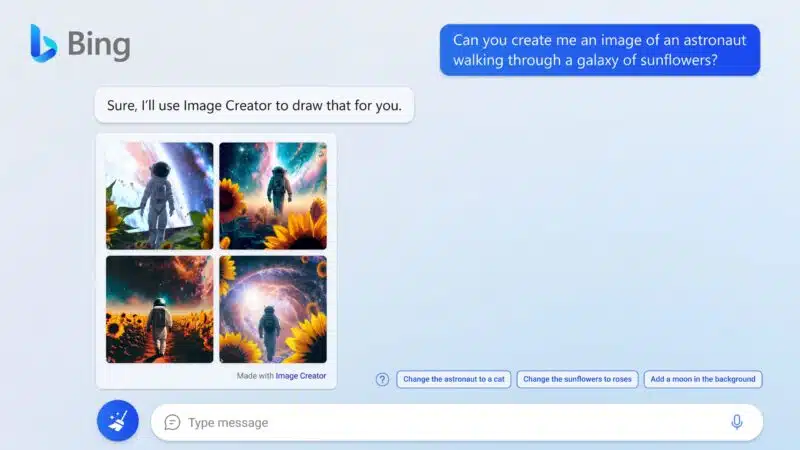
Microsoft launched a new version of Bing with ChatGPT as an integrated technology in February 2023, called “Bing Chat”.

It was only available as a limited preview for some time, but now, as long as you have a Microsoft account, you can use Bing in the Microsoft Edge browser to your heart’s content. It’s now included as an option on the menu underneath the search bar, along with “Search” and “Images”.

Bing with ChatGPT is the only chatbot on this list that gives you the choice of whether you want your answers to be “more creative”, “more precise” or “more balanced”. Here’s how it fared with our questions:

Bing’s answers were certainly more concise than the likes of Bard and ChatGPT, but as it’s integrated into a search engine, it’s also serving a slightly different purpose.

Along with answering queries, Bing Chat provided recommendations for relevant web pages, cited a lot of sources, and gave us a selection of related questions to ask. If you can’t use ChatGPT, it’s an excellent alternative.

3. Claude 2 (beta)

Price from: Free
Set Up: account creation required
Best ChatGPT AI alternative for: sleek interface + document uploading

Claude 2 is the second commercially available chatbot AI startup Anthropic has released, following their first effort, Claud 1.3, which was released just four months ago. Founded in 2021, Anthropic is backed by a $300 million investment from Google, which now has a 10% stake in the company.

The first thing you’ll notice about Claude 2 is the sleek user interface – it’s minimalistic and perhaps more aesthetically compelling than the likes of ChatGPT. You’re also able to upload documents for Claude 2 to analyze, which Bard can’t do yet.

One unique thing about Claude 2 is that it can deal with prompts of up to “up to 100K tokens” (elements of raw text), Anthropic says, “which means that Claude can work over hundreds of pages of technical documentation or even a book. Claude can now also write longer documents – from memos to letters to stories up to a few thousand tokens – all in one go.”

This means Claude 2 can deal with larger inputs than any other commercially available model at the moment. However, inputting sensitive company or personal information into AI chatbots comes with its own risks.

Claude’s privacy policy does say they will retain all of your prompts, which the chatbot needs to do in order to function and provide subsequent responses. However, these will be deleted after 90 days (beta only), and will not be used to train its language models unless you violate the Acceptable Use Policy, the company says in a support center document.

4. ChatSonic

  • Price: Free
  • Set Up: Account required (email and password)
  • Best ChatGPT AI alternative for: Up-to-date, accurate answers and images

ChatSonic is a chatbot created by AI content generation platform WriteSonic, and it’s one of the more useful ChatGPT AI alternatives currently available. Best of all, it won’t cost you a cent to use.

ChatSonic is built on top of the same technology that powers ChatGPT, and as you can see from the image below, the interface isn’t a world away from its rival’s:

The AI platform will behave as a General AI chatbot if you’d like it to, but there are various personas it can assume, such as a philosopher, astrologer, or stand-up comedian, something which ChatGPT doesn’t offer at the moment.

ChatSonic has other advantages over ChatGPT too. For one, it can create AI-generated images, and you’ll be able to create 100 per month for free with ChatSonic:

Crocodile chatsonic generation

On top of this, ChatSonic is connected to the internet – which means it’s able to provide real-time, up-to-date answers, especially concerning events that take place after 2021, of which ChatGPT has very limited knowledge.

5. OpenAI Playground

  • Price: Free
  • Set Up: OpenAI account required (email & password)
  • Best ChatGPT AI alternative for: Customization & experimentation

If you find yourself locked out of ChatGPT and you don’t want to get to grips with a ChatGPT alternative just yet, then use OpenAI’s “Playground” tool.

OpenAI playground is very similar to ChatGPT on the surface and is effectively just a more experimental version of the same tool – it’s actually been open for public use for longer than its more finely-tuned cousin.

It’s a lot more customizable on the whole – you can even select which language model you’d like it to use before you ask it any questions. OpenAI says that Davinci-003, which we used for the tests below, often answers questions with “higher quality, longer output, and better instruction following.”

As you can see from the image above, the OpenAI Playground user interface isn’t quite as straightforward as ChatGPT’s, so you might find it a little more difficult to use – but that’s the price you pay for the extra customization options.

When we’ve used OpenAI Playground, we’ve found that generally, it’s not as hesitant as ChatGPT when it comes to weighing in on complex, controversial topics, so you may get some interesting and unexpected answers while using it. However, it also, like ChatGPT, struggles with queries relating to events from after 2021.

6. YouChat

  • Price: Free
  • Setup? N/A (immediate usage – sign in send replies)
  • A great ChatGPT AI alternative for? Chatbot + search engine combo

YouChat is an AI chatbot and search assistant. It will provide you with similar answers to that of ChatGPT, but will also link you to webpages that relate to whatever query you choose to type in:

One advantage of YouChat is that you don’t even have to make an account, unlike ChatSonic and ChatGPT. Once you get onto the site, you can start using their AI Chatbot immediately. However, you will have to make an account if you want to continue your conversation with YouChat past its answer to your query.

You can certainly have conversations with YouChat, but much like ChatGPT, it’s better for condensing down complex information found on the internet and searching for information in a more efficient, quicker way. But unlike ChatGPT, YouChat will also show you an article written by a human, so it’s the best of both worlds if that’s your primary use case.

However, we did find YouChat slightly glitchier than ChatGPT and it decided to just not reply to a couple of queries we inputted into its search bar. Bear in mind, however, that it has only been fully operational since December 2022, so as is the case with ChatGPT, it’s likely to be further refined and improved.

7. Perplexity AI

  • Price from: Free
  • Set Up: N/A (immediate usage)
  • Best ChatGPT AI alternative for: Citing sources used to generate responses

Perplexity functions quite similarly to a search engine. However, Perplexity will produce an answer that combines information from top web results, rather than just providing you with a list like Google does. It’s not quite as big of a project as some of the other AI chatbots on this list, maintained by just a small, 8-person team – but it’s still an impressive ChatGPT AI alternative.

One thing that sets Perplexity apart is the way it neatly collates the sources used to create the answers it serves to users, which means you can judge whether they’re legitimate and credible.

You don’t have this power with ChatGPT, and in a world crippled by misinformation, it’s an excellent feature. ChatSonic also has this feature, but it doesn’t cite its sources every time as Perplexity does.

While using Perplexity, it was nice to have a list of related queries listed below every answer. An answer to any of the suggested queries can be generated instantly with a single click.

However, Perplexity did take slightly longer to produce an answer than some of the other entries to this list. Now that could be down to various factors (from site traffic to the tester’s internet connection) – but all the other chatbots on this list produced answers quicker.

8. Character AI

  • Price from: Free
  • Set Up: N/A (immediate usage)
  • Best ChatGPT AI alternative for: Entertaining responses

Character AI does what it says on the tin – it’s an artificial intelligence program that allows users to converse with artificially constructed simulations of famous characters from movies and TV shows, as well as public figures and celebrities.

One neat feature of Character AI is you can build your own character bot very easily. All you have to do is come up with what you want your chatbot to do and set a few parameters – after that, Character AI will leaf through huge troves of literature and written text to ensure the AI bot sounds like you intend it to.

Character AI does have its downsides. When we tested it, we found that some responses weren’t necessarily “out of character”, but weren’t particularly “in character” either – although these Super Mario and Elon Musk simulations certainly were:

Plus, its answers are definitely not as consistently accurate or as useful as the ChatGPT – it’s a bit more of a novelty tool to have a bit of fun with. If you’re just looking for an AI program to entertain you, then there aren’t many better than Character AI.

However, bear in mind that there are some questions marks about what data Character AI saves and whether Character AI is safe.

9. Jasper Chat

  • Price from: 5-day free trial, $29/month afterward (Starter plan)
  • Set Up: Account required + answers to intro questions
  • Best ChatGPT AI alternative for: Content Generation

Jasper Chat is a powerful AI tool that can help advertising and marketing businesses producing online content scale their operations.

It’s effectively an AI content-generating robot that has significantly more business-focused features than the other ChatGPT alternatives on this list. It can write adverts, create captions for social media posts, produce video scripts, and much more.

Jasper Chat will also remember past queries, conversations, and prompts that you type into its interface and factor these into how it responds, which ChatGPT doesn’t have the capacity to do. However, it’s similar to ChatGPT in the sense that it struggles with information relating to events that took place post-2021.

Jasper has a $29 per month Starter plan, but if you purchase the $49 per month, however, Jasper Chat will generate 50,000 words, while features in the package include Compose & Command features, as well as a Google docs style editor.

Why You Should Look for a ChatGPT Alternative

ChatGPT is a fantastic resource for individuals and businesses, but as with every type of software, no matter how useful, it has some downsides.

Along with the ChatGPT alternatives featured in this article, Tech.co has also been experimenting with ChatGPT and tracking developments since it came out to see exactly what it’s capable of. During our testing, we’ve identified four major downsides:

  • The site is often at capacity. Due to its soaring popularity, sometimes, ChatGPT has so many visitors it becomes inaccessible to users who want to start conversations.
  • It has limited knowledge of post-2021 events. ChatGPT is not well-trained to respond to questions about events that happened after 2021. This makes its answers to certain topics unintelligible or useless.
  • It is expensive to run and will quickly be monetized. ChatGPT is unlikely to be free forever, at least in its most advanced form – it was revealed recently that it costs “single digit cents per chat” per conversation.
  • It has only trained on text datasets. ChatGPT can hold a conversation, but it’s training data rather than human conversations, so it doesn’t “feel” human and doesn’t converse like one.

AI Updates: Copilot, GPT-4, Gemini & More

While this article focuses on ChatGPT alternatives, here’s a quick rundown of other AI projects and developments to be aware of.

Copilot (Microsoft)

After the successful launch and uptake of ChatGPT, Micorosft has begun to roll out AI capabilities across a number of its products, including Bing, Microsoft Teams, and Outlook.

Within Microsoft Teams, you can now use Copilot to summarize meeting notes and generate subsequent action points. As Microsoft explains, Copilot ” creates a new knowledge model for every organization — harnessing the massive reservoir of data and insights that lies largely inaccessible and untapped today.”

GPT-4 (OpenAI)

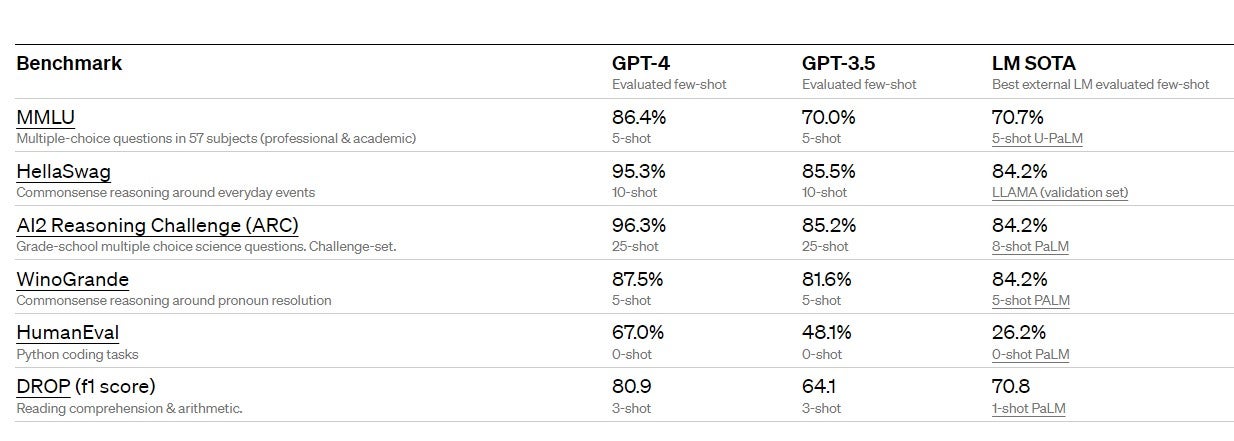
OpenAI recently released the latest iteration of the artificial intelligence language model that underpins ChatGPT, called GPT-4.

Sam Altman, founder of OpenAI, has called it the most capable model that the company has ever produced. GPT-4 is much better at tests than GPT-3.5, passing a bar exam with a score that fell in the top 10% of test takers, whereas GPT-3.5 came in the bottom 10%.

Preliminary testing also suggests that GPT-4 is better at managing requests for disallowed content, responding to them much less frequently than GPT-3.5.

Chinchilla AI (DeepMind/Alphabet inc.)

DeepMind is a subsidiary of Alphabet inc. in much the same way ChatGPT creator OpenAI is a subsidiary of Microsoft – and it’s making headway in the world of AI with its own language models too.

“Chinchilla” is the name of DeepMind’s most advanced AI-powered language model. The company claims that Chinchilla is faster and more powerful than ChatGPT and Gopher, the latter being another highly capable language model created recently by DeepMind.

Members of the public are currently unable to roadtest products that use the Chinchilla AI language model – and unfortunately, we’re some time away from training a chatbot on it.

Gemini (Deepmind)

Another language model being developed by Google is called Gemini – and recently DeepMind CEO Demis Hassabis said that Gemini’s algorithm will be much more capable than the GPT family of language models being used to power ChatGPT.

Gemini will, according to reports, be a lot less restrictive than ChatGPT and be able to think more creatively outside of its training data, the company says.

Neeva.ai

Neeva.ai was touted as an early ChatGPT alternative; an ad-free search engine that incorporated the power of AI into its query-answering mechanism. It cited all of its answers, too, a feature that is yet to be built into some chatbots.

However, the search engine shut down in early June 2023, with co-founder and former Google executive Sridhar Ramaswamy admitting that acquiring new users has been difficult, according to a now-inaccessible blog post on the site.

Websites Like ChatGPT: Other Useful AI Platforms

Here, we’ve put together a short list of some AI tools that aren’t quite websites like ChatGPT, but you’ll still find useful in your work or personal life.

QuillBot: a great ChatGPT alternative for paraphrasing

QuillBot is not a straightforward ChatGPT alternative like ChatSonic or Perplexity, but it does specialize in rephrasing blocks of text.

You can customize exactly how much QuillBot will change, and there’s an AI thesaurus included if you want to take a bit more control over the paraphrasing of specific sentences.

Wix ADI: the best ChatGPT alternative for website building

Wix ADI – which stands for “artificial design intelligence” is an AI-powered tool built into Wix’s website-building software that can generate a website for you with just a few design prompts and some information about what you’re going to use the website for.

wix adi set up process

One stage of the Wix ADI setup process. Image: Tech.co’s testing process

Wix ADI is one of the best AI website builders available, but there are other options out there too. Some AI website builders, such as Hostinger, will generate copy for your web pages and even design a logo for you from scratch, for instance.

Otter.ai: an AI tool for transcribing conversations

Otter is a useful AI tool for transcribing and summarizing meetings and interviews, which can then be reviewed and edited by users.

It’s great for journalists, and there’s a mobile app for users who want to record and transcribe on the go.

Google Workspace customers might already be familiar with Otter – since 2021, it has been available as an integration for Google Meet’s 100 million users.

Browse.ai: a system for tracking changes to websites

Browse.ai is a nifty little tool you can download as a browser extension. The tool lets you build “robots” and set them up to complete tasks of your choosing.

You can use Browse.ai for various purposes, such as tracking the price of products listed on specific websites, content aggregation, collecting bulk data on competitors, and even academic research.

Elicit: the best Chatgpt alternative for research

Elicit is an AI tool that will let you enter prompts or queries and search a bank of 175 million research papers for an answer. Alongside the papers, it provides a short abstract summary of what each paper is about, and you can filter the results by whether a PDF version is available.

Elicit AI user interface

Elicit’s interface

Should My Business Use ChatGPT or a ChatGPT Alternative?

ChatGPT is already being used by businesses and employees around the world, with innovative new use cases and useful ChatGPT prompts appearing every day. Other AI tools are being used to build resumes and websites. But one cursory glance through social media and you’ll quickly work out that ChatGPT’s responses often fall short of the mark – and some companies have banned employees from using them.

YouChat and Claude, however, are alternatives you should check out if you want a chatbot using real-time information, while OpenAI Playground is a great place to tinker with the ChatGPT’s settings if you’re interested in testing the limits of the technology.

If you’re exploring what AI can do for your business, make sure you test out those three to see how they fare against ChatGPT when it comes to complex queries – you might find yourself pleasantly surprised.

Written by:
Jack is the Editor for Tech.co. He has over 15 years experience in publishing, having covered both consumer and business technology extensively, including both in print and online. Jack has also led on investigations on topical tech issues, from privacy to price gouging. He has a strong background in research-based content, working with organizations globally, and has also been a member of government advisory committees on tech matters.

Atlanta Is the Best City for Digital Nomads, Report Shows 

Portland, OR and Austin, TX follow close behind the nation's frontrunner, with New York trailing behind at #94.

Looking to relocate your home office? Well, the results are in. Atlanta Georgia has been named the best urban area for digital nomads, thanks to its affordable rent, impressive internet speed, and close proximity to national treasures like the Great Smoky Mountains.

If it’s West coast living you’re after, Portland, Oregon narrowly missed out on stealing the top spot due to its abundance of recreational areas, while Seattle, Washington landed in fourth position. 

As remote solutions like web conferencing software make remote working easier than ever, the digital nomad scene is exploding in popularity. So, whether you’re a seasoned van lifer or a nomad newbie, these are the top cities to move to in 2023.

Atlanta Georgia is the Best City for Remote Workers

Digital nomads are remote workers that aren’t bound to a fixed location. While the concept has been around since the 1980s, the practice has grown at a breakneck speed in recent years thanks to the rapid adoption of workplace tech and the global WFH experiment kickstarted by Covid-19.

However, all cities aren’t created equally. While some provide digital nomads with everything they need to thrive including ample coffee shops and an affordable cost of living some urban areas simply don’t cut the mustard. 

Luckily, Reviews.org have researched most major urban areas in the US and determined that Atlanta, Georgia is currently the most livable city for remote workers

But why is Atlanta such a great city to work in? Well, according to Reviews.org, this decision was based on a number of factors including the southern city’s rock-bottom average monthly rent ($1.94 per square foot), its relatively high percentage of remote jobs (3.26%), and its impressive internet speeds. 

The site also cites Atlanta’s temperate weather, its assortment of over 115 state recreational areas, and its close proximity to the Smokey Mountains one of the US’s most esteemed natural treasures. 

Not sold on moving to the big peach? Other notable mentions include Portland OR, which was ranked in second place due to its vibrant city culture and competitive internet speeds, Austin TX, which boats affordable rents and a nearby airport, and Seattle which is already home to some of the biggest companies in the world.

If you’re looking to work from home, check out our list of remote-friendly companies.

Portland, Maine Lands at the Bottom of the List

But which urban areas should digital nomads avoid? According to the expert’s findings, remote workers should probably think twice before jetting to Myrtle Beach, Urban Honolulu HI, and Portland ME, which ranked 98th, 99th, and 100th respectively. 

Somewhat unsurprisingly, New York city also appeared very low down on the list at number 94, prominently due to its sky-high rental average of $6.39 per square foot, and lengthy distance away from its nearest national park, Shenandoah.  

Whether you’re looking to save a buck by dodging lofty rents in cities like New York and San Francisco, or you’re enticed by the freedom that nomadism can afford you, there is an abundance of reasons to ditch the rush hour commute for the open road. 

Working from anywhere wouldn’t be possible without the right software solutions though. So,  check out our guide to the best web conferencing apps if you’re looking to collaborate without limits.


Written by:
Jack is the Editor for Tech.co. He has over 15 years experience in publishing, having covered both consumer and business technology extensively, including both in print and online. Jack has also led on investigations on topical tech issues, from privacy to price gouging. He has a strong background in research-based content, working with organizations globally, and has also been a member of government advisory committees on tech matters.

Biden Is Close to Banning Non-Compete Agreements Outright

This ban would be a huge win for the 18% of US workers that are currently subject to the clause.

The Biden administration is getting extremely close to passing a rule that would ban the use of non-compete agreements — a restrictive contract that prevents employees from finding work with competing companies.

This ruling builds on a statement released by the Federal Trade Commission (FTC) In January which details the harmful implications these contracts have on competition in labor, products, and service markets.

By making it easier to search for more lucrative opportunities, the FTC estimates that banning noncompetes could increase workers’ earnings by almost $300 billion a year, which would be a massive win for the one in five US workers that are currently subject to these agreements.

The FTC is Proposing to Ban Non-Compete Agreements

Last week, President Biden announced that his administration is in the final stages of issuing a rule that would prohibit businesses from issuing non-compete agreements, and similar contracts, to their workers. This builds on the FTC’s proposed ban which was issued on the 5th of January, that deemed the contacts to be an exploitative practice.

If successful, the government’s ruling would affect employers from across industries and would have an acute impact on the biotech, pharmaceutical, and healthcare sectors, where agreements of these kinds have become commonplace.

Non-compete agreements are already severely limited in California, North Dakota, Oklahoma, and the District of Columba, and their use against low-wage workers are banned outright in a number of states including Maine, Maryland, and Washington.

However, if the Biden administration decides to implement this ban, employers across all US states would be prevented from issuing these agreements, making non-compete contracts in their current form completely obsolete.

What’s more, in addition to this veto, this regulation would also outlaw adjacent employment clauses that have similar effects as non-competes, force employers to notify workers that their agreements are no longer valid, and ban them from threatening staffers with non-competes that aren’t legal or enforceable.

But as the FTC and the Biden administration rally together to take down non-competes, what’s the problem with the clause anyway?

The Issue with Non-Compete Agreements

While non-competes supposedly date back to the reconstruction era, they were initially used in the corporate world to protect trade secrets and other confidential information from competing businesses. However, in recent years, the employment contract has increasingly been leveraged by employers to exert an unnecessary amount of control over their workers.

According to the FTC themselves, non-competes are responsible for suppressing wages and career progression, by making it harder, and in some cases impossible, for employees to find new opportunities in the same industry.

“Noncompetes are basically locking up workers, which means they are not able to match with the best jobs. This is bad for competition. It is bad for business dynamism. It is bad for innovation.” Chair Lina Khan, Chairperson of the Federal Trade Commission (FTC)

Chair Lina Khan, the Chairperson of the FTC believes the clause can have a negative impact on the economy too, due to the lack of job mobility that is caused by blocking workers from switching freely between jobs.

In many cases, non-compete agreements can also backfire for employers. This is because by forcing their workers to sign the contract — especially in states that regulate their use — they risk facing litigation from employees. The issues non-compete contracts seek to address are also often covered by confidentiality clauses too, making their use redundant in most corporate settings.

Why the FTC’s Proposed Bans Could Benefit Workers

But what does Biden’s proposed ban on non-compete mean for the average Joe? Well, in simple terms, getting rid of the restrictive clause could prove to be very lucrative for the 18% of US workers that are currently subject to the agreement.

In fact, according to the FCT, ditching the outdated contract could increase workers’ yearly earnings by up to $300 billion. This wouldn’t just affect white-collar workers either. Since companies that use non-competes belong to a wide range of industries, from production and hospitality to healthcare, this ban has the potential to improve wages across every facet of the US’s labor market.

In a climate where an alarming proportion of workers deal with salary stagnation, for a large portion of the US workforce, Biden’s pending ban couldn’t come soon enough.

Written by:
Jack is the Editor for Tech.co. He has over 15 years experience in publishing, having covered both consumer and business technology extensively, including both in print and online. Jack has also led on investigations on topical tech issues, from privacy to price gouging. He has a strong background in research-based content, working with organizations globally, and has also been a member of government advisory committees on tech matters.

Twilio Lays Off 17% of Staff in Second Round of Firings

As Twilio continues its restructuring efforts, 28% of the company have now been shown the door in the last six months.

The Silicon Valley kingpin Twilio has just announced plans to dismiss around 1,500 of its workers — equating to 17% of its total workforce — as part of a continued effort to restructure the company.

These cuts come just five months after the consumer engagement platform cut its personnel down by 11% in September, bringing its culling total to 26% and making this one of the most extensive layoffs we’ve seen in big tech so far — although in pure numbers the likes of Microsoft and Meta lay offs affected many more people.

With Twilio’s stock falling by 67% over the last year and some areas of the business reportedly being “too big”, it’s clear the company is dealing with the consequences of over-hiring throughout the pandemic. Here’s what we know so far.

Twilio Lays Off 1,500 Workers As Part of a Company Restructure

As big tech’s future grows increasingly unstable, communications company Twilio has decided to follow in the footsteps of other major big companies by shedding around 17% of its workforce.

The news was broken in an email sent out this Monday, which was later posted on the company’s website. In this email, Twilio’s CEO, Jeff Lawson, expresses his condolences to those affected and cites the company’s “need to reorganize” as the main impetus for the cuts.

“For the last 15 years, we ran Twilio for growth, building a tremendous customer base, product set, and revenue base. But environments change – and so must we.” – Twilio CEO Jeff Lawson.

Lawson explains that while the company has “very strong cash reserves”, this isn’t enough to get it to the next phase. Instead, significant structural changes, including forming two new business units, Twilio Communications, and Twilio Data & Applications, will be necessary if the firm has any hope of executing its new strategy.

Unfortunately, to make way for these new business units, Twilio’s staffers have been forced to take the brunt. Under Lawson’s own admission, the company’s current workforce is too large to support in conjunction with these new units, which is why around 1,500 have been shown the door.

Twilio’s CEO also revealed that he will be cutting his base salary by almost half to $65,535 per annum, to commit to the company’s renewed vision.

These Cuts Bring up Twilio’s Culling Total to 28%

While these layoffs are quite extensive, they aren’t the first time Twilio has made drastic cuts to personnel. In September last year, the San Francisco-based company fired 800 workers due to their lighting fast expansion throughout the pandemic.

In a letter sent out to employees, Lawson backed the decision as “wise and necessary”, and explained they were about aligning their investments more squarely with its priorities. In a separate blog post posted online, Lawson also announced that these layoffs were in response to the workforce growing “too fast” and “without enough focus” over the past two years.

These series of layoffs bring the company’s staffers to around 6,500, a 28%  decrease from Twlio’s 9,000-strong workforce in September.

Big Tech Continues To Deal With the Post-Covid Fall Out

As demand declines and big tech companies grapple with overstaffing efforts that took place during the pandemic, difficult decisions are needing to be made left right, and center. Unfortunately for many businesses, this is resulting in pretty severe layoffs.

Just this month, leading tech firms like eBay, Yahoo, and Meta have been forced to cut personnel to remain competitive and appease investors. Even the booming media empire Disney has been forced to axe 7,000 workers – equating to 7% of its workforce – as part of a massive corporate restructuring effort.

While the future remains uncertain, it’s likely this series of layoffs will grind to a halt anytime soon. So for a list of companies that have made job cuts in tech, stay up to date with our updated layoffs guide.

Written by:
Jack is the Editor for Tech.co. He has over 15 years experience in publishing, having covered both consumer and business technology extensively, including both in print and online. Jack has also led on investigations on topical tech issues, from privacy to price gouging. He has a strong background in research-based content, working with organizations globally, and has also been a member of government advisory committees on tech matters.

What is Resenteeism? Quiet Quitting’s Moody Successor

As workers are grow increasingly resentful towards their jobs, many are no longer staying quiet.

As employees continue to contend with job insecurity and low levels of satisfaction, a new workplace trend has come into vogue: resenteeism.

Unlike presenteeism — the practice of showing up to work despite being unwell or unproductive — resenteeism drops the facade of being content with your job and describes a more active response to workplace frustrations.

Due to its associations with checking out and doing the bare minimum, the term has been dubbed the natural successor to quiet quitting. And much like the hushed phenomenon, it can cost businesses dearly if left unaddressed.

For employers worried about the spread of resenteeism in their workplace, and for workers experiencing it themselves, this article dissects the employment term and its common origins, before offering some tangible ways to address staff disengagement head-on.

What Is Resenteeism? 

If you thought that employment buzzwords would be left in 2022, you’d be wrong. The business software company RotaCloud has recently affixed a name to a longstanding workplace trend that’s been hampering productivity and profitability for years.

Resenteeism is the shiny new term that describes remaining in a job while being fundamentally unhappy. Sound familiar? The phenomenon draws many parallels to presenteeism, which describes showing up for work to keep up appearances but getting very little done due to sickness or emotional challenges.

Both concepts are born from workplace dissatisfaction and anxieties over job security, but unlike presenteeism, resenteeism describes a less guarded expression of similar frustrations. Resentful employees tend to be more active about their concerns, and put simply, are no longer afraid of hiding them.

Resenteeism is closely tied to quiet quitting too, the term which rose to notoriety in 2022 thanks to apps like TikTok and Instagram. Just like quiet quitting, the concept describes the experience of employees that are choosing to check out before burning out. However, unlike quiet quitting, which by nature is a passive act, resentful staffers aren’t afraid to make some noise.

Why Are Workers Fed Up?

Workplace dissatisfaction is not a new phenomenon. However, recent research suggests the issue is getting worse than ever, with a Gallup survey revealing that only 32% of workers are actively engaged by their work, down from 36% in 2020. Another 2022 survey by UKG found that 45% of US workers wouldn’t wish their job on their worst enemy. But how has the situation gotten so dire?

According to RotaCloud, the Great Resignation is likely to play a major role. After large swathes of employees ditched their jobs in favor of new horizons in the wake of Covid-19, skeleton teams up and down the country were left behind to pick up the pieces. Combine this with growing fears over job security born from surging layoffs and an impending recession, and it’s no surprise that concepts like resenteeism are catching speed like never before.

But if you’ve spotted workers growing unsatisfied, or even resentful, in your workplace, stay rest assured — there are steps you can take to curve the trend.

What Can Employers Do to Tackle Resenteeism?

Spotting the early signs of resenteeism is essential if you’re committed to stamping it out early on. Not sure what to look out for? According to RotaCloud, some red flags to watch out for are workers that are displaying a notable lack of enthusiasm, a change in attitude or behavior, or a significant decline in their quality of work. If you’ve noted one or more of these signs, it’s a clear signal that action needs to be taken.

To prevent workers from feeling even more disillusioned, it’s important for managers to maintain clear lines of communication and check in with workers on a one-on-one basis if possible. These communications should be tactful and human and should give workers opportunities to express their concerns.

In addition to welcoming feedback, employers should do what’s in their power to improve the daily experience of their workforce. This can take many forms, including embracing flexible working, monitoring workloads to reduce cases of burnout, offering chances to progress where possible, and fostering an environment where discussions about mental health are welcome.

These strategies don’t need to cost businesses an arm and a leg, either. But even if these safeguards require financial investments, it’ll be nothing compared to the cost of a resentful workforce.

Written by:
Jack is the Editor for Tech.co. He has over 15 years experience in publishing, having covered both consumer and business technology extensively, including both in print and online. Jack has also led on investigations on topical tech issues, from privacy to price gouging. He has a strong background in research-based content, working with organizations globally, and has also been a member of government advisory committees on tech matters.

68% of ChatGPT Users Admit Hiding It From Their Boss

With AI technology continuing to shape the way we live and work, are tools like ChatGPT being secretly used in your office?

As the artificial intelligence (AI) chatbot ChatGPT continues to disrupt key industries, new findings reveal that 43% of professional workers are using ChatGPT for work-related tasks — and 68% are doing so without their manager’s knowledge.

This is a significant surge from the 27% of professionals using the content generation technology in early January, with employees belonging to a range of high-profile companies including Google, Twitter, and JP Morgan.

The impact its uptake will have on the business landscape is yet to be seen. Yet, with the insurgent app gaining 100 million users since November — making it the fastest-growing app in history — and Google and Microsoft preparing to roll out similar models, its use in the workplace isn’t set to fade anytime soon.

43% of Workers Are Using ChatGPT

ChatGPT is an AI-powered chatbot developed by OpenAI that uses deep learning techniques to create human like-responses.

Since it was first released in November, the free application has already gained a loyal user base among consumers. However, according to a recent survey by the professional messaging app Fishbowl, the use of ChatGPT has become extremely popular in workplace settings too, with almost half of the respondents admitting to using the tool at work in some capacity.

Specifically, out of the 11,793 professionals that took place in the survey, 5,067 (43%) use AI tools like ChatGPT for various tasks related to content creation including writing emails and copywriting. This is up almost 50% from early January, which is a stark signal of how fast this new technology is spreading.

But despite apps like ChatGPT recently entering the limelight, most employees aren’t using them in plain sight. In fact, when the workers were asked if their boss was aware of their practices, 68% of AI users admitted to concealing their use of the tech at the workplace.

White-collar workers aren’t taking a fully clandestine approach to using the tool, however, with discussions relating to ChatGPT surging by 107% on Fishbowl’s social media platform between January 2 and January 23. But since the artificial intelligence tool has entered the world of work, where is it being used the most?

Which Workers Are Using ChatGPT?

Due to ChatGPT’s varied applications, the language model can be leveraged by businesses in just about every industry. However, according to another survey by Fishbowl, marketing, and advertising companies have adopted the technology the most, with 37% of workers in the sector using the tool in some form when carrying out work-related tasks.

Tech and consulting are also turning to AI solutions in mass, with 35% and 31% of workers in the fields using apps like ChatGPT, respectively. These results chime with the findings of Fishbowl’s most recent survey, which confirmed that the tech is being utilized in major financial tech and consultancy companies like Google, Amazon, Meta, Twitter, McKisney, and Edelman.

But ChatGPT’s use isn’t limited to the professional world. A new survey by Study.com has found that one in four K-12 teachers have caught at least one student using ChatGPT to cheat at school. But teachers are fighting back against its growing adoption in classrooms, with New York City Public Schools banning the technology outright — and school boards in many states, like California, Washington, and Maryland considering taking similar actions.

AI Continues to Transform the Way We Work

As ChatGPT continues to take the world by storm, major tech companies are scrambling for their slice of the AI pie.

At the end of January, Microsoft confirmed that it would be investing a further $10 billion into ChatGPT’s developer OpenAI, as part of a wider effort to incorporate machine learning technology in their services. Microsoft Azure will also continue to be OpenAI’s exclusive cloud provider, in a partnership that will expose countless more businesses to AI technology.

Google has rolled out its new AI-powered chatbot ‘Apprentice Bard, too, as part of a ‘code red’ response to ChatGPT’s raging success. However, the technology firm’s share price plummeted 7% after its chatbot failed to answer a question correctly in a recent live stream, suggesting that the search tool has got a long way to go before it can replicate ChatGPT’s impressive levels of success.

Written by:
Jack is the Editor for Tech.co. He has over 15 years experience in publishing, having covered both consumer and business technology extensively, including both in print and online. Jack has also led on investigations on topical tech issues, from privacy to price gouging. He has a strong background in research-based content, working with organizations globally, and has also been a member of government advisory committees on tech matters.

Yahoo Cuts 20% of Workforce in Latest Lay Offs Shock

As Yahoo's advertising unit continues to underperform, its CEO has decided to channel funds elsewhere.

Despite a profitable 2022, Yahoo has decided to lay off 1,600 of its staff members, equating to one-fifth of the company. Following similar announcements made by eBay and Zoom this week, these changes will impact the company’s ad tech employees, with the team shrinking by 50% as a result.

Employees were notified on Thursday that 1,000 of the company would be laid off before the end of the day, while a further 600 workers are due to be released in six months.

According to Jim Lanzone the CEO of the pioneering platform, this decision was made as part of a restructuring of Yahoo’s advertising unit, which is not currently proving to be lucrative, and will help them “go on offence” by investing in other areas of the company.

Yahoo Lays Off 1,600 Workers Amid Company Restructuring

After losing money from its SSO and native ad tech businesses, Yahoo has decided to join the ranks of other tech companies like eBay, Zoom, Google, and Meta by axing over 20% of its staff.

These cuts will predominantly be made to the company’s ad tech employees, with 1,000 workers already being shown the door on Thursday, and a further 600 employees facing the same fate in six months’ time.

“These decisions are never easy, but we believe these changes will simplify and strengthen our advertising business for the long run, while enabling Yahoo to deliver better value to our customers and partners”  – Yahoo Spokesperson

With the US web service provider generating a healthy $8 billion per annum in profits, Yahoo’s CEO, Jim Lazone, maintains that this decision was not borne out of financial hardships. He explains that instead, the layoffs are part of a strategic change that seeks to make other parts of the business more profitable.

Yahoo Drops the Curtain on a Number of Ad Platforms

Yahoo and AOL, another trailblazing US web portal, were acquired by the private equity firm Apollo in 2021 for $5 billion. At the time of purchase, Yahoo and AOL housed over 30 ad tech companies, with the acquisitions spanning over ten years.

Combined, this ‘unified stack’ of businesses had access to enormous data sets that were thought to give ad platforms like Google and Meta a run for their money. Unfortunately, these ad platforms never lived up to the company’s expectations, and instead of conquering the market, lead to depleted resources and diminished returns on investments.

“A lot of resources were going into that unified stack without a return. This was a longstanding issue with every variation of this company…that needed to be solved eventually.” – Jim Lanzone, Yahoo’s CEO

The failure of this ‘united stack’ has resulted in several native advertising platforms being shut down, including Gemini and its supply-side platform (SSP) which helped digital publishers monetize their content through ads.

Is Yahoo Out of the Ad Game Forever?

While Yahoo may be ditching its unified ad stack, the service provider isn’t vacating the advertising space altogether.

Earlier this year, the California-based company announced a partnership with advertising powerhouse Taboola. According to Lanzone, by letting Taboola sell native ads on its pages, this new alliance could increase the number of advertisers competing for Yahoo’s ad placement eightfold.

The company is also planning to strengthen its demand-side platform (DPS) which helps advertisers buy ads automatically across multiple publisher sites. This DPN resource will be renamed ‘Yahoo Advertising’ and will be focusing on selling ads to Fortune 500 businesses and premium accounts across the world.

Despite 20% of Yahoo’s workforce facing the chopping block, Lanzone has announced plans to hire more roles in this team, as part of his vision to “simplify and strengthen the good parts of the business, while sunsetting the rest”.

However, even with the company’s recent strategy shift, it’s unlikely that Yahoo will be able to compete with the big players any time soon. Yet, with Yahoo’s biggest competitors in the space, Google and Meta, being forced to make similar cuts recently to recover costs, its as good a time as any to take a stab at the advertising duopoly.

Written by:
Jack is the Editor for Tech.co. He has over 15 years experience in publishing, having covered both consumer and business technology extensively, including both in print and online. Jack has also led on investigations on topical tech issues, from privacy to price gouging. He has a strong background in research-based content, working with organizations globally, and has also been a member of government advisory committees on tech matters.

Meta Wants Some Managers to Stop Managing or Quit

"I don’t think you want a management structure that’s just managers managing managers, managing managers..."

Mark Zuckerberg is pulling out all the stops to avoid even more tech layoffs this year, as Meta reportedly asked many of its managers to step away from their roles in favor of individual contributor. You know, that or quit the company.

The news comes at a tumultuous time in the tech industry, as virtually every firm in Silicon Valley and beyond have been cutting costs in the form of employee layoffs. Some CEOs are even taking pay cuts, a true sign that the recession is heavy on the minds of those in the industry.

That is certainly the case at Meta, given the admittedly creative solution to cutting costs that the social media giant is employing.

Meta to Managers: Stop Managing or Quit

According to a Bloomberg report, mid-level management employees at Meta — the parent company of Facebook, Instagram, and WhatsApp — are being asked to step down from their managerial responsibilities in favor of more individual contribution roles.

Like the rest of the tech industry, Meta is in cost cutting mode, having just laid off 11,000 employees in November. The social media company has been anything but shy about its plans to trim down its spending, with Zuckerberg calling 2023 “the year of efficiency” for Meta.

“We’re focused on becoming a stronger and more nimble organization.” – Mark Zuckerberg

“Nimble” is the key word in this most recent decision, as Meta hopes to eliminate these middle management roles in an effort to speed up the decision-making process.

Are More Meta Layoffs Coming?

There’s a pretty good chance that more Meta layoffs are coming, if only because the company has been so vocal about its plans to lay off more of its employees. Still, this initiative to move managers to other roles could soften the blow for some, particularly because the logic behind trimming these roles is relatively sound.

“I don’t think you want a management structure that’s just managers managing managers, managing managers, managing managers, managing the people who are doing the work.” – Mark Zuckerberg

Amongst that word salad is a good point. Tech companies have gotten a bit bloated lately and efficiency is key during a recession.

However, had Zuckerberg and the rest of the tech industry not gone on a short-lived hiring frenzy during the economic boom following the release of the vaccine, these problems could’ve been avoided all together.


Written by:
Jack is the Editor for Tech.co. He has over 15 years experience in publishing, having covered both consumer and business technology extensively, including both in print and online. Jack has also led on investigations on topical tech issues, from privacy to price gouging. He has a strong background in research-based content, working with organizations globally, and has also been a member of government advisory committees on tech matters.

Happily Never After: Disney Cuts 7,000 Jobs

Even the media empire isn't immune to economic downturn, with CEO Bob Iger planning to make cuts to the tune of $5.5 billion.

Even Mickey Mouse isn’t immune to a recession, as Disney announced it would be joining the scores of tech companies in laying off employees as part of a massive corporate restructure.

It’s no secret that the global economy isn’t doing so great right now. News of tech layoffs has become part of everyday life at this point, with the likes of Microsoft, Google, and dozens of others cutting jobs and slashing budgets.

Unfortunately, movies that make more than a billion dollars at the box office aren’t enough to protect you from economic downturn, with Disney announcing some serious cuts across the board to its media empire.

Disney to Cut $5.5 Billion in Costs

Disney announced this week that it would be laying off 7,000 employees, or 3% of its total workforce, in service of some serious cuts the company is going through. CEO Bob Iger noted that Disney plans to slash at least $5.5 billion from the budget in a massive corporate restructure for the media conglomerate.

If you’re worried about this cutting into your Marvel or Star Wars fandom, have no fear. Iger noted in a statement that creative work is the lifeblood of Disney and that these cuts will help them more than anything.

“We believe the work we are doing to reshape our company around creativity, while reducing expenses, will lead to sustained growth and profitability for our streaming business, better position us to weather future disruption and global economic challenges, and deliver value for our shareholders.” – Bob Iger, CEO of Disney

As for the specifics of the corporate restructure, Disney will now be made up of only three divisions: entertainment, ESPN, and parks and experiences.

This massive corporate restructure comes on the heels of Iger’s return to the company, who left the company at the end of 2021 but has already reclaimed his status as CEO, and his undoing a lot of changes made by his replacement.

How to Prepare for a Recession

With Disney making cuts, it’s safe to assume that no one is protected from the effects of the upcoming recession. Whether you’re a small startup or an enterprise-level company, shoring up your costs and buckling down for hard times can be daunting, but there are a few things you can do to prepare.

We talked to a wide range of business owners at the end of last year to get some insight into what surviving a recession looks like, with tips like focus on your priorities and get creative. The general consensus was that, instead of halting spending entirely, your business should start spending smart, targeting high yield areas that can make you money until the tide comes back in.

For more information on how to weather the storm, take a look at our guide to recession-surviving tips and come back to Tech.co for all the insight you can handle.


Written by:
Jack is the Editor for Tech.co. He has over 15 years experience in publishing, having covered both consumer and business technology extensively, including both in print and online. Jack has also led on investigations on topical tech issues, from privacy to price gouging. He has a strong background in research-based content, working with organizations globally, and has also been a member of government advisory committees on tech matters.

Google Stock Plummets After AI Chatbot Demo Fail

Google continues to lag behind Microsoft, who acquired OpenAI, the company behind the ChatGPT tech that has turned heads.

The AI race isn’t going too well for Google, with its parent company Alphabet taking a huge hit to share prices after its ChatGPT competitor Bard answered a question incorrectly in a promotional video.

AI-powered chatbots are all the rage right now, with virtually every big tech company making a push to establish the technology in a meaningful way. Clearly the market agrees that AI is important, with each move having a serious impact on stock prices.

Google discovered that this week, when a demonstration of its Bard technology fell flat along with its shares.

Google Down 9% After AI-Chat Bot Gets Answer Wrong

In a live-streamed presentation on Wednesday morning, Google demonstrated its AI-chatbot — dubbed Bard — and its ability to quickly answer questions with valuable and easily digestible information on the fly.

The demonstration sees a user asking Bard a simple question: “What new discoveries from the James Webb Space Telescope can I tell my 9-year-old about?” Bard then spits back a few interesting facts with lightning speed, demonstrating just how close this AI-powered chatbot is to launch.

The only problem is that the information provided isn’t entirely correct. Bard states that the pictures from the James Webb Space Telescope are the first of a specific planet. However, as discovered by Reuters shortly after the presentation, the European Southern Observatory’s Very Large Telescope actually took pictures of the same planet in 2004.

Google took the snafu in stride, reiterating that this kind of mishap is why testing is so important.

“This highlights the importance of a rigorous testing process, something that we’re kicking off this week with our Trusted Tester program. We’ll combine external feedback with our own internal testing to make sure Bard’s responses meet a high bar for quality, safety and groundedness in real-world information.” – a Google spokesperson

Unfortunately, the market was not nearly as forgiving, as Google’s parent company Alphabet had stock prices dropped 9% following the demonstration.

The Race for AI

After ChatGPT debuted with surprisingly stellar results, the race for AI supremacy heated up quick. With Microsoft’s swift acquisition of OpenAI — the company behind ChatGPT — the starting gun had officially gone off, spurring a mad dash for tech giants around the world.

Baidu is one of the companies vying for that AI tech, announcing that it is currently testing its own chatbot — dubbed ERNIE — that would bring the tech to China, where ChatGPT is not operational. Alibaba also just announced that it would join the fray, which means that AI is coming to China sooner rather than later.

If it seems like AI-powered chatbots are the new gold rush in tech, that’s because they absolutely are. And if Google can’t figure out a way to turn its search engine empire into a functioning chatbot soon, they’re going to be left in the dust.


Written by:
Jack is the Editor for Tech.co. He has over 15 years experience in publishing, having covered both consumer and business technology extensively, including both in print and online. Jack has also led on investigations on topical tech issues, from privacy to price gouging. He has a strong background in research-based content, working with organizations globally, and has also been a member of government advisory committees on tech matters.

eBay Lays Off Hundreds of Employees in Latest Redundancies

The CEO says that the move will free up "additional space to invest and create new roles in high-potential areas."

Online ecommerce platform eBay has confirmed in a filing to the Security and Exchange Commission that the company will be letting “approximately 500 employees go”.

The filing, made on February 7, says that the 500 unlucky staff members – who collectively represent 4% of eBay’s total workforce – will be notified at some point today that they’re surplus to requirements.

Citing the worsening macroeconomic situation, eBay’s CEO says the decision has been made to strengthen the company’s “ability to deliver better end-to-end experiences” for customers, and “support more innovation” across the company.

eBay Struggling in Bleak Economy

Like many companies forced into making layoffs, eBay’s decision to reduce its headcount by 500 signals that the company is struggling to cope with the current economic climate.

In the SEC filing, eBay chief executive Jamie Iannone says – in emphatically diplomatic fashion – that the company has had to take “a thoughtful look” at how best to run its operations in the current “macroeconomic situation”.

“To create long-term, sustainable growth for eBay,” he says the company needs “evolve” and focus on “driving growth, building a trusted marketplace, empowering enthusiasts, and seeding new technologies for the future.”

Laid-off Employees Promised Support

Also in the SEC filing, Iannone thanked the recently-axed employees for their “incredible talent, passion, and achievements”.

The eBay chief says that the company will support former employees as they “navigate the transition” to working elsewhere, and will provide “comprehensive transition packages with severance and employee incentive payments.”

Similar post-layoff help was announced by Zoom, which also hit the headlines today after laying off 1,300 employees itself.

More Layoffs Likely to Come

eBay and Zoom are the latest companies to join Microsoft, Meta, Amazon, and Google in laying off significant proportions of their staff, but they’re not going to be the last.

Just this week, for instance, rumors that Meta might be about to make even more layoffs have begun to do the rounds. The company has already laid off thousands of workers in the past half-year.

With the global economy failing to fill big tech with optimism, it’s only a matter of time before another established company is forced to part ways with hundreds – if not thousands – of staff members.

Written by:
Jack is the Editor for Tech.co. He has over 15 years experience in publishing, having covered both consumer and business technology extensively, including both in print and online. Jack has also led on investigations on topical tech issues, from privacy to price gouging. He has a strong background in research-based content, working with organizations globally, and has also been a member of government advisory committees on tech matters.

Microsoft Launches ChatGPT Powered Bing Search Engine

The new AI features will help Bing better respond to the increasingly complex search queries users are posing.

Tech giant Microsoft has just launched a new and significantly improved version of its search engine Bing, which has ChatGPT’s underlying artificial intelligence capabilities built into it.

Microsoft says the AI-powered technology will help Bing deal better with “more complex” queries raised by users of the search engine, while related functionalities have been added to Microsoft Edge that will let netizens compose social media posts off the back of searches.

The new version of Bing is available now as a limited preview, but Microsoft plans to scale this to “millions” of users within the coming weeks.

Microsoft Launches Bing with ChatGPT

“Today, we’re launching an all-new, AI-powered Bing search engine and Edge browser” Yusuf Mehdi, Microsoft Corporate Vice President & Consumer Chief Marketing Officer, announced in a recent blog post.

The new version of Bing, he says, will deliver “a better search” as well as “more complete answers”. With this update, Bing should now be viewed as an “AI copilot” for browsing the internet.

According to Microsoft, around half of the 10 billion search queries made every day go unanswered. That, Mehdi says, “is because people are using search to do things it wasn’t originally supposed to do”.

This is where the AI technology that powers the now-world-famous ChatGPT comes in – and it might just change how we search for information on the web forever.

What the New AI-Powered Bing Can Do

Microsoft says that the new AI chat experience within their Bing search engine will be able to help users that want a “detailed trip itinerary” or are “researching what TV to buy”. Previously, search engines would have struggled with the multi-faceted nature of this query and this would make the results unhelpful.

Now, “the chat experience empowers you to refine your search until you get the complete answer you are looking for by asking for more details, clarity, and ideas,” Mehdi says in the blog post.

The technology will take “key learnings and advancements” from ChatGPT and GPT-3.5 to serve answers at a higher speed and with increased accuracy. However, initial reports regarding the efficacy of the Bing chatbot claim that it’s behaving a little more cautiously than ChatGPT at present.

Microsoft has also applied artificial intelligence to the standard search algorithm utilized by Bing, which the company says “has led to the largest jump in relevance in two decades.”

Microsoft Edge Receives AI Upgrade

Along with these changes to Bing, Microsoft has also incorporated AI technology into its browser, Microsoft Edge.

Two new functions, “chat” and “compose”, will be available in the Edge sidebar. To explain how both of these work, Microsoft uses the example of a user searching for a summary of a specific financial report.

Microsoft details how you could “use the chat function to ask for a comparison to a competing company’s financials and automatically put it in a table”, or ask it to compose content such as social media posts based on a few prompts related to the content you’re looking at.

Bing – which is now 13 years old – has always played second fiddle to Google, and that’s unlikely to change any time soon. However, these new AI capabilities certainly give the less popular search engine a unique selling point that Google can’t compete with, for the time being at least, although it’s sure to be pinning its hopes on its own Bard AI solution.

Written by:
Jack is the Editor for Tech.co. He has over 15 years experience in publishing, having covered both consumer and business technology extensively, including both in print and online. Jack has also led on investigations on topical tech issues, from privacy to price gouging. He has a strong background in research-based content, working with organizations globally, and has also been a member of government advisory committees on tech matters.
Back to top