Apple Reportedly Swapping Its iPhone Lightning Port for USB-C Next Year

The reported change would be a big reversal from Apple and is likely spurred by government policy.

Apple analyst Ming-Chi Kuo has made a bold claim, saying that Apple will drop the Lightning port in favor of the far more universal USB-C port.

The change will — reportedly — arrive as soon as next year, with the release of the iPhone 15.

The change has long been rumored, so this isn’t a surprise. It’s a welcome change for many users, too, since it means new iPhones will be compatible with far more devices and cables.

What We Know

The analyst didn’t offer a source beyond mentioning his own survey, which indicates the news of a switch in charging ports comes from deductive research rather than a definitive leak.

But according to the two tweets that dropped the news, the switch is expected to arrive with the 2023 models.

The reported change would be a big reversal from Apple and is likely spurred more by government policy than the company’s own interest.

For years, the EU has been considering a policy that would make USB-C ports mandatory across all devices, including iPhone. Apple didn’t mince any words about its opposition to the idea back in 2020. Here’s what one spokesperson had to say at the time:

“Legislation would have a direct negative impact by disrupting the hundreds of millions of active devices and accessories used by our European customers and even more Apple customers worldwide, creating an unprecedented volume of electronic waste and greatly inconveniencing users.”

So, what does the update mean for you?

What it Means

Apple introduced the Lightning port to replace the chunky 30-pin dock connector back in 2012 and has been using it for every iPhone since. And ever since the tech giant dropped the headphone jack from its iPhone as well, the Lightning port has been pulling double duty, both charging the device and serving as the only port of call for those with wired headphones.

Updating to USB-C might be a tough transition — while a USB-C port could boost transfer and charging speeds, that might depend on which type of cable a user winds up with. There’s only one type of Lightning cable, but plenty of USB cables are fast while others are slow, which may lead to confusion.

Once the shift is over, though, we’ll all be free from the arguably overpriced Lightning cable, which is a win for everyone except Apple’s bean-counters.

One thing’s for sure: It’ll be a slow transition. There are over a billion iPhones in circulation around the globe, and none of them use UCB-C cables. A change in direction this large will have a big one-time impact on plenty of people, from individual consumers to businesses like restaurants that use POS systems on iPhones and haven’t yet shifted to USB-C.

Assuming this report is true, the 2023 dongle industry will be booming.

Written by:
Adam has been a writer at Tech.co for nine years, covering fleet management and logistics. He has also worked at the logistics newletter Inside Lane, and has worked as a tech writer, blogger and copy editor for more than a decade. He was a Forbes Contributor on the publishing industry, for which he was named a Digital Book World 2018 award finalist. His work has appeared in publications including Popular Mechanics and IDG Connect, and his art history book on 1970s sci-fi, 'Worlds Beyond Time,' was a 2024 Locus Awards finalist. When not working on his next art collection, he's tracking the latest news on VPNs, POS systems, and the future of tech.

Meta Prepares for Cutbacks, Avoids Policy Guidance, and Gets Sued

Here's a quick look at the most recent news cycle that Facebook's parent company has been dealing with in this week alone.

Meta isn’t having a good week.

Granted, Facebook’s parent company isn’t having a good year, either, just going off of stock prices, and it hasn’t started the decade in a great place, either. The world’s large social media platform still remains too big to fail, however, even if a few upcoming cutbacks will make it just a little bit smaller.

Here’s a quick look at the most recent news cycle that the company has been dealing with in this week alone, from a lawsuit to a guidance request withdrawal.

Metaverse Cutbacks are Coming

The metaverse has met its first big obstacle, with the news that Meta’s hardware division, Reality Labs, faces cutbacks. Chief Technology Officer Andrew Bosworth told staffers on Tuesday to expect more news on what the cutbacks will look like by next week, Reuters reports.

A spokesperson clarified that some projects will be postponed while others will be dropped entirely. No layoffs are being planned, according to the spokesperson.

Facebook revealed plans to discontinue its podcasts earlier this month, so it’s clear that priorities are shifting.

Ex-Facebook Content Moderator Sues Meta

Daniel Motaung is suing Meta and Meta’s third-party contractor, Sama, alleging that job ads failed to warn him of the extreme, traumatizing content he’d have to see.

Motaung says he reviewed content including child abuse and beheadings, all for around $2.20 an hour. Meta declined to comment.

Meta Withdraws Policy Guidance Request

On Wednesday, Meta announced that it is withdrawing an earlier request made to its independent Oversight Board, created to help moderate content related to Russia’s war in Ukraine.

In the request, Meta had asked for policy guidance. Now that it’s retracting that ask, Meta cites “ongoing safety and security concerns.” The statement doesn’t further clarify why this would require a retraction, though some say Meta is worried about threats from Russia, given the country’s past threats to Apple and Google employees. It’s the first time Meta has issued such a retraction.

Market Value Remains Lackluster

Worse, the company’s stock isn’t doing great, either: Meta Platforms has lost right around 50% of its market value since the start of 2022.

Why? Competition from TikTok is likely one big reason, as are privacy policies that have reduced the data Facebook accesses. The company’s big plans for the metaverse remain many years away, too, assuming they materialize at all.

Facebook Will Stop Tracking Your Location

It’s not all bad news, though: Facebook announced earlier this week that they’ll soon end their practice of tracking users’ locations in the background.

They’ll stop tracking locations on May 31st. By August 1st, they will also have deleted users’ past location histories as well, dropping the arguably invasive channel of data collection entirely.

It’ll be the biggest bulk deletion of data at Facebook since the company shuttered its facial recognition functions in November 2021, according to Fast Company. It’s a big win for user privacy, even if many, many third parties are still collecting plenty of other data through the social platform.

Facebook will undoubtedly keep chugging along for years to come, even as the tech industry is now entering a major downturn, but its status as one of the biggest social media platforms won’t last forever. Consider this your latest reminder that businesses should spread their social media presence over multiple platforms to stay their healthiest.

Written by:
Adam has been a writer at Tech.co for nine years, covering fleet management and logistics. He has also worked at the logistics newletter Inside Lane, and has worked as a tech writer, blogger and copy editor for more than a decade. He was a Forbes Contributor on the publishing industry, for which he was named a Digital Book World 2018 award finalist. His work has appeared in publications including Popular Mechanics and IDG Connect, and his art history book on 1970s sci-fi, 'Worlds Beyond Time,' was a 2024 Locus Awards finalist. When not working on his next art collection, he's tracking the latest news on VPNs, POS systems, and the future of tech.

Slack and Teams are Replacing Business Emails, Report Shows

This new survey suggests that employees are starting to prioritize casual and secure messaging.

COVID-19 appears to have had a massive impact on the way businesses communicate, with a new study revealing that the majority of workers now favor apps like Slack and Microsoft Teams over traditional forms of communication. 

While emails aren’t set to die out anytime soon, business chat apps appear to be growing in popularity due to their commitment to end-to-end encryption and their capacity for less-formal messaging.

With a recent report revealing that 75% of cyber attacks now start with an email, it’s no surprise that business owners are leaning towards more secure communication platforms.

The Way Businesses Communicate Is Changing

Yesterday, the communications company Spiceworks Ziff Davis (SWZD) released its first-quarter report on the current shape of communications in the workplace.

According to the report – which surveyed over 1,000 IT professionals – 51% of workers now prefer real-time messaging apps like Microsoft Teams and Slack, over email. Traditional phone calls have also appeared to decline in popularity, with the method of communication dropping 9% since 2019.

And these respondents aren’t alone. According to a recent blog post from Slack, 80% of Fortune 100 companies, including industry titans like Airbnb, Time, and Zendesk, are now relying on its platform Slack Connect to connect their teams.

However, email loyalists can rest assured. Despite the use of these tools growing year on year, the study also revealed that this move toward business chat apps is beginning to level out.

This suggests that while solutions like Slack and Teams are more in-favor than ever, traditional workplace communication isn’t set to die out any time soon.

Why are businesses favoring tools like Slack and Teams?

But why do the majority of professionals opt for instant communication platforms?

Well, according to the IT professionals interviewed for the report, while emails still appear to be the number one choice for more formal, lengthy forms of messaging, platforms like Teams and Slack are the perfect medium for day-to-day conversations.

“Chat is more like face-to-face. More attention on both sides for a short period of time. Much more efficient,” said an IT Professional from Spiceworks.

The accounts reveal that their slick, user-friendly interfaces and instant-messaging capabilities are massive reasons behind their uptick. And with 74% of U.S. companies currently or planning to implement a hybrid working model, it’s likely these communication tools will continue to be useful into the future.

But real-time chat features aren’t the only reason behind their success. Another reason employees are ditching emails in favor of newer tools is because of their commitment to security. As tools like Slack and Teams continue to evolve, they offer a range of useful security features including end-to-end encryption, multi-factor authentication, and enterprise mobility management.

In a climate where emails are no longer viewed as a secure mode of communication, it makes sense that teams are welcoming the use of safer tools.

How can business owners keep communications secure?

By connecting your team with tried and tested solutions like Slack and Microsoft Teams, your business can avoid the security pitfalls that can come with more traditional methods. But this isn’t the only way teams can communicate safely.

If your business relies fully or partly on email messaging, antivirus software is a great way to limit the danger of potential attacks. Since most phishing attacks are malware-based, a robust antivirus solution will ward off most threats before they enter your system.

The market is rife with cybersecurity tools, some more effective than others. To cut through the noise, read our guide to the best antivirus software for businesses.

Written by:
Adam has been a writer at Tech.co for nine years, covering fleet management and logistics. He has also worked at the logistics newletter Inside Lane, and has worked as a tech writer, blogger and copy editor for more than a decade. He was a Forbes Contributor on the publishing industry, for which he was named a Digital Book World 2018 award finalist. His work has appeared in publications including Popular Mechanics and IDG Connect, and his art history book on 1970s sci-fi, 'Worlds Beyond Time,' was a 2024 Locus Awards finalist. When not working on his next art collection, he's tracking the latest news on VPNs, POS systems, and the future of tech.

Amazon Wants Your Business to Deliver Its Parcels

In the face of ongoing logistical challenges, Amazon has been rolling out a secret delivery program for over a year.

For over a year, Amazon has quietly been paying local businesses in rural America to deliver its packages.

Since its rollout, the trial – officially known as the ‘Amazon Hub Delivery Partner Program’ – has largely evaded the public eye. But according to business owners involved, the program has recently been approved for greater funding and is set to exit its pilot phase over the coming months. 

For rural businesses that have been recruited by the program, the delivery scheme appears to be opening up valuable revenue-creating opportunities. However, with Amazon being under repeated scrutiny for treating workers poorly, the program’s seven-day commitment and low per-package payments won’t be for everyone.

Amazon Has Deployed a Secret Delivery Program

Since last summer, the e-commerce juggernaut Amazon has been recruiting small businesses to deliver its packages within a 10-mile radius from their grounds. The trial has been taking place in the rural states of Alabama, Mississippi, and Nebraska – areas that have historically been logistical nightmares for Amazon’s in-house delivery service.

As the demand for speedy delivery continues to surge, Amazon has struggled to keep its next-day delivery commitment in these rural states because of their sparse populations. By paying local businesses to cater to these remote communities, it’s easier for the tech company to fulfil its ‘last-mile’ deliveries, which are traditionally more costly and harder to organize.

Previously, Amazon relied on postal partners like UPS and the US Postal Service to carry out their rural orders. Now as the national postal service is encountering its own financial and operational hardships, the e-commerce company is appearing to try a different tact.

But despite the program’s clandestine deployment, this isn’t the first time it’s been tested out. The Hub Delivery Partner Program has actually been operating in a number of international countries for years, including in India since 2015.

What Businesses are Amazon Recruiting?

According to a source cited in Recode by Vox, Amazon appears to go after ‘mom-and-pop’ style businesses – small, independent establishments that are often family ran. The nature of these local businesses varies, with IT shops, florists, and restaurants alike all taking part in the program.

None of these businesses are required to have prior delivery experience. They do, however, need to own a physical location, a vehicle, and be able to commit to year-round deliveries. Amazon has also reported that the businesses need to be in current be in operation, so they’re able to be covered by liability insurance.

Is This a Win For Business Owners?

So for businesses considering taking part – what would partnering with the world’s biggest e-commerce company actually look like?

Well, according to business owners involved in the pilot, participants are required to commit to delivering packages seven days a week, with only five holiday days allowed each year.

What do they get in return for this heavy commitment? Well, the delivery scheme can be a valuable way for businesses to subsidize their revenue, in a landscape where lucrative opportunities are hard to come by.

Amazon’s own site reports that participating businesses can get paid around $1,500 to $2,000 each week, if they’re able to fulfill 600 to 800 orders. When this price is broken down, it equates to around $2.50 per package.

“All of our partners operate primary businesses and this program provides opportunity to help supplement their income,” – Lauren Samaha, Amazon spokesperson

For independent businesses in rural states that have been hit particularly hard over the past few years, this extra income can make the difference between sinking and staying afloat.

A business owner from Alabama that takes part in the program illustrates this, telling Vox that the pilot’s appeal “is diversifying the business and also creating jobs for people in the community.”

“That’s something we care about, and it’s been really good for my jobbers” he adds.

But the scheme’s round-the-clock commitments and $2.50 per-package payment isn’t going to be enough for every business, as the business owner continues to explain.

“Seven days a week for me is not a big deal because I’m at my shop every day, but for some people, it is a big deal.” 

Against the backdrop of Amazon worker exploitation scandals and union shutdowns, it’s important for interested businesses to do their own research before partnering with the tech firm. But with 1.1 million people in the U.S. already currently working for Amazon, it appears that a growing amount of businesses are adopting the mantra ‘if you can’t beat them, join them’.

Written by:
Adam has been a writer at Tech.co for nine years, covering fleet management and logistics. He has also worked at the logistics newletter Inside Lane, and has worked as a tech writer, blogger and copy editor for more than a decade. He was a Forbes Contributor on the publishing industry, for which he was named a Digital Book World 2018 award finalist. His work has appeared in publications including Popular Mechanics and IDG Connect, and his art history book on 1970s sci-fi, 'Worlds Beyond Time,' was a 2024 Locus Awards finalist. When not working on his next art collection, he's tracking the latest news on VPNs, POS systems, and the future of tech.

Microsoft Launches New Cybersecurity Services to Fight Online Threats

Microsoft Security Experts is a new service category designed to help businesses achieve "better security outcomes".

Tech giant Microsoft has launched three brand new cybersecurity services for businesses in an effort to provide more support in the battle against ransomware and other online threats.

The three new services will be placed under an umbrella service category that also includes Microsoft’s pre-existing security services such as Microsoft Security Services for Incident Response.

The decision comes after increased demand for cybersecurity tools like antivirus software and services due to the worrying rise of ransomware, malware, and other online threats, and the fact that there are various businesses that either don’t have a security operations center or need extra support to deal with cyber attacks.

Microsoft Launches New Cybersecurity Services

The three services – which were launched under the umbrella service category of “Microsoft Security Experts” – are human-led services designed to facilitate “secure, compliant, and productive outcomes” for businesses that use them.

In a blog post announcing the launch of the new services penned by Vasu Jakkal, Microsoft Corporate Vice President (Security, Compliance, Identity, and Management), one of the key reasons cited for launching the new service are the challenges that many businesses face while trying to create and maintain a functioning security team.

Now, instead, companies will have access to Microsoft’s teams of experts across three new services:

  • Microsoft Defender Experts for Hunting is for companies who have a working SOC (security operations center) but want additional support from Microsoft and access to Microsoft Defender’s team that proactively hunts threats.
  • Microsoft Defender Experts for XDR is for businesses that need to enlarge and expand their security operations center.
  • Microsoft Security Services for Enterprise, on the other hand, is for large businesses that essentially want Microsoft to provide services such as onboarding assistance, modernizing cybersecurity protocols, and handling incident response.

Existing security services provided by Microsoft – such as Microsoft Security Services for Incident Response & Microsoft Security Services for Modernisation – will become part of the Microsoft Security Experts category.

A Difficult Landscape for Businesses

Microsoft’s decision to launch these new services has been spurred on by the worrying rise in cyberattacks that have taken place over the last three to four years.

According to Microsoft, the company blocked 9.6 billion malware attacks and over 35.7 billion phishing attempts.

On top of this, “Microsoft Security is actively tracking more than 35 ransomware families and 250 unique threat actors,” and also “blocks more than 900 brute force password theft attempts every second.”

The company’s security products – which now rake in $15 billion a year in sales – are growing faster than any other product category developed by the business, despite the success of video conferencing and business communications platform Microsoft Teams during the pandemic.

This isn’t that surprising, however, considering cybercrime is set to cost businesses $10.5 trillion globally by 2025.

What Else Can You Do to Protect Your Company?

Ensuring you have appropriate cybersecurity tools to shield yourself from online threats is one of the most important parts of operating a business in 2022. Antivirus software with built-in ransomware protection, for instance, is a vital tool that every business should be using.

Training is equally as important as software – having staff that can spot threats that may appear in their email inbox, and know how to respond if a ransomware attack takes place, play a central role in shielding your business from harm.

Microsoft’s new security services may be precisely what you’re looking for if your business needs a human-led, hands-on approach and access to Microsoft’s vast bank of data on cyberthreats and attackers – a resource it seems likely will become increasingly valuable as attacks continue.

Written by:
Adam has been a writer at Tech.co for nine years, covering fleet management and logistics. He has also worked at the logistics newletter Inside Lane, and has worked as a tech writer, blogger and copy editor for more than a decade. He was a Forbes Contributor on the publishing industry, for which he was named a Digital Book World 2018 award finalist. His work has appeared in publications including Popular Mechanics and IDG Connect, and his art history book on 1970s sci-fi, 'Worlds Beyond Time,' was a 2024 Locus Awards finalist. When not working on his next art collection, he's tracking the latest news on VPNs, POS systems, and the future of tech.

US State Department Offers $15 Million for Ransomware Gang Info

Conti ransomware attacks have led to more pay-outs than any other strain of ransomware ever documented.

The US Department of State has offered a $15 million reward to anyone who has information on the identity and location of the online gang that distributes Conti ransomware.

The threat group – which recently forced the Costa Rican government into declaring a state of emergency – declared its support for Russia during the early days of the invasion of Ukraine and has claimed responsibility for a slew of cyberattacks over the past two years.

The value of the reward reflects the very real threat the group poses to both public and private sector digital infrastructure in the US, and the need to protect yourself with the relevant cybersecurity tools.

Price Set for Gang Information

Around $10 million dollars will be handed over to anyone who can correctly show the US government where the Conti gang operates and/or the identity of gang members.

An additional $5 million will be gifted to anyone who provides information that directly leads to their arrest.

“In offering this reward, the United States demonstrates its commitment to protecting potential ransomware victims around the world from exploitation by cybercriminals,” said Ned Price, spokesperson for the US Department of State.

In a statement, Department spokesperson Ned Price revealed that, as of January 2022, there have been around 1,000 victims of Conti ransomware, who combined have paid the gang around $150 million – ten times that of the reward figure.

Conti ransomware is, according to the Department, the “costliest strain of ransomware ever documented.”

Conti Ransomware: The Biggest Online Threat?

It’s important to remember that Conti is in fact the name of the ransomware strain, rather than the gang – although their success with that specific strain of malicious software has made the moniker stick.

Many believe the threat group Wizard Spider is responsible for the attacks involving Conti ransomware, but it’s hard to confirm (hence why the US’s reward for information is so lucrative).

The Conti strain first hit the headlines in 2020. Now, they have a site where they post leaked documents from victims who will not or cannot cough up the ransomware payload.

The group behind the Conti ransomware strain was one of the first malicious threat groups to throw their support behind Russia – however, this backfired after one disgruntled gang member leaked reams of internal chat data from the group’s messaging boards.

The group’s success with ransomware has no real analog – the amount of money they’ve been able to extort out of victims is unparalleled.

Protecting Your Business from a Ransomware Attack

Protecting yourself against ransomware and other online threats is extremely important, particularly if you’re a small business – roughly 82% of ransomware attacks happen to small businesses.

Being prepared will involve training staff to be alert to the signs of things like phishing attempts in emails, but also equipping workers with the right software to protect themselves.

For instance, most good antivirus software in 2022 has ransomware protection included, which can extend to the real-time backup of files but also includes things like email filtering and malware detection.

Written by:
Adam has been a writer at Tech.co for nine years, covering fleet management and logistics. He has also worked at the logistics newletter Inside Lane, and has worked as a tech writer, blogger and copy editor for more than a decade. He was a Forbes Contributor on the publishing industry, for which he was named a Digital Book World 2018 award finalist. His work has appeared in publications including Popular Mechanics and IDG Connect, and his art history book on 1970s sci-fi, 'Worlds Beyond Time,' was a 2024 Locus Awards finalist. When not working on his next art collection, he's tracking the latest news on VPNs, POS systems, and the future of tech.

Apple Director Resigns Over Company’s Return to Office Plans

The head of Apple's Machine Learning team has parted ways with the tech giant after just three months on the job.

Ian Goodfellow, Apple’s Director of Machine Learning, has resigned in opposition to the company’s return to office policy.

The news comes just days after Apple Together, a cohort of disgruntled Apple employees, penned an open letter expressing their opposition to plans to make spending three days in the office a requirement for the company’s 25,000 Bay Area employees after May 23rd. This will mark the final phase of the company’s gradual return to office strategy, which commenced last June but was then postponed due to Covid fears.

The fact the decision has caused at least one high-profile resignation is unsurprising considering the fact so many other companies are now offering full flexibility in light of its effect on employee wellbeing.

Apple’s Director of Machine Learning Resigns

Ian Goodfellow, Apple’s Director of Machine Learning, is leaving the company due to its return-to-work policy. Journalist Zoe Schiffer broke the story on Twitter, Goodfellow said in a letter to employees that he felt “strongly that more flexibility would have been the best policy for my team.”

Goodfellow, a former employee of Google who was a Senior Staff Research Scientist, is a highly respected figure in his field described by journalist Zoe Schiffer as Apple’s “most cited [machine learning] expert.”

He joins the cohort of Apple staffers known as Apple Together in his opposition to the return-to-work mandate.

Apple Together said in an open letter that “three fixed days in the office and the two WFH days broken apart by an office day, is almost no flexibility at all,” and complained that “office-bound work is a technology from the last century, from the era before ubiquitous video-call-capable internet and everyone being on the same internal chat application.”

GAN but not Forgotten

Ian Goodfellow – who has only been an Apple employee since March – headed up the Machine Learning department of Apple’s Special Projects group.

Goodfellow created GANs, a class of machine learning networks where two neural net architectures (generative and discriminative) are put up against one another to generate increasingly accurate outcomes through competition.

Goodfellow’s neural net models have been used to generate deep fakes as well as digital images that are indistinguishable from their copies.

Apple has been attempting to improve its AI capabilities for some time now – and has been acquiring AI startups since 2017, so Goodfellow’s short tenure and principled regulation will be a big blow.

Will more resignations follow?

It’s entirely possible. Many of the companies that would be looking to employ the same sorts of industry leaders, experts, and thinkers – such as Microsoft and Facebook, which also have ongoing AI projects – offer much more flexibility than Apple does when it comes to deciding on working from home.

The pandemic has created a shift in how we conceptualize the working day and, most importantly, has shown exactly how much work can get done without the need for an office – something that would have been unthinkable just a few years ago. This, combined with a general skills shortage and phenomena like the Great Resignation, means professionals have never been in a better position to demand flexible hours that work for them.

Apple’s return-to-office policy has clearly ruffled the feathers of plenty of employees – but whether any other big names will join Ian Goodfellow remains to be seen.

Written by:
Adam has been a writer at Tech.co for nine years, covering fleet management and logistics. He has also worked at the logistics newletter Inside Lane, and has worked as a tech writer, blogger and copy editor for more than a decade. He was a Forbes Contributor on the publishing industry, for which he was named a Digital Book World 2018 award finalist. His work has appeared in publications including Popular Mechanics and IDG Connect, and his art history book on 1970s sci-fi, 'Worlds Beyond Time,' was a 2024 Locus Awards finalist. When not working on his next art collection, he's tracking the latest news on VPNs, POS systems, and the future of tech.

Microsoft Teams Is Tackling Virtual Parent-Teacher Conferences Next

The new conferencing feature arrives in May and works across three forms of communication: chat, email, or phone.

Microsoft Teams is adding a new “Parent Connection” feature that lets teachers call their students’ guardians with a single click of a button.

It’s a tool that deepens the video conferencing service’s usefulness in the education sector, and could help it expand its presence.

If it’s as easy as it sounds to use, the new ability might be a boon, helping teacher-parent meetings move from lengthy in-person ordeals to slightly less lengthy virtual visits.

What to Know About Parent Connection

With the functionality, educators will be able to connect with the guardians of their students “with a single click,” as Microsoft Teams explains the feature in its publically available roadmap of updates. It works across three forms of communication: chat, email, or phone.

Parent Connection isn’t available yet — It’s set to arrive sometime in May, though no specific date has been announced. Once it has rolled out, the tool will be generally available worldwide, on web, desktop, and mobile.

The Teams app will be relaunching in the Microsoft Store in May as well, with a focus on school support.

“This app will support work, school, and consumer accounts on Windows 10 and Work or school accounts on Windows 11,” Microsoft stated about the app.

Can Virtual Calls Support Work and School Life Balance?

The tool won’t be featured in any business meetings, since it’s aimed at helping users in their home lives, but it’s a great example of the connections between the two. Harried parents or guardians might find a few more moments of peace if they don’t have to build their schedules around an in-person teacher meeting.

Much like childcare stipends are an often overlooked workplace benefit, these types of tools can help working parents balance their lives with their careers that much more easily.

Is Microsoft Teams the best conferencing tool for you?

The addition of a parent-teacher conference button probably isn’t what will convince you to opt for Microsoft Teams over other web conferencing solutions, but it doesn’t have to be. Teams is a great option by itself, due to a wealth of features and high adaptation in many circles. You can read more about its pros and cons in our official review, which compares it to competitor Google Meet.

Zoom is another fine pick for video meetings, thanks to a decent free plan, strong security, and its own wide range of features.

You can check out some additional conferencing tools with this table below, compiled by our researchers to help easily compare the pros, cons, audio functionality, and a stand-out perks each top software solution has to offer.

Written by:
Adam has been a writer at Tech.co for nine years, covering fleet management and logistics. He has also worked at the logistics newletter Inside Lane, and has worked as a tech writer, blogger and copy editor for more than a decade. He was a Forbes Contributor on the publishing industry, for which he was named a Digital Book World 2018 award finalist. His work has appeared in publications including Popular Mechanics and IDG Connect, and his art history book on 1970s sci-fi, 'Worlds Beyond Time,' was a 2024 Locus Awards finalist. When not working on his next art collection, he's tracking the latest news on VPNs, POS systems, and the future of tech.

The YouTube Go App Is Set to Leave in August

The main YouTube app has optimized for slower networks. As a result, the YouTube Go app is redundant.

The YouTube Go app will shut down in August 2022, Alphabet has announced.

The mobile app was designed to be a stripped-down version of the main YouTube app, available on Android — its features are limited so that it better functions in locations with bad or costly data connectivity.

But, the reasoning goes, the app hasn’t proved useful and popular enough to keep around. Current YouTube Go users are encoraged to download the non-stripped-down YouTube app instead.

YouTube Go’s Time Has YouTube Gone

YouTube Go will begin sunsetting in August, though there’s no word on how long the process will take. Users should make the switch now, rather than wait until the last minute. They have two options: They can either install the core YouTube app or simply visit youtube.com in their mobile browsers.

The main YouTube app is better in every way, since the Go version doesn’t allow fairly basic abilities: Go users can’t comment, post, create content, or use a dark theme.

“When we launched YouTube Go in 2016,” the YouTube team explains in their announcement, “it was designed for viewers in locations where connectivity, data prices, and low-end devices prevented us from delivering the best experience in the main YouTube app. Since then, YouTube has invested in improvements to the main YouTube app that make it perform better in these environments, while also delivering a better user experience which is inclusive of our entire community.”

The main YouTube app has boosted its performance for all entry-level devices as well as optimized for slower networks. Now, the YouTube Go app is redundant.

The team says they’ll roll out even more features aimed at helping those with less data the in near future as well, telling users to stay tuned for “additional user controls that help to decrease mobile data usage for viewers with limited data.”

YouTube’s Rolling Out More Features

Those extra controls aren’t the only changes YouTube has been making recently: The popular video sharing service added better search insight tools last month.

Those new abilities are aimed at helping creators figure out what user searches across all of YouTube can tell them about what new videos audiences are interested in. Searches can now cover all data from the past 28 days in English-speaking search terms from the US, the UK, Canada, Australia and India.

Since YouTube’s the biggest social media platform in the US by far — 2021 research data shows 81% of US adults say they use it, compared to the paltry 23% that say they ever used Twitter — businesses everywhere are interested in marketing on it.

And, with changes that open up YouTube to those with worse data connectivity, the platform is seeing a larger audience than ever. Check out our social media management tool recommendations to figure out how your business may be able to reach it’s audience of billions.

Written by:
Adam has been a writer at Tech.co for nine years, covering fleet management and logistics. He has also worked at the logistics newletter Inside Lane, and has worked as a tech writer, blogger and copy editor for more than a decade. He was a Forbes Contributor on the publishing industry, for which he was named a Digital Book World 2018 award finalist. His work has appeared in publications including Popular Mechanics and IDG Connect, and his art history book on 1970s sci-fi, 'Worlds Beyond Time,' was a 2024 Locus Awards finalist. When not working on his next art collection, he's tracking the latest news on VPNs, POS systems, and the future of tech.

Shopify Just Bought the Deliverr Shipping Network for $2.1 Billion

Deliverr has an asset-light infrastructure while Shopify owns a "network of large-capacity, self-operated hubs."

Ecommerce company Shopify supports small businesses with technology like ecommerce website builders and retail Point of Sale systems. Now, it’s dramatically expanding capacity in another area, fulfillment, with the acquisition of Deliverr.

Shopify is paying $2.1 billion in stock and cash to buy the ecommerce shipping company. Deliverr ships over one million orders monthly and gaining its network will more than double the size of Shopify’s fulfillment team.

It’s the biggest acquisition in Shopify’s history. The goal? Easier two-day delivery and end-to-end control over the ecommerce process.

Why Shopify Wants Deliverr

The two companies are a great match, according to Shopify’s press release about the deal.

Deliverr has an asset-light infrastructure while Shopify owns a “network of large-capacity, self-operated hubs.” These Shopify warehouses can be put to use with Deliverr’s connections, which include carrier partners and last-mile partners.

“Our goal is to not only level the playing field for independent businesses but tilt it in their favor — turning their size and agility into a superpower,” said Tobi Lütke, Shopify’s CEO. “Together with Deliverr, Shopify Fulfillment Network will give millions of growing businesses access to a simple, powerful logistics platform that will allow them to make their customers happy over and over again.”

Deliverr does already operate from warehouses located across the US, which will allow Shopify to bolster its reach. In the end, the benefit to the merchants who use Shopify is an easier, streamlined, and dependable way to get their products into buyers’ hands.

Deliverr Has a Lot to Offer

The press release notes that the current “hyper-fragmented” market of third-party logistics companies and transportation providers can make fulfilment a huge hassle for merchants.

With Deliverr, all aspects of inventory management and delivery can be handled together: inventory receiving and inspection, fulfillment optimization across online and brick-and-mortar channels, and the last-mile delivery services that can take packages to people’s doors.

Plus, Shopify says, “inventory placement algorithms” can predict demand in order to better route inventory. It all adds up to make Shopify a better rival to Amazon when it comes to delivering the goods.

Is Shopify right for you?

We’ve already rated Shopify’s software offering fairly highly, and this huge acquisition makes Shopify look even better moving forwards.

We have yet to see exactly how well Deliverr can carry through on the promises Shopify is making, but both companies have a solid track record and there’s no reason to think they won’t provide an end-to-end fulfillment service even stronger than Shopify’s existing one.

We can, however, confirm that Shopify’s ecommerce-centric website builder is the top pick for small ecommerce businesses in particular, thanks to solid features, 24/7 support via phone, live chat and email, and prices starting at just $29 per month.

It does charges transaction fees for all merchants not using Shopify’s own Payments processing system, though, which may be a constraint for some. You can read up on all the pros and cons in this article, where we stack Shopify up against industry heavyweight Wix.

Written by:
Adam has been a writer at Tech.co for nine years, covering fleet management and logistics. He has also worked at the logistics newletter Inside Lane, and has worked as a tech writer, blogger and copy editor for more than a decade. He was a Forbes Contributor on the publishing industry, for which he was named a Digital Book World 2018 award finalist. His work has appeared in publications including Popular Mechanics and IDG Connect, and his art history book on 1970s sci-fi, 'Worlds Beyond Time,' was a 2024 Locus Awards finalist. When not working on his next art collection, he's tracking the latest news on VPNs, POS systems, and the future of tech.

Toast POS to Integrate New Features for Hotel Restaurants

The new solution — dubbed Toast for Hotel Restaurants — will allow users to charge drinks and food to a guest's room.

Toast is coming to hotels, as the popular POS has added new features that will allow a more seamless experience for hotel restaurants looking to improve functionality.

A good POS is always evolving. Whether it be adding simple features to improve functionality or adding security measures to keep protecting users, the best POS systems are improving hardware and software on a consistent basis to make life easier for restaurant and retail business owners alike.

Fortunately, Toast POS is among those best POS systems, as it is officially launching some great features aimed at making life easier for hotel restaurants.

Toast POS Launches Hotel Restaurant Features

Announced in a company blog post, the popular POS provider is launching Toast for Hotel Restaurants, a new feature aimed at streamlining the unique operations of hotel restaurants around the country.

The new solution will provide a wide range of new features to POS, the most important of which is the ability to process room charges directly from the POS system. Whether it’s the hotel bar or a full-service restaurant, you’ll be able to easily charge drinks, food, and everything between to the room, an integral tool for any hotel restaurant.

Toast Hotels Square

“Hotels are adding more curated food and beverage experiences, but they often lack the ability to let guests order and pay on their own terms across hotel properties,” said Aman Narang, president and co-founder of Toast in the post. “The powerful combination of Toast’s cloud-based point-of-sale integrated directly with hotel property management systems will allow us to become the trusted technology provider for hotel food and beverage operations.”

Another function of Toast for Hotel Restaurant will be allowing the all-in-one POS hub to integrate with a wide range of hotel property management software (PMS). According to the post, Toast will now directly integrate with Stayntouch and Barefoot PMS, with other integrations like ClockPMS, Guesty, Infor Hospitality Management Solution, MEWS and SkyTouch Hotel OS being available through Omniboost, an accounting automation service for modern hotels and restaurants.

Is Toast a good POS system?

Toast is definitely one of the better POS systems out there. We found in our research that it offers a comprehensive platform providing strong menu customization and 24/7 support via phone, email, and live chat. Additionally, it’s perfect for businesses operating within the Android system, as its branded hardware runs on the popular operating system.

Now, if you’re the owner of a hotel restaurant, these features should make Toast a no-brainer. These hotel restaurant-facing features are a boon for anyone looking to implement these necessary functions, and they’ll make it easy to keep track of everything without having to mix and match too many software options.

We don’t believe Toast is the best POS for restaurants, however — our research found that Square POS was actually a better solution, thanks to its robust restaurant-specific hardware and notably lower price compared to competitors. For more information, take a look at our best restaurant POS comparison table below.

Written by:
Adam has been a writer at Tech.co for nine years, covering fleet management and logistics. He has also worked at the logistics newletter Inside Lane, and has worked as a tech writer, blogger and copy editor for more than a decade. He was a Forbes Contributor on the publishing industry, for which he was named a Digital Book World 2018 award finalist. His work has appeared in publications including Popular Mechanics and IDG Connect, and his art history book on 1970s sci-fi, 'Worlds Beyond Time,' was a 2024 Locus Awards finalist. When not working on his next art collection, he's tracking the latest news on VPNs, POS systems, and the future of tech.

Microsoft Edge Is Officially the Second Most Popular Desktop Browser

The desktop browser overtook Safari, the Apple-powered web browser, but still sits well behind Google Chrome.

Move over, Safari, there’s a new number two in town! Microsoft Edge has officially overtaken Safari as the second most popular desktop browser behind the one and only Google Chrome.

The browser wars have been far from close over the last few years, with Google Chrome dominating in popularity across the board. Still, the competition for second fiddle has been pretty steep, with the likes of Safari, Edge, and Firefox vying for that silver medal.

Now, it appears Edge has the edge (wink) over those competitors, as a web analytics firm has found that the Microsoft-powered browser has surpassed its Apple-powered counterpart in popularity.

Edge Passes Safari in Browser Popularity

According to research from StatCounter — a web analytics service that measures, among other things, browser market share —Microsoft Edge has locked into that second place with 10.07% of market share, surpassing Safari at only 9.62% market share.

Firefox isn’t to be completely counted out either. The open-source web browser developed by the Mozilla Foundation boasts a respectable 7.87% market share, which puts it at a firm but notable fourth place. Opera brings up the caboose on this one at 2.44% and it will likely stay that way, given its questionable security.

Let’s remember, though, these two browsers are very much competing for second place, and that’s it. Google Chrome has a strangle hold on desktop browser market share, at a whopping 66.58%, and it’s held fast at that high popularity rate for the better part of a decade.

What’s behind Microsoft Edge’s rise in popularity?

As with virtually any Microsoft service, you’re going to get a lot of updates. The Seattle-based tech giant is all about improving its products — from Teams to Dynamics 365 — as much as possible, taking customer feedback into account every single time, which could be why it’s considered the best place to work in 2022.

This has been especially true of Microsoft Edge, which sees consistent updates to the browser in meaningful ways. For instance, the browser added a built-in VPN just this week (although we’d still recommend opting for a tried and tested VPN) and added the popular sleeping tabs feature less than a month ago.

Comparatively, Safari isn’t as keen on updating its browser as consistently as Edge. In fact, Safari hasn’t seen an update since January 2022, which is an extremely long time to go without any improvements. Suffice it to say, it’s easy to see why Microsoft Edge has been trending up, while Apple’s browser has been falling in the ranks.


Written by:
Adam has been a writer at Tech.co for nine years, covering fleet management and logistics. He has also worked at the logistics newletter Inside Lane, and has worked as a tech writer, blogger and copy editor for more than a decade. He was a Forbes Contributor on the publishing industry, for which he was named a Digital Book World 2018 award finalist. His work has appeared in publications including Popular Mechanics and IDG Connect, and his art history book on 1970s sci-fi, 'Worlds Beyond Time,' was a 2024 Locus Awards finalist. When not working on his next art collection, he's tracking the latest news on VPNs, POS systems, and the future of tech.

Weeks After Returning to the Office, Apple Employees Have Had Enough

Members of Apple Together claim there is no one-size-fits-all solution when it comes to returning to the office.

After two years of working remotely during the pandemic, a number of Apple employees are striking out against the tech firm’s return-to-the-office pilot program.

The employees, who are part of the recently formed group called “Apple Together,” called out the mandate in an open letter to their company’s management. They cite the tech giant’s hypocritical messaging and the need for workplace flexibility among their top concerns.

The pilot, which requires workers to work on site for at least three days a week starting May 23rd, is similar to many models currently being rolled out across the country.

Apple New Pilot Calls Employees Back into the Office

It’s no big secret Apple has been trying to get its workers back into the office since the pandemic began.

After government regulations forced Apple’s 25,000 Bay Area workers to remain home throughout most of 2020 and 2021, the tech firm officially launched its ‘hybrid return pilot’ in June of last year.

However, aside from facing immediate backlash from Apple employees, the proposal was pushed back for many months due to new Covid-19 variants and growing case numbers. Now, as the threat of the virus has largely subsided, the Silicon Valley firm is officially trialing a gradual return to the office.

“For many of you, I know that returning to the office represents a long-awaited milestone and a positive sign that we can engage more fully with the colleagues who play such an important role in our lives. For others, it may also be an unsettling change,” said Tim Cook, Apple CEO

Apple began by asking employees back in just one day a week. This then moved up to two, and as of May 23rd, members of staff will expect to be working on site at least three days a week.

Lots of Apple Employees Are Pushing Back

So, what do Apple workers make of this pilot? Well, according to members of Apple Together – the employee advocacy group that grew out of the #AppleToo movement – they aren’t a fan.

In an open letter the group penned to members of management, they say that requiring workers to come to site three days a week will disproportionately impact those who are unable to relocate and pay for family care. This, they attest, could ultimately result in a “younger, whiter, more male-dominated” workforce.

Aside from the mandate’s impact on diversity, the group also points to the physical, mental, and environmental impact of commuting. They explain that if called back to the office, many staff members will be required to spend up to several hours each day in transit.

“The future is about connecting when it makes sense, with people who have relevant input, no matter where they are based,” read the open letter from Apple Together

Ultimately, members of the group are calling for Apple execs to get “out of the way,” claiming that the move is motivated by a desire to exert control over the workforce.

“[The pilot program] does not recognize flexible work and is only driven by fear. Fear of the future of work, fear of worker autonomy, fear of losing control,” wrote the group.

And these beliefs aren’t just held by members of Apple Together. According to a survey of 652 Apple employees conducted by the social network Blind, 67% of workers are dissatisfied with Apple’s return to office policy.

The workforce isn’t just going to take the news sitting down, either. Shockingly, the survey revealed that a further 56% of employees are actively looking to leave the company in response to its hybrid working plan.

While it’s unclear how likely workers are to follow through with this decision, these findings emphasize how strongly staff members feel about maintaining flexible conditions.

Is This Disdain Widespread?

The reactions of current Apple employees are damming. But do all workers feel the same way?

According to a recent survey by Advanced Workplace Associates, these attitudes are fairly widespread. The findings reveal that only 8% of white-collar workers in the U.S. would like to return to the office five days a week, with 86% wanting to work remotely for at least two.

A recent article by Bloomberg also points out that even for employees returning to the office, many are required to sit through video calls during meetings. The frustration is summed up by Maddi Perkins, a 26-year-old who works in finance, who explains “With my team, not all of us go into the office on the same days so if we have a meeting, it’s going to be on Zoom, which is annoying.”

With flexible forms of working not going away anytime soon, the need for effective collaborations tools has never been stronger. So, whether you’re welcoming employees back into the office or managing hybrid or remote teams, check out our top conference call services here.

Written by:
Adam has been a writer at Tech.co for nine years, covering fleet management and logistics. He has also worked at the logistics newletter Inside Lane, and has worked as a tech writer, blogger and copy editor for more than a decade. He was a Forbes Contributor on the publishing industry, for which he was named a Digital Book World 2018 award finalist. His work has appeared in publications including Popular Mechanics and IDG Connect, and his art history book on 1970s sci-fi, 'Worlds Beyond Time,' was a 2024 Locus Awards finalist. When not working on his next art collection, he's tracking the latest news on VPNs, POS systems, and the future of tech.

Elon Musk Says Businesses Might Have to Pay for Twitter 

If Musk's tweets are founded, businesses and governments will need to pay to continue using the 'digital town square'.

Twitter may no longer be free for businesses to use, according to a Tweet sent out yesterday by Elon Musk.

While the exact cost of this premium is unknown, the Tesla and SpaceX CEO hinted that staying on the social platform may soon come at a “slight cost” to commercial and government entities. He reassured casual users that they would always be able to use the site for free.

This news comes as Musk looks to cut the price of Twitter Blue, the site’s premium service that’s already being rolled out in the US, Canada, Australia and New Zealand.

Musk Hints at “Slight Cost” for Businesses and Governments Using Twitter

By now, it should be evidently clear that Elon Musk is not shy of controversy.

After buying out Twitter for $44 billion last month, the tech entrepreneur has repeatedly landed in hot water – whether it be from publicly criticizing Twitter staff or likening Microsoft founder Bill Gates to an emoji of a pregnant man.

In his latest act of contention, Musk Tweeted that Twitter would no longer be free for certain users, in a somewhat surreal comparison to the Freemasons offering free stone cutting services.

The Tweet, sent out on May the 4th, read “Twitter will always be free for casual users, but maybe a slight cost for commercial/ government users“.

Tweet also pictured below:


The tweet was posted a day after Musk told the annual Met Gala that he wanted to expand Twitter from its current niche role until it was being used by a much bigger percentage of Americans.

But with the CEO already reportedly telling investors that he might sell of the company’s shares in as little as three years, his long term on the social network remains unknown.

Irrespective of what may happen down the line, for businesses and government agencies currently using the social platform to connect with customers and promote their brand, news of this price increase is concerning.

Musk’s Money-Making Motives

But charging businesses and government agencies isn’t the only way Twitter might potentially boost profits going forward.

Last week, Reuters revealed that Musk was developing ways to monetise tweets that went viral or contain important information – while also considering slashing the salaries of Twitter’s executive and board members.

Musk has also expressed that he may begin to charge third-parties that quote or embed a tweet for their site.

These money-making strategies are nothing new for the social platform. In 2021, Twitter unveiled Twitter Blue, a paid subscription service that gave members access to premium features, costing $2.99 a month.

Read our guide on the best social media management tools

Written by:
Adam has been a writer at Tech.co for nine years, covering fleet management and logistics. He has also worked at the logistics newletter Inside Lane, and has worked as a tech writer, blogger and copy editor for more than a decade. He was a Forbes Contributor on the publishing industry, for which he was named a Digital Book World 2018 award finalist. His work has appeared in publications including Popular Mechanics and IDG Connect, and his art history book on 1970s sci-fi, 'Worlds Beyond Time,' was a 2024 Locus Awards finalist. When not working on his next art collection, he's tracking the latest news on VPNs, POS systems, and the future of tech.

New Google Docs Table Tool Will Make Managing Projects Easier

These new features will be rolled out for all Google users within the next few weeks.

Proving to be much more than just a mere word processor, Google Docs is about to add multiple new tools to its arsenal – including a table template option and a dropdown menu feature.

These tools, which are part of the company’s “smart canvas” initiative, will make it easier for teams to document, track and share the progress of their projects from a far.

While Google Docs may not take the take the prize over other project management software, these changes represent a broader move by the tech giant to make its in-house offering more competitive.

Google Docs Introduces New Table Features and Dropdown Menus

Last year, Google announced “smart canvas”, a Google Workspace initiative that aims to improve interaction between its tools. As part of this action, the tech company has been releasing a series of workplace collaboration features ever since – also referred to as “smart chips”.

On Monday, Google Docs latest “smart chips” were announced, in the form of new table templates and drop down menus.

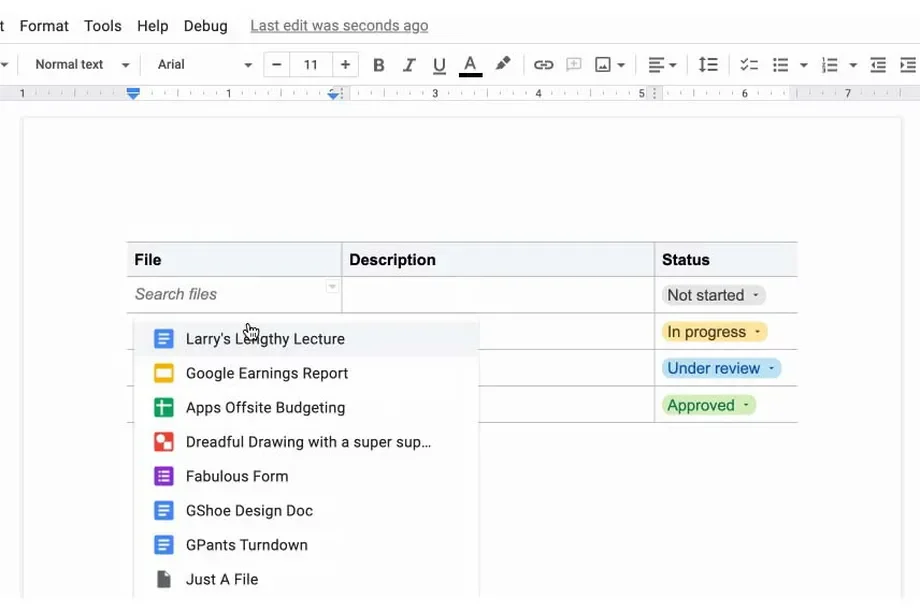
Google Doc's new table feature

The new table templates tool will allow users to quickly and easily insert formatted tables into a Google document. They’ve been designed to help users to track common project management workflows like product roadmaps and project assets. To guide workers through this new tool, the columns also include a sample row which detail how the tables can be used and edited.

In addition, Google Docs is also set to roll out interactive dropdown menus. These menus – which include options like “Not Started”, “In Progress”, and “In Review”- making it easy for users to indicate the status of their project.

They can be added to tables in the document or used across multiple Google Workspace platforms.

These features will become available to Workspace and legacy G Suite customers, as well as regular Google users alike. They are being rolled out over the next few weeks and will be able to be accessed through the dropdown “Insert” menu.

Google Docs is Modernizing its Offering

With the G Suite family recently hitting two billion users, there’s no denying the popularity of Google Docs. However, with the online word processor receiving growing criticism for remaining stuck in the past, it seems like Google’s Smart Canvas initiative couldn’t have come at a better time.

In an effort to become more than just a static writing tool, Google Docs has recently welcomed a range of dynamic changes to its platform. These include the roll out of a page less format feature in February, a emailing drafting feature in March, and an emoji react function in April.

These new features, alongside its new project management tools, bring the Google Docs into the 21st century and make it appeal to a much wider demographic. But even with these new add-ons, can Google Docs really be used as an effective project management solution?

Should I Use Google Docs to Manage my Project?

While Google Docs is primarily a writing and editing tool, its recent improvements make it capable of managing small projects. However, due to its lack of task management features, it’s best to restrict its use to ideation and planning stages.

If you’re spearheading a slightly more complex project or managing larger teams, it’s best to use specialized software. We’ve reviewed monday.com, analyzed ClickUp, and put Wrike through its paces, and found that they’re all pretty easy to use and offer a slew of useful and dynamic features.

Project managing on a budget? Don’t worry. Lots of credible providers also offer free plans so you can still deliver results without splashing the cash. Read our up-to-date project management software reviews to learn more about the industries top solutions.

Written by:
Adam has been a writer at Tech.co for nine years, covering fleet management and logistics. He has also worked at the logistics newletter Inside Lane, and has worked as a tech writer, blogger and copy editor for more than a decade. He was a Forbes Contributor on the publishing industry, for which he was named a Digital Book World 2018 award finalist. His work has appeared in publications including Popular Mechanics and IDG Connect, and his art history book on 1970s sci-fi, 'Worlds Beyond Time,' was a 2024 Locus Awards finalist. When not working on his next art collection, he's tracking the latest news on VPNs, POS systems, and the future of tech.

India Passes Law Forcing VPNs to Collect User Data

A new national directive seems to have rendered VPN technology - built on a lack of data collection - legally inoperable.

The Indian government recently passed a law that demands all companies collect and hold user data for up to five years, which stands at odds with the core mission statement of most VPNs.

VPNs are used by both businesses and consumers all over the world to encrypt their internet traffic and protect themselves with an enhanced level of online privacy.

But this new law may mean this privilege is no longer available to internet users in India, who already have to deal with their government’s intrusive approach to online life.

India Passes Data Retention Law

India has passed a new national directive that applies to VPN companies, as well cloud service providers, data centers, and crypto exchanges, which effectively makes it a legal requirement to collect specific, extensive customer data and hold onto it for at least five years. Companies will also have to report “unauthorized access to social media accounts” as part of the directive.

Instigated by the country’s Computer Emergency Response Team, known as CERT-in, ignoring the demands could lead to up to one year in jail.

VPN companies operating in India will have to hold on to customer names, data about usage patterns, validated physical and IP addresses, and other types of information that could be used to identify an individual.

Concerningly, even if a customer cancels their subscription with a VPN company and deletes their account, the data will still have to be held.

Why This Creates a Massive Problem for VPN Companies

The main selling point of every good VPN has been that it doesn’t hold, collect, or record any user data on the customers that use its services – this is the whole reason that people use VPNs when they head onto the internet. The core purpose of a Virtual Private Network is that the web addresses you visited are decoupled from your IP address – so the demand to collect customer information and activity-related data is completely at odds with this.

Some VPN companies have taken this a step further, deploying RAM-only servers that wipe themselves clean every time they’re powered down (which is regularly). This has been a trend in the industry for a year or so now and most of the big names you’ll recognize (ExpressVPN, NordVPN, Surfshark) all have RAM-only servers.

The prevalence of RAM-only servers in VPN infrastructure in India will cause providers of such services legal problems for just carrying on operating the same way as they have been.

What happens in countries where VPNs are illegal?

Importantly, India hasn’t passed a piece of legislation that says VPNs are outright illegal. Instead, they’ve made it a legal requirement to collect certain types of data – which VPNs deliberately don’t do – and have subsequently made VPNs illegal as a byproduct.

There are very few countries where VPNs are completely illegal – but this directive passed by the Indian Government may provide a pathway for countries that have struggled to crack down on VPN usage but would quite like to. There are a number of countries (like China) where, legally, VPNs are in a bit of a grey area.

With the technology completely illegal in so few countries, it will be interesting to see how the Indian government chooses to enforce this law and how it affects businesses that use VPNs – especially considering the state of their global economy.

In places like the US, business VPNs are very popular, and this makes it more difficult for countries like China to crack down on the technology because their commercial usage is so vital and important that it would be economically unwise to do so. Considering this, it wouldn’t be unsurprising if there were some unforeseen effects of the ban in India.

One thing is for certain though – internet freedom in the world’s second-most populous country has been dealt a massive blow.

Written by:
Adam has been a writer at Tech.co for nine years, covering fleet management and logistics. He has also worked at the logistics newletter Inside Lane, and has worked as a tech writer, blogger and copy editor for more than a decade. He was a Forbes Contributor on the publishing industry, for which he was named a Digital Book World 2018 award finalist. His work has appeared in publications including Popular Mechanics and IDG Connect, and his art history book on 1970s sci-fi, 'Worlds Beyond Time,' was a 2024 Locus Awards finalist. When not working on his next art collection, he's tracking the latest news on VPNs, POS systems, and the future of tech.

The Regretaverse: Will Metaverse-Hesitant Businesses Get Left Behind?

The price of virtual assets continues to soar - but is now the time to jump on the bandwagon?

A question concerning many companies in 2022 is this: Is the Metaverse really going to take off and, further, what can I do to ensure my business isn’t left behind?

In a week where 55,000 deeds to virtual land were sold by an NFT company for a combined total of $320 million, the question has never felt more pertinent. Whether you’ve just built an ecommerce website or are making your first attempt to digitally market your business, it only feels like a matter of time before the worlds of virtual retail and real estate will be as relevant as their physical counterparts.

Even if you’re not ready to sell virtual products like NFTs on your online store just yet, getting clued up on the Metaverse whilst it’s still in its infancy may pay dividends in the future.

The Metaverse is Not a ‘Fad’

Surveys consistently show that business leaders with influence aren’t taking the Metaverse buzz lightly – JP Morgan recently declared it a $1 trillion dollar industry.

Business leaders across the board are excited. According to a recent WestMonroe survey of 150 executives working in a variety of different industries, 88% said they saw some or significant future business value in the metaverse for their industry in the next one to five years, whilst a very similar percentage (86%) said the same for their company specifically.

What’s more, the World Economic Forum found that 42% of global executives think that the metaverse will be “transformational” whilst 71% said it would have a positive impact on their businesses.

There should be no mad rush to panic stations just yet however – a Gartner survey from February of this year revealed that more than a third of consumers have never heard of the metaverse.  But business leaders that aren’t considering the possibilities that could come with the shift to more virtual spaces – and think the whole thing will just collapse – are becoming increasingly sparse.

Keeping Your Ear to the Ground

For those working in retail – online and offline – you’re going to be hearing a lot more about the metaverse over the next few years, whether you like it or not.

Analogously to the way many businesses have made their stock available to purchase online as well as in-store over the past decade, virtual versions of clothing are already becoming available for metaverse avatars in non-physical shops located within virtual spaces.

This wouldn’t be a world away from what you can find in contemporary iterations of many video games, which let players do just that. There have even been suggestions that these virtual versions could be used as proof-of-purchase needed to collect the physical copy. This is just one example of how a fixture of the everyday “real-world” economy – buying clothes – can easily be replicated in the metaverse.

At the moment, a good question to ask is: “what are the biggest brands in your industry currently doing to cement their position in the virtual world?”

Right now is a good moment to start investigating what the biggest brands in your industry currently doing to cement their position in the virtual world. A huge number of large businesses with the capital to expand into the metaverse immediately (Nike, Salesforce, and Gucci, for example) have done so. In terms of inspiration, then, there’s quite a lot to choose from.

A subsequent question that would flow naturally from this sort of competitor analysis would relate to how your brand will operate in the Metaverse. A year ago, this question may seem like a waste of time to answer – but thinking about it now could mean you’re much better placed to adapt to rapidly increasing periods of time people are spending in virtual spaces.

The Price of Virtual Land Continues to Rise

Along with virtual retail opportunities, the virtual land market has exploded over the past year or two and plots are already being sold for eye-watering prices.

This week, the Bored Ape Yacht Club – one of the most well-known collections of Non-Fungible Tokens (NFTs) – raised $320 million in the largest NFT mint in history. The importance of this deal can’t be understated – the NFTs were used as deeds to virtual land in Otherside, a $450 million-funded Metaverse created by Yuga Labs, the company behind the Bored Ape Yacht Club.

Although a lot of land has been purchased by celebrities or “those in the know,” the money being thrown at metaverse real estate illustrates how serious people are about it.

Giving the Metaverse the Respect it Deserves

You’re probably not going to be buying up virtual land tomorrow, but retailers should be encouraged to start treating the metaverse like social media in the early days – a new and novel frontier, but one with almost unlimited potential for marketing, advertising, and raising brand awareness.

If your business isn’t trading online yet, building your own online store should be your first point of order. But after you’re settled in and selling products at a healthy rate, getting into the habit of exploring Metaverse-based opportunities now will prepare you to take calculated risks and investments in digital spaces in the next few years.

Written by:
Adam has been a writer at Tech.co for nine years, covering fleet management and logistics. He has also worked at the logistics newletter Inside Lane, and has worked as a tech writer, blogger and copy editor for more than a decade. He was a Forbes Contributor on the publishing industry, for which he was named a Digital Book World 2018 award finalist. His work has appeared in publications including Popular Mechanics and IDG Connect, and his art history book on 1970s sci-fi, 'Worlds Beyond Time,' was a 2024 Locus Awards finalist. When not working on his next art collection, he's tracking the latest news on VPNs, POS systems, and the future of tech.

Gee, That’s Suite: Google Offers US Firms $100,000 for Tech Training

The Alphabet subsidiary is expanding its Career Certificates program, already used by hundreds of thousands of people.

Google announced this week that it plans to make around $100,000 worth of tech training available to any US business that wants it.

The move will remove one of the major barriers – the price – that deters businesses from providing the level of training employees of almost all businesses require in 2022.

With cyber-threats becoming ever more frequent, investing in staff training and arming them with tools like antivirus software and password managers has never been more important to business success and safety.

Google’s Grant to US Tech Companies

Google has revealed it will be able to pay for digital training courses for up to 500 employees at any US business.

The courses available cover a wide variety of subjects and disciplines, and employees would be able to upskill themselves in areas such as digital marketing, design, IT Support, and data analysis.

The pledge is part of Google’s Certificates program, already a popular way for businesses in the US and beyond to ensure their staff teams are equipped to meet the demands of the contemporary, heavily digital working world.

According to Google, the average salary for entry-level roles across certificate fields at present is $63,600.

What is Google’s Certificates Program?

Google defines its Career Certificates program as a collection of “flexible online training programs designed to earn job-ready skills in high-growth, high-demand career fields such as IT Support, Project Management, Data Analytics, and UX Design.”

The program was initially launched back in 2018, and is supposed to be a way for workers to boost their resumes by learning core digital skills and mastering popular programs – at a speed that suits them.

Google says around 70,000 people in the US have gained a google certificate and around 205,000 people across the globe now have one. The courses – which usually take less than 6 months to finish – are available for under $40 per person through Coursera.org.

According to the tech giant, three-quarters of Google’s program graduates “report an improvement in their career within 6 months of certificate completion”.

Training is Only one Half of the Puzzle

Training staff in a discipline – say data protection and security, for example – and then not providing them with adequate software to carry out what they’ve been taught effectively renders training pointless.

You could have the best-trained staff in the world but still, if you’re not making the relevant tools available, it’ll be a wasted investment.

This is particularly important in the context of cybersecurity – both training and software are vital in protecting your business from attacks, and one without the other is a recipe for disaster. There’s no point, for instance, in installing a new state-of-the-art antivirus program if your employees don’t know how to use it.

Whatever your companies plan for investing in and upskilling your employees, be sure to check out Google’s Career Certificates program – and now there’s more funding available for US businesses, there’s no real catch.

Written by:
Adam has been a writer at Tech.co for nine years, covering fleet management and logistics. He has also worked at the logistics newletter Inside Lane, and has worked as a tech writer, blogger and copy editor for more than a decade. He was a Forbes Contributor on the publishing industry, for which he was named a Digital Book World 2018 award finalist. His work has appeared in publications including Popular Mechanics and IDG Connect, and his art history book on 1970s sci-fi, 'Worlds Beyond Time,' was a 2024 Locus Awards finalist. When not working on his next art collection, he's tracking the latest news on VPNs, POS systems, and the future of tech.

Facebook Discontinues Podcasts, Will Start Removing Them on June 3

Live Audio Rooms will be integrated into Facebook Live, allowing users to go live with just audio if they want.

Facebook has pivoted away from yet another form of media: The social network will stop allowing new podcasts to be uploaded this week, and will fully remove all current podcasts by next month.

In addition, Facebook will end its short-form audio feauture, Soundbites, and shut down its audio hub, both in the “coming weeks.”

The company launched multiple audio projects back in April 2021, but they don’t appear to have seen the results they wanted, even while podcasts thrive on other platforms. It’s another example of the wax and wane of social platforms’ interest in strategies to boost engagement.

Facebook Podcasts Didn’t Take Off

As part of the change, Live Audio Rooms will be integrated into Facebook Live, allowing users to go live with just audio in addition to the typical video/audio combination.

Facebook says it isn’t planning to let users know that podcasts will stop being available soon, leaving that deed to the podcast publishers themselves.

“We’re constantly evaluating the features we offer so we can focus on the most meaningful experiences,” a Meta spokesperson told Bloomberg, which reported the news first.

Nevertheless, it’s a fast shift in direction.

First, there’s the fact that all podcasts will be taken down just a month after the news that Facebook is retiring them breaks — that’s a quick turnaround time for any operations that want to move their podcasts somewhere else while retaining any audience they may have built within Facebook.

Plus, Facebook’s own promotion of its foray into podcasts was continuing apace as recently as last week, according to one commenter who noted that they were emailing him about putting his podcast on Facebook as recently as last week.

The turnabout brings to mind Facebook’s 2016-era “pivot to video,” an attempt to boost video engagement on the platform that backfired for both publishers and Facebook itself, thanks to the social media giant’s inflated metrics.

How Businesses Can Keep Up Content Marketing

Businesses that rely on content marketing may find podcasts to be a cost-effective way to stay on their customers’ minds. We’ve dropped some advice on how best to go about it in the past — know your audience, track your stats, and have a story with an interesting angle.

But, as Facebook’s shakeup indicates, content marketing efforts are only as stable as the platforms that they’re hosted on.

But Facebook likely wasn’t contributing many views compared to well-established podcast services, given that they’ve just axed their entire program — and that’s before considering that the platform reported its first-ever drop in daily active users just last February.

Businesses can learn a lesson here: Keep your options open and never lock yourself into just one platform. At least, not without an escape plan.

Written by:
Adam has been a writer at Tech.co for nine years, covering fleet management and logistics. He has also worked at the logistics newletter Inside Lane, and has worked as a tech writer, blogger and copy editor for more than a decade. He was a Forbes Contributor on the publishing industry, for which he was named a Digital Book World 2018 award finalist. His work has appeared in publications including Popular Mechanics and IDG Connect, and his art history book on 1970s sci-fi, 'Worlds Beyond Time,' was a 2024 Locus Awards finalist. When not working on his next art collection, he's tracking the latest news on VPNs, POS systems, and the future of tech.

Report Finds Mental Health Apps Are Bad for Your Digital Health

"The vast majority of mental health and prayer apps are exceptionally creepy," says Jen Caltrider, lead on the analysis.

A new analysis covering 32 different apps in the category of mental health and prayer has concluded that the vast majority have poor user security and data policies — while still gathering a lot of personal data from their users.

Of the 32 apps analyzed, 29 were judged to have poor privacy and security, according to the report from Mozilla. Just three of the apps passed the test.

In other words, if you have poor mental health, reconsider which apps you’re trusting to help you — they might just be giving you worse data protection as part of the bargain.

Why Mental Health Apps Aren’t Safe

Out of all the types of apps that collect user data, it’s easy to see why mental health apps would gather the most. They’re aimed at helping users track deeply personal information, like their current moods and various biometrics that could offer insight into how they’re feeling at any given time.

It’s bad enough that lead for the Mozilla “*Privacy Not Included” guide, Jen Caltrider, outright calls it creepy.

“The vast majority of mental health and prayer apps are exceptionally creepy,” Caltrider said in a statement covered by The Verge. “They track, share, and capitalize on users’ most intimate personal thoughts and feelings, like moods, mental state, and biometric data.”

You can look through the guide online yourself to see if any apps you recognize are on it.

What’s Collected and How to Avoid it

Some specific examples of the savory types of information gathered by the apps that Mozilla looked under the hood of?

The Talkspace therapy app collects user chat transcripts, AI chatbot Woebot shares user information for use in advertising, and BetterHelp shares metadata from every message (not the contents) with Facebook, meaning that Facebook might know how much time you spend in therapy sessions.

Remote therapy is more popular than ever, and many people opt for mental health apps as an inexpensive alternative to one-on-one sessions. But apps that hover up data under the guise of helping their users’ wellbeing are just making life worse for those who already have plenty of concerns to begin with.

Staying Safe

Free mental health apps are one perk that some businesses are offering employees the chance to take advantage of — they can be used remotely, and they help address employee wellbeing, a major concern in recent years. But you won’t want to use any on Mozilla’s list.

You can avoid that privacy tradeoff by taking a look at the (few) mental health apps that Mozilla has cleared for safe data handling practices.

And, if possible, you can try non-app solutions, from self-help books to bloggers to in-person or remote video sessions with specialists. A good VPN and antivirus software can’t hurt, either.

Written by:
Adam has been a writer at Tech.co for nine years, covering fleet management and logistics. He has also worked at the logistics newletter Inside Lane, and has worked as a tech writer, blogger and copy editor for more than a decade. He was a Forbes Contributor on the publishing industry, for which he was named a Digital Book World 2018 award finalist. His work has appeared in publications including Popular Mechanics and IDG Connect, and his art history book on 1970s sci-fi, 'Worlds Beyond Time,' was a 2024 Locus Awards finalist. When not working on his next art collection, he's tracking the latest news on VPNs, POS systems, and the future of tech.

Labor Department Has “Grave Concerns” About Bitcoin in 401(k) Accounts

Fidelity Investments has made the cryptocurrency available to investors and the Labor Department is concerned about the risk.

You might want to rethink cryptocurrency as a retirement plan, as the Labor Department has come out and openly criticized the move by Fidelity Investments to allow investors to put bitcoin into their 401(k) accounts.

From non-fungible tokens (NFT) to bitcoin, the blockchain fever is in full force around the world. While prices have dipped in recent months and NFT scams have become near-daily headline news, investors are still hungry to keep the cryptocurrency bubble afloat. Mainstream entities have even gotten on board, with companies accepting cryptocurrency for everything from movie tickets to clothing.

However, the Labor Department is skeptical about one company’s plans to allow bitcoin investments in retirement plans, as it could have a negative effect on something that’s supposed to be anything but volatile.

Labor Department: “We have grave concerns”

Fidelity Investment announced earlier this month that it would allow investors in 401(k) accounts access to bitcoin, making it the first investment firm to allow cryptocurrency investments in retirement plans.

“There is growing interest from plan sponsors for vehicles that enable them to provide their employees access to digital assets in defined contribution plans, and in turn from individuals with an appetite to incorporate cryptocurrencies into their long-term investment strategies,” said Dave Gray, head of workplace retirement offerings and platforms at Fidelity Investments.

However, in an interview with the Wall Street Journal, Ali Khawar, acting assistant secretary of the Employee Benefits Security Administration, said that the Labor Department has “grave concerns with what Fidelity has done.” The concerns are largely based in the volatility of bitcoin and cryptocurrency being used as an investment tool for plans that are supposed to be as stable as possible.

“For the average American, the need for retirement savings in their old age is significant. We are not talking about millionaires and billionaires that have a ton of other assets to draw down.”

To be clear, the Labor Department isn’t entirely against the use of cryptocurrency in general, with Khawar noting that it has some “intriguing use cases.” However, with bitcoin and cryptocurrency still fluctuating so dramatically, he believes it needs to “mature” before being used in something as important as retirement plans.

Crypto at Work: A Growing Trend

This certainly isn’t the first instance of mainstream entities trying to insert cryptocurrency into their business. In fact, it’s a growing trend, with AMC, Gamestop, JC Penny, the Gap, and Shopify all accepting cryptocurrency payments for their products and services. Even the Dallas Mavericks and Miami Dolphins have begun allowing cryptocurrency transactions for tickets and merchandise.

It’s not just companies either. One study found that 36% of employees in the US would like the option to be paid, in part, in cryptocurrency, and 42% would like NFTs to be a performance reward option.

Simply put, times are a-changing. Getting on board with cryptocurrency as an employer could be a good way to attract new talent, although understanding the risks will be key to making sure you don’t end up holding the bag if something goes wrong.


Written by:
Adam has been a writer at Tech.co for nine years, covering fleet management and logistics. He has also worked at the logistics newletter Inside Lane, and has worked as a tech writer, blogger and copy editor for more than a decade. He was a Forbes Contributor on the publishing industry, for which he was named a Digital Book World 2018 award finalist. His work has appeared in publications including Popular Mechanics and IDG Connect, and his art history book on 1970s sci-fi, 'Worlds Beyond Time,' was a 2024 Locus Awards finalist. When not working on his next art collection, he's tracking the latest news on VPNs, POS systems, and the future of tech.
Back to top